

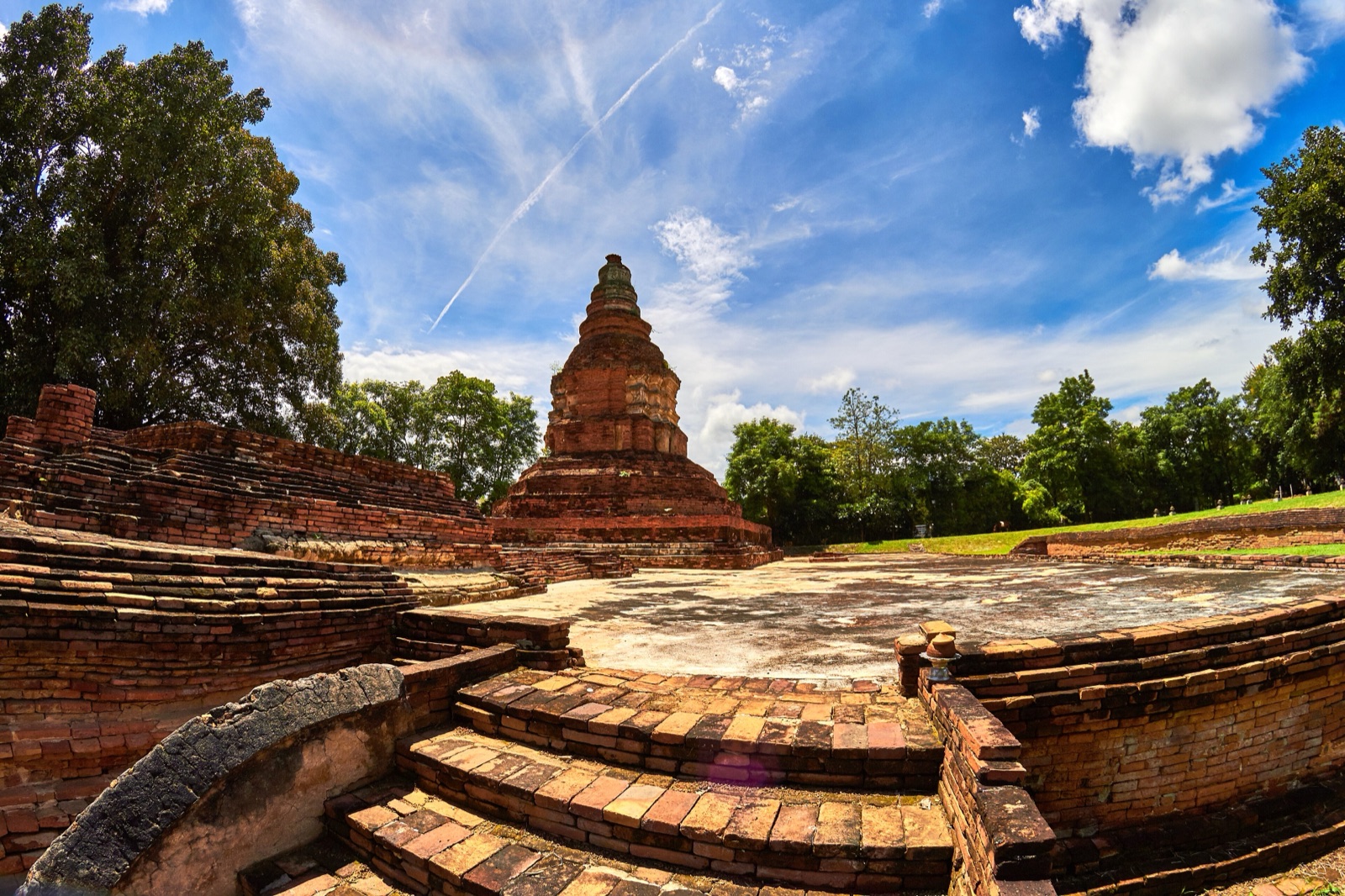
Photo: Pixabay user iTenz / Wikimedia Commons (CC0)
King Mangrai: Founder of Chiang Mai and the Lanna Kingdom
Phaya Mangrai (มังฯรายฯ, Kham Mueang reading mang lai) was the first king of the Mangrai dynasty. He united the northern states into the kingdom of Lanna and founded Chiang Mai in 1296, as the Moradok Lanna dictionary records. His life is a journey from the Kok River valley down to the Ping River valley, and the city he laid out has been lived in without a break for more than 700 years.
Phaya Mangrai, not "Pho Khun Mengrai"
Many people know the name "Mengrai", but the Moradok Lanna dictionary explains that "the Yonok Chronicle and secondary sources often use Mengrai", while the name used in Lanna is Mangrai.
The same goes for the title. Phaya (พญา, read pha-ya) means "lord of the land, sovereign", and the dictionary gives "Phaya Mangrai" as its example. "Pho Khun" was a Sukhothai custom.
A 2018 study by Charun Daennalert (จรูญ แดนนาเลิศ) and Prayun Imiwat (ประยูร อิมิวัตร) cites the historian Prasert na Nagara (2006): when Britain colonised Burma, the name "Mang", which resembles a Burmese title for high-ranking men, could have been used to claim that Lanna had once belonged to Burma. Siam therefore began writing "Mengrai", and the name stuck.
From Ngoen Yang to Chiang Rai
The two authors state that Phaya Mangrai was the son of Lao Meng, king of Hiran Nakhon Ngoen Yang, and Nang Thep Kham Khayai, daughter of Thao Rung Kaen Chai, ruler of Chiang Rung in Sipsong Panna.
When he came to the throne of Ngoen Yang, the towns of the Kok River valley were divided and constantly competing for manpower. Phaya Mangrai brought them together, claiming direct descent from Pu Chao Lao Chong and the royal regalia handed down in the dynasty: the victory sword, the spear and the sa-li-kan-chai knife.
He later founded Chiang Rai (ชยฯงรายฯ, in Kham Mueang chiang hai) in 1262, as the dictionary records.
Taking Hariphunchai: the ruse of Ai Fa
The next great milestone was Hariphunchai, the city of La Pun (หลฯะพูร, la pun), today's Lamphun: an old Mon city that flourished with Buddhism.
According to the chronicles, Phaya Mangrai sent Ai Fa as a spy into the court of King Yiba. Ai Fa made the townspeople dig irrigation canals in the dry season until they grew resentful, then spread the word that Phaya Mangrai was kind to his people, and the townspeople went over to Phaya Mangrai.
Monawat Phromrat (2025) offers another reading: the rush to dig canals in the dry season may reflect a real drought in the Ping River basin during a period of global climate instability, not just a spy's trick. The irrigation systems of that time stayed in use throughout the Lanna period, which is why Lanna communities have a kae fai (แก่ฝายฯ, kae fai), the person who looks after the weir and leads the villagers in repairing it each year.
Wiang Kum Kam: the city before Chiang Mai
After taking Hariphunchai, Phaya Mangrai gave the city to Ai Fa to govern and went on to found new towns, before building Wiang Kum Kam on the Ping River in 1286, according to Monawat.
In the dictionary, wiang (วยฯง, wiang) means "a town, a small town" and "a wall, a fort". The records describe how Phaya Mangrai had moats dug on all four sides, channelled the Ping River around the town, and built residences, houses and a market inside. The town plan and temples such as Wat Chedi Liam resemble Lamphun, which the researcher sees as "copying" the sacredness of the old city into the new one.
Founding Chiang Mai, 1296
The dictionary records that Chiang Mai (ชยฯงไห่มฯ, in Kham Mueang chiang mai) "was founded in 1296 as the capital of the Lanna kingdom, which was an independent state until 1558". The city's full name is Nopphaburi Si Nakhon Ping Chiang Mai.
The three kings
Charun Daennalert and Prayun Imiwat (2018), citing Prasert na Nagara, say Phaya Mangrai was a friend of King Ngam Mueang of Phayao and King Ramkhamhaeng of Sukhothai. The three had sworn friendship by the Ing River, and when he founded Chiang Mai, Phaya Mangrai invited both friends to help choose the site. The Three Kings Monument in the centre of Chiang Mai today was built after this story.
The seven auspices
Old documents say the site of Chiang Mai had seven auspicious signs (chai mongkhon). Monawat Phromrat (2025) groups them in two:
| Group | Auspicious sign | Meaning, as the researcher interprets it |
|---|---|---|
| Water | land sloping from the foot of the mountain down to the Ping River | mountain water drains away quickly, even in floods |
| Water | the Mae Kha canal and Huai Kaeo stream curving around the city | water available throughout the city |
| Water | a large lake to the north | catches the rainy-season water and stores it for the dry season |
| Water | the Ping River to the east | a trade route down to the Gulf of Thailand, and a sacred river |
| Auspicious animals | white deer, white barking deer (fan) and white mice | fertile soil, not a low-lying place where water stands |
The dictionary explains due mueang (ดืเมิอฯง) by saying that the navel of Chiang Mai "has been at the centre of Chiang Mai since Phaya Mangrai", who built a temple at the very heart of the city, so people came to call it "Wat Sadue Mueang" (temple of the city's navel).
Rule and legacy
Charun Daennalert and Prayun Imiwat (2018), citing Sa-nguan Chotsukrat (สงวน โชติสุขรัตน์, 2009), summarise Phaya Mangrai's work in several areas:
- Expansion: he annexed Khelang (Lampang) and sent his son Khun Khruea to govern Mueang Nai.
- Rule through kinship: he lived in Chiang Mai and sent his son Khun Khram to rule Chiang Rai as the viceroy's city.
- Law: he used the Mangraisat law code, which may have been influenced by the Mon dhammasattha of Hariphunchai.
- Buddhism: he adopted Theravada Buddhism from Hariphunchai and built Wat Kan Thom (Chang Kham) in Wiang Kum Kam.
The two authors also note that Lanna kings were not regarded as gods, so they did not take the names of Hindu deities but used local names such as "Mangrai" or "Kue Na". The dynasty he founded ruled Chiang Mai as an independent state until 1558.
Struck by lightning in the city: the end, according to legend
According to legend, Phaya Mangrai died after being struck by lightning in the middle of Chiang Mai. Thai Wikipedia, citing Prasert na Nagara (2006), dates this to 1311, when he was 72.
Monawat Phromrat (2025) points to an interesting detail in the Chiang Mai Chronicle: after his cremation, a chetiya khuha (a shrine chamber) was built over the site, a bodhi tree was planted and a fence put around it. This pattern was normally reserved for the Buddha and his disciples, which shows that later generations honoured him as a ton bun (ต฿นฯบุญ, ton bun), a man of merit who saved the land from hard times.
Timeline, and the years on which sources disagree
| Event | Year (CE) | Note |
|---|---|---|
| Birth | 1238 or 1239 | Thai Wikipedia contradicts itself between the text and the infobox |
| King of Ngoen Yang | 1259 or 1261 | Wikipedia (citing Prasert na Nagara) gives 1259; Charun and Prayun give 1261 |
| Founds Chiang Rai | 1262 | Moradok Lanna dictionary |
| Takes Hariphunchai | 1281 or 1292 | Prasert na Nagara gives 1281; the Jinakalamali gives 1292 (as cited by Wikipedia) |
| Builds Wiang Kum Kam | 1286 | according to Monawat |
| Founds Chiang Mai | 1296 | Moradok Lanna dictionary |
| Death | 1311 | Wikipedia, citing Prasert na Nagara |
Years in the Lanna chronicles are written in the Chula Sakarat or other eras, so converting them can differ between versions and translators.
Summary
- Phaya Mangrai (Kham Mueang mang lai) was the first king of the Mangrai dynasty; the name "Mengrai" comes from the Yonok Chronicle and later documents.
- He began at Ngoen Yang, founded Chiang Rai in 1262, took Hariphunchai, and built Wiang Kum Kam before Chiang Mai.
- Chiang Mai was founded in 1296 on a site with seven auspicious signs, chosen together with King Ngam Mueang and King Ramkhamhaeng.
- New research links the "flooded city" story and Phaya Mangrai's water management to the unstable global climate of the time.
- According to legend he died struck by lightning in the middle of Chiang Mai, and was honoured as a man of merit of Lanna.
Look up มังราย and city words such as ดือเมือง in the Moradok Lanna dictionary (in Thai), and read about the Chiang Mai city pillar in the article Sai Khan Dok (in Thai).
Sources
- Moradok Lanna dictionary (in Thai): มังราย · เจียงใหม่ · พญา · ดือเมือง · สรีกัญไชย
- จรูญ แดนนาเลิศ และประยูร อิมิวัตร [Charun Daennalert and Prayun Imiwat]. (2018). "พญามังราย" ปฐมกษัตริย์แห่งการปกครองแผ่นดินล้านนาโดยธรรม ["Phaya Mangrai", the first king to rule Lanna by the Dhamma]. Journal of Humanities and Social Sciences, Dhonburi Rajabhat University 1(3). In Thai (citing Prasert na Nagara 2006 and Sa-nguan Chotsukrat 2009).
- มนวัธน์ พรหมรัตน์ [Monawat Phromrat]. (2025). มองเชียงใหม่ใหม่: พญามังราย อำนาจ กับภูมิอากาศโลก [A new look at Chiang Mai: Phaya Mangrai, power and the global climate]. Payap University Journal 35(2). In Thai.
- พญามังราย (Phaya Mangrai). Thai Wikipedia (years of birth, accession, the taking of Hariphunchai and death, citing Prasert na Nagara 2006; used as a lead only). In Thai.


