

Photo: Unknown author / Wikimedia Commons (Public domain)
Sin Tin Chok: The Lanna Skirt with a Woven Chok Hem
Sin tin chok (สิ้นฯตีนฯจ฿กฯ, Kham Mueang reading sin tin chok) is the tube skirt of Lanna women whose lower hem is joined with a band of intricate chok weaving. The Moradok Lanna dictionary describes it as a skirt built in three parts, the head, the body and the foot, with patterns that set it apart from the skirts worn every day.
So a sin tin chok is not just clothing: it is craftwork that tells of its home district, beliefs and the skill of its weaver. This article introduces each part of the skirt, the many kinds of sin in the Lanna language, and the chok patterns of the main weaving centres.
"Sin" in the Lanna language
For sin (สิ้นฯ, sin), the dictionary's first meaning is "a tube skirt, a woman's wrap-around". It also has an interesting second meaning: "a cloth wrapped around the base of a grown tree that has not yet fruited, believed to help it bear fruit".
Putting on a skirt is nung (นุ่ง, nung); the dictionary's example is "nung sin", to wear a skirt. A skirt whose two ends have already been sewn together into a tube is called tuang sin (ต่วฯงสิ้นฯ, tuang sin).
Head, body and foot: a skirt in three pieces
A Lanna skirt is sewn together from three pieces of cloth. The dictionary calls this kind of skirt sin to tin to aeo (สิ้นฯตํอฯตีนฯฯตํอฯแอวฯ, sin to tin to aeo), "a skirt with a joined foot and a joined waist", and explains: "the waist is usually a piece of white or dun (brown) cotton sewn on, the hem is usually a beautiful chok-woven band sewn on, and the body is usually plain or horizontally striped".
| Part | Kham Mueang | Where | Description |
|---|---|---|---|
| Head (waistband) | ห฿วฯสิ้นฯ hua sin | the top, at the wearer's waist | a plain white or red cloth sewn on |
| Body | (not in the dictionary) | the middle, the widest part | usually woven in horizontal stripes |
| Foot (hem) | ตีนฯสิ้นฯ tin sin | the bottom edge | the hem; when woven with chok it is called tin chok |
Udom Roongruangsri (อุดม รุ่งเรืองศรี) writes in the Encyclopedia of Thai Culture: Northern Region, Volume 8, that the waistband is a separate cloth sewn on, "a plain white or red cloth"; the body is woven in horizontal stripes, most often yellow alternating with thin red or black bands, called "sin ta manao"; and the foot is the hem, where "the well-to-do used a foot decorated with chok".
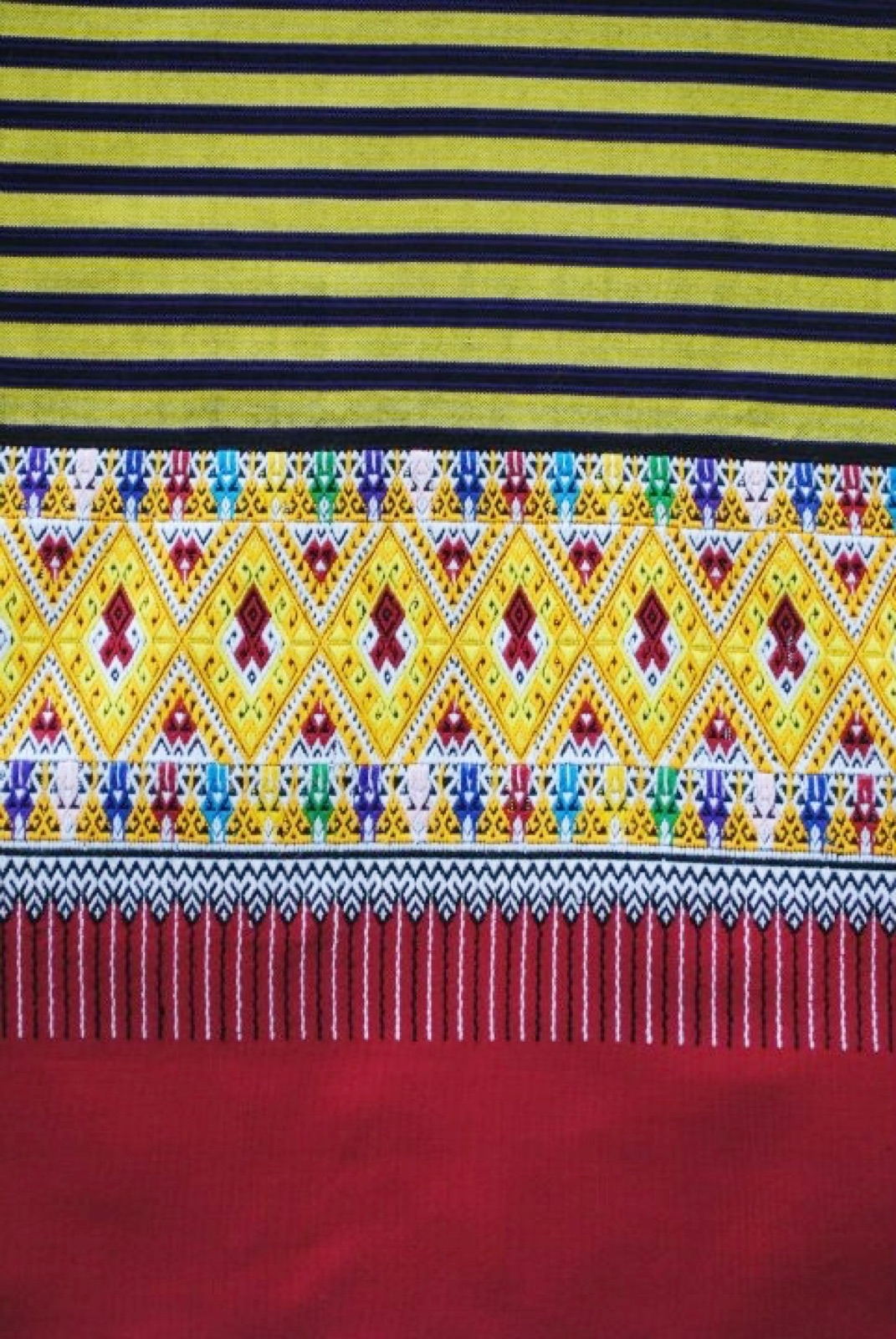
The chok hem has layers of its own
Udom Roongruangsri explains that the chok band itself has sections: the upper part is usually woven with birds, triangles or other motifs; the middle with diamond shapes; and the lowest part with lines hanging down, called "hang sa pao" ("junk tail").
What is chok? Weaving patterns by "reaching in"
In the dictionary, chok (จ฿กฯ, chok) means "to reach in, to scoop out: putting the hand in to feel for or take hold of something". The name describes the technique exactly: the weaver reaches in and lifts the warp threads a section at a time, then slips in extra coloured threads to form the pattern.
A 2024 study by Chanthrapha Ruchinam (จันทราภา รุจินาม) and Rattathai Phoncharoen (รัฐไท พรเจริญ) describes chok weaving as "lifting the warp threads with a porcupine quill, then adding colourful, special weft threads section by section across the cloth". The work demands great precision and is slow, so it is usually woven as small pieces for decoration.
A loom in Lanna is a huk (หูก, huk) or ki (กี่, ki); weaving is to huk (ทํอฯหูก, to huk); and the thread is fai (ฝ้ายฯ, fai), which the dictionary explains as "cotton fluff; thread used for weaving or other work".
Kinds of sin in the dictionary
The Lanna language has many names for skirts by pattern and weaving method. Here are examples recorded in the Moradok Lanna dictionary:
| Lanna word | Lanna script | Meaning (from the dictionary) |
|---|---|---|
| sin ta | สิ้นฯตา | a skirt patterned in checks, with a horizontally striped body and a waist and hem of plain red, black or brown cloth |
| sin ta ba nao | สิ้นฯตาบ่าฯนาฯวฯ | a skirt with yellow and black stripes |
| sin pong | สิ้นฯป้ลฯอฯง | a skirt with horizontal patterns |
| sin tin to | สิ้นฯตีนฯฯตํอฯ | a skirt whose hem was sewn on afterwards |
| sin man | สิ้นฯม่านฯ | a Burmese-style skirt, often woven with silver and gold threads |
| sin yok | สิ้นฯย฿กฯ | a skirt woven with elaborate brocade patterns |
| sin mai kham | สิ้นฯไหมฯฅำ | a skirt woven with gold thread, all over or only at the hem |
The dictionary also records lai dok buang (ลายฯดอฯกบ้วฯง, lai dok buang), an architectural ornament of flowers inside diamond-shaped frames, which also means "the flower pattern on the hem of a skirt". The patterns on cloth and on Lanna temple halls share the same names.
Chok patterns from the main weaving centres
The Moradok Lanna dictionary lists the places that make sin tin chok "still keeping their local character": Mae Chaem District in Chiang Mai, Wiang Sa and Na Noi Districts in Nan, Long District in Phrae, and Si Satchanalai District in Sukhothai. Each has its own chok patterns and colours. Here are three with studies to cite:
Mae Chaem District in Chiang Mai is one of the best-known centres of sin tin chok. Chutima Ngamphiphat (2021) states that Mae Chaem chok has 11 main patterns, and weavers combine elements of them into 5 more popular patterns, 16 patterns in all. The motifs often refer to Buddhism, such as lanterns, offering bowls, naga serpents, swans (hong), water vessels and junks (sa pao). The same study says Mae Chaem chok cloth is registered as a Geographical Indication (GI) with the Department of Intellectual Property.
Doi Tao District, south of Chiang Mai, has a sin tin chok nicknamed "the queen of skirts". Chanthrapha Ruchinam and Rattathai Phoncharoen (2024) tell how, when the Bhumibol Dam was built (1961–1964), villagers had to move away from the rising water and weaving almost died out, so the surviving skirts are also called "flood skirts". Today young people have revived the weaving. Its main patterns fall into three structures, lai kut, lai khom and lai khruea, and in the past each family had its own family pattern.
Long District in Phrae has the Mueang Long chok cloth, which the Department of Sericulture calls "the marvel of Tai Yuan silk". It was traditionally woven to be sewn on as a skirt hem, which "showed the social status of the wearer". Long weavers favour yellow as the main colour for their chok patterns, and use cotton, silk, and silver and gold threads.
The 16 Mae Chaem chok patterns (Chutima Ngamphiphat, 2021)
11 main patterns: ลายหละกอนหลวง · ลายเจียงแสนหน้อย · ลายขันเสี้ยนสำ · ลายหงส์บี้ · ลายหงส์ปล่อย · ลายโกมฮูปนก · ลายโกมหัวหมอน · ลายขันสามแอว · ลายขันแอวอู · ลายกุดขอเบ็ด · ลายนกนอนกุม (the abstract of the same study writes "ลายนกกูม")
5 popular combined patterns: ลายหละกอนหน้อย · ลายหละกอนก๋าง · ลายเจียงแสนหลวง · ลายนาคกูม · ลายนกนอน
These are local pattern names not yet found in the Moradok Lanna dictionary, so they are written in Thai script only.
Where sin tin chok came from, and how it is worn today
The origin of sin tin chok is still not settled. Chanthrapha Ruchinam and Rattathai Phoncharoen (2024) suggest that the sin tin chok of many districts "probably" descends from the skirts of the people of Chiang Saen, who resettled in Chiang Mai, Lampang, Nan and elsewhere in the reign of King Rama I. Old Chiang Saen skirts often had a red hem woven with bird motifs; in Lanna belief the bird is an auspicious animal that stands for the journey to heaven. This is the authors' hypothesis, not a settled historical fact.
The same study says that in the past every Lanna woman was expected to weave, and to own at least one sin tin chok to wear at important ceremonies. Today sin tin chok is still worn to merit-making festivals such as poy luang, salak phat and Pi Mai Mueang (the Lanna New Year) and chunla kathin, as well as for the traditional dress days of government offices and schools.
Summary
- Sin tin chok (read sin tin chok) is the Lanna tube skirt with a chok-woven hem, in three parts: head, body and foot.
- Chok means "to reach in": the weaver lifts the warp threads and slips in coloured threads section by section to make the pattern.
- The Lanna language has many more skirt names, such as sin ta, sin pong, sin man, sin yok and sin mai kham.
- The main weaving centres have distinctive patterns: Mae Chaem (16 patterns), Doi Tao ("flood skirts") and Long (yellow as the main colour).
- Sin tin chok is still worn to the important merit-making festivals of Lanna today.
Look up more Lanna words about cloth and dress in the Moradok Lanna dictionary (in Thai), and read about a festival where Lanna women wear sin tin chok in Poy Luang (in Thai).
Sources
- Moradok Lanna dictionary (in Thai): สิ้นตีนจก · สิ้น · ตีนจก · สิ้นต่อตีนต่อแอว
- อุดม รุ่งเรืองศรี [Udom Roongruangsri]. ผ้าซิ่นตีนจก [Sin tin chok]. In Encyclopedia of Thai Culture: Northern Region, Vol. 8 (published by the Northern Thai Information Center, Payap University Library). In Thai.
- ชุติมา งามพิพัฒน์ [Chutima Ngamphiphat]. (2021). การประยุกต์ลวดลายผ้าซิ่นตีนจกอำเภอแม่แจ่ม จังหวัดเชียงใหม่ สำหรับการสร้างสรรค์แฟชั่นร่วมสมัย [Applying Mae Chaem sin tin chok patterns to contemporary fashion]. Journal of Liberal Arts, RMUTK 3(2), 25–36. In Thai.
- จันทราภา รุจินาม และรัฐไท พรเจริญ [Chanthrapha Ruchinam and Rattathai Phoncharoen]. (2024). ผ่าความงามซิ่นตีนจกดอยเตา สู่กระบวนการพัฒนาต่อยอดในยุคโควิด 19 [The beauty of Doi Tao sin tin chok and its development in the COVID-19 era]. Journal of Architecture, Design and Fine Arts, Naresuan University 15(1). In Thai.
- กรมหม่อนไหม [Department of Sericulture]. ผ้าจกเมืองลอง: มหัศจรรย์ผ้าไหมไทยวน ลวดลายวิจิตร จังหวัดแพร่ [Mueang Long chok cloth: the marvel of Tai Yuan silk, Phrae]. Leaflet. In Thai.
Look up "สิ้นตีนจก" in the Moradok Lanna dictionary (in Thai)


