

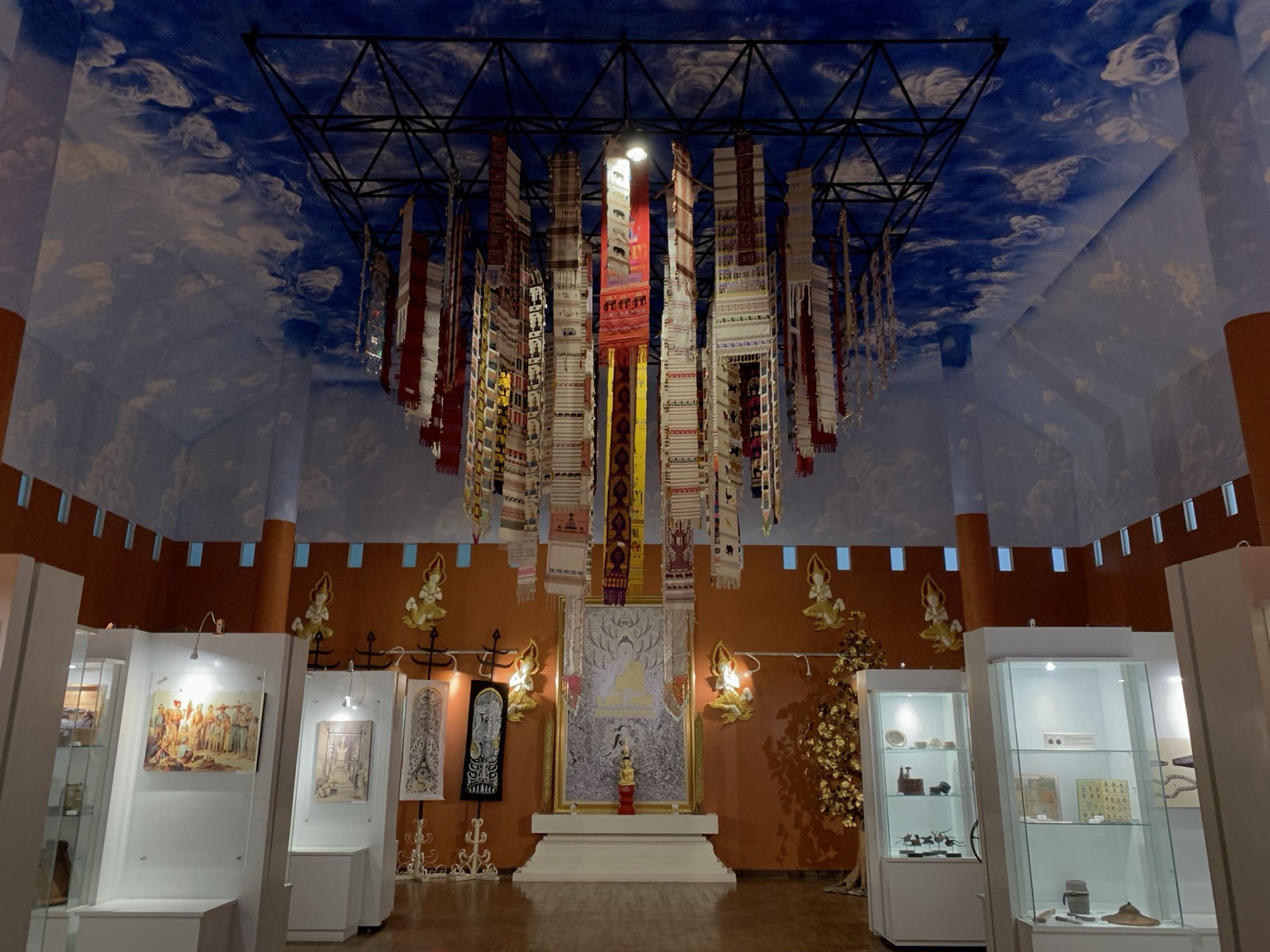
Photo: Chainwit. / Wikimedia Commons (CC BY 4.0)
Tung: Lanna Banners, Their Kinds and Meanings
The tung (ทุง, Kham Mueang reading tung), or Lanna tung, is the banner of the Lanna people, made of cloth, paper, wood or metal. Tung are found in temples, in processions, on the sand chedis of the New Year festival and in funeral processions. The Moradok Lanna dictionary sums it up: the tung is "a sign for both the living and the dead". This article introduces each kind of tung, what it means, and why people in Lanna like to "offer a tung".
What is a tung, and where did it come from?
The dictionary explains that a tung is "a piece of cloth, metal, paper, wood or other material", which may be square, triangular or another shape, used as the sign of a person or a group, or as a traditional offering, and "a symbol that gives confidence and a sense of belonging".
The oldest artistic evidence of tung found so far, according to a 2021 study by Netchanok Taengthapthim (เนตรชนก แตงทับทิม), is a set of model iron and gold tung found in the relic chamber of Wat Dok Ngoen in Hot District, Chiang Mai, dating from around the 21st Buddhist century (roughly 1458–1557 CE). They are metal sheets cut into a roughly human shape, and a painted phra bot banner found in the same chamber shows tung hanging from the tops of poles.
Folk legends tell several stories of how the tung began. A well-known one is the legend of Doi Tung ("banner mountain"): when a relic stupa was to be built on Doi Din Daeng, a centipede banner 3,000 wa (about 6 km) long was raised on the mountain, and it was decided that the stupa's base would extend as far as the banner's tail flew. So the mountain was named Doi Tung (Phra Palad Phongsiri Buddhivamso and colleagues, 2020).
The legend of the tung and the five Buddhas
The study by Phra Palad Phongsiri Buddhivamso and colleagues (2020) gives a legend, cited from Phra Ratchapariyat (2016), that the five Buddhas were born from the eggs of a white crow and were taken in and raised by a hen, a naga, a turtle, a cow and a washerwoman. When they had become monks and met again, they made tung in the shapes of those who raised them, to dedicate merit to their mothers.
The legend explains that the parts of a tung stand for the five Buddhas: the head of the tung for the washerwoman's cloth beater, the long body for the naga, the checked pattern for the turtle's shell, and the round ornaments for the cow. This is a belief passed down in story, not historical fact.
Why do people in Lanna offer tung?
Offering a tung is called tan tung (ทาฯนฯทุง, tan tung) in Kham Mueang. Phra Palad Phongsiri and colleagues (2020) sum up four purposes for making tung:
- Homage to the Buddha, and dedicating merit to relatives who have died.
- Announcing a celebration of a religious building or public work, such as a poy luang festival or the opening of a bridge.
- Rituals, such as song khro (sending away misfortune) and suep chata (extending life), in the belief that the tung drives away danger.
- Festivals, such as the New Year, kathin robe offerings and ceremonies for the dead.
The deepest belief is that the tung connects the human world with heaven: whoever offers a tung will not fall into hell, and the dead for whom their descendants offer a tung will rise to heaven. The same study gives a legend from Phayao about a hunter who had killed animals all his life but once made a tung for the great Buddha image (Phra Chao Ton Luang) at Wat Si Khom Kham. When he died and was thrown into hell, that tung wrapped around him and pulled him out (citing Thongthawi Yotphimsan, 2008).
Tung for auspicious occasions
Many kinds of tung are used at merit-making ceremonies and celebrations. The Moradok Lanna dictionary records these:
| Tung | Lanna script | Meaning (from the dictionary) |
|---|---|---|
| tung chai | ทุงไชยฯ | a large triangular cloth banner |
| cho chang | ชํอฯช้างฯ | a large triangular banner, often carried at the head of a procession |
| cho noi | ชํอฯน้อฯย | a tiny triangular flag, 5–20 cm long, used to decorate sand chedis |
| tung sip-song rasi (12 zodiac tung) | ทุง 12 ราศี | a zodiac banner divided into panels, each with the animal of a year |
| tung sai mu | ทุงไส้หู | a paper banner cut and folded in many layers into a string like pig's intestines |
| tung chak khep | ทุงจักฯเขัปฯ | a centipede banner raised near a temple to show that someone has reserved the temple for a kathin offering |
Cho (ชํอฯ, cho) is a triangular flag. The dictionary says it is used "at both auspicious and inauspicious ceremonies", and is made of mulberry paper, kite paper or cloth.
The 12 zodiac tung is also called tung tua poeng (ทุงต฿วฯเพิ่งฯ, tung tua poeng), because tua poeng (ต฿วฯเพิ่งฯ, tua poeng) is a person's zodiac animal, the animal of their birth year. People in Lanna like to offer this kind of tung on their birthday year and to plant it on a sand chedi at the New Year. Read more about tung at the New Year in the article Yi Peng, Pi Mai and tung (in Thai).
Tung ka dang: tung that are not made of cloth
Tung ka dang (ทุงระฯกด้างฯ, read tung ka dang or tung kha dang) is a rigid tung made of wooden boards or metal sheet, or cast in concrete, cut with plant motifs, animals of the Himavanta forest or the 12 zodiac animals, then lacquered, gilded and set with glass, and stood up as an object of worship. Unlike a cloth tung that flutters in the wind, a tung ka dang can stand for many years.
Funeral tung: tung sam hang and tung lek tung tong
The tung sam hang (ทุงสามฯหางฯ, tung sam hang), or tung phi tai (ทุงผีตายฯ, "tung for the dead"), is a banner shaped like a person, with three tails hanging down, carried at the head of a funeral procession to the cemetery. The dictionary says yellow cloth is used for a monk's funeral and white paper or cloth for a layperson's, and the three tails "may mean the Three Characteristics": impermanence, suffering and non-self.
The tung lek tung tong (ทุงเหัลฯกทุงทอฯง, tung lek tung tong, "iron and copper tung") is a small triangular flag made of iron and copper or brass, set beside the coffin.
What does the tung sam hang mean? Scholars disagree
Scholars' views on the tung sam hang
- Aphithan Somchai (1998) describes the image on the tung sam hang as "the figure of a deity".
- Benchaphon Sitthipranit (2006) believes it is a symbol of a deity who guides the spirit of the dead to the Tavatimsa heaven.
- Manee Payomyong (2005) says the tung sam hang is the sign of the gods in heaven.
- Professor Saeng Monwithun calls it a "funeral tung" and explains it as something made to dedicate merit to the dead, not a deity.
All of these are summarised from the study by Netchanok Taengthapthim (2021), who agrees with the last view: the tung sam hang is an offering dedicated to the dead, which is why the name or zodiac animal of the dead person is sometimes written or drawn on it.
One tung, two meanings
Netchanok Taengthapthim's study (2021) points out that some kinds of tung now used at funerals were originally auspicious objects:
- The model iron and gold tung from the relic chamber of Wat Dok Ngoen (21st Buddhist century, roughly 1458–1557 CE) were placed in a chedi's relic chamber as offerings, not as dedications to the dead.
- A tung sam hang appears on the wooden Buddha footprint of Wat Ban Piang in San Pa Tong District, from around the 24th Buddhist century (roughly 1758–1857 CE), plainly an auspicious object.
- The meaning of dedicating merit to the dead became prominent after the 24th Buddhist century, when palm-leaf texts of the anisong (merit) genre spread during the restoration of the land after Burmese rule.
The researcher concludes that although tung are used at funerals, in Lanna belief the tung remains auspicious, because it is merit sent on to the dead.
The tung and a person's fate: tung ka khing
The tung ka khing (ทุงค่าฯฅิงฯ, tung ka khing) is a tung as long as a person is tall, used in the suep chata ceremony for extending life. The dictionary explains that it means "the figure, that is, our own body", so the tung stands for the life of the person whose fate is being renewed. Read more about this ceremony in the article Suep Chata (in Thai).
Besides the tung above, the study by Phra Palad Phongsiri and colleagues (2020) names other kinds, such as the cloth-panel tung, the tube tung, the pomelo tung and the nang phlan tung, which are not yet in the Moradok Lanna dictionary.
Lanna words about tung
| Lanna word | Lanna script | Meaning (from the dictionary) |
|---|---|---|
| sao tung | เสัาทุง | a Lanna banner pole, usually for a tung tua poeng |
| pok ka dong | ป฿กฯกโด฿งฯ | to climb up and cut the branches of a tree, then hang a tung in it |
| chedi sai | เจดียฯซายฯ | a sand chedi, on which cho flags and tung are planted at festivals |
| ka dat sa | ระฯกดาษฯฯสา | paper made from the bark fibre of the sa (mulberry) tree |
Summary
- The tung is the banner of Lanna, made of cloth, paper, wood or metal: "a sign for both the living and the dead".
- People in Lanna offer tung (tan tung) in homage to the Buddha and to dedicate merit, believing the tung links the human world with heaven.
- Tung for auspicious occasions include the tung chai, cho, the 12 zodiac tung, tung sai mu, tung ka dang and tung chak khep.
- Funeral tung are the tung sam hang and the tung lek tung tong, which research shows were originally auspicious objects.
Look up "tung" and other kinds of tung in the Moradok Lanna dictionary (in Thai), and read about tung at the New Year in the article Yi Peng, Pi Mai and tung (in Thai).
Sources
- Moradok Lanna dictionary (in Thai): ตุง · ตุงสามหาง · ตุงกะด้าง · จ้อ
- พระปลัดพงศ์ศิริ พุทฺธิวํโส, พิงพร ศรีแก้ว และประพินท์ สังขา [Phra Palad Phongsiri Buddhivamso, Pingporn Srikaew and Praphin Sangkha]. (2020). ชื่อปีนักษัตรที่ปรากฏในตุงล้านนา [Zodiac year names on Lanna tung]. Journal of Graduate MCU Khon Kaen 7(1), 79–95. In Thai.
- เนตรชนก แตงทับทิม [Netchanok Taengthapthim]. (2021). ตุง: ความเป็นมงคลและอวมงคล ความหมายที่ทับซ้อน [Tung: auspicious and inauspicious, overlapping meanings]. Journal of Humanities and Social Sciences, Udon Thani Rajabhat University 10(2), 163–178. In Thai.


