

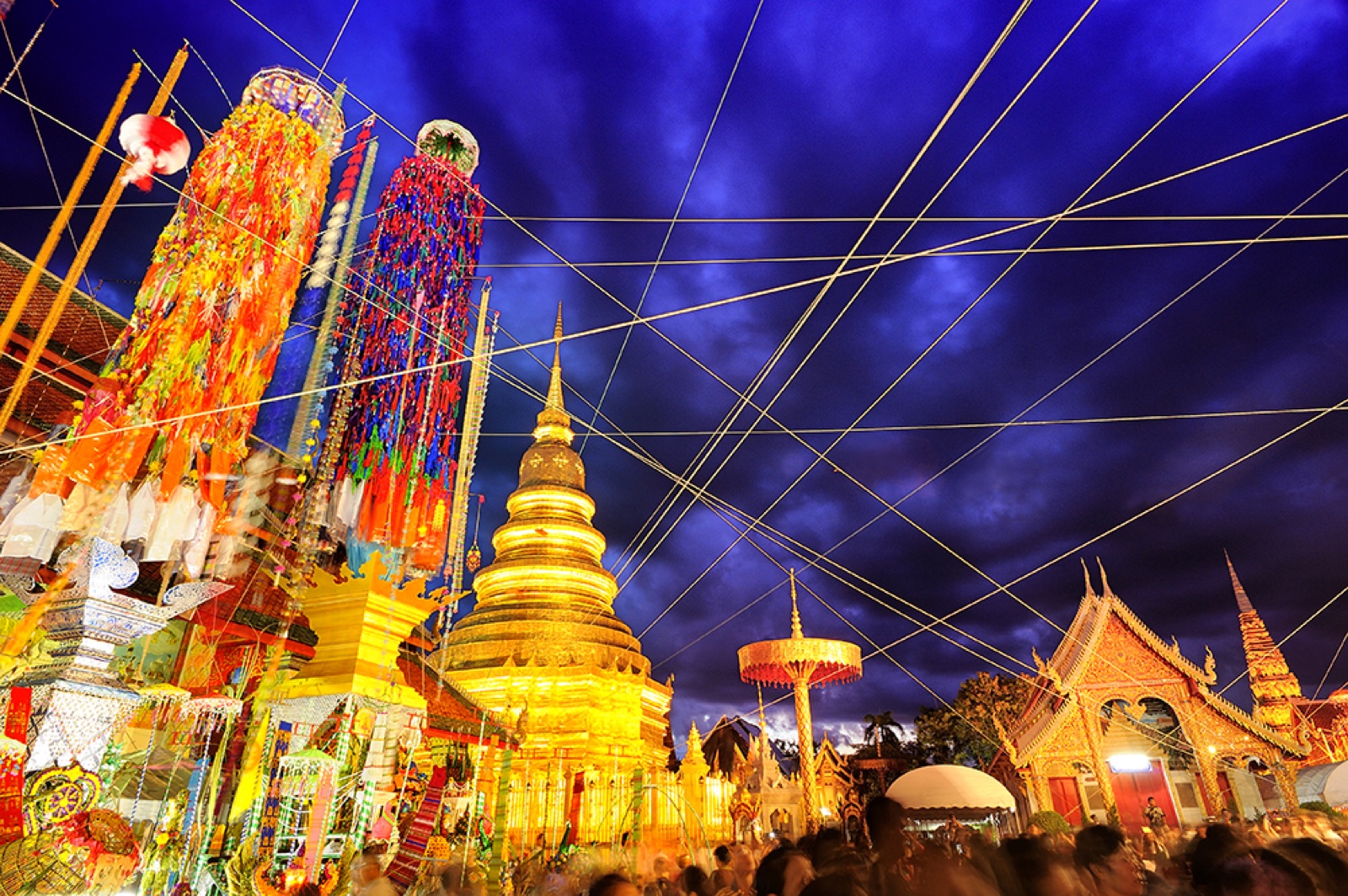
Photo: Roopyai Art / Wikimedia Commons (CC BY-SA 3.0)
Tan Kuay Salak: Lanna's Merit-Basket Festival
Tan kuay salak (tan kuai salak, ทาฯนฯกวฯยฯสๆลฯากฯ) is the Lanna way of making salakabhatta merit. Villagers fill woven baskets called kuay with gifts and food, then offer them to the monks by drawing lots, so nobody chooses which monk receives which basket. The festival is usually held around the 12th Northern month, which is this time of year.
It is known as merit "for the dead, and charity for the living": people dedicate the merit to relatives who have passed away, and at the same time share food with those in need at the time of year when the rice in the granary is running low.
What does tan kuay salak mean?
The name is made of three Lanna words:
- Tan is the Northern form of than, "giving": an offering to the monks.
- Kuay (กวฯยฯ, kuai): the dictionary describes it as "a woven container for holding things, in many sizes and kinds", like a basket or a bamboo bin.
- Salak (สๆลฯากฯ, salak): a small slip used for drawing lots or telling fortunes.
Salakabhatta (สๆลฯากฯภัต์ตฯ, salak-ka-phat) is defined in the dictionary as "gifts offered to monks by drawing lots, usually made during the Buddhist Lent".
The same festival has different names in different places, and the Moradok Lanna dictionary records several of them:
| Lanna word | Lanna script | Meaning (from the dictionary) |
|---|---|---|
| kin kuai salak | กินฯกวฯยฯสๆลฯากฯ | to make salakabhatta merit |
| kin salak | กินฯสๆลฯากฯ | the salakabhatta merit-making festival |
| tan salak | ทาฯนฯสๆลฯากฯ | see tan kuay salak |
| pa-we-ni kin kuai salak | ปาเวณีกินฯกวฯยฯสๆลฯากฯ | the salakabhatta tradition |
Origin: salakabhatta in the Buddhist scriptures
Salakabhatta goes back to the Buddha's time. Chamnan Koetcho (ชำนาญ เกิดช่อ, 2024), writing about tan kuay salak in Nan, explains that the Cullavagga of the Vinaya Pitaka tells of a famine when villagers could not feed the whole Sangha. The Buddha allowed several kinds of offered meals, salakabhatta among them, and allowed names to be written on lots so that the meals could be shared out.
The story most villagers know comes from the Dhammapada commentary: the tale of the ogress Kali.
The legend of the ogress who made the first salakabhatta
As summarised by Chamnan Koetcho (2024) and the Payap University Library, two women had held a grudge against each other through many lives. In one life, one was born a daughter of a good family in Savatthi, and the other an ogress who followed her and ate her children.
The young mother ran with her baby to the Buddha at Jetavana. The Buddha taught: "Hatred is never appeased by hatred, but by non-hatred." The ogress gave up her grudge and went to live with the young woman.
The ogress knew in advance whether a year would be wet or dry, so she told the woman to farm the high fields in wet years and the low fields in dry years. Her rice grew well, villagers came to ask for advice and repaid her with gifts until she had more than she needed, and she offered the surplus to the monks by drawing lots. The Payap University document calls this the first salakabhatta in Buddhism.
Why the 12th Northern month?
The Payap University Library (Northern Thai Information Center) says that the people of Lanna make salakabhatta from the full moon of the 12th Northern month until early in the 2nd Northern month (Yi), and gives seven reasons. The main ones are:
- Villagers are free from work in the rice fields and stay home in the rainy season.
- Fruit is ripening: pomelos, oranges, bananas, sugar cane.
- The monks are all at the temple for the Lent retreat.
- It is when the rice in the granary is running low, so the offerings also help the poor.
- It raises funds for the temple.
The same document notes that a temple holding the great Vessantara sermon, the pa-we-ni tang tham luang (ปาเวณีตั้งฯธัม์มฯหลฯวฯง, the Tang Tham Luang festival), skips salakabhatta that year, and that in the past some temples held it only every two or three years, depending on the villagers' means.
In 2026: the Moradok Lanna Lanna calendar (in Thai) gives the full moon of the 12th Northern month as 26 September 2026, the end of Lent (15th waxing day of the 11th month, duean kiang) as 26 October 2026, and Yi Peng (15th waxing day of the 2nd month) as 24 November 2026. Each temple sets its own date.
Kuay salak: preparing on "wan da"
A kuay salak (กวฯยฯสๆลฯากฯ, kuai salak) is, in the dictionary's words, "a container or basket holding the gifts for salakabhatta". The baskets are prepared on wan da (วันฯดา, wan da), the day of preparation, one day before the festival. Northerners call this work taeng da khua tan (แต่งฯดาระฯค฿วฯทาฯนฯ, taeng da khua tan): getting the khua tan (ระฯค฿วฯทาฯนฯ, khua tan), the gifts for the offering, ready.
The Payap document says that the men split bamboo into thin flat strips, chak tok (จักฯตอฯก, chak tok), and weave the baskets. One household may weave many, so that every departed relative receives merit. The women prepare what goes inside, for example:
- rice, chillies, shallots, garlic, salt
- cooked food, dry food, sweets, fruit
- everyday household goods, according to each family's faith and means
The basket is lined with banana leaves or coloured paper before it is filled. Money tied to sticks is set on a cone of flowers on top, called the "yot", as much as the giver can afford. Friends and relatives who want to share the merit bring gifts to hom khua (รอฯมระฯค฿วฯ, hom khua), that is, to contribute.
The dictionary records two more kinds of basket used at salakabhatta:
| Lanna word | Lanna script | Description (from the dictionary) |
|---|---|---|
| kuai song | กวฯยฯซอฯง | a small, open-weave woven container like a light crate, the ends of the strips left loose and the rim not finished |
| kuai tin chang | กวฯยฯตีนฯช้างฯ | an open-weave basket shaped like an elephant's foot, lined with banana leaves before use |
Sen salak: the name and the dedication
The heart of the festival is the sen salak (เส้นฯสๆลฯากฯ, sen salak), which the dictionary defines as "the owner's name and the gifts in salakabhatta merit-making".
Chamnan Koetcho (2024), citing the Nan National Museum, writes that in the past the slips were made of bai lan (ไบลานฯ, bai lan, palm leaf) or dried palmyra leaf, about 3–4 cm wide and 40–50 cm long, with pointed ends. Today they are usually written or printed on paper.
On the slip go the name of the basket's owner and the dedication of merit, with the names of those it is dedicated to. The Payap document notes that some people also dedicate merit to themselves for after their own death, and that there must be one slip for every basket.
The day of tan kuay salak
The Payap document and Chamnan Koetcho (2024) describe a similar order of events, though details differ from temple to temple:
- Hae khua tan: on the morning of the festival, villagers hae khua tan (แห่ระฯค฿วฯทาฯนฯ, hae khua tan), carrying the gifts to the temple in procession. Some places have salak trees, dancers, gongs and drums. The baskets are set out in rows in the temple grounds or the hall.
- Collecting the slips: the owners bring their slips and place them before the main Buddha image.
- Dividing the slips: the pu chan (ปู่จาร์ยฯ, pu chan, the lay temple leader) gathers the slips and works out how to divide them among the monks and novices, setting some aside for the temple. In Nan, gathering the slips into bundles and dividing them is called sun sen salak.
- Reading the slips: the monks and novices read out the names and dedications on the slips they have received.
- Finding your slip: each owner looks for the monk or novice who drew their slip and offers the basket. The monk reads the text again, accepts the basket, gives a blessing and returns the slip to its owner.
The Payap document adds that walking around with a basket looking for your slip brings people from different villages together, and gives young men and women a chance to meet and talk.
Kinds of salak: salak chok and salak yom
Besides the small baskets, there are several special kinds of salak.
Salak chok (สๆลฯากฯโช฿คฯ, salak chok) is described by the dictionary as "gifts made specially, with many household goods and a large sum of money". The Payap document says that in the past it was built as a small house, filled with pots, bowls, mats, pillows, mattresses, mosquito nets and food, with banana plants and sugar cane tied around it, and carried to the temple with drums and gongs.
Salak yom (สๆลฯากฯย้อฯม, salak yom) is a salak made only by young unmarried women.
The Payap document says that a young woman saved up from her teens until she had enough for a salak yom, built as a tall tree with an umbrella at the top and hung with gifts, and that it was especially popular among the Tai Yong. In the past it was said that a woman who had not yet offered a salak yom was not ready to marry.
The same document divides salak festivals into three kinds:
| Kind | Description |
|---|---|
| salak noi (small salak) | for one temple only |
| salak luang (great salak) | monks from other temples are invited |
| salak kho fon (rain salak, or salak of Indra) | held when the rains fail, dedicating merit to Indra and the deities |
Merit for the dead, charity for the living
Chamnan Koetcho (2024) explains that villagers believe tan kuay salak brings great merit, like a sanghadana offering, because it is not given to any particular monk. He cites Matichon Weekly (2023) for the saying that the festival is merit for the dead and charity for the living.
A study of the festival in Lampang by Phra Phanuphong Techapanyo et al. (2026) found that people dedicate the merit to the departed, to themselves in the future, and to deities or those they have wronged in past lives. It also found that the custom is fading in some areas as urban life, family structures and kinship networks change, and suggests keeping it alive by teaching both the community and visitors about it.
Summary
- Tan kuay salak (tan kuai salak) is Lanna salakabhatta: gifts in kuay baskets offered to monks by drawing lots.
- It goes back to the Buddhist scriptures and to the legend of the ogress Kali, said to have made the first salakabhatta.
- It is usually held from the full moon of the 12th Northern month to early in the 2nd, when the fields are quiet and fruit is ripe.
- The sen salak carries the owner's name and the dedication; salak chok and salak yom are special kinds of salak.
- It is both merit for the departed and charity for the living.
Look up more Lanna words for merit-making in the Moradok Lanna dictionary (in Thai), and read about the festivals at the end of the year in Yi Peng, Pi Mai and Tung (in Thai).
Sources
- The Moradok Lanna dictionary (in Thai): ตานก๋วยสะหลาก · ก๋วยสลาก · เส้นสะหลาก · สะหลากย้อม · สะหลากโจ้ก
- สำนักหอสมุด มหาวิทยาลัยพายัพ ศูนย์ข้อมูลภาคเหนือ. ประเพณีตานก๋วยสลาก [Payap University Library, Northern Thai Information Center: The tan kuay salak tradition] (citing มณี พยอมยงค์ (1986), ประเพณีสิบสองเดือนล้านนา [The twelve-month traditions of Lanna]). In Thai.
- ชำนาญ เกิดช่อ. (2024). ตานก๋วยสลาก: วัฒนธรรมชาวพุทธในจังหวัดน่าน [Tan kuay salak: a Buddhist culture of Nan Province]. วารสารภาษาไทยและวัฒนธรรมไทย 10(2). In Thai.
- พระภาณุพงศ์ เตชปญฺโญ และคณะ. (2026). ประเพณีตานก๋วยสลาก: ความสำคัญในสังคมสมัยใหม่ [The tan kuay salak tradition: its importance in modern society]. วารสารวิทยาลัยสงฆ์นครลำปาง 15(1). In Thai.
- Moradok Lanna Lanna calendar (dates for 2026). In Thai.
Look up "ตานก๋วยสะหลาก" in the Moradok Lanna dictionary (in Thai)


