

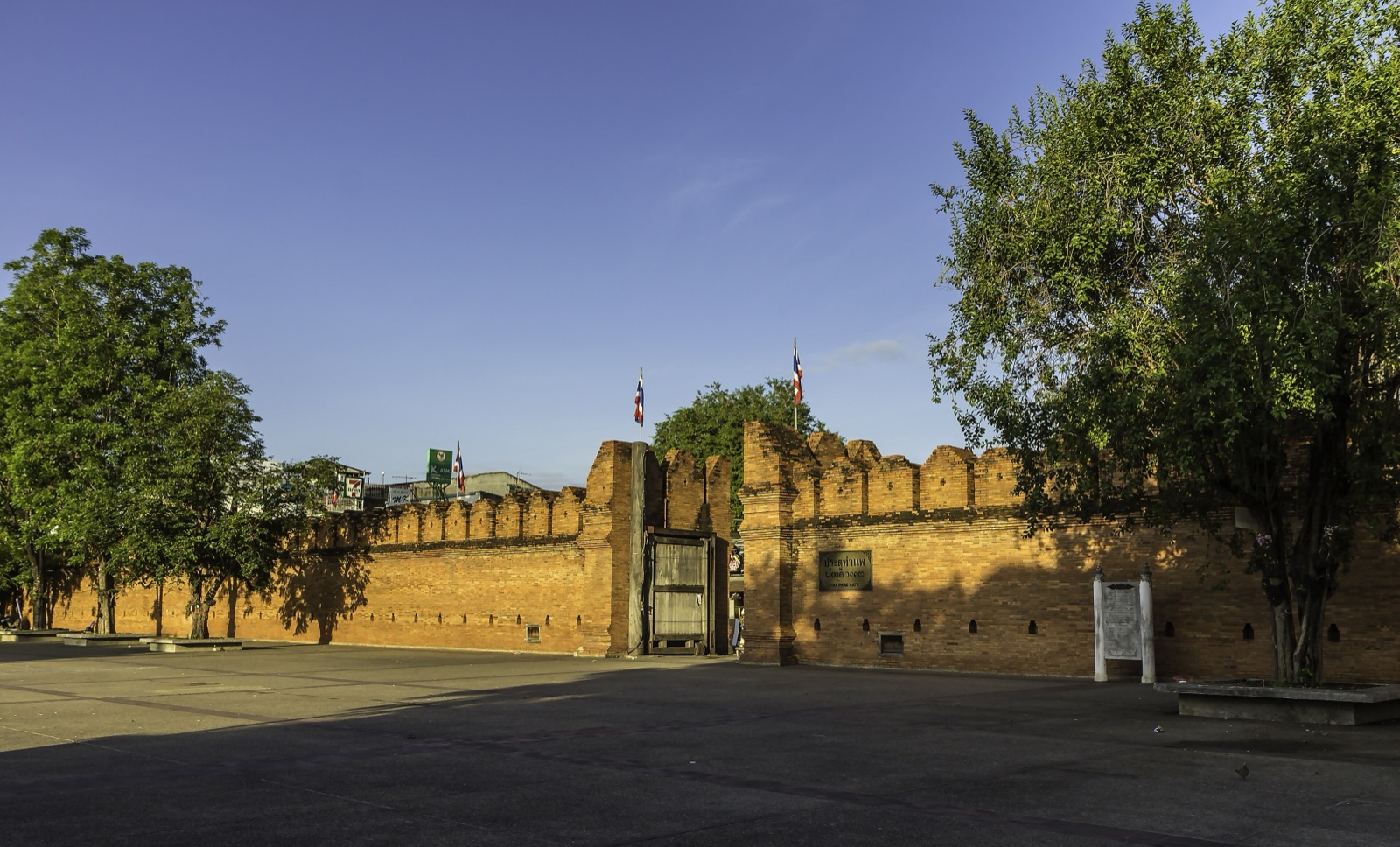
Photo: Photo Dharma from Sadao, Thailand / Wikimedia Commons (CC BY 2.0)
Suep Chata: The Lanna Rite to Extend Life
Suep chata (สืปฯชตา, Kham Mueang reading suep cha-ta) is the Lanna rite to extend life. The Moradok Lanna dictionary describes it as a ceremony "to bring auspiciousness, to lengthen life, and to give strength of heart and hope". In Lanna the rite can be held for a person, for a village or for a whole city, so it is found everywhere from a birthday at home to a great provincial ceremony.
What is chata, and why "extend" it?
The word chata (ชตา, read cha-ta) has two meanings in the dictionary. The first is a birth record: a note of the time, day, month and year of birth, often inscribed on a palm leaf with a stylus and kept rolled up. The second is a horoscope: the positions of the planets at the time a person was born, or when something important such as a city was founded.
Suep (สืปฯ, read suep) means to extend, to continue, to carry on without a break. Suep chata therefore means extending one's fortune so that it continues and is not cut short.
People in the old days believed that one's chata showed the good and bad turns of life. When it looked bad there were several remedies, such as song khro (sending away misfortune), worship of the nine planets, and suep chata (Encyclopedia of Thai Culture: The North, vol. 7, quoted by CMU ACCL). Suep chata is often held together with pat khro (ปัดฯโระฯคอฯะห์, read pat kho), brushing misfortune away from oneself. The dictionary records that when the two are done together, the ceremony is called "suep cha-ta pat khro".
Three kinds of suep chata: person, village and city
Most sources divide the rite into three kinds: for a person, for a village and for a city (Naewna, 2025; Thansettakij, 2025). A study by Phrakhru Kittiphatthananuyut (พระครูกิตติพัฒนานุยุต, 2018) gives only two, for a person and for a village, while the Moradok Lanna dictionary records even more.
| Rite | Lanna script | When it is held (per the dictionary) |
|---|---|---|
| For a person (suep chata khon) | สืปฯชตาฅ฿นฯ | On important occasions such as a birthday, receiving a rank or post, moving into a new house, or when ill and an astrologer warns that one's fortune is bad |
| For a village (suep chata ban) | สืปฯชตาบ้าฯนฯ | When something inauspicious happens in the village, or every year, for the well-being of the whole village |
| For a city (suep chata mueang) | สืปฯชตาเมิอฯง | So that the city prospers and is rich in crops and food |
| For a river (suep chata sai nam) | สืปฯชตาสายฯนาฯ | To raise awareness so that people care for the river together |
The inauspicious forces a village rite aims to remove are called khuet (ขึดฯ, read khuet) in Kham Mueang. The dictionary explains this as a jinx that "causes decline from what one had", such as loss of lifespan, of rank or of happiness.
As for the city rite, Naewna (2025) explains that it was originally held when the city was in trouble or turmoil, or at war, in line with beliefs about the influence of the planets. The ruling lords held the ceremony so that the city's life would go on.
The props: forked poles, bridges and bamboo tubes
What makes this rite stand out are the suep chata props, each meaning to "prop up", "extend" and "add to" a life. This section draws on the Encyclopedia of Thai Culture: The North, vol. 7, as published by the Center for the Promotion of Arts and Culture, Chiang Mai University (CMU ACCL).
The prop, mai kham in Thai and mai kam in Kham Mueang (kham, คำฯ), is a forked pole (ไม้แง่มฯ, read mai ngaem) used to stop something from sinking or falling over. The dictionary gives a second meaning: to support, to back, to help. In the rite, the props are like supports that keep a life from falling.
| Suep chata prop | What it is |
|---|---|
| Props (mai kham) | Forked poles. Naewna (2025) says three body-length props are used, plus small props one cubit long, as many as one's age or more, but not more than 108 |
| Bridge, or khua (ข฿วฯ) | Two lengths of bong bamboo pinned together into a double bridge |
| Water and sand tubes | Bamboo tubes: one holds water and sand, the other unhusked and husked rice, sealed with dry banana leaf |
| Silver and gold strings | Six cotton strings tied with cowrie shells, betel, puffed rice, silver, gold, bananas and sugar cane |
| Tian and tung kha khing | A beeswax candle and a paper banner |
| Triangular flags | As many as the age of the person for whom the rite is held, stuck into a banana stem |
| Ta laeo (ตาแหลฯวฯ) | A woven bamboo star with a hexagonal pattern |
Many small items have their own Kham Mueang names too, such as unhusked rice (เขั้าเปิลฯอฯก, read khao pueak), cowrie shells (หอฯยฯเบ้ยฯ) and the bai si (บาฯยฯระฯสี, read bai sa-li), which the dictionary describes as "an offering to call and welcome the khwan (the life spirit), made of folded banana leaves joined in tiers".
The dictionary records that the ta laeo (read ta laeo) is used in the suep chata rite "because people believe the ta laeo protects against spirits and evil things", and that it sees far and wide "like the eye of a hawk".
As long as the body: "kha khing"
The props, bridge, tubes, candle and banner must all be as long as the height of the person for whom the rite is held. Lanna people call this kha khing (ค่าฯฅิงฯ, read kha khing). The dictionary defines it as "the same size as the model", and the word khing on its own means "self, body". The props are made to the size of the person, as a stand-in for that person's life.
The prop arch and the sacred thread
In a rite for a person, Phiraphat Kiatphinyo (2025) describes how the props are tied into a triangular arch with the person seated inside. A sacred thread (สายฯสิญจฯน์, read sai sin) runs from the top of the arch and is looped around the person's head while the monks chant.
When the rite is over, villagers plant the banana and sugar-cane shoots and the coconut seedlings, spread the sand in the temple grounds, and lay the bridges across muddy paths. CMU ACCL says each family brings som poi water (som poi, ส฿มฯป่อฯยฯ, a soap-pod infusion) and sand to the rite, then takes them home to sprinkle around the house.
The steps of the rite
The lay leader of the ceremony is the pu chan (ปู่จาร์ยฯ, read pu chan, or pu a-chan), whom the dictionary describes as "the leader responsible for all the religious ceremonies". Phiraphat Kiatphinyo (2025) sets out the steps as follows:
- Taeng da: preparing all the ritual items.
- Asking forgiveness: the pu chan leads a request for forgiveness for anything that might give offence.
- Calling the devas: inviting the deities to witness and rejoice in the merit.
- Making a resolve: praising the Triple Gem, then each participant makes a wish.
- The monks chant: the monks give the precepts, then chant the protective paritta verses.
- Wen than: the pu chan formally offers the gifts to the monks, called wen tan in Kham Mueang (เวนฯทาฯนฯ).
- Sharing merit and pouring water: dedicating the merit to the deities, the ancestors and all beings.
CMU ACCL notes that the rite needs at least 9 monks, and that a village rite chanted at several points around the village at once uses as many as 45 monks.
The suep chata chants: scholars' views
- Choedchat Hiranro (เชิดชาติ หิรัญโร, 2014) studied the chants used in Lanna suep chata rites and found three groups: gathas (at the start, similar to those of other Buddhist ceremonies, with gathas unique to Lanna at the end), suttas or parittas (in the middle, for protection from danger) and local Lanna dhamma texts, usually preached after the chanting to strengthen the belief in extending life. Together they answer people's spiritual needs at the crises of life.
- Phrakhru Kittiphatthananuyut (2018) concludes that the suep chata rite was influenced by Brahmanical custom and blended smoothly into Buddhist ritual.
The suep chata of Chiang Mai city
Chiang Mai still holds the city rite as a great ceremony. In 2026, the year of the city's 730th anniversary (King Mangrai founded it in 1295–1296), the province held the rite at 10 sites across the city at once (Thai Post, 2026):
- The city centre, at the Three Kings Monument, and the sadue mueang (สดืเมิอฯง, the city's navel), which the dictionary explains as "the city pillar, the heart of the city".
- Five city gates: Tha Phae, Chiang Mai, Saen Pung, Suan Dok and Chang Phueak.
- Four corner bastions, called chaeng (แจ่งฯ): Chaeng Ku Hueang, Chaeng Hua Lin, Chaeng Si Phum and Chaeng Ka Tam.
How: a firework at the city centre is the signal for every site to begin at the same moment, with the provincial governor, descendants of the Northern royal houses, heads of government offices and the public taking part.
Summary
- Suep chata (read suep cha-ta) is the Lanna rite to extend life, for auspiciousness, strength of heart and hope.
- It can be held for a person, a village or a city, and the dictionary also records a rite for a river.
- The key props are the forked poles, the bridge and the water and sand tubes, all "kha khing", as long as the person's body.
- The pu chan leads the rite with at least 9 monks, and the chants include gathas, parittas and local dhamma texts.
- Chiang Mai still extends the life of the city at its gates, corners and centre; in 2026 it was held at 10 sites at once.
Look up more Lanna words about rituals in the Moradok Lanna dictionary (in Thai), and read about the guardian spirits of Chiang Mai in the article Pu Sae Ya Sae (in Thai).
Sources
- Moradok Lanna dictionary (in Thai): สืบจ๊ะต๋า · จ๊ะต๋า · ก๊ำ · ต๋าแหลว · ก้าคิง
- คลังความรู้ล้านนา มหาวิทยาลัยเชียงใหม่ [Lanna Knowledge Archive, Chiang Mai University]. (2020). สืบชะตาคน [Suep chata for a person]. CMU ACCL (from the Encyclopedia of Thai Culture: The North, vol. 7). In Thai.
- พีรภัทร์ เกียรติภิญโญ [Phiraphat Kiatphinyo]. (2025). คอลัมน์ Cat out of the box (เรื่องพิธีสืบชะตาและปู่จ๋าน) [Cat out of the box column (on the suep chata rite and the pu chan)]. Thansettakij. In Thai.
- แนวหน้า [Naewna]. (2025, 9 February). ภูมิบ้าน ภูมิเมือง: 'สืบชะตาหลวง' ภูมิพิธีชีวิตต่ออายุบ้านเมือง [Local wisdom: the great suep chata, a rite to extend the life of the city]. Naewna. In Thai.
- เชิดชาติ หิรัญโร [Choedchat Hiranro]. (2014). ธัมม์ คาถา และพระสูตรกับกระบวนการสร้างความศักดิ์สิทธิ์ในพิธีสืบชะตาล้านนา [Dhamma texts, gathas and suttas in the making of sacredness in the Lanna suep chata rite]. Vannavidas 14, 107–129. In Thai.
- พระครูกิตติพัฒนานุยุต และคณะ [Phrakhru Kittiphatthananuyut and colleagues]. (2018). พุทธจิตวิทยาเพื่อลดการฆ่าตัวตายโดยพิธีกรรมสืบชะตาในล้านนา [Buddhist psychology to reduce suicide through the suep chata rite in Lanna]. Journal of Social Science and Humanities 11(3). In Thai.
- ไทยโพสต์ [Thai Post]. (2026, 4 June). เชียงใหม่สืบชะตาเมือง ฉลอง 730 ปี ลุ้นขึ้นทะเบียนมรดกโลก [Chiang Mai extends the life of the city for its 730th anniversary, hoping for World Heritage listing]. In Thai.
Look up "สืบจ๊ะต๋า" in the Moradok Lanna dictionary (in Thai)


