

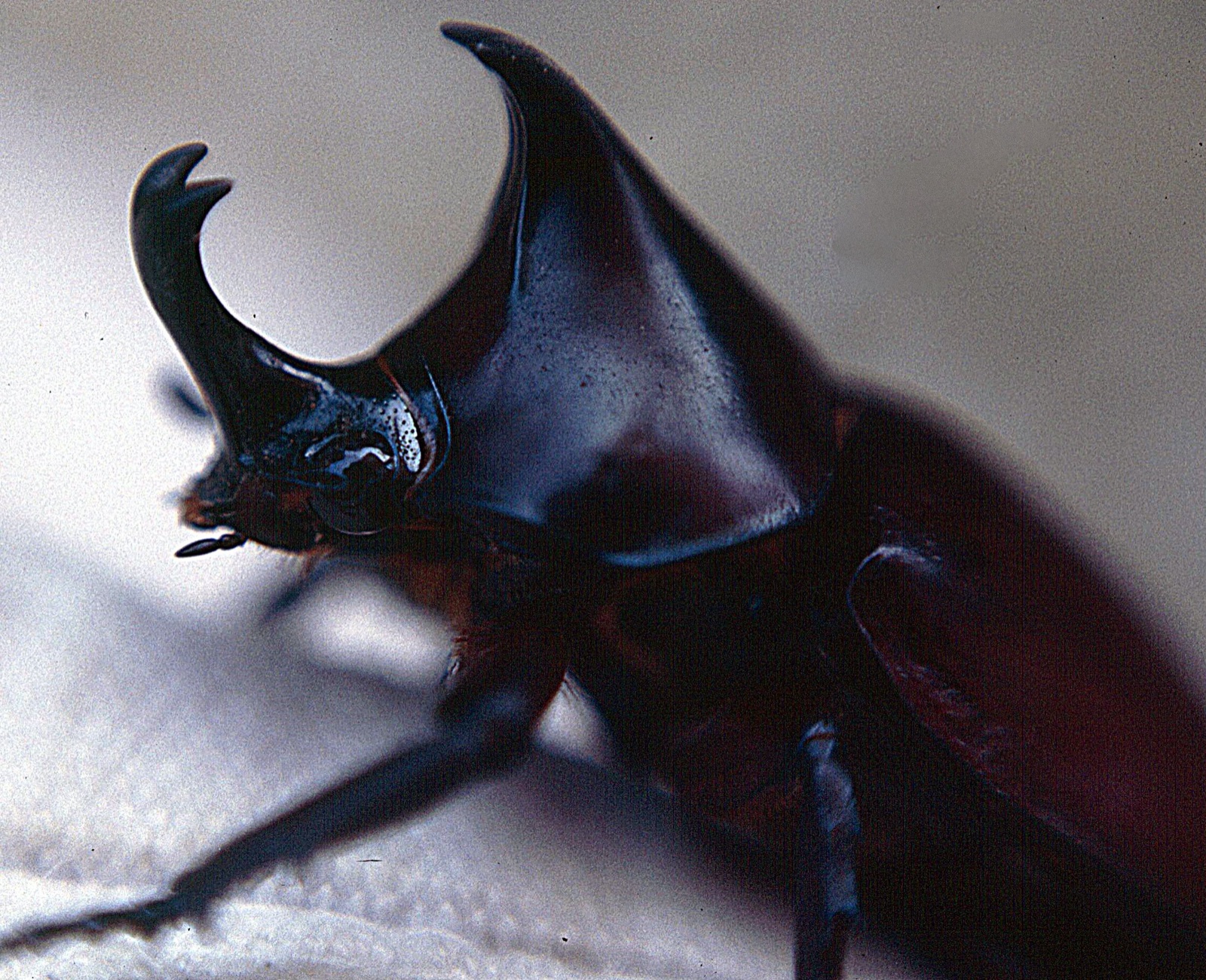
Photo: C.Farquet / Wikimedia Commons (CC0)
Chon Kwang: Lanna Beetle Fighting, Its Log and Rules
Chon kwang (ช฿นฯก่วฯางฯ, Kham Mueang reading chon kwang), or beetle fighting, is a Lanna folk sport of the rainy season. Two male rhinoceros beetles are set against each other on a short log, with a female beetle hidden in the middle of the log to spur them on. Beetle fighting has its own equipment, steps and vocabulary, and it is still played today.
This article is about how the game is played, from finding beetles and preparing the log to the rules of winning and losing. For the names of each kind of beetle, such as kwang song, kwang saem and kwang ki, see the article Kwang Lanna (in Thai).
What is chon kwang?
The Moradok Lanna dictionary describes chon kwang as "using kwang song beetles to fight on a log, with a female beetle showing only her back from a hollow in the middle of the log; they grip, squeeze and push each other back and forth with their horns". The one that retreats or cannot fight according to the rules loses.
The star of the game is the kwang song (ก่วฯางฯโซ้฿งฯ, kwang song), a big male beetle with long horns. Beetles used for fighting are called kwang chon (ก่วฯางฯช฿นฯ, kwang chon), which the dictionary defines as "a beetle used for fighting as a form of gambling, usually a kwang song".
The kwang (ก่วฯางฯ, kwang), the Siamese rhinoceros beetle, grows up underground and comes out in the rainy season, so the fighting season is short and comes only once a year.
Finding fighters: which beetles players prefer
Players choose beetles by kind, colour and temperament. The dictionary records several names of beetles that are "popular as fighting beetles", for example:
| Kham Mueang | Lanna script | Meaning (from the dictionary) |
|---|---|---|
| kwang ko | ก่วฯางฯกํอฯ | a beetle born in the hollow of a wild chestnut (ko) tree; hairy, very hardy, clever and quick; popular as a fighting beetle |
| kwang hak | ก่วฯางฯรักฯ | any beetle of a brownish-black colour like lacquer (hak) |
| kwang hak nam pu | ก่วฯางฯรักฯนาฯปู | a jet-black beetle with big, thick horns and a large body, considered "a fighting beetle with a fighter's blood", used in gambling dens where the stakes are quite high |
In the past, the easiest way to catch beetles was to hang a piece of sugarcane overnight, so that beetles came to feed on the sweet juice. Chiang Mai Citylife (2017) reports that beetles are often found near sugarcane fields, and that before a fight owners feed their beetles fresh sugarcane to build strength. One beetle seller explained that sugarcane is "sweet and sticky", so a beetle spends hours sucking the juice.
Today, villagers in some places still collect beetles in the forest to sell. Naewna (2022) reported that in Tam Subdistrict, Mueang Phayao District, male beetles sell for 20–500 baht each, depending on size and horn length, while females sell for only 1–3 baht each.
The kon kwang log and the mai phat stick: a player's equipment
The arena for beetle fighting is not an open ground but a log about a metre long, called a kon kwang (คอฯรก่วฯางฯ, kon kwang).
The heart of the log is the slot in the middle that holds a kwang mae ut (ก่วฯางฯแม่อู้ด, kwang mae ut), a female beetle, with only her back showing. The dictionary explains that the male beetles "smell her and become fired up" until they fight as if their lives were at stake.
The other essential piece of equipment is the mai phat (ไม้ผัดฯ, mai phat), also called mai phan (ไม้ผั่นฯ, mai phan) or mai laet. The dictionary calls it "an essential tool that every beetle fighter must have". Players practise twirling its handle quickly back and forth, so that it makes a loud noise and makes the log vibrate, rousing the beetles.
Kham Mueang even has a word for the sound of this stick: laet laet (แลัดฯๆ, laet laet), which the dictionary illustrates with "like the sound of a mai phan when beetles are fighting".
Before the log: cham kwang and matching the pairs
A real fighting beetle does not go onto the log without a trial first. This step is called cham kwang (ชามฯก่วฯางฯ, cham kwang). The dictionary explains that it means "testing a fighting beetle's moves, to learn its skill, wits and strength, by setting it against a beetle of about the same size before it goes onto the stage (the fighting log) for real".
The beetles used for practice are usually kwang saem (ก่วฯางฯแซมฯ, kwang saem), medium-sized males, which the dictionary says are used as "practice or decoy beetles to train the kwang song".
When it is time for a real fight, the two beetles must be evenly matched. Chiang Mai Citylife (2017) reports that beetles are paired by length, body width and horn size.
Khao kham: how they fight, and who wins
When two beetles are put on the log, they walk towards each other and then grip and push with their horns. This move has its own name: khao kham (เขั้าฅามฯ, khao kham).
The detailed rules can differ from one venue to another. Chiang Mai Citylife (2017) describes the rules in use as follows:
Each time the beetles unlock their horns counts as 1 round. A beetle falling off the log also counts as a round, so owners try to turn the log to keep their own beetle on top.
A fight ends when one beetle gives up or breaks a horn, or after 12 rounds. A beetle that refuses to fight loses.
One beetle seller's view is that a beetle that has lost once will usually lose every time after that. Winning beetles are now often released back into nature to breed.
Bon kwang: gambling and the social world of beetle fighting
A place where beetle fights are held is called a bon kwang (บ่อฯรก่วฯางฯ, bon kwang), which the dictionary defines plainly as "a place for gambling on beetle fights", like a cockfighting or bullfighting venue.
Chiang Mai Citylife (2017) tells several stories from the past: beetle fighting was once a pastime of well-off householders while ordinary people fought cocks; monks at some temples had novices help collect beetles; and some people released beetles at the end of Buddhist Lent to make merit. Later, gambling became part of the game, and it spread to people of every class.
Beetle fighting today: fewer beetles, farms and beauty contests
Chiang Mai Citylife (2017) reports that beetles in the North have declined sharply, and points to the use of farm chemicals, especially in longan orchards. Sellers now bring in beetles from other regions, and some people breed beetles at home, which is still debated among players.
In Phayao, Naewna (2021) reported on a rhinoceros beetle breeding farm in Phu Kamyao District that makes a special sawdust mix for the females to lay eggs in, raises the larvae in a room kept at about 25 °C, and sells selected beetles to enthusiasts.
The game itself is changing too. Some events hold beauty contests judged on the shape of the horns rather than strength, while Udom Wongson told Citylife that "fewer young people are showing an interest in beetle fighting these days as it's seen as a farmer sport".
"They were living pieces of art." — Ajarn Vithi Phanichphant, historian, Chiang Mai University (Citylife, 2017)
Beetle prices and markets (Citylife, 2017)
- Beetles are graded A–D. A 5 cm beetle costs about 40 baht; a 6.3 cm beetle can fetch 350 baht.
- Five years before the article, some beetles sold for only 5 baht; at the time of writing the lowest price was 20 baht.
- The very best beetles can cost 10,000 baht or more.
- Chiang Mai's big beetle markets are behind the flower market near the Arcade bus station, and at Kat Wua in Hang Dong District.
Summary
- Chon kwang (read chon kwang) is a Lanna folk sport of the rainy season, around September–October.
- The arena is the kon kwang log, with a female beetle hidden in its middle, and players twirl the mai phat stick to make a laet laet sound that rouses the beetles.
- Before a real fight comes cham kwang, a trial bout, and the beetles are matched to be close in size.
- The beetles fight with the khao kham move; the one that retreats or refuses to fight loses.
- Wild beetles are fewer today, and breeding farms and beauty contests have appeared, but the words of beetle fighting live on in Kham Mueang.
Look up more words about beetles in the Moradok Lanna dictionary (in Thai), and read the names of each kind of beetle in the article Kwang Lanna (in Thai).
Sources
- Moradok Lanna dictionary (in Thai): ชนกว่าง · คอนกว่าง · เข้าคาม · จามกว่าง · ไม้ผั๋ด
- Citylife. (2017). Battling Beetles: A Northern Thai Tradition. Chiang Mai Citylife (interviews with Stéphane Rennesson, Warakon Thumma, Sumit Utalerd, Udom Wongson and Ajarn Vithi Phanichphant)
- IRASEC. (2017). Beetle fighting and Northern Thai cosmology. Talk by Stéphane Rennesson, Alliance Française Chiang Mai, 26 September 2017
- แนวหน้า. (2022, 18 September). หนึ่งปีมีครั้งเดียว!! ชาวบ้านเก็บ 'ด้วงกว่าง' ขายตัวละ 500 สร้างรายได้ [Once a year! Villagers collect rhinoceros beetles to sell for up to 500 baht each]. In Thai.
- แนวหน้า. (2021, 23 August). ฟาร์มพะเยาเพาะเลี้ยงขาย 'ด้วงกว่าง' นักสู้แห่งขุนเขา แข่งชนเป็นกีฬาพื้นบ้านล้านนา [A Phayao farm breeds rhinoceros beetles, "mountain fighters" pitted against each other in a Lanna folk sport]. In Thai.


