

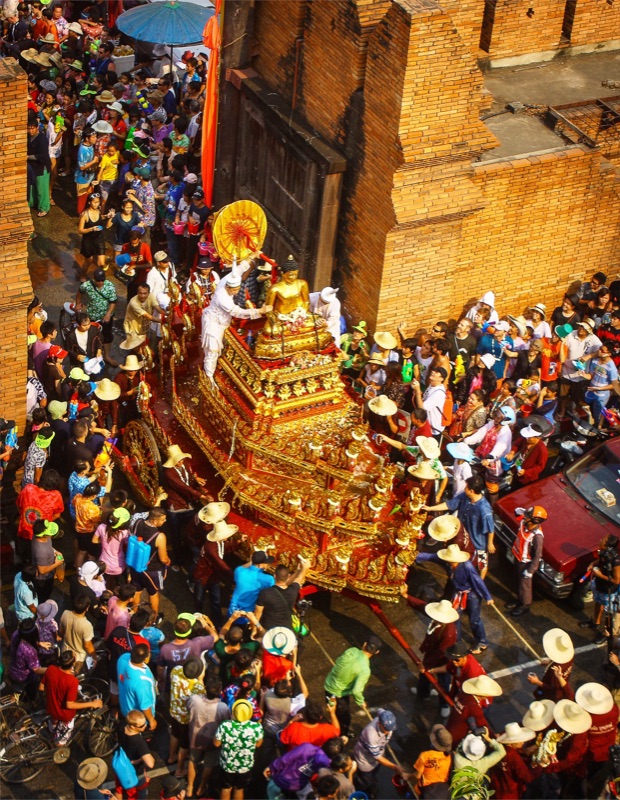
Photo: Dinesh Valke from Thane, India / Wikimedia Commons (CC BY-SA 2.0)
Dam Hua: Asking Elders' Forgiveness at the Lanna New Year
Dam hua (ดำห฿วฯ, Kham Mueang reading dam hua) is the rite in which younger family members bring puffed rice, flowers, incense, candles and turmeric and som poi water to ask forgiveness and blessings from the elders they respect during Pi Mai Mueang (ปีให่มฯเมิอฯง, pi mai mueang), the Lanna New Year or Songkran. It is still done in every household today, and it is the time when Lanna families come back together.
What does dam hua mean?
The Moradok Lanna dictionary gives dam hua two meanings. The first is "to wash one's hair", cleaning the head with water and herbs such as kaffir lime. The second is a rite of respect for elders or benefactors at festivals such as Songkran.
The first meaning explains why the rite is called "dam hua": originally it really was washing the head of an elder with scented water. The phrase hot nam dam hua (ห฿ดฯนาฯดำห฿วฯ, hot nam dam hua), familiar to Thais from other regions as "rot nam dam hua", is explained by the dictionary as "pouring water for elders, respected people and benefactors".
| Lanna word | Reading | Meaning (from the dictionary) |
|---|---|---|
| dam hua | dam hua | to wash one's hair; a rite of respect for elders or benefactors |
| hot nam dam hua | hot nam dam hua | pouring water for elders, respected people and benefactors |
| sa-kao dam hua ระฯสเกั้ลฯาดำห฿วฯ | sa-kao dam hua | a rite of respect for elders or benefactors |
| su-ma สูมา | su-ma | to ask forgiveness, to apologise, to say sorry |
| kho su-ma ขํอฯสูมา | kho su-ma | to say sorry, to ask to be forgiven |
| kam su-ma คำฯสูมา | kam su-ma | words asking forgiveness |
Dam hua in the old days: really pouring water on the head
In dam hua today, the elder usually dips a hand in the som poi water and strokes his or her own head as a token. But old records tell that in the past water was really poured over the head.
The Reverend Daniel McGilvary, an American missionary who arrived in Chiang Mai in 1867, wrote in his book A Half Century Among the Siamese and the Lāo (1912) that at the New Year, princes, officials and people of influence would go to "dam hua" the ruler of Chiang Mai, to wish him a happy New Year.
The name, Dam Hūa, means "bathing the head" or "head-bath," and it is really a ceremonial bathing or baptism of the Prince's head with water poured upon it, first by princes and officials in the order of their rank, and so on down to his humblest subjects. — Daniel McGilvary (1912)
McGilvary's account in detail
- That year the ruler was away at war, so the rite could not be held at the usual time, but a few days after his return it was held with great splendour.
- The first part took place in the ruler's palace. The great hall was full of princes and officials, the air was heavy with the scent of flowers, and everyone stood waiting with silver vessels of water.
- The court scribe read an address of welcome, then an invocation calling on the sacred powers to protect the ruler, the land and its people.
- Then his relatives and high officials poured water over the ruler's head one by one while he stood, "drenching him completely and flooding all the floor".
- The second part took place at a booth on a sandbar in the Ping River. The ruler rode there on an elephant with golden trappings to receive the same bath from his subjects, first the nobles and then the common people.
Whom to dam hua, and when
The dictionary lists those whom younger people go to dam hua: mother, father, grandparents, teachers and monks, and other benefactors. The old people of the house, whom Khon Mueang call ui (อุ้, ui), are often the first to receive it.
The dam hua offerings: what to bring
According to the dictionary, younger people bring puffed rice, flowers, incense, candles, scented water, perfume and turmeric and som poi water, together with suitable food and goods to give to the elders.
| Lanna word | Lanna script | Meaning (from the dictionary) |
|---|---|---|
| khao tok | เขั้าตอฯก | unhusked rice roasted until it pops open like a flower |
| khan khao tok dok mai | ขันฯเขั้าตอฯกดอฯกไม้ | a footed tray of puffed rice and flowers |
| lam tian | ลำทยฯร | a stick candle, such as a beeswax candle |
| ton tian | ต้฿นฯทยฯร | a set of beeswax candles arranged on a tall footed tray, used as an offering |
| mak sum | หมฯากฯสุ่ม | an offering tree of dried areca nuts strung over a wooden frame, presented to nobles or respected people |
| pha tong | ผ้าต่อฯง | a pha khao ma cloth (also called pha kha-ma) |
| sa-lung | สๆลฯง | a salung bowl: a vessel for water or merit-making offerings |
The MFU Archives give similar examples of popular dam hua gifts: a pha kha-ma cloth, a shirt, a sarong, a handkerchief, seasonal produce and fruit, and traditional offerings such as ton dok, ton tian, ton phueng, mak sum and mak beng. If people go as a group, everything is loaded onto a chong oi or chong tan (ชอฯงทาฯนฯ, chong tan), which the dictionary explains is a tray-shaped litter with poles for carrying.
Turmeric and som poi water, the heart of dam hua
Nam khao min som poi (นาฯํ้เขั้าหิ้มฯรส฿้มฯป่อฯยฯ, nam khao min som poi) is clean water mixed with turmeric powder, in which dried pods of som poi (ส฿มฯป่อฯยฯ, som poi) are soaked, or pods roasted over a fire until charred and fragrant. The dictionary records that later people stopped adding turmeric powder and added perfume and dried fragrant flowers instead, such as saraphi, safflower, phayom and prayong, or fresh flowers such as jasmine and rose petals.
Research by Phra Maha Siwakon Panyawachiro and colleagues (2026) explains that Lanna people regard som poi as an auspicious plant that drives away bad things, so the som poi water used at Songkran is like holy water that washes away misfortune with the old year and begins the new year auspiciously.
How to dam hua an elder
The MFU Archives divide dam hua into 3 kinds, by who receives it:
Bless the som poi water with auspicious words, such as "sabba dukkha sabba bhaya sabba roga vinassantu" ("may all suffering, all danger and all illness be destroyed"), then stroke your own head with it to wash away anything bad.
After doing dam hua for themselves, the elders of the house use the same som poi water to stroke the heads of juniors, such as a wife, children and grandchildren.
Younger people go to dam hua their parents, teachers, senior monks or other respected people, on their own or together in a procession. Large processions often go with gongs and drums, splashing water merrily all along the way.
The steps of dam hua for an elder, as explained by the dictionary and the MFU Archives, are:
- Prepare the offerings: arrange puffed rice, flowers, incense, candles and turmeric and som poi water in a bowl or sa-lung, together with the gifts.
- Raise the bowl and ask forgiveness: the younger people sit before the elder, raise the offerings, and say the kam su-ma, apologising for any wrong done by body, speech and mind during the past year.
- The elder accepts the bowl and gives a blessing: the elder accepts the offerings and gives a blessing. In Kham Mueang, giving a blessing is called pan pon (ปันฯพอฯร, pan pon). The dictionary says the one receiving the apology wishes them happiness, well-being and good fortune.
- Stroking the head with som poi water: after the blessing, the elder dips a hand in the som poi water and strokes his or her own hair for good fortune, and may stroke the younger people's heads too (see the "Dam hua for juniors" tab above).
What dam hua says about Lanna people
Dam hua is not just a New Year rite: it binds families and communities together. Children who work far away come home to pay respect to their elders, and the resentments of the year are eased through the words kho su-ma. The som poi research above concludes that dam hua is both an expression of gratitude and a way of building harmony in the family and the community.
Organisations and institutions in the North still hold dam hua for their senior figures every year. Mae Fah Luang University in Chiang Rai, for example, has held a water-pouring dam hua ceremony for its president and senior executives every year since 2001, inviting the leaders of nearby communities to join.
Summary
- Dam hua originally meant "to wash one's hair" and became the name of the rite of asking elders' forgiveness and blessings at Pi Mai Mueang.
- McGilvary's account (from 1867) shows that dam hua in the old days really meant pouring water over the ruler's head.
- The main dam hua offerings are puffed rice, flowers, incense, candles and turmeric and som poi water, which Lanna people believe washes away misfortune.
- The younger people say su-ma, the elder gives a pan pon blessing and then strokes his or her own head with som poi water; water is not poured on the hands.
Look up more Lanna words about Pi Mai Mueang in the Moradok Lanna dictionary (in Thai), and read the Lanna words for Songkran, tung and Yi Peng in the article Yi Peng, Pi Mai and tung.
Read next: Wan Phaya Wan, 16 April: why it moved, and every day of Pi Mai Mueang
Sources
- The Moradok Lanna dictionary (in Thai): ดำหัว · น้ำเข้าหมิ้นส้มป่อย · สูมา · ปั๋นปอน
- McGilvary, D. (1912). A Half Century Among the Siamese and the Lāo: An Autobiography (chapter VII, Pioneer Work). Project Gutenberg (Thai translation: กึ่งศตวรรษในหมู่คนไทยและคนลาว [Half a century among the Thai and the Lao], Matichon).
- หอจดหมายเหตุมหาวิทยาลัยแม่ฟ้าหลวง. (2026). พิธีดำหัวอธิการบดี [Mae Fah Luang University Archives: The dam hua ceremony for the president]. MFU Archive. In Thai.
- พระมหาศิวกร ปญฺญาวชิโร, พระปลัดสุกฤษฏิ์ ปิยสีโล, พระครูใบฎีกาเฉลิมพล อริยวํโส และพระครูโสภิตชัยวงศ์ [Phra Maha Siwakon Panyawachiro, Phra Palad Sukrit Piyasilo, Phra Khru Baidika Chaloemphon Ariyawangso and Phra Khru Sophitchaiwong]. (2026). ส้มป่อย: บทบาทในพิธีกรรมและความเชื่อท้องถิ่นล้านนา [Som poi: its role in Lanna rituals and local beliefs]. วารสารสังคมศาสตร์และศาสตร์รวมสมัย [Journal of Social Science and Contemporary Science] 7(1). In Thai.


