

ภาพประกอบ: มรดกล้านนา
Wan Phaya Wan, 16 April: Why the Lanna New Year Moved
Wan Phaya Wan (วันฯพยฯาวันฯ, Kham Mueang reading wan pha-ya wan) is the Lanna Thaloeng Sok, the day the Chula Sakarat (Lesser Era) year changes to a new year, and the most auspicious day of Pi Mai Mueang (ปีให่มฯเมิอฯง, pi mai mueang), the Lanna New Year. Today Wan Phaya Wan falls on 16 April, not 15 April as many people remember.
This article explains why the Lanna New Year moved, and walks through it day by day, from Wan Sangkhan Long to Wan Pak Duean: what Lanna people do and what each day is called.
When is Wan Phaya Wan?
The Lanna calendar calculates the New Year according to the Suriyayat treatise, counting from the moment the sun enters Aries, not from a fixed date like the international calendar. So the New Year slowly drifts later, a little every few decades.
A Lanna calendar expert interviewed by Siam Rath (2022) summed it up: Wan Phaya Wan used to fall on 14 April, then on 15 April, and since 2013 CE it has fallen on 16 April, which will last about another 30 years. Calculating it year by year with the formula in the next section shows that the shift did not happen all at once: there were periods when the old and the new dates alternated.
| Years (CE) | Wan Phaya Wan (Thaloeng Sok) |
|---|---|
| 1900–1930 | 15 April |
| 1931–2012 | 15 or 16 April (alternating with the leap-year cycle) |
| 2013–2042 | 16 April every year |
| From 2043 | 16 or 17 April |
Why 16 April has been used since 2019
Although the calculated date had shifted in 2013, the government still set the Songkran holidays as 13–15 April, as it had since about 1948. So the dates most people knew did not match the Lanna calendar.
Krungthep Turakij reported that the Chiang Mai Provincial Culture Council, together with the Royal Court Astrologers, Lanna astrologers and Thai calendar experts, calculated that from 2013 to 2042 the Maha Songkran day falls on 14 April. In 2018 the Culture Council sent an open letter to the Minister of Culture, and in 2019 the Department of Cultural Promotion announced 14 April as Maha Songkran day.
Since then, Pi Mai Mueang has followed the calculation: Sangkhan Long on the 14th · Wan Nao on the 15th · Wan Phaya Wan on 16 April. The Lanna Traditional House Museum of Chiang Mai University likewise announced that Lanna Songkran in 2022 fell on 14–16 April.
How to calculate Wan Phaya Wan yourself
The Lanna calendar and the Royal Court Astrologers use the same year length from the Suriyayat treatise: 365.25875 days (292207 ÷ 800), slightly longer than the year of the international calendar (365.2425 days). So the Thaloeng Sok comes about 23 minutes later each year, and shifts by 1 day roughly every 62 years.
You can calculate the Thaloeng Sok time of any year in 3 steps:
- Find the Chula Sakarat year: CS = BE − 1181 (or CE − 638)
- Find the remainder: multiply the CS year by 292207, add 373, divide by 800 and keep the remainder
- Convert it to a time: remainder × 108 = the number of seconds after midnight (because 1 day has 86,400 seconds, divided into 800 parts of 108 seconds each)
For the date, compare with the year before: start from last year's Wan Phaya Wan, then
- if this year's remainder is smaller than last year's (the time has crossed midnight), add 1 day
- if this year has a 29 February, subtract 1 day
If you would rather not calculate it yourself, use the Moradok Lanna Wan Phaya Wan calculator (in Thai). Just enter a Buddhist Era year to get Wan Phaya Wan and the Thaloeng Sok time at once, with a table of the next 20 years.
Wan Phaya Wan and the Thaloeng Sok time, 2027–2042 CE (calculated with the formula)
| CE | BE | CS | Wan Phaya Wan | Thaloeng Sok time |
|---|---|---|---|---|
| 2027 | 2570 | 1389 | 16 Apr | 20:52:48 |
| 2028 | 2571 | 1390 | 16 Apr | 03:05:24 |
| 2029 | 2572 | 1391 | 16 Apr | 09:18:00 |
| 2030 | 2573 | 1392 | 16 Apr | 15:30:36 |
| 2031 | 2574 | 1393 | 16 Apr | 21:43:12 |
| 2032 | 2575 | 1394 | 16 Apr | 03:55:48 |
| 2033 | 2576 | 1395 | 16 Apr | 10:08:24 |
| 2034 | 2577 | 1396 | 16 Apr | 16:21:00 |
| 2035 | 2578 | 1397 | 16 Apr | 22:33:36 |
| 2036 | 2579 | 1398 | 16 Apr | 04:46:12 |
| 2037 | 2580 | 1399 | 16 Apr | 10:58:48 |
| 2038 | 2581 | 1400 | 16 Apr | 17:11:24 |
| 2039 | 2582 | 1401 | 16 Apr | 23:24:00 |
| 2040 | 2583 | 1402 | 16 Apr | 05:36:36 |
| 2041 | 2584 | 1403 | 16 Apr | 11:49:12 |
| 2042 | 2585 | 1404 | 16 Apr | 18:01:48 |
For number lovers: the full day-count formula
Take (292207 × CS + 373) ÷ 800. The whole-number part is the number of days since the epoch of the Chula Sakarat era. Adding 1,954,168 gives the Julian Day Number of Wan Phaya Wan, which any calendar program can convert to a date. The remainder gives the time, as in step 3.
Moradok Lanna has checked this formula against the real announcements: it matches both 2022 (13:49:48) and 2026 (14:40:12), and it gives the years in which the date changed exactly as Siam Rath reported: 15 April for the first time in 1900 CE (BE 2443), and 16 April every year from 2013 CE (BE 2556).
When will Wan Phaya Wan move to 17 April?
By the calculation, Wan Phaya Wan will be 16 April every year until 2042 CE, and 17 April will occur for the first time in 2043 CE (BE 2586), at 00:14, just after midnight.
But the shift will be gradual, as it was last time, because the leap-year cycle (years with a 29 February) pulls the Thaloeng Sok time back every 4 years:
- At first, about one year in four will be 17 April: 2043, 2047, 2051, 2055 CE and so on
- From about 2074 CE, years falling on 17 April will become more frequent
- After 2100 CE, no year will fall on 16 April any more
See other years in the Wan Phaya Wan calculator (in Thai). In years when the Thaloeng Sok is close to midnight, such as 2043 CE, check again against that year's Songkran announcement, because just a few minutes can change the date.
14 April: Wan Sangkhan Long
Wan Sangkhan Long (วันฯสํฯขาน์ตฯล่อฯง, wan sang-khan long) is the Maha Songkran day, when the old year is passing away. The word long means to flow past, like drifting downstream.
The dictionary records that older generations have always understood Wan Sangkhan Long to be 13 April, but "this is a misunderstanding, because the government announced it that way". The Lanna calendar is lunisolar, so the date keeps changing: in 2021, for example, it fell on 14 April at 03 hours 39 minutes.
What Lanna people do on this day, as recorded by the Chiang Mai University Library and Mae Fah Luang University:
- Setting off firecrackers before dawn, to drive bad things away with the old year
- Villagers believe that Pu Sangkhan and Ya Sangkhan (pu sang-khan ya sang-khan, Grandfather and Grandmother Sangkhan) float down the river on a raft to carry away misfortune, so the elders wake the children early to help
- Cleaning the house, washing the bedsheets and blankets, and bathing and washing one's hair, so that both the house and the body are clean before the New Year
15 April: Wan Nao
Wan Nao (วันฯเนาฯ, wan nao) corresponds to Wan Nao in central Thailand. The dictionary explains that it is the day "the sun is travelling between 2 signs, Pisces and Aries", so it is not yet counted as the New Year.
Wan Nao is a wan da (วันฯดา, wan da), a preparation day, when people get everything ready for the great merit-making of the next day: food, khao taen rice crackers, khao khaep crisps, turmeric and som poi water, tung and cho flags.
The sources used in this article agree that on this day you must not curse, use rude words or quarrel. Villagers believe that anyone with a foul mouth on Wan Nao will have bad luck all year.
The afternoon is the time for khon sai khao wat (ข฿นฯซายฯเขั้าวัดฯ, khon sai khao wat), "carrying sand into the temple": scooping sand from the river to build chedi sai (เจดียฯซายฯ, che-di sai), sand chedis, at the temple, ready for planting tung on Wan Phaya Wan. Mae Fah Luang University records that it repays the sand carried out of the temple on people's feet all year.
16 April: Wan Phaya Wan, the Thaloeng Sok
Wan Phaya Wan is New Year's Day and the most auspicious day of the year. In the morning every household goes to the temple to make merit. The main activities of the day are:
| Lanna word | Lanna script | Meaning (from the dictionary) |
|---|---|---|
| tan khan khao | ทาฯนฯขันฯเขั้า | offering a food tray: taking trays of food, fruit, sweets, water, flowers, incense and candles to offer to the monks, dedicating the merit to ancestors, to those one has wronged in past lives, and to the guardian spirits of the place |
| tan tung | ทาฯนฯทุง | offering a tung, such as a tung tua poeng or 12 zodiac tung, planted on the sand chedi |
| mai kam sa-li | ไม้คําฯระฯสี | a bodhi-tree prop: a forked stick taken to prop up a bodhi tree at Songkran, regarded as extending one's fate |
People also bathe Buddha images and relic chedis with turmeric and som poi water. The Lanna Traditional House Museum of Chiang Mai University says that the morning is for making merit dedicated to the departed, to the deities and to those one has wronged in past lives, and the afternoon into the evening is the time for dam hua, paying respect to elders. Read about the steps and the offerings for dam hua in the article Dam Hua, and about the different kinds of tung in Tung: Lanna Banners.
Krungthep Turakij also reports that Lanna people regard Wan Phaya Wan as an auspicious time for starting to learn a subject, paying homage to teachers, suep chata (extending one's life) and holding auspicious ceremonies for the home.
Video: Lanna ways on Wan Phaya Wan
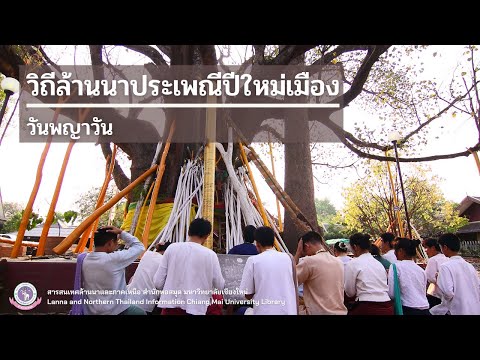
A short clip from the Lanna Information by CMULibrary channel of the Chiang Mai University Library, published on Wan Phaya Wan, 16 April 2020, showing how Lanna people go to the temple to make merit and give alms on the best day of the year.
17–18 April: Wan Pak Pi and Wan Pak Duean
Wan Pak Pi (วันฯปากฯปี, wan pak pi) is defined in the dictionary as "the day after Wan Phaya Wan or the Thaloeng Sok, 1 day later". The Ramkhamhaeng University Library explains it as "the first day of the year".
What people do on Wan Pak Pi, as recorded by Mae Fah Luang University and the Ramkhamhaeng University Library:
- Monks hold a lot khro ceremony to lessen misfortune, or worship the nine planets, and many villages hold a suep chata ceremony for the village (read more in Suep Chata)
- Younger people continue to pay dam hua respects to monks and elders
- In the evening every household makes kaeng ba nun (kaeng ba nun, jackfruit curry). Villagers believe that the name nun, "to support", will support their life (nun chiwit), bringing luck and progress all year
Wan Pak Duean (วันฯปากฯเดิอฯร, wan pak duean) is "the day after Wan Pak Pi, 1 day later", according to the dictionary. It is the first day of the new month, and people carry on pouring water and paying dam hua respects.
Some sources, such as the Ramkhamhaeng University Library, count further days, Wan Pak Wan and Pak Yam, but give no clear dates or ceremonies for them. These words are not yet in the dictionary.
Every day of Pi Mai Mueang in one table
| Date | Lanna name | Central Thai name | What people do |
|---|---|---|---|
| 14 Apr | Wan Sangkhan Long | Wan Maha Songkran | set off firecrackers to drive away bad things; clean the house and the body |
| 15 Apr | Wan Nao (wan da) | Wan Nao | prepare merit offerings; no cursing; carry sand into the temple and build sand chedis |
| 16 Apr | Wan Phaya Wan | Wan Thaloeng Sok | tan khan khao, tan tung, mai kam sa-li; bathe Buddha images; dam hua in the afternoon |
| 17 Apr | Wan Pak Pi | – | lot khro, suep chata for the village, eat kaeng ba nun |
| 18 Apr | Wan Pak Duean | – | first day of the new month; more dam hua |
Summary
- Wan Phaya Wan is the Lanna Thaloeng Sok. Since 2013 CE, by the calculation, it has fallen on 16 April.
- In 2019 the Department of Cultural Promotion announced 14 April as Maha Songkran day, so Pi Mai Mueang is counted as Sangkhan Long on the 14th · Nao on the 15th · Phaya Wan on the 16th.
- The New Year shifts because the Suriyayat year is 365.25875 days long. You can calculate it yourself with the formula (292207 × CS + 373) ÷ 800, and years falling on 17 April will begin in 2043 CE.
- After Wan Phaya Wan come Wan Pak Pi (the 17th) and Wan Pak Duean (the 18th), each day with its own activities and taboos.
Look up more Lanna words about Pi Mai Mueang in the Moradok Lanna dictionary (in Thai), and read the Lanna words for Songkran, tung and Yi Peng in the article Yi Peng, Pi Mai and tung.
Sources
- The Moradok Lanna dictionary (in Thai): วันพญาวัน · วันสังขานต์ล่อง · วันเน่า · วันปากปี๋ · ปี๋ใหม่เมือง
- สยามรัฐ. (2022, 14 April). เถลิงศกใหม่วันที่ 16 เม.ย. 'วันพญาวัน' [The new era year begins on 16 April: "Wan Phaya Wan"]. สยามรัฐออนไลน์ [Siam Rath Online]. In Thai.
- ไทยโพสต์. (2026). นางสงกรานต์ปี 2569 นางรากษสเทวี [The Songkran lady of 2026: Nang Raksot Thewi]. ไทยโพสต์ [Thai Post] (the Songkran announcement for 2026). In Thai.
- เดลินิวส์. (2026). ประกาศนางสงกรานต์ปี 69 นาม 'รากษสเทวี' เกณฑ์ธัญญาหารวิบัติ-น้ำน้อย [The 2026 Songkran lady announced as "Raksot Thewi": a forecast of failing crops and little water]. เดลินิวส์ [Daily News]. In Thai.
- Eade, J. C. (1998). Round-Number Reckoning in Thai for the 5000 Years of the Buddha. Journal of the Siam Society 86 (the Suriyayat year length of 365.25875 days).
- วลัญช์ สุภากร. (n.d.). 16 เม.ย. วันพญาวัน วันเถลิงศกป๋าเวณีปี๋ใหม่เมือง วัฒนธรรมสงกรานต์ล้านนา [Walan Suphakon: 16 April, Wan Phaya Wan, the Thaloeng Sok of the Pi Mai Mueang tradition and Lanna Songkran culture]. กรุงเทพธุรกิจ [Krungthep Turakij]. In Thai.
- พิพิธภัณฑ์เรือนโบราณล้านนา มหาวิทยาลัยเชียงใหม่. (2022). ประเพณีสงกรานต์ล้านนา ปี พ.ศ. 2565 ตรงกับวันที่ 14 - 16 เมษายน [Lanna Traditional House Museum, Chiang Mai University: Lanna Songkran in 2022 falls on 14–16 April]. ศูนย์ศึกษาศิลปะและวัฒนธรรมล้านนา มช. [Center for the Promotion of Arts and Culture, CMU]. In Thai.
- ศูนย์บรรณสารและสื่อการศึกษา มหาวิทยาลัยแม่ฟ้าหลวง. (n.d.). ประเพณีปีใหม่เมือง [Mae Fah Luang University Library: The Pi Mai Mueang tradition]. ฐานข้อมูลท้องถิ่นจังหวัดเชียงราย [Chiang Rai local database]. In Thai.
- นที จิตรเสรีพงศ์. (2018). วัฒนธรรมปีใหม่เมืองชาวล้านนา [Nathi Chitsereephong: The Pi Mai Mueang culture of the Lanna people]. สนเทศน่ารู้ สำนักหอสมุดกลาง มหาวิทยาลัยรามคำแหง [Ramkhamhaeng University Central Library]. In Thai.
- สำนักหอสมุด มหาวิทยาลัยเชียงใหม่. (2020). วิถีล้านนาวันปีใหม่เมือง | วันพญาวัน [Lanna ways on Pi Mai Mueang | Wan Phaya Wan] and วันสังขานต์ล่อง [Wan Sangkhan Long]. Lanna Information by CMULibrary (YouTube). In Thai.
Look up "วันพญาวัน" in the Moradok Lanna dictionary (in Thai)


