

Photo: Carlos Adampol Galindo / Wikimedia Commons (CC BY-SA 2.0)
Yi Peng, Pi Mai and Tung: Lanna Festival Words
The Lanna year has two great festivals that every household looks forward to: Yi Peng (ยี่เพงฯ, yi peng) and Pi Mai (ปีให่มฯ, pi mai), the New Year. One thing you see at both is the tung (ทุง, tung), the Lanna banner. This article gathers the Lanna words used in the festivals of the year, with their meanings from the Moradok Lanna dictionary, which calls a tradition pa-we-ni (ปาเวณี, pa-we-ni), as in pa-we-ni pi mai, the Songkran tradition.
Why Yi Peng is "the second month"
| Festival | Lanna month | Central Thai equivalent |
|---|---|---|
| Yi Peng | the 2nd northern month, 15th day of the waxing moon | the 12th month, 15th day of the waxing moon |
| Pi Mai (Songkran) | the 7th month | the 5th month |
Lanterns and lamps: Lanna words for light
There are several Lanna words for lanterns and lamps, which differ in shape and in when they are used. The dictionary says that the phang pha-tip is usually lit in worship at the Yi Peng festival, and that the kom loi is very popular at the Loy Krathong festival.
Kom fai (โค฿มฯไฟ, kom fai): a paper toy shaped like a cylinder on a bamboo frame, with a lump of fuel hung at its mouth; once lit, it rises into the sky. It is released at night (also called wao fai, "fire kite").
Kom loi (โค฿มฯลอฯยฯ, kom loi): made of kite paper in an oval shape like a balloon and filled with hot smoke to make it rise. It is released in the daytime in clear weather and is very popular at Loy Krathong (also called wao khwan, wao lom or wao hom).
Kom phat (โค฿มฯผัดฯ, kom phat): a cylindrical lantern with a shaft that turns all the way round and pictures drawn on the turning part. When a flame is lit in the middle, the lantern spins and the pictures can be seen.
Phang pha-tip (phang pha-tip): a lamp made from a phang (a flat earthenware dish) filled with wax or oil, with a cotton thread as the wick. It is usually lit in worship of the Buddha at the Yi Peng festival.
Lanna words at Pi Mai Mueang
Pi Mai (ปีให่มฯ) means the new era year, or the Songkran festival. Each of its important days has its own name:
| Day | Lanna script | Meaning (from the dictionary) |
|---|---|---|
| Wan Sangkhan Long | วันฯสํฯขาน์ตฯล่อฯง | Maha Songkran day, when the sun enters Aries |
| Wan Nao | วันฯเนาฯ | Wan Nao, when the sun is between Pisces and Aries |
| Wan Phaya Wan | วันฯพยฯาวันฯ | the Thaloeng Sok, the day the Chula Sakarat year changes to a new year |
Words for New Year activities worth knowing:
- Dam hua (ดำห฿วฯ, dam hua): a rite of respect for elders or benefactors, taking puffed rice, flowers, incense, candles and turmeric and som poi water to ask their forgiveness; the one receiving it gives a blessing in return
- Kam phue (กำผึ, kam phue): to fling or scatter, as in splashing water at Songkran
- Ko ku (กํอฯกู่, ko ku): to build a stupa or chedi in memory of the dead; at Songkran the family comes home to make merit and pay dam hua respects at the ku
- Paeng ban (แปลฯงบ้าฯนฯ, paeng ban): a suep chata merit-making ceremony for the village during Songkran
Tung: the banners of the Lanna people
A tung (ทุง) is a banner made of cloth, metal, paper or wood, used as a sign or as a traditional offering. The dictionary says the tung is a sign of both the living and the dead.
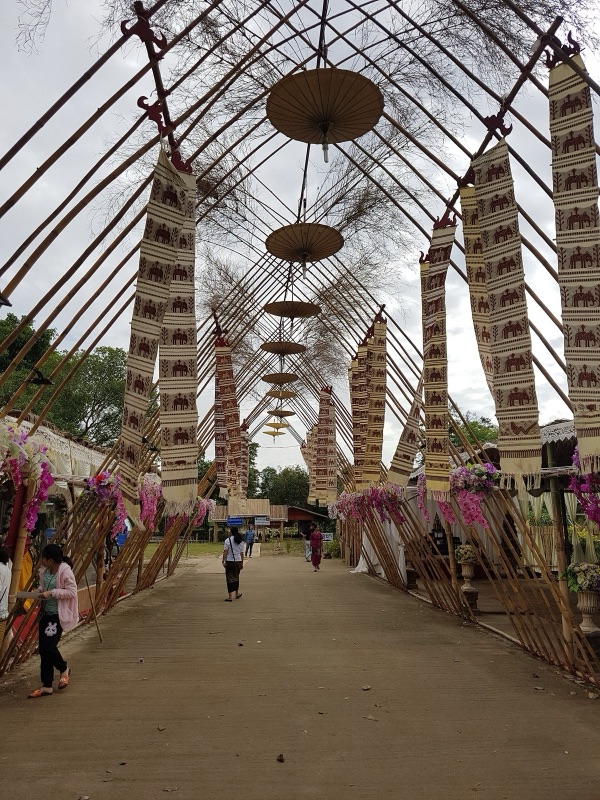
At Pi Mai, Lanna people do tan tung (ทาฯนฯทุง, tan tung), offering tung by planting them on sand chedis. A popular kind is the 12 zodiac tung, or tung tua poeng, with the animal of one's birth year, in the hope of bringing good fortune to oneself and one's family. The sand chedis are also decorated with cho noi (ชํอฯน้อฯย, cho noi, tiny triangular flags), and khueang (เขิอฯง, khueang, a kind of palm) is used to tie the cho flags and tung that are planted on the sand chedis.
Other kinds of tung
- Tung ka dang (ทุงระฯกด้างฯ, tung ka dang): a banner made of wooden boards or metal sheet, worked with flower patterns, animals of the Himavanta forest or the 12 zodiac animals, lacquered and gilded, and set up as an object of worship
- Tung chak khep (ทุงจักฯเขัปฯ, tung chak khep): a centipede banner hung on a bamboo pole near a temple, a sign that someone has reserved that temple for a kathin offering
- Tung sai mu (ทุงไส้หู, tung sai mu): a paper banner cut and folded in many layers into a string like pig's intestines
- Tung ka khing (ทุงค่าฯฅิงฯ, tung ka khing): a tung as long as a person is tall, used in the suep chata ceremony
Summary
| Festival | Words worth knowing |
|---|---|
| Yi Peng and Loy Krathong | phang pha-tip · kom loi · pa-tu pa · (other lanterns: kom fai · kom phat) |
| Pi Mai | Wan Sangkhan Long · Wan Nao · Wan Phaya Wan · dam hua · kam phue · ko ku |
| Both festivals | tung · tan tung · 12 zodiac tung · cho noi |
Yi Peng is coming soon this year. Look up more Lanna festival words in the Moradok Lanna dictionary (in Thai), and read the Kham Mueang used at the market in the article Going to the kad like a local.
Read next: Wan Phaya Wan, 16 April: why it moved, and every day of Pi Mai Mueang


