

Photo: Christophe95 / Wikimedia Commons (CC BY-SA 4.0)
Sai Khan Dok: Honouring Chiang Mai's Inthakhin City Pillar
Sai Khan Dok (ไส่ขันฯดอฯก, Kham Mueang reading sai khan dok) is the tradition of honouring the Inthakhin Pillar, the city pillar of Chiang Mai. Every year, from about late May to early June, the people of Chiang Mai carry flowers, incense and candles to place in the khan dok flower bowls set out in rows at Wat Chedi Luang Worawihan, asking for peace in the city and for the rains to come in their season. The tradition is also called Khao Inthakhin, and it is unique to Chiang Mai, unlike city-pillar worship anywhere else in Thailand.
What is Sai Khan Dok?
Khan dok (ขันฯดอฯก, khan dok) means "a footed flower bowl" in the Moradok Lanna dictionary, and sai khan dok means putting flowers into such bowls in worship. The dictionary explains under the word khao in-tha-khin (เขั้า±นทฯขี, Kham Mueang reading khao in-tha-khin) that around the Inthakhin Pillar "flower bowls are set in rows to receive the flowers people bring in worship, which is called 'sai khan dok'". So the tradition of worshipping Chiang Mai's city pillar has two names: Khao Inthakhin and Sai Khan Dok.
The people of Chiang Mai remember the time of the festival with the rhyme "the 8th month in, the 9th month out", or in short "paet khao kao ok" ("eight in, nine out"): the festival begins in the 8th northern month and ends in the 9th northern month.
| Lanna word | Lanna script | Meaning (from the dictionary) |
|---|---|---|
| khan dok | ขันฯดอฯก | a footed flower bowl |
| khan khao tok dok mai | ขันฯเขั้าตอฯกดอฯกไม้ | a footed bowl of puffed rice and flowers |
| khao tok | เขั้าตอฯก | unhusked rice roasted until it pops open like a flower |
| sa-due mueang | สดืเมิอฯง | the city pillar; the heart of the city |
| wai sa | ไห้วฯสา | to pay respect |
The Inthakhin Pillar, Chiang Mai's city pillar
Inthakhin (±นทฯขีลฯฯ, Kham Mueang reading in-tha-khin) is a word from Pali, which the dictionary translates as "city pillar", while the Inthakhin Pillar (เสัา±นทฯขีลฯฯ, sao in-tha-khin) is the name of Chiang Mai's own city pillar.
The Moradok Lanna dictionary records the pillar's history as follows:
- King Mangrai built the Inthakhin Pillar when he began building the city of Chiang Mai in 1296 CE.
- The pillar originally stood at Wat Sadue Mueang, or Wat Inthakhin, diagonally across from today's Three Kings Monument (sa-due mueang, สดืเมิอฯง, means "the heart of the city").
- King Kawila, the first ruler of Chiang Mai, moved the pillar to Wat Chedi Luang Worawihan around 1800 CE, and it has stayed there to this day.
The Inthakhin vihara in Wat Chedi Luang is a brick-and-stucco building in the form of a cruciform mondop. Research by Thanaphon Rueankham and Prathip Phuetthonglang (2024) describes the Inthakhin Pillar as a brick-and-stucco pillar 1.35 metres high, while information cited in another study (Phra Palad Klainak Ariyawangso and colleagues, 2024) states that the pillar is buried underground, beneath the busabok pavilion that houses a Buddha image.
The legend: Indra, the Lua and the two kumbhanda giants
The legend of the Inthakhin Pillar is a story handed down over generations. The version published by Wat Chedi Luang Worawihan (cited in Thansettakij, 2025) runs briefly as follows:
The land of Chiang Mai was once home to the Lua people. Spirits troubled them until they went hungry, so Indra caused a well of silver, a well of gold and a well of gems to appear in the city, looked after by 9 wealthy Lua clans, 3 clans to each well. The Lua had to keep the precepts and hold to the truth to receive what they wished for.
News of the riches of Wiang Noppaburi made other cities send armies to demand a share, so the Lua asked a hermit to petition Indra. Indra had two kumbhanda (giants), Phaya Yakkharat and Phaya Amonthep, bring the Inthakhin Pillar and bury it in the middle of the city. The pillar turned the enemy armies that came into merchants.
Later some merchants failed to keep the rules and some grew greedy, so the two giants grew angry and carried the pillar back up to heaven, and the three wells declined.
An old Lua man was ordained and meditated under a yang na tree for three years. A senior monk foretold disaster, then advised everyone to cast an ang khang, a great cauldron, together, to put figures of animals and people into a pit, and to set up the Inthakhin Pillar on top, with ceremonies of worship ever after.
In the legend, the kumbhanda are giants, which in Kham Mueang are called yak (ยัก์ขฯ, yak). The dictionary explains them as "non-human beings in the Jataka tales, shaped like people but very large, with long fangs and great powers". Thansettakij (2025) states that in the time of King Kawila statues of the kumbhanda and of a hermit were built beside the vihara, and the research by Thanaphon Rueankham and Prathip Phuetthonglang (2024) mentions the shrine of Phaya Yakkharat, guardian of the vihara, standing nearby.
Mai mai mueang: the yang trees beside the Inthakhin Pillar
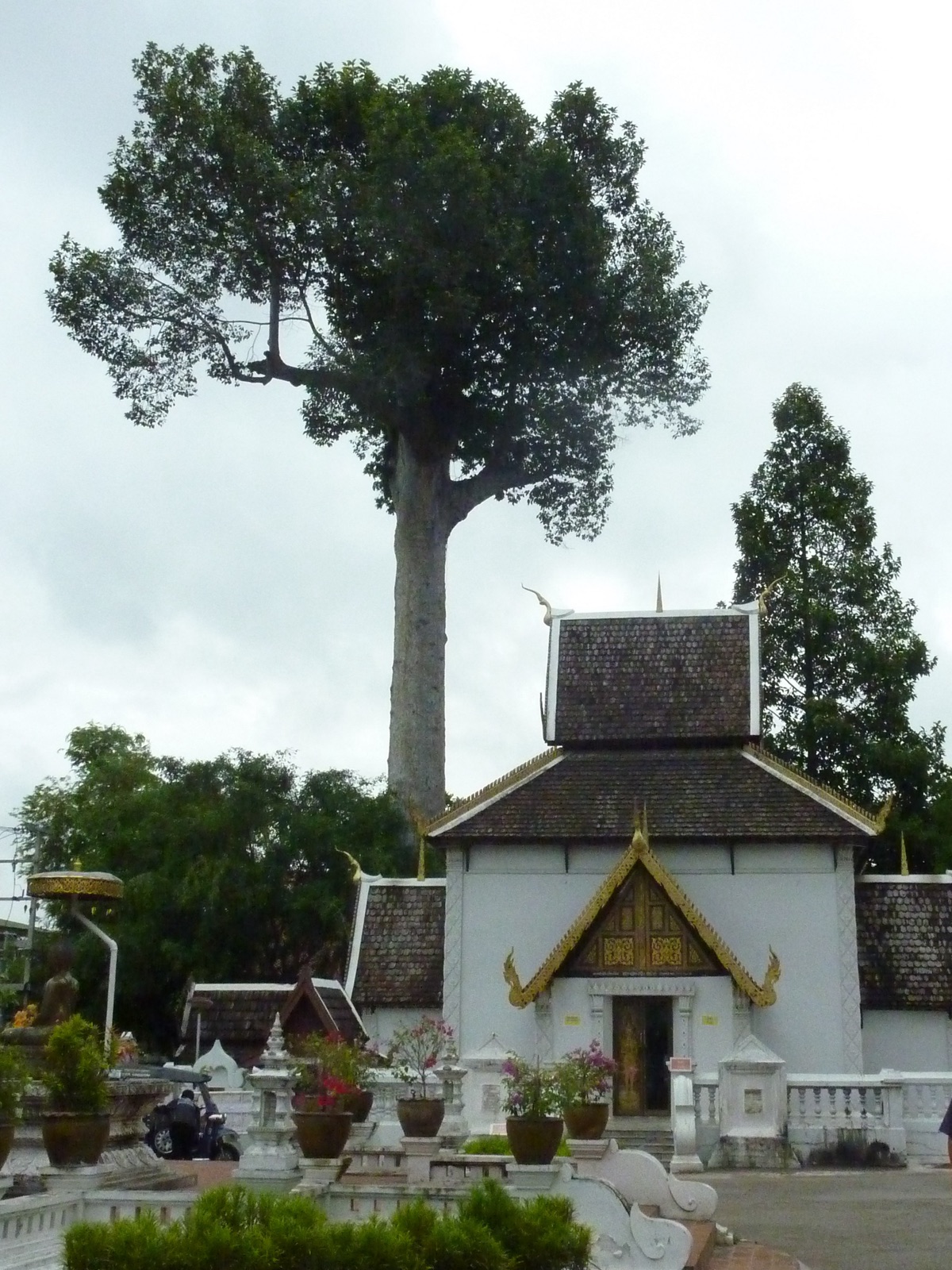
Beside the Inthakhin vihara stand tall yang na trees (Dipterocarpus alatus), which in Kham Mueang are called mai yang (ไม้ยางฯ, mai yang). These trees are mai mai mueang (ไม้หมฯายฯเมิอฯง, mai mai mueang), trees that mark the site of a city. The dictionary gives an example under the word mai mai mueang Chiang Mai: "a large, tall yang na tree planted by King Kawila, the 1st ruler of Chiang Mai, near the city pillar of Chiang Mai (the Inthakhin Pillar)".
The research by Thanaphon Rueankham and Prathip Phuetthonglang (2024) states that the temple has 3 yang na trees more than 200 years old. The largest stands between the Inthakhin vihara and the shrine of Phaya Yakkharat; King Kawila planted it when he moved the Inthakhin Pillar from Wat Sadue Mueang, as "the tree that pairs with the Inthakhin Pillar, according to the legend".
"The 8th month in, the 9th month out": when is the festival?
Sai Khan Dok lasts 7 days by the Lanna lunar calendar, but the sources give starting days that differ by one day:
- The dictionary (under khao in-tha-khin) says it begins on the 12th day of the waning moon of the 8th northern month, called "khao in-tha-khin", and runs until the 3rd day of the waxing moon of the 9th northern month, called "ok in-tha-khin".
- The dictionary (under sao in-tha-khin) and the research by Phra Palad Klainak Ariyawangso and colleagues (2024) give the 13th day of the waning moon of the 8th month to the 4th day of the waxing moon of the 9th northern month.
2026: Sai Khan Dok from 13 to 19 May, with the Ok Inthakhin merit-making on 20 May (Thairath, 2026; Chiang Mai News, 2026).
Where: Wat Chedi Luang Worawihan, Phra Pokklao Road, Mueang Chiang Mai District, open for Sai Khan Dok every day from 06:00 to 24:00. Check the dates each year in the announcements of Chiang Mai Province.
How to take part in Sai Khan Dok
On the first day of the festival, the Governor of Chiang Mai presides over the invitation of Phra Chao Fon Saen Ha (ระฯพเจั้าฝ฿นฯแสนฯห่า, phra chao fon saen ha), also called Phra Phuttha Khanthararat, from Wat Chang Taem. The image is placed on a busabok float and carried in a Lanna-style procession to be enshrined temporarily at Wat Chedi Luang, where people bathe it, because this Buddha image is believed to be able to bring rain (Thairath, 2026). The dictionary records that Phra Chao Fon Saen Ha is a bronze Buddha image in the posture of subduing Mara, and "a sacred Buddha image, the guardian of the city".
Those who go to Sai Khan Dok bring at least puffed rice, flowers, incense and candles in worship, following Lanna belief (Phra Palad Klainak Ariyawangso and colleagues, 2024). Khao tok (เขั้าตอฯก, khao tok) is puffed rice, and a khan khao tok dok mai (ขันฯเขั้าตอฯกดอฯกไม้, khan khao tok dok mai) is a footed bowl of puffed rice and flowers. In 2026 the Tourism Authority of Thailand's Chiang Mai office also prepared sets of local flowers and turmeric and som poi water for participants to wai sa the Inthakhin (Chiang Mai News, 2026). In Kham Mueang this water is called nam khao min som poi (นาฯํ้เขั้าหิ้มฯรส฿้มฯป่อฯยฯ, nam khao min som poi), and the word wai sa (ไห้วฯสา, wai sa) means to pay respect.
- Bathe Phra Chao Fon Saen Ha, enshrined temporarily in the temple.
- Sai khan dok: place flowers, incense and candles in the flower bowls set out in rows.
- Wai sa the Inthakhin Pillar: men may go up into the vihara to pay homage; women pay homage from outside.
- Worship the kumbhanda and the hermit statue beside the vihara.
- Inside the vihara, 9 monks chant in worship of the Inthakhin Pillar, and there are celebratory performances throughout the festival.
The rite in the past: from the ruler of the city to the municipality
The research by Phra Palad Klainak Ariyawangso and colleagues (2024), citing Museum Thailand, tells that in the past the ruler of the city began the rite by making offerings to the guardian deities, the phi mueang (ผีเมิอฯง, phi mueang; the guardian spirits of the city), and worshipping the kumbhanda, and by inviting the phi chao nai (ผีเจั้านาฯยฯ, phi chao nai; guardian spirits, often of revered figures from legend) to possess a medium, to ask whether the city's fortunes would be good or bad, and whether the rains would be plentiful. Such a medium is called a ma khi (ม้าขี่, ma khi) in Kham Mueang.
If the medium foretold bad fortune for the city, a suep chata mueang (สืปฯชตาเมิอฯง, suep cha-ta mueang) ceremony was held to extend the city's fate and lessen the danger. There were also so singing and the fon dap (ฟ้อฯรดาบฯฯ, fon dap), the sword dance, offered to the spirits of the ancestors. Rites of this kind continued until the Second World War, when they stopped. Today Chiang Mai City Municipality carries on the tradition, blending in Buddhist ceremonies.
Scholars' views
- The origin of the rite: Phra Palad Klainak Ariyawangso and colleagues (2024) found no documentary evidence yet of the Inthakhin worship tradition in the Mangrai dynasty or before the time of King Kawila, so the form practised today may be a custom revived in the time of King Kawila.
- Spirits and Buddhism: the same study explains that the rite blends Brahmanical ceremony, Buddhism and older beliefs. It once included animal sacrifice, sword dances and spirit possession; later these parts were dropped, leaving dancing and singing as offerings and worship with flowers, incense and candles, in keeping with the Buddhist principle of not harming living beings.
- Its meaning for people: the people of Chiang Mai believe that worshipping the Inthakhin Pillar keeps the city safe from disaster and brings the rains in their season, and that it builds morale. In a year without the rite, it is believed, the city may meet with calamity.
The suea mueang (เสิ้อฯอเมิอฯง, suea mueang), in the dictionary, is "the guardian spirit that protects and watches over the city". This word helps explain why the people of Chiang Mai attach so much importance to the city pillar and the city spirits: both are believed to protect the city and keep it peaceful and happy.
Summary
- Sai Khan Dok, or Khao Inthakhin, is the tradition of honouring the Inthakhin Pillar, the city pillar of Chiang Mai, at Wat Chedi Luang Worawihan.
- The festival lasts 7 days in "the 8th month in, the 9th month out", about late May to early June; in 2026 it ran from 13 to 19 May.
- Legend tells that Indra had two kumbhanda giants bring the pillar to bury for the Lua. King Mangrai built the pillar in 1296 CE, and King Kawila moved it to Wat Chedi Luang around 1800 CE.
- The yang na trees beside the pillar are the mai mai mueang Chiang Mai, planted by King Kawila.
- Participants bring puffed rice, flowers, incense and candles to put in the flower bowls and bathe Phra Chao Fon Saen Ha, and women pay homage to the pillar from outside the vihara.
Look up more Lanna words about the city and beliefs in the Moradok Lanna dictionary (in Thai), and read another legend of Chiang Mai's city spirits in the article Pu Sae Ya Sae.
Sources
- The Moradok Lanna dictionary (in Thai): เข้าอินทะขีน · เสาอินทขีล · ไม้หมายเมืองเจียงใหม่ · พระเจ้าฝนแสนห่า
- พระปลัดไกลนาค อริยวํโส (ศรีแสง), สงัด เชียนจันทึก และพระมหาวิเศษ ปญฺญาวชิโร [Phra Palad Klainak Ariyawangso (Sisaeng), Sangat Chianchanthuek and Phra Maha Wiset Panyawachiro]. (2024). แนวทางการส่งเสริมประเพณีบูชาเสาอินทขีลของพุทธศาสนิกชน จังหวัดเชียงใหม่ [Guidelines for Buddhists' promotion of the Inthakhin Pillar worship tradition, Chiang Mai Province]. Journal of Modern Learning Development 9(2). In Thai.
- ธนพร เรือนคำ และประทีป พืชทองหลาง [Thanaphon Rueankham and Prathip Phuetthonglang]. (2024). วัดเจดีย์หลวง: สัปปายะอารามเพื่อการท่องเที่ยวเชิงพุทธศาสนาในจังหวัดเชียงใหม่ [Wat Chedi Luang: a suitable monastery for Buddhist tourism in Chiang Mai Province]. วารสารเมธีวิจัย [Methi Research Journal] 1(1). In Thai.
- ฐานเศรษฐกิจ. (2025, 23 May). งานประเพณีใส่ขันดอกบูชาเสาอินทขีล วัดเจดีย์หลวง เริ่ม ๒๓–๒๙ พ.ค. ๖๘ [The Sai Khan Dok festival honouring the Inthakhin Pillar at Wat Chedi Luang, 23–29 May 2025]. Thansettakij (legend cited from Wat Chedi Luang Worawihan). In Thai.
- ไทยรัฐ. (2026, 13 May). เริ่มแล้ว ประเพณี "ใส่ขันดอกบูชาเสาอินทขีล" สักการะเสาหลักเมืองเชียงใหม่ ประจำปี ๒๕๖๙ [The 2026 "Sai Khan Dok" tradition honouring Chiang Mai's city pillar begins]. Thairath. In Thai.
- เชียงใหม่นิวส์. (2026, 10 May). "ใส่ขันดอก บูชาเสาอินทขิล ๒๕๖๙" ประเพณีศรัทธาคู่เมืองเชียงใหม่ ["Sai Khan Dok, honouring the Inthakhin 2026": a tradition of faith of Chiang Mai]. Chiang Mai News. In Thai.
Look up "ใส่ขันดอก" in the Moradok Lanna dictionary (in Thai)


