

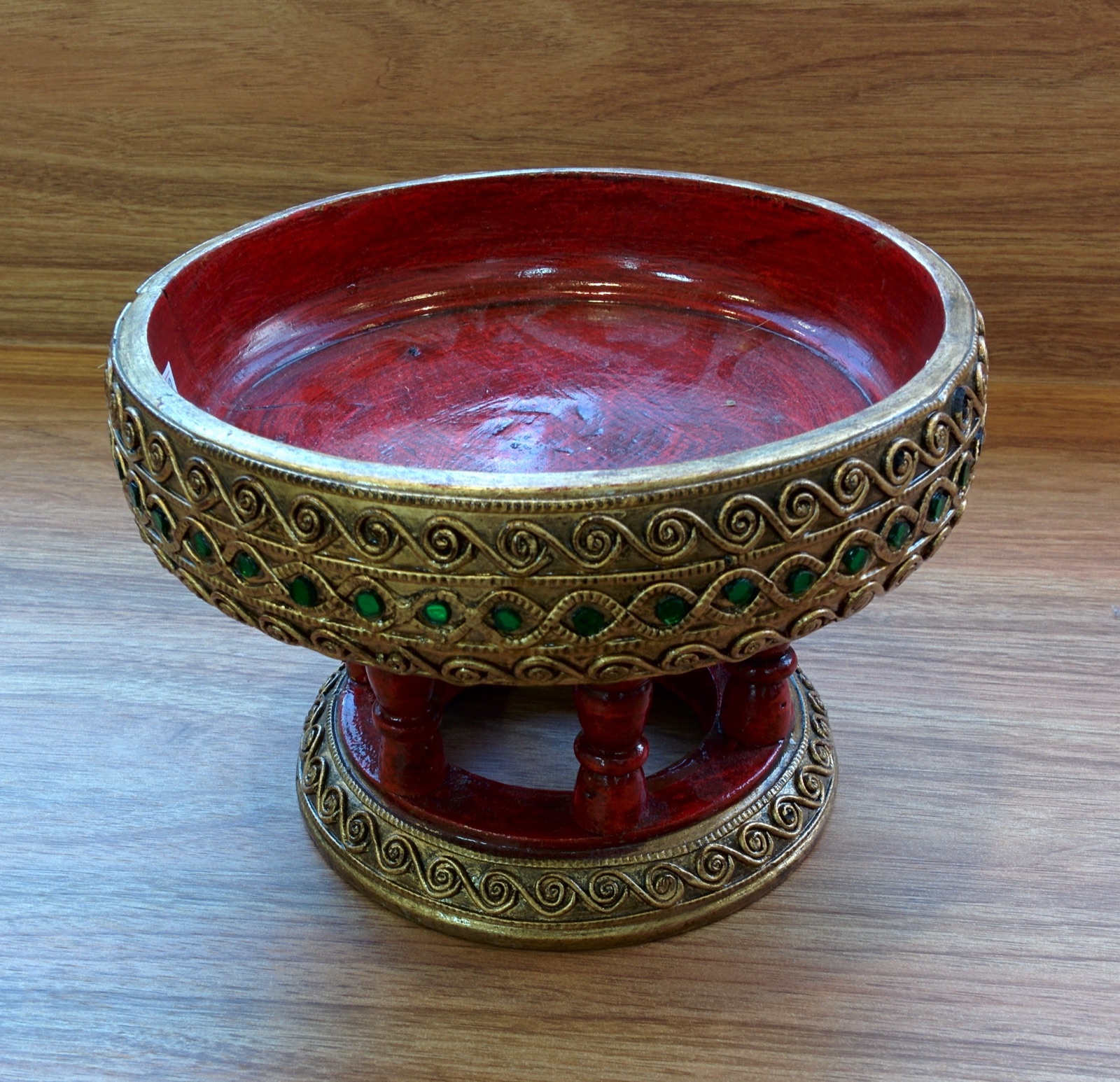
Photo: Chainwit. / Wikimedia Commons (CC BY-SA 4.0)
Khantoke: Lanna's Footed Food Tray and the Khantoke Dinner
Khantoke (khan tok, ขันฯโต฿กฯ) is a round tray on a footed stand that people in Lanna use to serve food. Everyone sits around it on the floor of the house and eats sticky rice together, so the word means both the vessel and a way of eating. Today khantoke has also become the "khantoke dinner", the welcome banquet most visitors think of when they come to Chiang Mai.
This article looks at the dictionary words for khantoke, the dishes that go on the tray, and how a family meal became a feast for honoured guests.
What is a khantoke?
The Moradok Lanna dictionary describes khantoke as "a tray-shaped vessel on a tall stand, used as a food tray by people whose staple food is sticky rice". It can be called simply tok (โต฿กฯ, tok) or sa tok (สโต฿กฯ, sa tok).
A khantoke works like the dining table of a home where people eat on the floor. It lifts the food to hand height, so nobody has to bend down to the floor, and everyone sits around the same tray.
The dictionary also distinguishes two kinds of khantoke by material and region, and several words for using one:
| Lanna word | Lanna script | Meaning (from the dictionary) |
|---|---|---|
| khan tok yuan | ขันฯโต฿กฯยวฯร | a khantoke of teak wood, common across Lanna |
| khan tok lao | ขันฯโต฿กฯลาวฯ | a khantoke of woven bamboo and rattan, popular in Isan and Sipsong Panna |
| khan khao | ขันฯเขั้า | a rice tray; a set of dishes for a meal |
| kua khao | กัวฯะ | a wooden tray for stirring steamed sticky rice; also a set of dishes |
| da khan tok | ดาขันฯโต฿กฯ | to set food on a khantoke |
| hang khan tok | ห้างฯขันฯโต฿กฯ | to prepare a meal using a khantoke as the tray |
| kin khan tok | กินฯขันฯโต฿กฯ | to eat a meal served on a khantoke |
Size and material showed status
An article by Bodinthon Senpharat (บดินทร์ธร เสนพรัตน์) in Silpa Wattanatham magazine (2025) divides khantoke into 3 sizes: the small khantoke (khan tok noi), about 10–15 inches across; the medium khantoke (khan tok ham), about 17–25 inches; and the great khantoke (khan tok luang), about 25–40 inches.
The same article says that in the past the nobility, officials and civil servants favoured khantoke of silver, gilded metal, or wood lacquered and decorated in gold leaf in a style called "lai kham" (gold pattern), and used large trays because they served many dishes. Ordinary villagers usually used a small khantoke made of rattan or wood.
Where did khantoke come from?
There is no firm evidence of which culture shaped the khantoke. A 2022 study by Songsuk Bunthawong (ทรงสุข บุญทาวงค์) and colleagues collects two views from local scholars:
- The khantoke may have been influenced by the Siamese tiap, a footed vessel for presenting food offerings to monks, perhaps brought north when Chiang Mai was restored under King Kawila (1796).
- Or it may resemble the Burmese stands used to hold bowls of food.
The visual evidence the study points to is the mural in the vihara of Wat Pa Daet in Mae Chaem District, painted by Tai Yai (Shan) artists, which shows guests being welcomed with khantoke. The vihara was consecrated in 1885, so welcoming guests with khantoke goes back at least that far.
What is served on a khantoke
The heart of a khantoke meal is steamed sticky rice, khao nueng (เขั้าหึ้นฯง, khao nueng), kept in a kong khao (ก่อฯงเขั้า, kong khao), a basket woven from bamboo or rattan. To eat, you chok kong khao (จ฿กฯก่ลฯอฯงเขั้า, chok kong khao): reach into the basket, take some rice, roll it into a ball and dip it into the dishes. In Kham Mueang, "to eat a meal" is kin khao (กินฯเขั้า, kin khao).
There is no fixed menu for a khantoke; each household and occasion is different. Dishes that the sources mention again and again include:
| Dish | Lanna script | Kham Mueang reading | The dictionary describes it as |
|---|---|---|---|
| Hang le curry | แกงฯฮังฯเล | kaeng hang le | a curry of large pieces of pork belly, simmered until the sauce reduces |
| Green chilli dip | นาฯระฯพิกฯหุ่ม | nam phik num | a chilli dip made from young green chillies, a well-known local dish |
| Tomato and pork chilli dip | นาฯระฯพิกฯอ่อฯง | nam phik ong | an orange chilli dip of tomatoes and dried chillies, simmered until thick |
| Pork cracklings | แฅปฯหู | khaep mu | pork skin fried until crisp |
| Northern sausage | ไส้อ่฿วฯ | sai ua | minced pork mixed with herbs and spices, stuffed into casings, then fried or grilled |
| Larb | ชิ้นฯลาปฯ | chin lap | finely minced meat mixed with larb chilli paste |
| Om curry | แกงฯอ่อฯม | kaeng om | meat stewed until tender, seasoned with om curry paste |
| Khae curry | แกงฯแฅ | kaeng khae | a curry made with many kinds of vegetables |
| Fermented pork | ชิ้นฯส้฿มฯ | chin som | meat fermented with garlic, cooked rice and salt until sour |
| Grilled leaf parcel | หํอฯแอัปฯ | ho aep | fish or shrimp mixed with chilli paste, wrapped in banana leaf and grilled |
| Chicken salad | ยำชิ้นฯไก่ | yam chin kai | a spicy chicken salad |
| Rice crackers | เขั้าแตนฯ | khao taen | a snack of steamed sticky rice, dried and then fried until puffed |
Hang le curry is also called simply hang le (ฮังฯเล) or "hin le", as the dictionary records, and the dictionary specifies that the meat "must be pork belly, mixed with lean meat without fat".
From khantoke to khantoke dinner
Silpa Wattanatham magazine says that as urban values spread, eating from a khantoke began to fade from city life in the North. But the khantoke found a new life as a welcome banquet, which the magazine calls "an applied culture created only a few decades ago".
1885 Guests welcomed with khantoke appear in the mural of the vihara at Wat Pa Daet, Mae Chaem
1946 A welcome banquet for the director of McCormick Hospital
1953 A farewell banquet for Sanya Dharmasakti, chief justice of Region 4
1964–1965 Royal welcome banquets for King Baudouin of Belgium and King Olav V of Norway at Bhubing Palace
1970 The Old Chiang Mai Cultural Center on Wua Lai Road opens as Chiang Mai's first khantoke restaurant business
Kraisri Nimmanahaeminda and the banquet of 1953
Silpa Wattanatham (2025), citing the writing of Phudet Saensa (ภูเดช แสนสา), says the first banquet in "khantoke dinner" style was organised by Kraisri Nimmanahaeminda in 1953 at his house on Fa Ham Road, as a farewell for Sanya Dharmasakti, who was moving to a post in Bangkok, and for George Whitney, the American consul in Chiang Mai. The event drew so much interest that four more were held between 1953 and 1958.
The two sources therefore agree on the 1953 banquet but differ slightly on which event was "the first": the study by Songsuk and colleagues also records an earlier khantoke banquet in 1946. The Michelin Guide (2019) says the Old Chiang Mai Cultural Center was the first place to serve khantoke with a cultural show, from 1970, which matches the study.
What to wear to a khantoke
Silpa Wattanatham quotes the Encyclopedia of Thai Culture: Northern Region, Volume 2, which says that the dress code for that banquet was:
- Men: an indigo mo hom shirt or local dress with a jasmine garland, and either Western trousers or tiao sa do (ต่ยฯวสดํอฯ, tiao sa do), loose trousers with a low crotch reaching mid-shin, with a pha khao ma cloth tied at the waist
- Women: a sarong-style pha thung, a long-sleeved blouse or local dress, and hair worn up and decorated with dok ueang (ดอฯกเอิ้อฯง, dok ueang), a wild orchid, or other orchids
This style of dress is still popular at khantoke events today.
Khantoke today
Today the khantoke dinner is held by government offices, tourism businesses and students alike; faculties at Chiang Mai University, for example, often welcome new students with a khantoke. These events usually include local performances, such as the fingernail dance, fon lep (ฟ้อฯรเลัปฯ, fon lep), the candle dance and the silk-reeling dance, with music from a salo so sueng ensemble (ว฿งฯสลํอฯซํอฯซึงฯ, wong salo so sueng).
The study by Songsuk and colleagues (2022) sees khantoke as "cultural capital" that earns income for Chiang Mai through tourism. It also points out that another strand of local cuisine, the food of the Northern royal courts, is still little known and deserves more attention.
Why "dinner"? Silpa Wattanatham explains that before electricity was widespread, people usually ate from a khantoke during the day. When khantoke became a banquet blending Western customs with Lanna ones, it came to be held in the evening, like an international dinner party.
Summary
- Khantoke (tok, sa tok) is a round tray on a footed stand, used to serve a shared meal of sticky rice on the floor.
- The dictionary distinguishes khan tok yuan (teak, the Lanna style) from khan tok lao (woven bamboo and rattan); size and material once showed the owner's status.
- A khantoke meal usually includes khao nueng (sticky rice), hang le curry, nam phik num, nam phik ong, pork cracklings, sai ua sausage and seasonal vegetables.
- The khantoke dinner is an applied culture: important banquets took place between 1946 and 1965, and it became a business when the Old Chiang Mai Cultural Center opened in 1970.
Look up more Northern food words in the Moradok Lanna dictionary (in Thai), and read about the Kham Mueang words used when shopping for food in Going to the kad like a local (in Thai).
Sources
- Moradok Lanna dictionary (in Thai): ขันโตก · เข้าหนึ้ง · แก๋งฮังเล · น้ำพิกหนุ่ม
- ทรงสุข บุญทาวงค์ และคณะ [Songsuk Bunthawong et al.]. (2022). อาหารพื้นเมืองเชียงใหม่ในมิติประวัติศาสตร์และการท่องเที่ยว [Chiang Mai local food in its historical and tourism dimensions]. Journal of Northeastern University 12(4). In Thai.
- บดินทร์ธร เสนพรัตน์ [Bodinthon Senpharat]. (2025). “ขันโตกดินเนอร์” วัฒนธรรมรับรองแขกบ้านแขกเมืองสุดอบอุ่นของชาวเหนือ เกิดขึ้นเมื่อไหร่? [When did the "khantoke dinner", the North's warm welcome for guests, begin?]. Silpa Wattanatham. In Thai (citing Phudet Saensa and the Encyclopedia of Thai Culture: Northern Region, Vol. 2).
- Michelin Guide. (2019). On the culinary trail: khan tok dining in the North. Michelin Guide Thailand.


