
Photo: Lannafolium / Wikimedia Commons (CC0)
The Lanna Clock: Yam Kong, Yam Tut, Yam Thalae
The Lanna clock is the old Northern Thai way of telling the time, which splits the day into periods of an hour and a half called yam (ยามฯ). The Moradok Lanna dictionary defines yam as "a short period of time, divided into 3 kinds: yam kong, yam tut and yam thalae", and it gives the clock times of every yam, day and night.
The names also hide words people still use every day, such as ngai, "morning", and laeng, "evening". This article lays all the yam out as a 24-hour clock, explains what the names mean, and compares them with the Central Thai mong, thum and ti.
See which yam it is right now, or turn the dial to any time you want to check.
Where do the names yam kong, yam tut and yam thalae come from?
The three groups are named after three signalling instruments in the dictionary:
- Kong (กลฯอฯง) is a drum.
- Tut (ตูด) the dictionary glosses as "a whistle-horn: an animal horn blown as a signal".
- Thalae is a trumpet. The dictionary writes the Thai form of this group as "yam trae" (trumpet watch), e.g. yam thalae kham = [ยามแตรค่ำ], and it has the word thalae hoen (แถๆลฯเหินฯ), a curved horn "shaped like a buffalo horn, with a flared mouth".
The fourth yam of each round, such as yam tiang, yam kham and yam doek, has no instrument in its name. The dictionary does not say which instrument was actually struck or blown for each yam, so it is safer to read the names as memory aids rather than as a record of how time was signalled.
The full 24-hour Lanna clock
Put the dictionary times in order and you get 16 yam of an hour and a half each. They follow the same pattern four times, tut → kong → thalae → yam, each round lasting six hours.
| Time | Name of the yam | Lanna script | Group |
|---|---|---|---|
| 00:00–01:30 | yam tut hung | ยามฯตูดรุ่ง | tut |
| 01:30–03:00 | yam kong hung | ยามฯกลฯอฯง | kong |
| 03:00–04:30 | yam thalae hung | ยามฯแระฯตรุ่ง | thalae |
| 04:30–06:00 | yam hung or yam jao | ยามฯรุ่ง | yam |
| 06:00–07:30 | yam tut jao | ยามฯตูดเชั้า | tut |
| 07:30–09:00 | yam kong ngai | ยามฯกลฯอฯง | kong |
| 09:00–10:30 | yam thalae tiang | ยามฯแระฯตท่ยฯง | thalae |
| 10:30–12:00 | yam tiang | ยามฯท่ยฯง | yam |
| 12:00–13:30 | yam tut jai | ยามฯตูดช้ายฯ | tut |
| 13:30–15:00 | yam kong kham | ยามฯกลฯอฯงฅํา | kong |
| 15:00–16:30 | yam thalae kham | ยามฯแระฯตฅํา | thalae |
| 16:30–18:00 | yam kham | ยามฯฅํา | yam |
| 18:00–19:30 | yam tut doek | ยามฯตูดเดิกฯ | tut |
| 19:30–21:00 | yam kong doek | ยามฯกลฯอฯง | kong |
| 21:00–22:30 | yam thalae doek | ยามฯแระฯตเดิกฯ | thalae |
| 22:30–24:00 | yam doek | ยามฯเดิกฯ | yam |
In speech the leading yam is often dropped, and the dictionary also lists the short forms, such as tut jao, tut doek, tut hung, thalae tiang and thalae kham, with the same times as the full names.
Hung, jao, ngai, tiang, kham, doek: the endings tell the part of the day
The last word of each name is an everyday word for a part of the day. Learn these and you can tell at once roughly when a yam falls.
| Ending | Where it falls on the clock | Meaning in the dictionary |
|---|---|---|
| hung | 00:00–06:00 | dawn, bright (yam hung = early morning) |
| jao | 04:30–07:30 | the time before sunrise |
| ngai | 07:30–09:00 | morning after sunrise |
| tiang | 09:00–12:00 | noon (tiang is set at 10:30–12:00) |
| kham | 13:30–18:00 | in the clock names: the afternoon up to 6 p.m. (see the note at the end) |
| doek | 18:00–24:00 | late, late at night |
Two words that Central Thai speakers often get wrong are jao (เชั้า) and ngai (ง่ายฯ). The dictionary explains that jao is "the time before sunrise", while the morning after sunrise until before noon is called wela ngai. So breakfast is khao ngai (เขั้างายฯ), not "khao chao".
In the same way, tiang (ท่ยฯง) means "noon", but the dictionary sets yam tiang at 10:30–12:00, so the yam ends exactly at midday and the next one, yam tut jai, starts at noon sharp.
Drums, gongs and bells: the temple's time signals
Before clocks, the sounds from the temple were the village clock. The dictionary records several of the instruments:
- Kong pu ja (กลฯอฯงปู่ชา), the worship drum: a large two-headed drum beaten as an offering to the Buddha on the eve of holy days and on holy days, with three small drums called kong top keeping the rhythm.
- Kong mong (ค้อฯงห้มฯอฯง), a small gong; a single one hung on a stick is used "by the watchman to strike the time or announce news".
- Ho la-kang (หํอฯรฆังฯ), the bell tower, used to signal the time for merit-making and "to mark dusk, struck in turn with the drum".
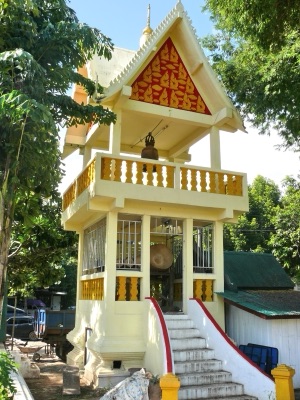
Photo: Ellnik / Wikimedia Commons (CC BY-SA 3.0)
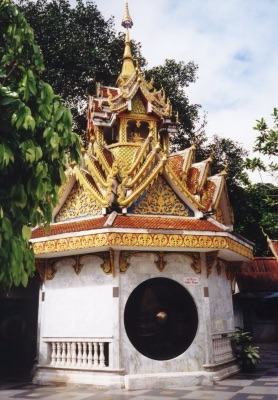
Photo: Ahoerstemeier / Wikimedia Commons (CC BY-SA 3.0)
Drums are also the sound of Lanna's big temple festivals. Read about the great drum at a temple fair in Poy Luang.
Compared with Central Thai mong, thum and ti
Central Thai also names the hours after the sounds that marked them. Prof. Chamnong Thongprasert of the Royal Institute explains that daytime hours are called mong, the hours from nightfall to midnight thum, and the hours after midnight up to 5 a.m. ti, while 6 p.m. is yam kham (ย่ำค่ำ, "the dusk drumming", a different word from the Lanna yam kham) "because at 6 p.m. the monks usually beat the drum to tell the time". The same article quotes Prince Damrong Rajanubhab, who recalls that in the Grand Palace, after the watch bell was rung, "men blew the curved horn, played the oboe and beat the bronze drum for a while longer".
The clear difference is the size of the unit:
| Central Thai | The Lanna clock | |
|---|---|---|
| Unit | one hour per mong, thum or ti | an hour and a half per yam |
| Units per day | 24 hours | 16 yam |
| Names | counted: sam mong, song thum | proper names: yam kong ngai, yam thalae doek |
| 08:00 | song mong chao | yam kong ngai |
| 20:00 | song thum | yam kong doek |
Today most Khon Mueang use the nalika (นาฯฬิกา), the clock, and count hours the Central Thai way. The old yam names now live mostly in old texts, ritual timing and the speech of elders.
Time words still used every day
The full yam names are rarer now, but many words for parts of the day are still in everyday use:
- Yam laeng (ยามฯแลงฯ), evening. The evening meal is khao laeng (เขั้าแลงฯ).
- Yam pat kham (ยามฯพาดฯฅํา), the time close to dusk.
- Yam ton (ยามฯทอฯร), lunchtime, the daytime.
- Doek (เดิกฯ), late at night, as in yam doek.
Kin khao ngai laeo ka? – Have you had breakfast yet? Adding ka at the end turns a sentence into a question, like the dictionary's own example ap nam laeo ka? ("have you bathed yet?")
Kin khao laeng laeo ka? – Have you had dinner yet? Laeng tells you it is the evening meal.
Ma yam pat kham – Come close to dusk, before it gets dark.
More on "kham" in the dictionary
The word kham (ฅํา) has several meanings in the dictionary. The first counts lunar days, as in ok paet kham (the 8th day of the waxing moon) and haem sip kham (the 10th day of the waning moon). The second is "the dark time when night begins". In the clock names, though, kham covers the afternoon up to 6 p.m., as the table above shows.
Summary
- The Lanna clock divides the day into 16 yam of an hour and a half, following the round tut → kong → thalae → yam four times.
- The three group names match three signalling instruments: kong (drum), tut (a horn blown as a signal) and thalae (trumpet).
- The endings tell the part of the day: hung, jao, ngai, tiang, kham, doek, and the yam ending in kham fall in the afternoon.
- Khao ngai is breakfast and khao laeng is dinner, words still used every day.
- Central Thai also named hours after drum and gong signals, but counts one unit per hour: mong, thum, ti.
Look up all the yam names in the Moradok Lanna dictionary (in Thai), and read how Lanna counts its months in Duean Nuea.
Sources
- Moradok Lanna dictionary: ยาม (ref 13025) and all the yam names (13026–13057), ก๋อง (316), ตูด (8315), ถะแหลเหิน (14903), ก๋องปู่จา (336), ก๊องหม้อง (310), หอหละกัง (6275), เจ๊า (3302), งาย (16807), ค่ำ (2450)
- จำนงค์ ทองประเสริฐ. "ทุ่ม-โมง-นาฬิกา" [Thum, mong and nalika]. Royal Institute of Thailand (web archive copy): royin.go.th
Practise the words from this article
Flip through 40 flashcards of the Lanna words used in this article.


