
Photo: Takeaway / Wikimedia Commons (CC BY-SA 3.0)
Rice and Paddy Words in Kham Mueang
Rice in Kham Mueang (Northern Thai) is khao (เขั้า). The Moradok Lanna dictionary (in Thai) explains that Lanna people say the word for rice as khao with their own tone, halfway between the central Thai falling and high tones, a sound central Thai does not have: kin khao is "to eat a meal" and khao tom is rice soup. The rice field is na (นาฯ), and farming rice is yia na or sai na.
Rice runs through the whole Northern Thai year, so the language has many words for it. This article collects Kham Mueang words for rice and paddy life from the dictionary: kinds of rice, kinds of paddy, the growing rice plant, field work, the buffalo, the granary, the weir-and-canal system, and the rites for the spirit of the rice.
Kinds of rice
Northern Thai people mainly eat sticky rice, so steamed sticky rice has its own name, khao nueng. Ordinary non-sticky rice is khao chao. Rice is also named by where and when it grows, and by whether it has been milled.
| Kham Mueang | Lanna script | Meaning (from the dictionary) |
|---|---|---|
| khao nueng | เขั้าหึ้นฯง | steamed rice, steamed sticky rice |
| khao chao | เขั้าจ้าวฯ | ordinary (non-glutinous) rice, loose when cooked |
| khao kam | เขั้ากํา | black sticky rice |
| khao hai | เขั้าไร่ | upland rice, grown on hillsides or high ground with rain water |
| khao pi | เขั้าปี | main-season rice |
| khao do | เขั้าดํอฯ | off-season rice; a quick-growing variety |
| khao chuea | เขั้าเชิ้อฯอ | paddy rice kept as seed |
| khao plueak | เขั้าเปิลฯอฯก | unhusked paddy rice |
| khao san | เขั้าสานฯ | milled rice |
| som mue | ซ้อฯมมื | hand-pounded brown rice is called khao som mue |
| khao pian | เขั้าปยฯร | broken rice |
| khao sio | เขั้าซิวฯ | small-grained milled rice |
| khao kao | เขั้าเกั่า | old rice, kept from last year |
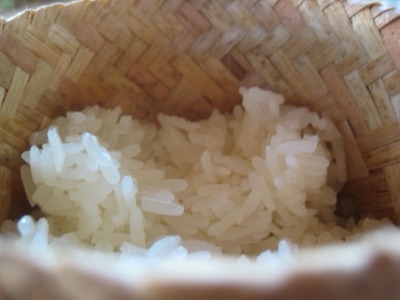
Photo: Thomas Wanhoff / Wikimedia Commons (CC BY-SA 2.0)
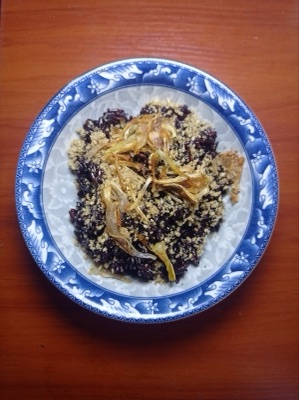
Photo: စာကလေး SarKaLay / Wikimedia Commons (CC0)
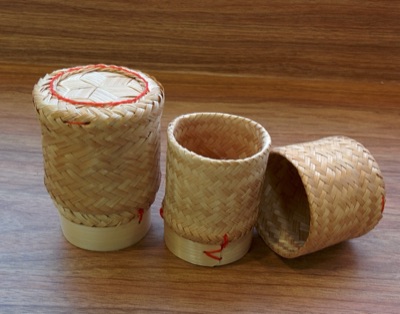
Photo: Susan Slater / Wikimedia Commons (CC BY-SA 4.0)
Kinds of paddy
The word na branches into many words that tell you the season, the position of the field, and where its water comes from.
| Kham Mueang | Lanna script | Meaning (from the dictionary) |
|---|---|---|
| na pi | นาฯปี | a field planted in the normal season |
| na chiang | นาฯจยฯง | an off-season field |
| na do | นาฯดํอฯ | a field of quick-growing rice, harvested early |
| na don | นาฯดอฯร | a field on high ground, often short of water |
| na hong | นาฯโห้฿งฯ | a field lower than the fields next to it |
| na nam fa | นาฯนาฯฟ้า | a rain-fed field with no irrigation ("sky-water field") |
| na hang | นาฯร้างฯ | an abandoned field |
| khan na | ฅันฯนาฯ | the earth bund around each paddy plot |
| long | ล้อฯง | a ditch draining water from a low field; waterlogged low ground |
| na na | ห้นฯานาฯ | the rice-farming season |
From ka to huang: the growing rice plant
A seedling in Kham Mueang is ka (ก้ลฯา). The dictionary defines it as a plant raised to be moved and planted elsewhere, and rice seedlings raised in a nursery bed for the paddy. When the rice heads, the ear is called huang.
| Kham Mueang | Lanna script | Meaning (from the dictionary) |
|---|---|---|
| ka bong | ก้ลฯาบ฿งฯ | seedlings pulled from the bed and replanted for a while to grow strong before going to the paddy |
| bong | บ฿งฯ | (verb) to nurse seedlings until they are strong enough to plant |
| khao man | เขั้ามานฯ | rice "with child": the plant just before the grain forms (man = pregnant) |
| khao nam nom | เขั้า¢น฿มฯ | "milk rice": grain still a milky liquid |
| khao mao | เขั้าเหั้มฯา | young sticky rice past the milk stage, the grain just turning firm |
| huang | รวฯง | a cluster or hanging bunch, as an ear of rice |
| khao tao | เขั้าท่าฯวฯ | rice flattened by flood or storm, usually ready to harvest |
| khao huea | เขั้าเริ้อฯอ | dropped grain that sprouts again and sets new ears |
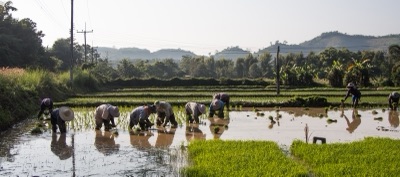
Photo: Takeaway / Wikimedia Commons (CC BY-SA 4.0)
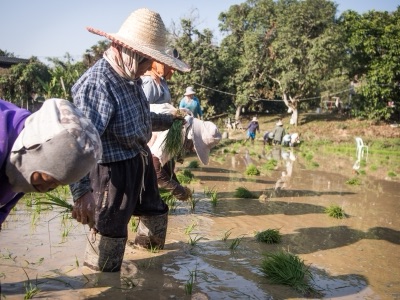
Photo: Takeaway / Wikimedia Commons (CC BY-SA 3.0)
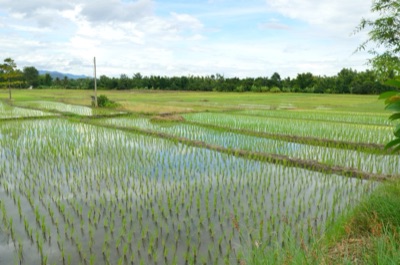
Photo: Supercarwaar / Wikimedia Commons (CC BY-SA 3.0)
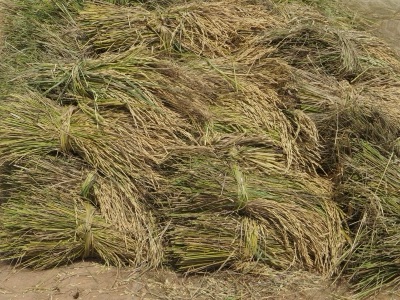
Photo: Myrmux / Wikimedia Commons (CC BY-SA 4.0)
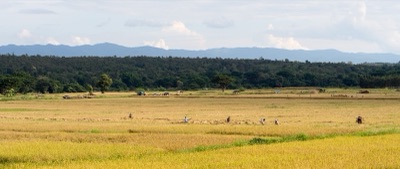
Photo: Takeaway / Wikimedia Commons (CC BY-SA 3.0)
A farmer's year: words for field work
Farming rice can be said in several ways: yia na, yia khao, yia tong yia na, and sai na, which the dictionary explains as the planting steps from ploughing and sowing to transplanting. Yia hai sai na, "to work fields and paddies", means farming in general.
This table lists the words in the order of the work, from the first ploughing to the rice going into the granary. For the Lanna months, read the Northern months.
| Step | Kham Mueang | Lanna script | Meaning (from the dictionary) |
|---|---|---|---|
| start | haek na | แรกฯนาฯ | the first ploughing, on the most auspicious day of the season |
| preparing | thai na | ไถนาฯ | ploughing the field with oxen, buffalo or a tractor |
| preparing | piang | ปยฯง | a board dragged by oxen or buffalo to level the mud before transplanting |
| planting | wan | ห่วฯานฯ | to scatter, to sow |
| planting | kuai ka | กวฯยฯก้ลฯา | the basket for carrying seedlings to the paddy |
| planting | puk khao | ปลฯกเขั้า | to plant rice, to transplant |
| planting | dam na | ดำนาฯ | to transplant rice (yia na is the usual word) |
| harvest | kiao khao | ก่ยฯวเขั้า | to harvest rice with a sickle |
| harvest | khiao | ฅยฯว | sickle |
| threshing | ti khao | ตีเขั้า | to beat rice so the grain falls from the ear |
| threshing | fat khao | ฟาดฯเขั้า | to thresh rice (in slang, also "to eat") |
| threshing | ta lang | ตาลางฯ | the threshing floor |
| threshing | ta lang khi khwai | ตาลางฯขี้ฅวฯายฯ | a threshing floor sealed with buffalo dung and water, dried in the sun |
| threshing | hai ta lang | ไร่ตารางฯ | a paddy plot used as the threshing floor |
| threshing | khu ti khao | ฅุตีเขั้า | a large woven tub for threshing |
| cleaning | ha khao | หะเขั้า | to toss threshed grain so the wind blows away empty husks |
| cleaning | wi khao | วีเขั้า | to toss grain and fan away empty husks and leaves |
| cleaning | ka pat khao | กาพัดฯเขั้า | a large round woven fan for winnowing |
| cleaning | phak ha khao | ผากฯหะเขั้า | a wooden shovel for paddy rice |
| storing | lak khao khuen long | ลากฯเขั้าขึ้นฯหลฯอฯง | to cart the rice to the granary |
| storing | wan khao khuen long | วันฯเขั้าขึ้นฯหลฯอฯง | the right day to put rice in the granary |
| milling | tam khao | ตำเขั้า | to pound paddy rice in a foot-operated mortar to remove the husk |
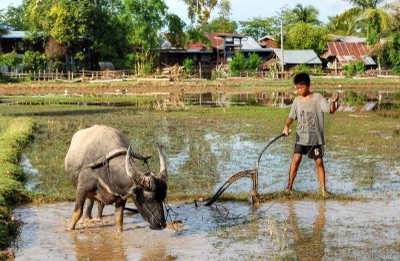
Photo: Paulrudd / Wikimedia Commons (CC BY-SA 3.0)
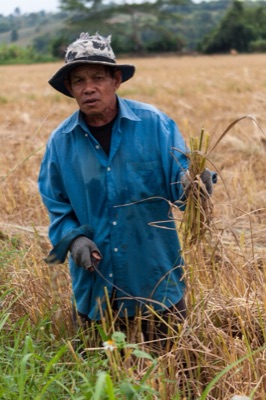
Photo: CEphoto, Uwe Aranas / Wikimedia Commons (CC BY-SA 3.0)
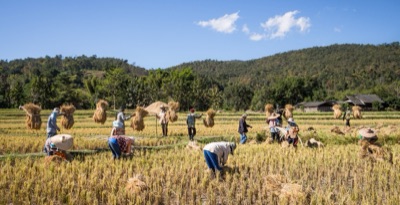
Photo: Takeaway / Wikimedia Commons (CC BY-SA 4.0)
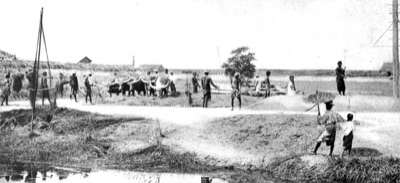
Photo: G. P. Putnam's Sons / Wikimedia Commons (Public domain)
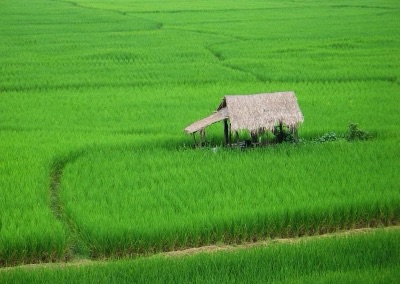
Photo: Takeaway / Wikimedia Commons (CC BY-SA 3.0)
Working together
Rice work is heavy, so there are words for sharing labour and sharing the harvest.
| Kham Mueang | Lanna script | Meaning (from the dictionary) |
|---|---|---|
| ao mue | ´ามื้ | to help someone first, so they will come and help you back |
| chang yia na | จ้างฯเยยฯะนาฯ | to hire someone to farm |
| yia na pha koeng | ฿งฯเยยฯะนาฯผ่าเกิ่งฯ | sharecropping: splitting the paddy rice half and half with the owner |
| tup ma ngaen | ตูหมฯาแหงฯร | a lean-to field hut for planting and harvest time |
| nam khok | นาฯฅอฯก | a bamboo water flask on a shoulder strap |
| pha ka lom | ผ้ากลอฯม | a head cloth tied under the chin against the sun |
The buffalo and the paddy
Before tractors, the main power in the fields was the buffalo (khwai, ฅวฯายฯ) and the ox (for other animal names, read animal names in Kham Mueang). So Kham Mueang has its own words for harness and training.
| Kham Mueang | Lanna script | Meaning (from the dictionary) |
|---|---|---|
| aek | แอกฯ | yoke: two curved pieces of wood around the neck of a ploughing or cart ox or buffalo |
| aek kho | แอกฯฅํอฯ | the upper curved piece, resting on top of the neck |
| aek om | แอกฯอ้อฯม | the lower curved piece, tied to the upper one |
| sai ok | สายฯอ฿กฯ | the strap that ties the animal to the yoke |
| pen na | เปนฯนาฯ | (of oxen or buffalo) trained to plough |
| foek na | เฝิ้กฯนาฯ | to train oxen or buffalo to plough |
| ka haeng khwai | ค่าฯแรงฯฅวฯายฯ | the fee for hiring a buffalo for the season |
| hong khwan khwai | ร้อฯงขัวฯรฅวฯายฯ | calling the buffalo's spirit after the season |
Hong khwan khwai is held after the season. The dictionary explains that while ploughing, people may scold or beat a buffalo that does not do what they want, so farmers hold this rite to thank the buffalo, ask its forgiveness (kho su ma), and wish it health, many calves and no sickness. For soul-calling rites, read Hong Khwan.
Long khao: the granary
Threshed and cleaned rice goes up into the long khao (หลฯอฯงเขั้า), the rice granary. The dictionary says it can also be called yia.
| Kham Mueang | Lanna script | Meaning (from the dictionary) |
|---|---|---|
| long | หลฯอฯง | granary, store |
| yia | เยยฯ | granary: a square, closed-walled building with a roof for paddy rice or other grain (another entry: เอยฯยฯ) |
| sawian | สๆวฯยฯร | a large woven bamboo cylinder for rice, plastered with dung, set on a raised floor called long khao |
| bung | บุ่ง | a tall woven bamboo bin for paddy rice |
| sat thu | สาดฯถุ | an open-weave mat lining the granary floor |
| tang | ตางฯ | a bamboo measure for paddy rice; one tang holds 14 kilograms |
| pak kha tuen tak khao | ปักขฯทืนฯตักฯเขั้า | a table of good and bad days for taking rice out of the granary, hung on the granary |
Mueang fai: water for the paddies
Paddies in the Lanna valleys depend on the mueang fai system: the fai (ฝายฯ), a weir across a stream that raises the water, and the mueang, a dug canal that carries it to the fields. Villagers run it together, with their own leaders.
| Kham Mueang | Lanna script | Meaning (from the dictionary) |
|---|---|---|
| mueang | เหิอฯง | an irrigation canal |
| fai mong | ฝายฯมอฯง | a weir built mainly of large posts |
| fai hin khwang | ฝายฯหินฯฅ่วฯางฯ | a rubble weir of heaped stones that dams and slows the stream |
| mong fai | มอฯงฝายฯ | the large posts driven in to build a weir |
| tae | แท | a small dam in a canal branching from the weir, before the water goes on to a tang |
| tang | ท้าฯงฯ | a divider sharing water between branch canals or setting the water level in a field |
| tong fai | ท้อฯงฝายฯ | the water below the weir |
| kae fai | แก่ฝายฯ | the weir leader, who calls villagers to repair the system and leads the weir-spirit rite |
| kae mueang | แก่เหิมฯอฯง | the head of the canal system |
| lam fai | ล่ามฯฝายฯ | the weir leader's assistant, who carries his messages to the villagers |
| phi fai | ผีฝายฯ | the guardian spirit of the weir |
| ho phi fai | หํอฯผีฝายฯ | a small raised spirit house at the head of the canal |
| liang phi fai | ล้ยฯงผีฝายฯ | feeding the weir spirit, usually at the end of the farming season |
According to the belief recorded in the dictionary, when a new weir is finished the villagers invite the chief spirit of the area to live in the weir spirit house. At the end of the season they pool money for offerings, and the weir leader invites the spirit to receive them. For more on spirit words, read phi in Kham Mueang.
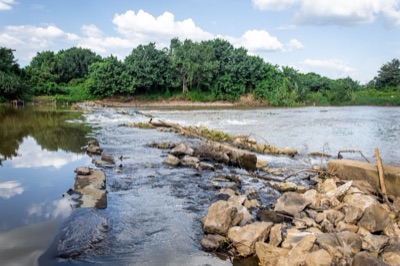
Photo: Supanut Arunoprayote / Wikimedia Commons (CC BY 4.0)
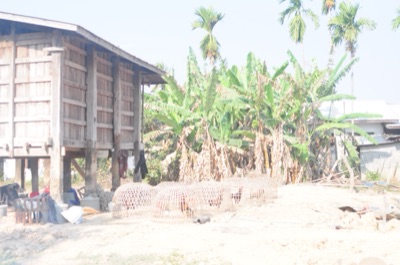
Photo: มะเดื่อ แสลงหลวง / Wikimedia Commons (CC BY 3.0)
The spirit of the rice and rice rites
Lanna people believe rice has a spirit, khwan khao (ขัวฯรเขั้า), and a guardian the dictionary compares to Mae Phosop, the central Thai rice goddess: Ya Khwan Khao (ย่าขัวฯรเขั้า), a sacred presence in the rice plant and the grain that keeps the harvest plentiful.
| Kham Mueang | Lanna script | Meaning (from the dictionary) |
|---|---|---|
| su khwan khao | สู่ขัวฯรเขั้า | inviting the rice spirit from the field to the granary after harvest, and back to the field when planting begins |
| suep cha ta khao | สืปฯชตาเขั้า | the rite to extend the life of the rice, held on an auspicious day so next year's crop will thrive |
| tan khao mai | ทาฯนฯเขั้าไห่มฯ | offering the new rice to the guardian deities of the headwaters and the ancestors who owned the fields, before eating any of it |
| doi kham | ดอฯฅำ | the heap of paddy rice offered at tan khao mai ("golden mountain") |
| lon bat | ล้฿นฯบาฯระฯต | a merit-making after harvest, filling the monk's bowl until rice overflows into a heap |
| khao phra chao | เขั้าระฯพเจั้า | a small set of rice and food offered to the Buddha image on the home altar each morning |
Read more about the new-rice offering in Tan Khao Mai and about life-extension rites in Suep Chata.
From granary to table
Once rice reaches the kitchen, there is another set of words for meals and for rice in different states.
| Kham Mueang | Lanna script | Meaning (from the dictionary) |
|---|---|---|
| khao ngai | เขั้างายฯ | breakfast |
| khao ton | เขั้าทอฯร | lunch |
| khao laeng | เขั้าแลงฯ | dinner |
| khao chae | เขั้าแช่ | sticky rice soaked in the evening to steam the next morning |
| khao hung | เขั้าหุง | boiled ordinary rice |
| khao yen | เขั้าเอยฯันฯ | day-old steamed sticky rice, dry and hard, steamed again before eating |
| khao un | เขั้าอุ่ร | freshly steamed sticky rice, or day-old rice steamed again |
| khao ba lang | เขั้าบ่าฯห้ลฯางฯ | rice stuck to the bottom of the pot |
| khao ho | เขั้าหอฯ | a packed meal to take out |
| khao tak | เขั้าตากฯ | sun-dried cooked sticky rice, food for long journeys |
For pots and baskets for cooking rice, read Lanna kitchen words. For rice dishes, read Khong Kin Khon Mueang and Kin Lam Kin Lam.
Khao that is not rice
Be careful: some Kham Mueang words begin with khao but have nothing to do with rice.
| Kham Mueang | Lanna script | Meaning (from the dictionary) |
|---|---|---|
| khao sa li | เขั้าสาลี | maize, corn |
| khao pang | เขั้าป้างฯ | millet |
| khao min | เขั้าหิ้มฯร | turmeric |
| khao (verb) | เขั้า | to enter, to go in |
| khao long | เขั้าห้ลฯอฯง | to die ("to enter the coffin") |
| khao wa sa | เขั้าหลฯามฯวัªา | the start of Buddhist Lent |
| khao wat | เขั้าวัดฯ | to become a temple boy |
Rice sayings
- Khao na pa tao (เขั้าหนฯาปลฯาเทั้าฯ): the dictionary glosses it as "fish in the water, rice in the fields", a land of plenty.
- Fai mai long khao: "the granary is on fire", so hungry it burns.
- Khao wit laeng (เขั้าหิวฯดแลงฯ): not enough rice for dinner.
- Khao bo tok tong (เขั้าบํต฿กฯท้อฯง): not eaten yet; no rice has reached the stomach.
Summary
- Rice is khao; steamed sticky rice is khao nueng, ordinary rice khao chao, black sticky rice khao kam.
- A seedling is ka, rice about to head is khao man, and the ear is huang.
- Field work runs from haek na and thai na through dam na, kiao khao, ti khao and wi khao to lak khao khuen long.
- The granary is long khao or yia, and the paddies are watered by the mueang fai system led by the kae fai.
- The rice spirit is khwan khao and its guardian Ya Khwan Khao. Khao sa li is not rice at all: it is corn.
Search more rice words in the Moradok Lanna dictionary (in Thai), and read about the animals of the fields in animal names in Kham Mueang.


