

Photo: Takeaway / Wikimedia Commons (CC BY-SA 3.0)
Salo So Sueng: Lanna Folk Music and Its Instruments
Salo so sueng, or the salo so sueng ensemble (ว฿งฯสลํอฯซํอฯซึงฯ, wong salo so sueng), is the folk ensemble of Lanna, led by the salo and the sueng. The sweet sound of a bowed fiddle paired with the clear sound of a plucked lute is a sound Northern people know well from merit-making festivals, weddings and celebrations. This article introduces each instrument and answers the question: what does "so" in the ensemble's name mean?
What is salo so sueng?
The Moradok Lanna dictionary explains that the salo so sueng ensemble is "a folk ensemble led by the salo and the sueng, accompanied by drums, a bamboo flute and small cymbals", and an ensemble that "the ancestors of the Lanna people created, refined and developed over generations".
The research of Butsakon Samrongthong (บุษกร สำโรงทอง, 2009), which studied the culture of passing on Lanna music, states that the most famous music in the Lanna region is the salo, so, sueng ensemble, whose singers are called chang so (ช่างฯซํอฯ, Kham Mueang reading chang so).
Lanna folk instruments can be divided into 4 groups by the way they are played: plucked, bowed, struck and blown.
| How it is played | Instrument (Kham Mueang) | Lanna script | Meaning (from the dictionary) |
|---|---|---|---|
| Bowed | Salo | สลํอฯ | a bowed instrument, like the so u fiddle |
| Plucked | Sueng | ซึงฯ | a plucked instrument like a guitar, with 2 pairs of strings |
| Plucked | Pia | เพยฯะ | a plucked instrument with a neck attached to half a coconut shell, which the player holds against the chest |
| Blown | Pi | ปี่ | a wind instrument that accompanies so singing |
| Blown | Khui (flute) | ขุ่ | made of ruak bamboo, with holes bored along its length |
| Struck | Kong (drum) | กลฯอฯง | hollow wood with a skin stretched over it, struck with the hand or a stick |
| Struck | Sawa | ส่วฯา | large cymbals, of the same family as the ching |
| Struck | Sing (small cymbals) | สิ่งฯ | flat pieces of brass shaped like the lid of a khanom khrok pan |
Salo: the coconut-shell fiddle
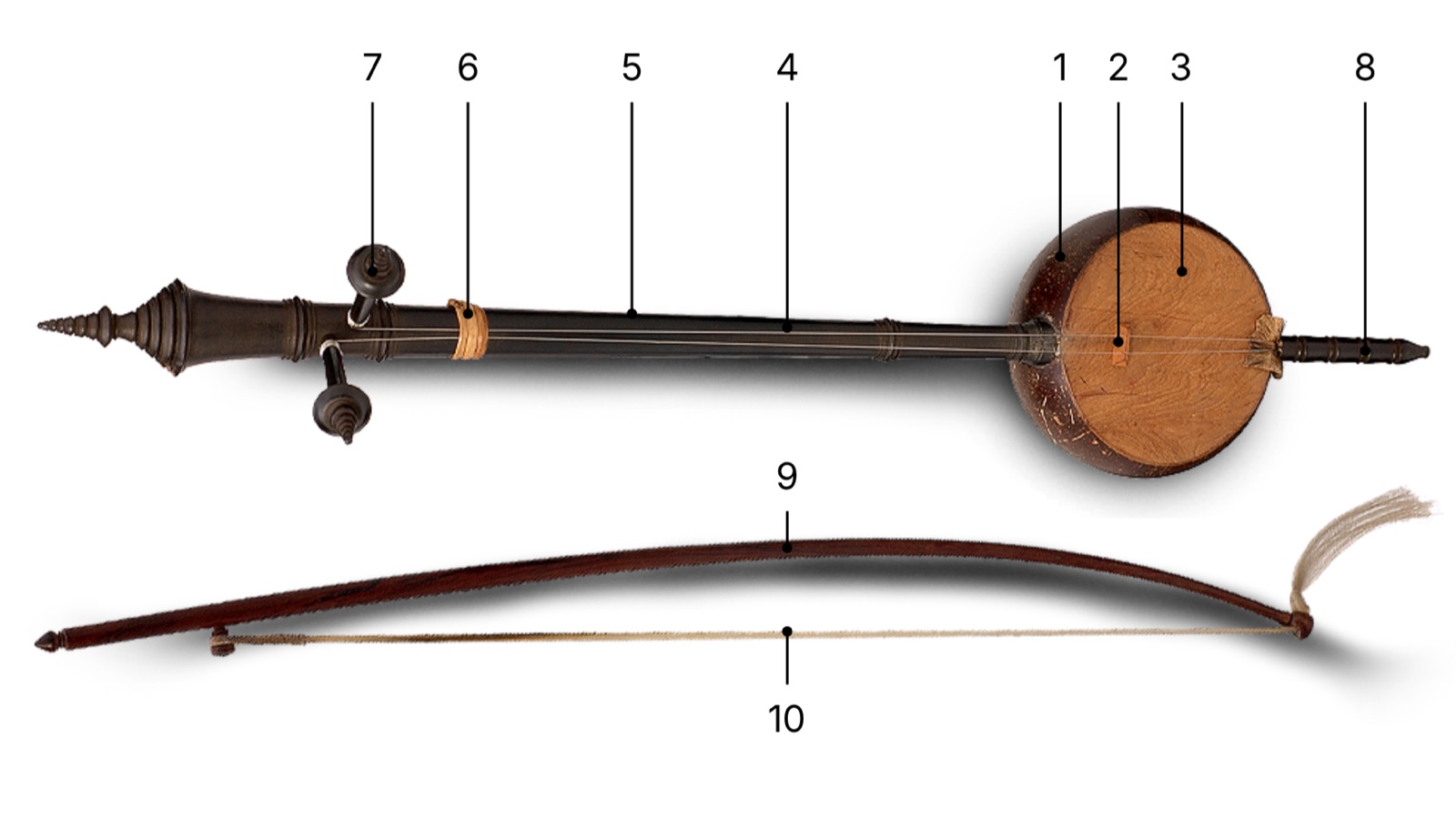
The salo (สลํอฯ, salo) is the bowed instrument of Lanna. The dictionary says it has several other names, such as salo (ซะลํ้อฯ, written ซะล้อ), and tha-lo (ถะล้อ or ธะล้อ). So the word si salo (สีสลอฯ, si salo) means "to play the fiddle, Lanna style".
The body of the salo is made from a coconut shell, which the Khon Mueang call a ka-long (กะโห้฿ลฯง, ka-long), used as the sound box. The research of Buranaphan Chaila (บูรณพันธุ์ ใจหล้า, 2020), which studied instrument makers in Chiang Mai, records that the sa-la (ส่ๆลฯา, sa-la), or craftsmen, like to use rosewood (mai chingchan), which the Khon Mueang call mai ket, for the neck, because it is a hardwood.
According to this study, the steps of making a salo are: making the neck, shaping the body, making the tuning pegs, making the bow, polishing the coconut shell, cutting the sound box, fitting the strings, tying the rattan band around the chest, and finally testing the sound. The wooden bridge that holds up the strings is called yong salo (อยฯอฯงสลํอฯ, yong salo) in the dictionary.
Sueng: the four-string lute
The sueng (ซึงฯ, sueng) is the plucked instrument of Lanna. The dictionary explains that it is "like a guitar, with 2 pairs of strings", making 4 strings in all.
The research of Kanlayani Saisuk (กัลยาณี สายสุข, 2021) explains that the sueng in common use come in 3 sizes: the small sueng (sueng tat), the medium sueng and the large sueng (sueng luang). Its main parts are the sound box, or hong siang, the soundboard, the neck, the frets, the bridge, the tuning pegs, the head and the strings.
The traditional way of making one is to cut a whole block of wood to shape, hollow out the inside as a sound box, and close the front with a wooden board. The favourite woods are teak and jackfruit. The same study also records a new idea from craftsmen in Thoeng District, Chiang Rai, who build sueng from old teak taken from furniture, doors and window panels, to use less wood.
An example of tuning: the craftsman Kachon Thewokhat explains that on a luk sam salo the low string is tuned to do and the high string to sol of the flute.
What does "so" in the ensemble's name mean?
The word so (ซํอฯ, so) in the Lanna language does not mean a bowed instrument. The dictionary explains that it is a verb meaning "to sing Lanna folk songs", also called "so puen mueang" (local so). The singer is the chang so, and singing is called khap so (ขัปฯซํอฯ, khap so).
Under the word pheng so (เพลฯงซํอฯ, pheng so), the dictionary divides so singing into 2 cultural zones, each with a different accompanying ensemble.
Western Lanna, that is Chiang Mai, Lamphun, Lampang and Chiang Rai, sings so with the pi or the pi chum ensemble, in which pipes lead the accompaniment. Together this is called "so Chiang Mai".
Eastern Lanna, that is Nan, Phrae, Phayao and part of Chiang Rai, sings so with the salo and sueng (the people of Nan call the sueng a "pin"). Together this is called "so Nan". Thai PBS's programme Thai Sin (2023), in its episode "The Salo of Nan", introduced Pho Khru Arunsin Duangmun, who carries on the making of the salo and pin and the improvised singing of Nan.
The pi chum ensemble: three pipes accompanying the singers
Pi chum (ปี่ชุม, pi chum) literally means "a set of pipes", because chum means "set". The dictionary explains that the pi chum sam (ปี่ชุมสามฯ, pi chum sam) has 3 pipes:
- Pi kho (ปี่โข้, pi kho): the largest pipe in the set, also called pi mae ("mother pipe").
- Pi kang (ปี่กลฯางฯ, pi kang): the medium pipe.
- Pi koi (ปี่ก้อฯยฯ, pi koi): the small pipe.
Adding a pi tat makes 4 pipes, called pi chum si, and adding a pi nang as well makes 5, called pi chum ha. The salo can also play with the pipe ensemble: the dictionary says the salo is "played with the pipe ensemble in so singing, and used to accompany choi recitation".
Drum bands and pat kong: Lanna percussion music
Besides string ensembles, Lanna has several kinds of percussion band. Butsakon Samrongthong (2009) found that percussion bands have different names in different places, such as phat khong, wong pat and klong teng thing, but the most widespread name is pat kong (พาท์ยฯค้อฯง, pat kong).
| Band / instrument | Lanna script | Meaning (from the dictionary) |
|---|---|---|
| Kong luang | กลฯอฯงหลฯวฯง | a large, long single-headed drum with a narrow waist, popular for loudness contests and for leading processions of offerings |
| Kong aeo | กลฯอฯงแอวฯ | a single-headed drum like the kong luang but smaller, about 1.5–2 metres long |
| Kong ta-lot-pot | กลฯอฯงตห฿ลฯดป฿ดฯ | a small double-headed drum that keeps the rhythm for the large drum |
| Tueng nong | ตึ่งฯโน฿งฯ | procession music, with the kong aeo, ta-lot-pot, gongs, cymbals and pi nae |
| Pi nae | ปี่แน | a horn, like the Mon oboe |
| Kong pu che | กลฯอฯงปู่เจ่ | a single-headed drum played hanging from the shoulder, an instrument of the Tai Yai (Shan) |
The dictionary explains that when the kong aeo is played together with gongs, sawa cymbals and the ta-lot-pot drum, it is called kong tueng nong after the sound it makes, and each area has its own name: Lamphun calls it kong poeng mong, Lampang kong tok seng, and Phrae and Nan kong uet sueng. Read more about the great drum at merit-making festivals in the article Poy Luang.
Music teachers and passing on the tradition
Lanna music is passed on from teacher to pupil. Butsakon Samrongthong (2009) explains that most learning takes place at the teacher's house, where pupils learn not only music but also conduct and morals by following the teacher's example, and that musicians of every lineage hold a wai khru ceremony (ไห้วฯระฯคู, wai khu) to pay respect to their teachers.
The 3 kinds of Lanna music wai khru ceremony, and the lineage of salo and sueng makers
3 kinds of wai khru ceremony (Butsakon Samrongthong, 2009)
- The ceremony of entering discipleship, for beginners
- The wai khru before a performance, to ask permission from and pay respect to the teachers, and to ask for their blessing on the performance
- The annual wai khru, held around mid-April at the New Year
- For chang so singers there is also a special ceremony called baeng khru so ("dividing the so teacher") for those who wish to become professional singers
The lineage of salo and sueng makers in Chiang Mai (Buranaphan Chaila, 2020)
- The tradition of making salo and sueng began with Chao Sunthon na Chiang Mai, who passed it on to Bunrat Thipparat, a woodturner who lived with Chao Sunthon for about 20 years.
- Bunrat passed it on to his pupils, such as Kachon Thewokhat, a salo and sueng maker recognised by Lanna musicians today.
- Over roughly the past 50 years, Lanna instruments have developed in beauty, sound quality, the division into small, medium and large sizes, and the luk sam–luk si tuning system.
Summary
- The salo so sueng ensemble is the Lanna folk ensemble led by the salo and the sueng, with drums, flute and small cymbals.
- The salo is a bowed fiddle with a coconut-shell sound box, and the sueng is a plucked instrument with 4 strings (2 pairs). Both come in 3 sizes.
- The so in the ensemble's name means the folk singing of the chang so, not a central Thai bowed fiddle.
- So Chiang Mai is accompanied by the pi chum pipe ensemble, while so Nan is accompanied by the salo and the sueng (pin).
- Lanna also has percussion bands, such as pat kong, tueng nong and the great drum, passed on from teacher to pupil with wai khru ceremonies.
Look up more Lanna words about music in the Moradok Lanna dictionary (in Thai), and read courting choi verses in the article Kwang Lanna.
Sources
- Moradok Lanna dictionary (in Thai): วงสะล้อซอซึง · สะล้อ · ซึง · เพงซอ · ปี่จุม
- บุษกร สำโรงทอง [Butsakon Samrongthong]. (2009). พิธีกรรมและความเชื่อที่เกี่ยวข้องกับวัฒนธรรมการสืบทอดดนตรีล้านนา [Rituals and beliefs in the culture of passing on Lanna music]. Research report, Thailand Research Fund (TRF). In Thai.
- บูรณพันธุ์ ใจหล้า [Buranaphan Chaila]. (2020). ภูมิปัญญาการสร้างเครื่องดนตรีล้านนาเพื่อสืบทอดการสร้างเครื่องดนตรีพื้นบ้านและเสริมสร้างความเข้มแข็งทางวัฒนธรรม [The wisdom of Lanna instrument making, to pass on folk instrument making and strengthen culture]. Chiang Mai Rajabhat Research Journal 21(1). In Thai.
- กัลยาณี สายสุข [Kanlayani Saisuk]. (2021). การสร้างซึงจากไม้เก่าสู่การพัฒนาคุณภาพเครื่องดนตรีล้านนา [Building sueng from old wood to improve the quality of Lanna instruments]. Humanities and Social Science Review Journal 23(1). In Thai.
- Thai PBS. (2023, 27 December). ไทยศิลป์ ตอน สะล้อเมืองน่าน [Thai Sin: The Salo of Nan]. In Thai.
Look up "วงสะล้อซอซึง" in the Moradok Lanna dictionary (in Thai)


