

Photo: KOSIN SUKHUM / Wikimedia Commons (CC BY-SA 4.0)
King Kue Na: Phra Sumana, Wat Suan Dok and Doi Suthep
Phaya Kue Na (King Kue Na) was the sixth king of the Mangrai dynasty. He invited Phra Sumana Thera from Sukhothai to spread Sri Lankan-lineage Buddhism in Chiang Mai, built Wat Suan Dok as his residence, and, according to legend, sent a royal elephant to carry a relic of the Buddha up Doi Suthep, the shrine Chiang Mai people still come to pay respects to today.
Who was King Kue Na?
The word phaya (พญา, Kham Mueang reading pha-ya) is explained in the Moradok Lanna dictionary as an old word meaning "lord of the land, sovereign, king", as in Phaya Mangrai and Phaya Lithai. This is why the names of Lanna kings of the Mangrai dynasty so often begin with it.
Thai Wikipedia, citing the work of Sarassawadee Ongsakul (สรัสวดี อ๋องสกุล, 2014), says King Kue Na was the eldest son of Phaya Pha Yu and Queen Chittra Thewi. He ruled Chiang Saen before taking the throne of Chiang Mai, and was succeeded by his son, Phaya Saen Mueang Ma. The inscription of Wat Phra Yuen calls him "Chao Thao Song Saen Na, the Dhamma king" (thammikarat), a king who ruled by the Dhamma.
Inviting Phra Sumana from Sukhothai
The story of the invitation is told in detail in the Mulasasana Chronicle (Tamnan Mulasatsana) of Wat Suan Dok, a palm-leaf work composed by the monks of Wat Suan Dok between 1456 and 1510. An analysis by Sirisak Aphisakmontri and Thanikan Worathammanon (ศิริศักดิ์ อภิศักดิ์มนตรี และธณิกานต์ วรธรรมานนท์, 2017) concludes that he was invited twice.
King Kue Na sent envoys to invite Phra Sumana in Sukhothai directly, but he declined and sent Phra Satthatissa in his place.
King Kue Na first sent envoys to King Maha Thammaracha Lithai of Sukhothai with tribute. The Sukhothai king was pleased, and this time Phra Sumana accepted.
According to the chronicle, Phra Sumana brought the Tipitaka and relics of the Buddha, which he had dug up at Mueang Pang Cha, to present to King Kue Na.
Phra Sumana belonged to the old Sri Lankan lineage (Lankawong kao), also called the Ramanna (Mon) lineage, which he had studied at the school of the Mahasami Udumbara in Mueang Phan (near Martaban) before settling in Sukhothai. Research by Phra Maha Chirasak Chiratthammo (2014), cited in the article above, counts Phra Sumana's arrival in 1369 as the second era of Buddhism in Lanna, after the era of Queen Chamadevi.
Wat Suan Dok, or Wat Bupparam
King Kue Na built a temple for Phra Sumana to reside in. Its formal name is Wat Bupparam, from the Pali word buppha (บุบผฯฯา, Kham Mueang reading bup-pha), meaning "flower", which matches the name people commonly use, Wat Suan Dok, "the flower-garden temple". The Mulasasana Chronicle records that Phra Sumana was its first abbot, from 1369 to 1393.
Monks descended from this temple are called hon suan dok (ห฿นฯสวฯรดอฯก, Kham Mueang reading hon suan dok) in Lanna. The dictionary explains the term as "the monks of the Wat Suan Dok school … or those who follow the teaching of the Lankawong, or Sinhalese, school, the old sect". Later, in 1430, another school arose, the hon pa daeng (ห฿นฯป่าแดงฯ, hon pa daeng), the new Sri Lankan lineage that Phra Maha Thammakhamphi brought from Sri Lanka (Phra Maha Chirasak, 2014, cited in Sirisak and Thanikan, 2017).
The first relic and the town of Tak
The Mulasasana Chronicle tells an interesting story. When King Kue Na had built a chedi (เจดียฯ ฿ฯ, Kham Mueang reading che-di) ready to enshrine the relic, Phra Sumana refused to enshrine it. His reason was that his relatives in Sukhothai used to come and pay homage to this relic, and once it was enshrined in Chiang Mai it would be hard for them to come.
ดังเมืองตากก็อยู่ท่ามกลาง ๒ อันนี้แล ข้าจักเอาเมืองนั้นบูชาศีลาธิคุณแห่งเจ้ากูแล — King Kue Na, in the Mulasasana Chronicle (cited in Sirisak and Thanikan, 2017)
(In English: "The town of Tak lies between these two [realms]; I shall give that town in homage to the virtue of my lord.")
So King Kue Na gave Tak, the town between the two realms, to Phra Sumana's nephew Thit Sai to govern, and Phra Sumana agreed to enshrine the relic in the chedi of Wat Suan Dok. The researchers see this story as reflecting the politics between Lanna and Sukhothai, with religion serving as a bridge of friendship.
The elephant of fortune and the relic of Doi Suthep
The story Chiang Mai people know best about King Kue Na is the legend of the white elephant sent out to choose a site. Professor Emeritus Surapol Damrikul (สุรพล ดำริห์กุล, 2014) summarises it from the Yonok Chronicle as follows.
According to the legend, Phra Sumana brought two relics that he had found in an abandoned chedi at Mueang Pang Cha. King Kue Na had one enshrined at Wat Suan Dok. The other was placed on the back of the royal elephant, and the king made a solemn wish and let the elephant go. The elephant climbed the mountain and knelt down on a certain peak. When the relic was taken down from its back, the elephant died, and King Kue Na had a chedi built there to enshrine the relic. The Yonok Chronicle gives the year of its founding as 1386.
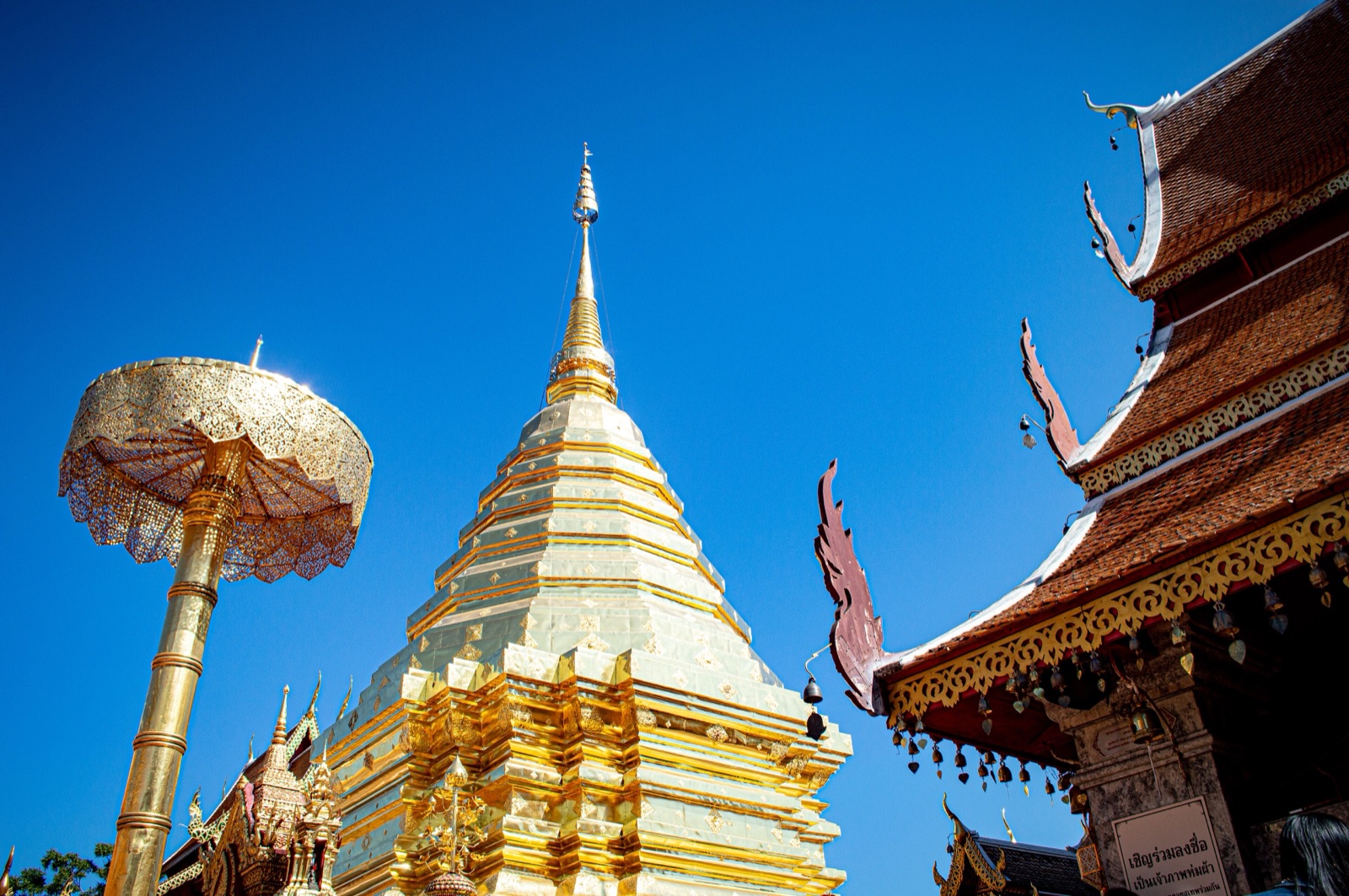
A scholar's view: why the relic is not on the highest peak
Surapol Damrikul (2014) studied the San Ku ruins on the summit of Doi Pui, higher than the site of the Doi Suthep relic. He found terracotta votive tablets that he dates as far back as the Hariphunchai period, and so suggests that San Ku may have been the mountain's original sacred site, linked to the hermit Wasuthep in the beliefs of the Lua people. He interprets the relic procession as possibly intended for San Ku, but when the elephant stopped and died before reaching it, this was taken as a sign to build the relic chedi at that spot instead. After that, San Ku lost its importance until it was forgotten.
The Doi Suthep relic in Lanna life today
More than 600 years after King Kue Na's reign, the Doi Suthep relic is still the spiritual centre of Chiang Mai, in both belief and tradition.
Under the belief in the birth-year relic (that pi koet, ธาฯตฯปีเกิดฯ) recorded in the dictionary, the great relic of Doi Suthep is the relic of people born in the Year of the Goat. Lanna people believe that before birth the soul rests at the relic of its birth year, and returns there after death. Going to wai sa (ไห้วฯสา, wai sa), to pay respects to, the relic of one's birth year is therefore considered auspicious.
| From King Kue Na's reign | Today |
|---|---|
| Wat Suan Dok (Bupparam) | a royal temple; the dictionary records it as the site of one of the stupas of Khruba Siwichai's relics |
| The Doi Suthep relic chedi | the birth-year relic for the Year of the Goat, and the goal of the tiao khuen doi walk |
| The elephant's path up the mountain | an old walking route, separate from the road built in 1934 |
Research by Phra Anuwat Anuwattano (พระอนุวัฒน์ อนุวตฺตโน, 2022) explains that the walk up Doi Suthep, tiao khuen doi, is held every year on the night before Visakha Bucha and has been handed down since King Kue Na's time. Walkers carry flowers, incense and candles in procession. The road that cars use today was begun in 1934 by Khruba Siwichai (ระฯคูบาฯระฯสีวิไชยฯ, Kham Mueang reading khru-ba si-wi-chai) and the faithful, separate from the old elephant path. Along the way, tu chao (ทุเจั้า, tu chao), monks, chant as they lead the procession.
Summary
- King Kue Na, the sixth king of the Mangrai dynasty, ruled Chiang Mai from about 1355/1356 to 1385/1386 (sources disagree).
- He invited Phra Sumana Thera from Sukhothai through King Maha Thammaracha Lithai, bringing the old Sri Lankan lineage of Buddhism to Lanna in 1369.
- He built Wat Suan Dok (Bupparam), the origin of the "hon suan dok" school, and according to the Mulasasana Chronicle gave away the town of Tak so that Phra Sumana would enshrine the relic.
- According to legend, he sent an elephant to carry a relic up Doi Suthep, still the birth-year relic for the Year of the Goat and the goal of the tiao khuen doi walk today.
Look up more Lanna words about temples and monks in the Moradok Lanna dictionary (in Thai), and read about the city's guardian spirits on the same mountain in the article Pu Sae Ya Sae.
Read next: Lanna's revered monks, short lives of ten elders and khruba Lanna people honour, beginning with Phra Sumana, who founded the hon suan dok school.
Sources
- Moradok Lanna dictionary (in Thai): พญา · หนสวนดอก · เจดีย์ · ธาตุปีเกิด
- ศิริศักดิ์ อภิศักดิ์มนตรี และธณิกานต์ วรธรรมานนท์ [Sirisak Aphisakmontri and Thanikan Worathammanon]. (2017). วิเคราะห์ตำนานมูลศาสนา ฉบับวัดสวนดอก [An analysis of the Mulasasana Chronicle, Wat Suan Dok version]. Journal of Fine Arts 8(1). In Thai.
- สุรพล ดำริห์กุล [Surapol Damrikul]. (2014). โบราณสถานสันกู่ ดอยปุย: พื้นที่ศักดิ์สิทธิ์ของพระฤาษีวาสุเทพ? [The San Ku ruins on Doi Pui: a sacred site of the hermit Wasuthep?]. Journal of Fine Arts 5(1). In Thai (citing the Yonok Chronicle).
- พระอนุวัฒน์ อนุวตฺตโน (บังเมฆ) [Phra Anuwat Anuwattano (Bangmek)]. (2022). วิเคราะห์ประเพณีสรงน้ำพระธาตุ: ศึกษาเฉพาะกรณีเตียวขึ้นดอยสุเทพ จังหวัดเชียงใหม่ [An analysis of the relic-bathing tradition: the case of the walk up Doi Suthep, Chiang Mai]. Panya Journal 29(3). In Thai.
- พญากือนา (King Kue Na). Thai Wikipedia (years of reign, parents and the Wat Phra Yuen inscription, citing Sarassawadee Ongsakul 2014). In Thai.
Look up "หนสวนดอก" in the Moradok Lanna dictionary (in Thai)


