

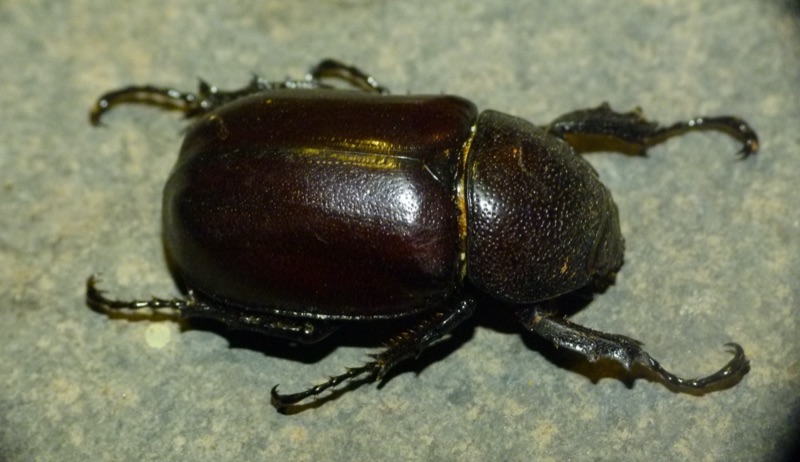
Photo: Basile Morin / Wikimedia Commons (CC BY-SA 4.0)
Kwang: Lanna Names for Rhinoceros Beetles
Kwang (ก่วฯางฯ, kwang) in the Lanna language is the rhinoceros beetle, a hard-winged beetle whose males have horns. They come out in the rainy season, around August–October. People in Lanna have given beetles very detailed names, by size, by the shape of their horns and by their role. This article gathers the Kham Mueang (Northern Thai) names for beetles from the Moradok Lanna dictionary, with the Lanna (Tai Tham) script for each word.
The names of each kind of kwang
| Name | Lanna script | Meaning (from the dictionary) |
|---|---|---|
| kwang song | ก่วฯางฯโซ้฿งฯ | a large male beetle with long horns, popular for fighting |
| kwang saem | ก่วฯางฯแซมฯ | a medium-sized male beetle, with horns longer than a kwang ki's but shorter than a kwang song's |
| kwang ki | ก่วฯางฯกิ | a male beetle with shorter horns than usual; some have only a small forked knob showing |
| kwang ka-thing | ก่วฯางฯระฯกทิงฯ | a beetle with 3 horns, 1 below and 2 above, with pointed tips that do not fork |
| kwang kim | ก่วฯางฯคีมฯ | a beetle with two horns of equal length sticking out from the head like pincers |
| kwang sang | ก่วฯางฯซางฯ | a large, light-brown kind of beetle; the males have 3 or 5 horns |
| kwang mae ut | ก่วฯางฯแม่อู้ด | the female beetle, which has no horns (also called kwang i lum) |
How do kwang song, kwang saem and kwang ki differ?
All three are male beetles. They differ in body size and horn length. Click each tab to see.
ก่วฯางฯโซ้฿งฯ — a large male beetle with long horns, popular for fighting: the real fighting beetle.
ก่วฯางฯแซมฯ — a medium-sized male beetle, with horns longer than a kwang ki's but shorter than a kwang song's. It is used as a kwang som (sparring beetle) or kwang lo (decoy beetle) to train a kwang song's skills.
ก่วฯางฯกิ — a male beetle with shorter horns than usual, the lower horn longer than the upper. There are several kinds, such as ki chang, ki khong, ki fai and ki mong.
The largest, with the longest horns, is the kwang song, which the dictionary explains like this:
The female beetle: kwang mae ut or kwang i lum
According to the dictionary, only the males have horns. The female beetle has none, and people in Lanna call her kwang mae ut (ก่วฯางฯแม่อู้ด) or kwang i lum (ก่วฯางฯอี่หุ้ลฯม).
A courting chant of the young men
Choi (ช้อฯยฯ) is the chanting of verses in the style of so or khrao poetry by young men who go out at night to aeo (แอ่วฯ, to go visiting) the young women. The dictionary quotes a choi about beetles under the word กว่าง. Its first lines are:
…กว่างแซมกว่างโซ้ง เขายาวนักหนา กว่างแม่นั้นจา จื้อว่าอี่หลุ้ม มันบ่มีเขา…
("…Kwang saem and kwang song, their horns so very long; the mother beetle, they say, is called i lum, and she has no horns…")
These lines run through the beetle names just like the table above: kwang saem, kwang song, and the mother beetle (i lum) with no horns.
Read the full chant from the dictionary
…กว่างแซมกว่างโซ้ง เขายาวนักหนา กว่างแม่นั้นจา จื้อว่าอี่หลุ้ม มันบ่มีเขา ตั๋วมนตะหลุ้ม เป๋นตี้ฮักหุมกว่างปู๊ กว่างกิ๋เขาสั้น นั้นไผก็ฮู้ ไจ๊เป๋น กว่างตั้งอย่างเดียว อี่นายอี่น้อง ลูกของป้อเสี่ยว อ้ายมาคนเดียว ฟั่งหลั๋บเน่อเจ้า…ฟั่งหลั๋บเน่อเจ้า…
In English: "…Kwang saem and kwang song, their horns so very long; the mother beetle, they say, is called i lum, and she has no horns, her body round and plump, loved by all the males. Kwang ki have short horns, as everyone knows, and are only used as kwang tang. Oh my dear, my darling, daughter of my father's friend, I have come alone, don't fall asleep yet, my dear… don't fall asleep yet, my dear…"
Source: the Moradok Lanna dictionary, under the word kwang.
Summary
- Kwang (ก่วฯางฯ) is the rhinoceros beetle, a hard-winged beetle; only the males have horns.
- The males are named by size and horns: kwang song (large, long horns) · kwang saem (medium) · kwang ki (short horns).
- The female has no horns: kwang mae ut or kwang i lum.
- Other names by horn shape: kwang ka-thing · kwang kim · kwang sang.
Look up the names of other kinds of beetle in the Moradok Lanna dictionary (in Thai), or read on about Lanna words for the market in the article Going to the kad like a Khon Mueang.


