
Photo: YashiWong / Wikimedia Commons (CC BY-SA 3.0)
Bai Tong: Wrapping, Lining and Krathong in Kham Mueang
Bai tong (ไบตอฯง, Kham Mueang reading bai tong) is the banana leaf of central Thai, and one of the most used leaves in northern life. It wraps rice, wraps sweets, lines trays and makes krathong. One leaf does so much that the dictionary needs a whole paragraph to describe it.
This post is part of our series Kham Mueang Word of the Week, where we take one Lanna word and tell the story behind it. Every word comes from the Moradok Lanna dictionary. It is a word for the end of the year, close to Yi Peng and Loy Krathong.
What does bai tong mean?
The dictionary says bai tong is "the leaf of the banana tree", called bai tong or tong kuai (ตอฯงก้ลฯวฯ, read tong kuai) by the Lanna people. The banana itself is kuai (ก้ลฯวฯยฯ, read kuai) in Kham Mueang, because Kham Mueang has no consonant clusters. The single blade of the banana plant is what is called bai tong.
It is so useful because of what the leaf is like. The dictionary describes it as "large, flexible and waterproof; the leaf is soft, tough, not brittle and easy to tear, of a good thickness, and can be used for decoration".
Ho: wrapping food in bai tong
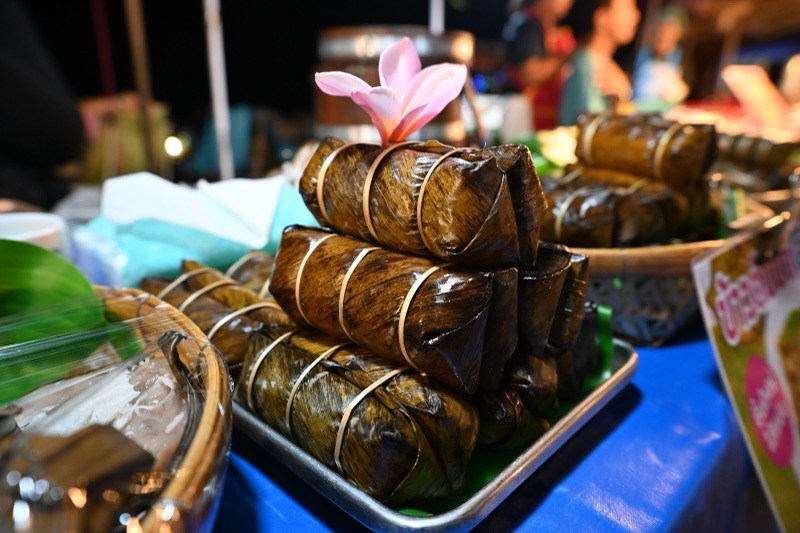
The dictionary says "banana leaf is used widely to wrap food and as a food container". The verb ho (หํอฯ, read ho) means "to wrap or cover things", and the same word names things wrapped in leaves or paper.
Kham Mueang has separate names for leaf parcels according to how they are cooked.
| Kham Mueang | Lanna script | Meaning (per the dictionary) |
|---|---|---|
| ho nueng | หํอฯหึ้นฯง | steamed parcel: plants or meat mixed with seasoning, wrapped in banana leaf and steamed until cooked |
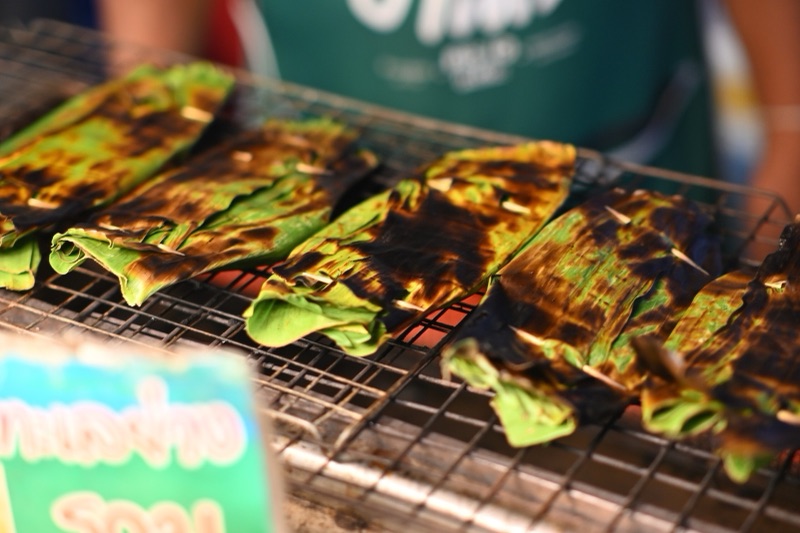
| ho aep | หํอฯแอัปฯ | fish, shrimp or something else mixed with chilli paste, wrapped in banana leaf and grilled over a fire |
| ho chok | หํอฯจัอฯก | a small parcel wrapped in banana leaf or paper, tied in a bunch |
| jin som mok | ชิ้นฯส้฿มฯห฿มฯก | sour sausage wrapped in banana leaf and buried in hot ashes until cooked |
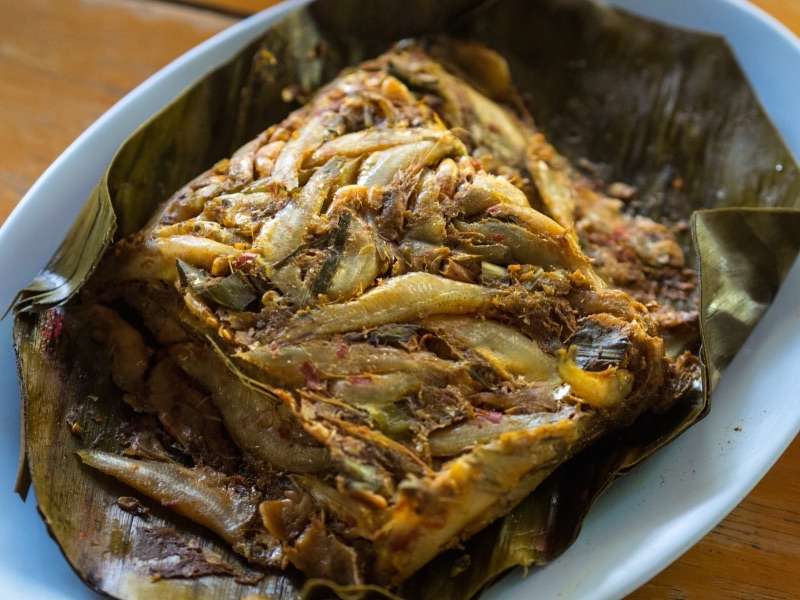
Another charming word is mok (ห฿มฯก, read mok), meaning to bury something in a hot place to cook, as in mok kuai (ห฿มฯกก้ลฯวฯย, read mok kuai), bananas buried in hot ashes until ripe.
The bamboo strips that tie the parcels have a word too. The dictionary gives chak tok (จักฯตอฯก, read chak tok) as splitting bamboo into thin flat strips for tying things.
Rong: bai tong as a base and lining
Bai tong is not only for wrapping. The dictionary says it is used "to make leaf cups for sweets, trays and bai si offerings", and for decoration, and as "a symbol in Hindu and Buddhist rites".
In big merit-making, banana leaf has a job too. A document from the Payap University Library says the kuay salak (กวฯยฯสๆลฯากฯ, read kuai salak), the salak basket, is lined with banana leaf or coloured paper before the gifts go in. Read on in Tan Kuay Salak.
Another word where the banana leaf is plain to see is sa-tuang (สทวฯง, read sa-tuang). The dictionary explains it as "krathong: a tray for offerings, about 10 to 50 cm, made with banana trunk sheath as a square frame, bamboo sticks laid across underneath, and the floor lined with banana leaf, for laying out the offerings".
Krathong: banana leaf on Yi Peng night
The dictionary uses the word krathong both for the leaf cup that holds sweets and for the sa-tuang offering tray. Loy krathong (ลอฯยฯ, read loi krathong) is described as "the name of the tradition in which a krathong with incense and candles is lit and floated on water, held on the full-moon night of the 12th month or Yi Peng, also called pa-wen-ni yi peng".
In the dictionary, Yi Peng (ยี่เพงฯ, read yi peng) is "the 2nd northern month, 15th waxing day", which is the central Thai 12th month (full moon). In 2026 the 15th waxing day of the 2nd month falls on Tuesday 24 November 2026 (see the day in the Lanna calendar).
Yi Peng also has the pa-tu pa (ปตูป่า, read pa-tu pa), a gateway decorated with branches, leaves, banana plants and sugarcane, "often made for festivals such as Loy Krathong". So the banana plant comes to Yi Peng as both leaf and trunk. For more words of the festival, read Yi Peng words.
Related words
- bai tong / tong kuai: banana leaf. Bai tong tueng is the phluang leaf, a different thing.
- ho: to wrap, and things wrapped in leaves, such as ho nueng, ho aep, ho chok.
- mok: to cook by burying in hot ashes, as in mok kuai and jin som mok.
- sa-tuang: offering tray with a banana-leaf floor.
- loy krathong / yi peng: the festival of the full moon of the 2nd northern month, where banana leaf is the main material of the krathong.
Summary
- Bai tong (tong kuai) is the banana leaf: large, flexible, waterproof, soft but tough, easy to tear.
- It is used to wrap food and sweets (ho nueng, ho aep, ho chok, jin som mok), to line trays and baskets, and to make krathong (sa-tuang, loy krathong).
- Bai tong tueng is the phluang leaf, not a banana leaf.
- In 2026 Yi Peng and Loy Krathong fall on Tuesday 24 November.
- A krathong of banana leaf still has to be picked up after floating.
Look up the full meaning of ใบต๋อง in the Moradok Lanna dictionary (in Thai), and read about the offerings in Temple Offerings in Lanna.
Sources
- Moradok Lanna dictionary (in Thai): ใบต๋อง · ต๋องก้วย · ห่อหนึ้ง · ห่อแอ็๋บ · สะตวง · ลอยกระทง
- Payap University Library, Northern Information Centre. Tan kuay salak (on baskets lined with banana leaf). In Thai.
- Thai Rath Online. (November 2023). Dr. Jessada insists: banana-leaf, bread and fish-food krathong can all harm the environment. In Thai.
- Moradok Lanna calendar (2026 date)
Practise the words from this article
Flip through 22 flashcards of the Lanna words used in this article.


