
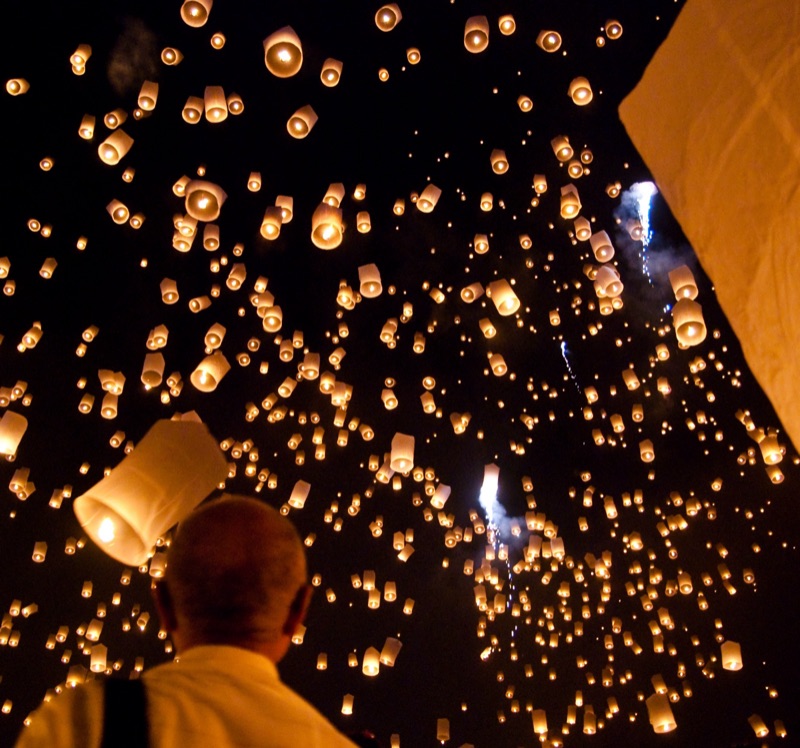
Photo: Donavanik / Wikimedia Commons (CC BY-SA 4.0)
Tan Tot: Lanna Giving in Secret at Night
Tan tot (ทาฯนฯทอฯด, Kham Mueang reading tan tot) is the Lanna way of "giving by laying down", and one of the most charming kinds of merit-making in Northern Thailand. The givers slip their gifts into place at night, then hide, so the person receiving never knows who gave them. This one word holds the heart of giving without expecting thanks.
This post opens our series Kham Mueang Word of the Week, where we take one Lanna word and tell the story behind it. Every word comes from the Moradok Lanna dictionary.
What does tan tot mean?
The word has two parts. Tan (ทาฯนฯ, read tan) is glossed in the dictionary as "helping, giving, donating", the same as central Thai than. Tot matches central Thai thot, "to lay down, to offer", as in tot kathin (ทอฯดกฐิร, read tot ka-thin), the robe offering at the end of the rains retreat.
The dictionary describes tan tot as "an offering much like the forest-robe offering (thot pha pa)", with one difference: tan tot is meant for one particular monk, made at night, and kept secret. In central Thai it is called than thot.
Tan tot for a monk: how it was done
As the dictionary tells it, villagers prepare the gifts just as for a forest-robe offering, then wait until the monk has gone to sleep. Quietly they set everything in front of his living quarters. Everyone then goes off to sum muet (ซุ่มมืดฯ, read sum muet), "hide in the dark", and someone lights a firecracker so that the monk wakes with a start and comes out to look.
The monk walks up to the gifts, looks around and sees nobody, so he asks, loud enough to be heard: "Whose is this? Where does it come from? Is it from people or from a phi, a spirit (ผี)? Is it proper for a monk to use? If not, please carry it all back again." He goes back inside, and after a while comes out once more. When the gifts are still there, he gives thanks, takes the robe and gives a blessing, and the ceremony is over.
Tan tot in the community: sharing with elders in need
In some communities tan tot is not only for monks. A study by Pawina Ngamprapasom (2014) at Ban Pong Ho San, Mae Tha district, Lampang, describes villagers pooling food, goods and money for elders who are struggling, with no children to look after them. Kham Mueang calls this hardship tuk (ทุก์ขฯ, read tuk). It is done at night in the month of Yi Peng (ยี่เพงฯ, read yi peng), around November.
The givers walk up in silence, set off a firecracker to announce themselves, put the gifts at the top of the house stairs, then step back into a dark corner. The elder opens the door and calls out to ask whether the gifts come from spirits or from people, saying that this house is not a huean yen (เริอฯรเอยฯันฯ, read huean yen), a house where someone has recently died. Then the elder will hue pon (หื้พอฯร, read hue pon), "give a blessing", and the people hiding in the bushes call out sa-tu (สาทุ, read sa-tu, "sadhu") all together.
A study by Sunthon Khlai-am (2015) in Dok Kham Tai, Phayao, describes tan tot in the same spirit: "placing gifts" that shows villagers' care for people in hardship.
Tan tot vs tan kuai salak and poy luang
Lanna has many kinds of tan (giving), each with a different receiver and a different way of giving.
| Kind of giving | Given to | How |
|---|---|---|
| Tan tot | one monk, or an elder in need | at night, left in secret, giver unnamed |
| Tan kuai salak (ทาฯนฯกวฯยฯสๆลฯากฯ) | monks, by drawing lots | by day, with the giver's name and dedication written on the slip (read more) |
| Poy luang (พอฯยฯหลฯวฯง) | the temple, to celebrate a new building | a big festival of several days with offering processions (read more) |
Summary
- Tan tot (ทาฯนฯทอฯด) is Lanna "giving by laying down": done at night and kept secret
- As the dictionary tells it: gifts are set in front of a monk's quarters, a firecracker goes off, the givers hide, and the monk asks "whose is this, where does it come from?" before accepting and blessing
- Some communities, for example in Lampang and Phayao, do tan tot to share with struggling elders in the Yi Peng month
- Unlike tan kuai salak and poy luang, which happen by day and name the givers
Read the full entry at ตานต้อด in the Moradok Lanna dictionary, or read about another kind of Lanna giving in Tan Kuay Salak.
Sources
- Moradok Lanna dictionary: ตานต้อด · ตาน · ตานจูด · เฮือนเย็น · หื้อปอน
- Pawina Ngamprapasom. (2014). แนวทางการฟื้นฟูประเพณีตานตอด [Guidelines for reviving the Tan Tod tradition]. Srinakharinwirot Research and Development Journal (Humanities and Social Sciences) 6(11)
- Sunthon Khlai-am. (2015). การจัดการความรู้ในการดำเนินการประเพณีตานต๊อด ตำบลดอกคำใต้ อำเภอดอกคำใต้ จังหวัดพะเยา [Knowledge management in the Tan Tod tradition, Dok Kham Tai, Phayao]. Mekong-Salween Civilization Studies Journal 6(2)


