
Photo: Chainwit. / Wikimedia Commons (CC BY-SA 4.0)
What Is Tua Mueang? The Lanna Script Explained
Tua Mueang (ต฿วฯเมิอฯง, Kham Mueang reading tua mueang) is the Lanna Dhamma script: the letters people in Lanna used for centuries to inscribe scriptures, write manuals, compose poetry and record the history of their towns. You can still see it all over Northern Thailand today, from temple signs to street signs. This is the first lesson of our course Learn the Lanna Script from Zero. It explains what Tua Mueang is, what it is called, where it came from, and why it is well worth learning to read.
What is Tua Mueang?
The Moradok Lanna dictionary describes Tua Mueang as the script used in the Lanna kingdom since ancient times. It served religious purposes, such as palm-leaf scriptures and folded mulberry-paper books kept in temples, and secular ones, such as literature, astrology and medical texts.
Lanna has its own words for the parts of writing. The dictionary explains that pian ja-na (พยัญชฯน, read pian ja-na) means consonants, and each consonant is called a tua, "letter": tua ka (ก, read tua ka) is the letter k. Vowels are called mai (ไม้, read mai), as in mai ka and mai ka (the short and long a). Consonants and vowels together are called akson or akkhara, "letters".
The system works much like the Thai script: a consonant is the core, and vowels and tone marks sit around it, before, after, above and below. The big difference is that Tua Mueang likes to stack letters: a final or following consonant is often written hanging below the line, so a whole word looks like a single cluster. Stacked letters get their own lessons at the intermediate level.
One script, many names: Tua Mueang, Dhamma script, Tai Tham
The same script goes by several names, depending on who is speaking and where.
| Name | Who uses it | Meaning |
|---|---|---|
| Tua Mueang | Northern Thai people in everyday speech | "the letters of the mueang", the script of the Lanna people |
| Lanna Dhamma script (อักษรธรรมล้านนา) | Thai textbooks and scholars | the script used to write the tham, the scriptures |
| Tai Tham | international scholarship and Unicode | the umbrella name for the whole family of scripts |
In Kham Mueang, tham (ธัม์มฯ, read tham) means a scripture inscribed on palm leaves, and the dictionary says a monk giving a sermon by reading from a palm-leaf text is said to wa tham. The name "Dhamma script" simply tells you what the letters were for. Northern Thai people call themselves khon mueang (ฅ฿นฯล้านฯนาฯ, read khon mueang) and their language kam mueang (คำฯเมิอฯง, read kam mueang), so their letters are naturally the tua mueang.
Where you can see Tua Mueang
You don't need a library to see Tua Mueang. Just walk into a wat (วัดฯ, read wat), a temple, anywhere in the North.
- Signs (pai, ป้ายฯ) in front of temples, shrines and government offices. Many give the name three ways, in Thai, Tua Mueang and English, like the Wat Klang Wiang sign in Chiang Rai at the top of this page.
- Palm leaves (bai lan, ไบลานฯ): scriptures inscribed (jan, จารฯ) with a stylus (lek jan, เหัลฯกจารฯ) and kept in the scripture library (ho tham, หํอฯธัม์มฯ).
- Pap sa (พัปฯสา, read pap sa): folded books of mulberry paper, used for manuals and scriptures (read more in Pap Sa and Palm Leaves).
- In ceremonies such as tet tham mueang (เทส์นฯธัม์มฯเมิอฯง, read tet tham mueang), the Lanna-style sermon read from a palm-leaf text in Lanna script. Today some temples print the text in Thai letters on paper instead; the dictionary calls this "an imitation leaf in place of a real one".
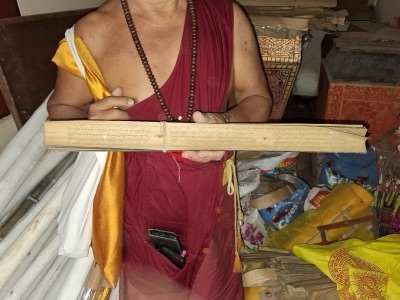
Photo: Lannafolium / Wikimedia Commons (CC0)
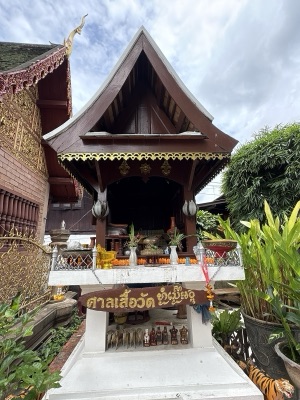
Photo: Chainwit. / Wikimedia Commons (CC BY 4.0)
A short history of Tua Mueang
Scholars are still working out the details of this script's history. The points below summarise the English Wikipedia article "Tai Tham script", which cites research on Lanna scripts and literature; the history lesson later in this course goes deeper, with academic sources.
- Its letter shapes closely resemble the Mon script used in the Haripunchai kingdom (Lamphun) around the 13th century CE.
- The oldest known document using it is dated 1376 CE and was found in Sukhothai: a single line of Pali written in this script.
- By the 15th century at the latest, the script had been adapted to write the local language, most probably first in Chiang Mai, and it was promoted as a tool for unifying Lanna (ล้านฯนาฯ, read lan na) under King Tilokarat.
- From Lanna it spread to Laos, Isan, the Shan State and Sipsong Panna.
- In the 20th century, as schooling switched to the Thai script, Tua Mueang stopped being the main script of the North.
Lanna never had just one script. The dictionary also records fak kham (ฝักฯขามฯ, read fak kham), an old Sukhothai script with square letters "like tamarind pods", used on stone inscriptions, and the khom script (ขอฯม, read khom) of the ancient Khmer. There were two sets of numerals as well: lek nai tham (เลขฯในธัม์มฯ(๐๑๒๓๔๕๖๗๘๙), read lek nai tham), used in scriptures, and lek man (เลขฯม่านฯ(0123456789), read lek man), also called astrologers' numerals, borrowed from Burmese and used in medical and astrological texts.
There are ongoing efforts to revive it. In 2011, for example, the Chiang Mai Primary Educational Service Area Office 1 launched a project called "U Kham Mueang Lueang Lue Akson" with a three-level Lanna language curriculum, from primary to upper secondary school, aiming to have pupils read and write Tua Mueang (MGR Online).
Sister scripts: Tai Khün, Tai Lue and Lao Tham
Several Tai peoples outside Thailand's eight northern provinces use scripts from the same family, each with some letter shapes and spellings of its own.
- Tai Yuan (ไทยวฯร, read tai yuan): the Northern Thai people of the eight provinces, owners of Tua Mueang.
- Khoen (เขินฯ, read khoen): the dictionary says this is the name for the Tai people of Jiang Tung (ชยฯงตุง, read jiang tung, Kengtung), the Tai Khoen or Tai Khün, named after the Khuen River that runs past the city.
- Jao Tai Lue (ชาวฯไทลื้, read jao tai lue): the Tai Lue people of Sipsong Panna, who, the dictionary notes, have both a spoken and a written language of their own.
- Lao (ลาวฯ, read lao): in Laos and Isan there is a Lao form of the Dhamma script, known as Lao Tham, used for temple scriptures.
Because they are one family, Unicode puts them all in a single block called Tai Tham (U+1A20–U+1AAF), with 127 characters, added in Unicode 5.2 in 2009 following a proposal by Michael Everson and colleagues. Once you can read Tua Mueang, these sister scripts become much easier.
Why learn to read Tua Mueang?
In the past, the temple was the school. The dictionary tells the story under the word khayom (ขโย฿มฯ, read kha-yom), a temple boy: after finishing primary school, parents often took their son to the temple to become a monk's pupil, and the first thing he had to learn was Tua Mueang, until he could read and write it, so he could chant and read palm-leaf scriptures. A man who had been ordained as a monk and then left the monkhood was given the title nan (หนฯานฯ, read nan).
Today, being able to read (an, อ่านฯ) and write (khian, ขยฯร) Tua Mueang brings both knowledge and joy.
- Read the signs around you. Many temple, street and government signs in the North carry Tua Mueang.
- Open the heritage in the palm leaves. Poems, chronicles, medical manuals and teachings still wait in temple libraries all over Lanna (read about Khao, Lanna chain-rhyme verse).
- Understand Kham Mueang more deeply. Spelling in Tua Mueang shows where words come from: some Kham Mueang words pronounced with h, for example, are spelled with r.
- Get the most from the dictionary. Every word in the Moradok Lanna dictionary is shown in Lanna script, and the better you read, the more fun it is to explore.
- Pass it on. A script lives only as long as people still read it.
Try typing a word you like below and see how it is written in Tua Mueang. Words not yet in the dictionary show no letters, because we only use spellings that have been checked.
Learning with Moradok Lanna: how this course works
The Moradok Lanna Tua Mueang course has 42 lessons, from consonants, vowels, tones and final consonants all the way to reading temple signs and palm leaves. See the full course map at Learn the Lanna Script from Zero.
- Every lesson uses real words from the dictionary, and always says where each fact comes from.
- The next lesson covers consonants, starting with the ka and ja rows, one letter at a time with example words.
- Practise right away with the Lanna typing tool, the typing tutor, the word quiz and the Lanna word of the day (all in Thai).
The course motto comes from the dictionary's example under tae wa (แท้ว่าฯ, read tae wa): "khai hian tua mueang tae wa", meaning "I really want to learn the Lanna script."
Summary
- Tua Mueang is the Lanna Dhamma script, used for both religious and secular writing. In Lanna, consonants are called tua and vowels mai.
- It has several names: Tua Mueang, the Lanna Dhamma script and Tai Tham all refer to the same family of scripts.
- You can see it on temple signs, street signs, palm-leaf scriptures and folded pap sa books.
- Sister scripts are used by the Tai Khün, the Tai Lue and the Lao, and they share one Unicode block.
- Reading it opens the heritage in the palm leaves, deepens your Kham Mueang and lets you get the most from the dictionary.
Look up any word and see it in Lanna script in the Moradok Lanna dictionary (in Thai), and see the full course map at Learn the Lanna Script from Zero.
Sources
- Moradok Lanna dictionary: ตั๋วเมือง · เปียนจ๊ะนะ · ธรรม · ขะโยม · เขิน · ฝั๋กขาม
- Wikipedia. Tai Tham script (used as an overview; it cites McDaniel 2005 and Everson et al. 2007)
- Everson, M., Hosken, M., & Constable, P. (2007). Revised proposal for encoding the Lanna script in the BMP of the UCS. Unicode Technical Committee.
- Wikipedia. Tai Tham (Unicode block) (code range U+1A20–1AAF, Unicode 5.2)
- MGR Online (27 September 2011). ชม.เปิดโครงการ "อู้คำเมืองเลื่องลืออักษร" สอนภาษาล้านนา ตั้งเป้าเด็กอ่านเขียน "ตั๋วเมือง" ได้ Chiang Mai launches a project to teach the Lanna language, aiming for pupils to read and write Tua Mueang (in Thai)
Practise the words from this article
Flip through 30 flashcards of the Lanna words used in this article.
Look up "ตั๋วเมือง" in the Moradok Lanna dictionary (in Thai)


