
Duean Yi: The Lanna Month of Yi Peng
Duean Yi (เดิอฯรยี่, Kham Mueang reading duean yi) is the second month of the Lanna year. It matches the 12th month of central Thailand and falls roughly from November to early December. Duean Yi in Lanna is a month people look forward to: it brings the night of Yi Peng, the last days of the Kathin robe-offering season, the first cool winds and golden rice fields ready to harvest.
This post gathers what to know about Duean Yi: the key dates for 2026, merit festivals, cool-season words in Kham Mueang, work in the rice fields, and the month's bad day according to the elders' verse.
- Month begins: 1st waxing day of Duean Yi = Tuesday 10 November 2026
- Yi Peng: 15th waxing day = Tuesday 24 November 2026
- Month ends: 15th waning day = Wednesday 9 December 2026 (this month has 30 days)
- Next month: Duean Sam begins on Thursday 10 December 2026
What is Duean Yi?
Lanna counts its months (duean, เดิอฯร) two months ahead of central Thailand. The first month of the year is Duean Kiang (เดิอฯรกยฯง, duean kiang), which matches the central Thai 11th month. So Duean Yi is the second month and matches the central Thai 12th month. The next month is Duean Sam (สามฯ, sam, "three"), which the dictionary says matches the first month (เดือนอ้าย) in Bangkok. Read why Lanna counts this way in Duean Nuea.
Duean Yi is a duean ku (เดิอฯรคู่, duean ku), an even-numbered month, so it is a full month of 30 days.
- Duean ok (เดิอฯรออฯก, duean ok) is the waxing half, 15 days. The night of the 15th waxing day is called duean peng, the full moon.
- Duean haem (เดิอฯรแรมฯ, duean haem) is the waning half, which has 15 days in even months.
- The last night of the month, the 15th waning day, is called dap tem (ดัปฯเตมฯ, dap tem). The dictionary even gives "the 15th waning day of Duean Yi" as its example.
Key dates of Duean Yi 2026
Buddhist holy days are called wan sin (วันฯสีลฯฯ, wan sin) in Kham Mueang. They come in two kinds: wan sin noi (วันฯสีลฯฯห้นฯอฯยฯ, wan sin noi), the 8th waxing and waning days, and wan sin luang (วันฯสีลฯฯหลฯวฯง, wan sin luang), the 15th waxing day and the 15th waning day of even months.
| Date (2026) | Lunar date | What it is |
|---|---|---|
| Tue 10 Nov | 1st waxing day of Duean Yi | first day of Duean Yi |
| Tue 17 Nov | 8th waxing day | wan sin noi |
| Tue 24 Nov | 15th waxing day | Yi Peng · wan sin luang · last day of the Kathin season |
| Wed 2 Dec | 8th waning day | wan sin noi |
| Wed 9 Dec | 15th waning day (dap tem) | wan sin luang · last day of Duean Yi |
All dates are calculated with the Moradok Lanna calendar. Each temple may hold its merit-making on a different day, so check with your local temple.
Yi Peng: the full moon of Duean Yi
Yi Peng (ยี่เพงฯ, yi peng) is the 15th waxing day of the second northern month. The dictionary also calls this night duean yi peng (เดิอฯรยี่เพงฯ, duean yi peng). In 2026 it falls on Tuesday 24 November.
Central Thailand calls this day Loy Krathong. The dictionary explains loi krathong (ลอฯยฯ, loi krathong) and says Lanna people call it "pa-weni yi peng", the Yi Peng custom. On this night homes and temples light phang pha-tip (ผังฯผทีปฯ, phang pha-tip), flat clay lamps offered to the Buddha.
Kathin and Tang Tham Luang: merit in Duean Yi
After ok wa-sa (ออฯกวัสสฯา, ok wa-sa), the end of the rains retreat in Duean Kiang, villagers offer the Kathin robe (ผ้ากฐิน, pha kathin). The dictionary explains that it may be offered only from the 1st waning day of Duean Kiang to the 15th waxing day of Duean Yi. The ceremony is called tot kathin (ทอฯดกฐิร, tot kathin) in Kham Mueang.
In 2026 the Kathin season therefore opens on Tuesday 27 October and closes on Yi Peng night, 24 November.
Another big merit festival of the month is pa-weni tang tham luang (ปาเวณีตั้งฯธัม์มฯหลฯวฯง, pa-weni tang tham luang), listening to the Maha Chat (Vessantara) sermon. Research cited in Tang Tham Luang says it is mostly held in Duean Yi, though some places move it to the 3rd or 4th month, as the temple and villagers agree.
The cool winds arrive: cool-season words
Duean Yi falls at the start of the cool season in northern Thailand. Northern people call the cool season kuam nao. Pleasant, just-cool-enough weather has a lovely word: nao ot hot (หนฯาวฯอัอฯดฮัอฯด, nao ot hot). We make it our word of the month for Duean Yi.
| Kham Mueang | Lanna script | Meaning (from the dictionary) |
|---|---|---|
| hing fai | หิงฯไฟ | to warm yourself by a fire in the cold season |
| hing nao | หิงฯหนฯาวฯ | to sit by a fire to beat the cold |
| tum nao | ตุ่มหนฯาวฯ | goose bumps |
| suea nao | เสิ้อฯอหนฯาวฯ | a jacket against the cold; also suea un |
| kao moei | เคั้าฯฯเหิมฯอฯย | a kind of owl that often calls in the cold season |
| het hom | เหัดฯหอฯม | a small mushroom that grows on lawns and paddy dykes in the dewy cool season |
Duean Yi is also when bua tong (บ฿วฯทอฯง, bua tong), the Mexican sunflower, turns the hills yellow. The dictionary says it grows thickly on Doi Mae U Kho in Mae Hong Son and flowers from November to December. Words for dew, mist and frost on the mountains are in Nature and Weather Words.
In the fields: time to harvest
Early in the cool season the main-season rice ripens in many areas, and farmers begin to kiao khao (ก่ยฯวเขั้า, kiao khao), cutting rice with a sickle. As an example from Phayao, MGR Online (2016) reported that 10% of the main-season rice was cut in October, with about 85% more expected in November, right in Duean Yi.
- Cut rice is tied into a fao (เฟั่า, fao), a sheaf, and stacked to dry before threshing.
- The stubble left in the field is called to fueang (ตํอฯเฟิอฯง, to fueang).
- After the harvest, phak kat na (ผักฯกาดฯนาฯ, phak kat na) sprouts across the fields: a fragrant green eaten with laap or dipped in chilli paste.
The new rice is later offered at the new-rice merit festival in the 4th month: see Tan Khao Mai. For rice-field words all year round, read Lanna Rice Farming Words.
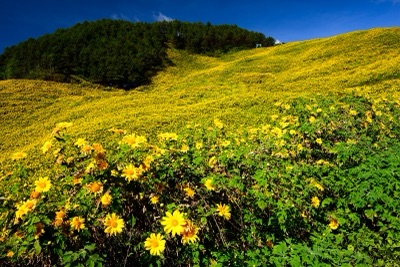
Photo: Warahemato / Wikimedia Commons (CC BY-SA 4.0)
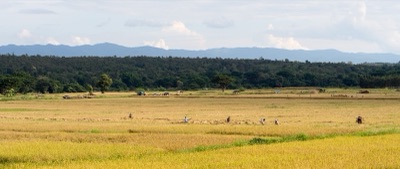
Photo: Takeaway / Wikimedia Commons (CC BY-SA 3.0)

Photo: John Shedrick / Wikimedia Commons (CC BY 2.0)

Photo: Yingthipc / Wikimedia Commons (CC BY-SA 3.0)
The bad day of Duean Yi: "only Tuesday"
Lanna people observe wan sia (วันฯเสยฯ, wan sia), the inauspicious days of each month. The dictionary records that many elders know a verse by heart: "Kiang, ha, kao, sia tit kap jan; yi, hok, sip, sia angkan wan diao; sam, jet, sip-et, sia phat kap sao; si, paet, sip-song, sia put kap suk". It means: in months 1, 5 and 9 the bad days are Sunday and Monday; in months 2, 6 and 10 only Tuesday; in months 3, 7 and 11 Thursday and Saturday; in months 4, 8 and 12 Wednesday and Friday.
By this verse, the bad day of Duean Yi, Duean Hok and Duean Sip is Tuesday alone. In 2026 the Tuesdays of Duean Yi are 10, 17 and 24 November and 1 and 8 December.
Summary
- Duean Yi is the 2nd northern month, the 12th month in central Thailand. In 2026 it runs from 10 November to 9 December and has 30 days.
- Yi Peng 2026 falls on Tuesday 24 November. It is both a wan sin luang holy day and the last day of the Kathin season.
- The month's merit festivals are tot kathin, Yi Peng and tang tham luang.
- The word of the month is nao ot hot, pleasantly cool weather. In the fields it is time to kiao khao, harvest the rice.
- By the bad-day verse, Duean Yi is "bad on Tuesday only".
Look up more month and day words in the Moradok Lanna dictionary, check the lunar date of any day in the Lanna calendar, and read the basics of the northern months in Duean Nuea.
Sources
- Moradok Lanna dictionary: duean yi(https://moradoklanna.com/dict/?เดือนยี่) · wan sia(https://moradoklanna.com/dict/?วันเสีย) · pha kathin(https://moradoklanna.com/dict/?ผ้ากฐิน) · nao ot hot(https://moradoklanna.com/dict/?หนาวอ๊อดฮ็อด)
- Moradok Lanna Lanna calendar: 10 November to 10 December 2026
- MGR Online (31 October 2016). พฤศจิกาฯ นี้นาข้าวพะเยาพร้อมเกี่ยว 85% เผยผลผลิตทั้งจังหวัดล้น 2.4 แสนตัน [This November Phayao's rice is 85% ready to harvest; province-wide output tops 240,000 tonnes]
- Timing of Tang Tham Luang: per the sources in Tang Tham Luang (Phra Maha Charin and colleagues, 2025)
- Photos from Unsplash and Wikimedia Commons as credited under each image.
Look up "เดือนยี่" in the Moradok Lanna dictionary (in Thai)


