
Photo: sarunya from Pixabay / Wikimedia Commons (CC0)
Lanna Temple Offerings: Khao Tom Mat, Sweets, Salak Basket
Khong tan, the temple offerings, are called khua tan (ระฯค฿วฯทาฯนฯ, read khua tan) in Kham Mueang (Northern Thai): the gifts prepared for the monks and for merit-making. At a big merit festival such as tan kuay salak, villagers pack one bamboo basket with rice, chillies, salt and fruit, and sometimes khao tom mat and sweets as well, then offer it to the monks by drawing lots.
This post goes through the offerings one by one: what each is called in Kham Mueang, why the sources say it is put in, and where the sources give no reason, so we do not guess. It is another post in our Lanna Kitchen series, which tells food through Kham Mueang words.
What are khong tan?
Tan (ทาฯนฯ, read tan) is glossed in the dictionary as "helping, giving, donating", the same as central Thai than. Khua tan is "offerings, things for presenting to monks", in the dictionary's words.
There is no fixed set of offerings. Each household prepares them according to its faith, means and what is available in the village. The sources we read agree that it depends on the faith and standing of whoever owns the basket.
Preparing on wan da: men weave, women pack
The day before the festival is wan da (วันฯดา, read wan da). The dictionary explains it as "the eve; the day for preparing the equipment, one day before the event". A Payap University Library document says the men weave the baskets while the women prepare the gifts: "cooked food, rice, dried food, everyday goods", according to faith and means. These are packed into the kuay (กวฯยฯ, read kuai), the basket, lined with banana leaf or coloured paper.
Relatives and friends who want to join the merit bring things to help, which is called hom khua (รอฯมระฯค฿วฯ, read hom khua), "to donate things together". Banknotes tied to a stick are then pushed into the mouth of the basket. This is called the yot (the "top"), as much or as little as faith allows.
What goes in a salak basket?
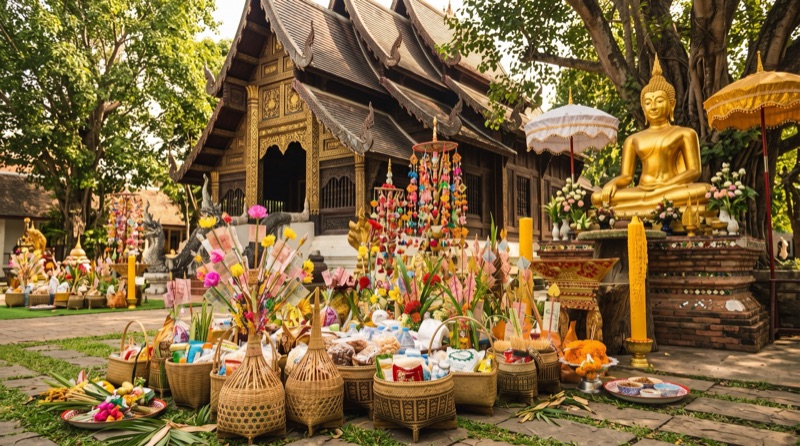
The list below is gathered from four published documents (see the sources at the end). They describe different places: Nan, Lanna in general, and a Lanna community at Ban Nam Thong in Kamphaeng Phet province. So they do not agree on every point, and that is normal.
In the widget, tap an item to put it in the basket, then tap it again to read its Kham Mueang word, its dictionary meaning and why it is offered, with the source. Here is a summary of where each group comes from.
| Item | Kham Mueang (reading) | Named by |
|---|---|---|
| Rice | khao san | Payap Univ. · Chamnan 2024 · Kamphaeng Phet |
| Chilli, shallots, salt | phik · hom bua · kuea | Payap Univ. · Chamnan 2024 · Kamphaeng Phet |
| Fish sauce | nam pa | Chamnan 2024 |
| Khao tom mat, sweets | khao tom mat · khao nom | Kamphaeng Phet · Northern learning institute |
| Banana, pomelo, sugarcane | kuai · ba o · oi | Payap Univ. · Chamnan 2024 |
| Betel, miang | pu (betel leaf) · miang | Chamnan 2024 · Kamphaeng Phet · Northern learning institute |
| Candles, flowers, popped rice | tian · khan khao tok dok mai | Chamnan 2024 · Northern learning institute |
Some sources also list other things, such as fermented fish, shrimp paste, dried fish, matches, cloth dye, soap and toothpaste, which the widget does not draw. Chamnan Kerdchor (2024) sums them all up as goods for consumption and use that the monks can put to use.
Why these things?
The sources state only a few reasons clearly.
- Fruit: Payap University says the merit festival falls when fruit such as pomelo, oranges, bananas and sugarcane is ripening.
- Rice: the same document says it is when the rice in the barns runs low, so offering salak is also a chance to help the poor.
- Pantry food and supplies: Chamnan Kerdchor (2024) sums them up as things the monks can use.
- Banana leaf: it lines the basket before the gifts go in.
- The yot (money): Payap University counts "an opportunity to raise money and materials for the temple" among the reasons for the tradition.
For khao tom mat, sweets and betel, the sources we read only say they go in the basket and do not explain why, so we do not guess. All the dictionary can add is that miang (ห้มฯยฯง, read miang), fermented tea leaf, "is widely used as a welcome gift, whether for visits, gatherings, traditions or charity events".
Khao tom mat: sticky rice in banana leaf
Among these items, the Kamphaeng Phet–Tak local database (2022), writing about tan kuay salak in the Lanna community at Ban Nam Thong, says "some baskets also hold betel, cigarettes, khao tom mat and all kinds of old-fashioned sweets". The online knowledge base of the Northern Learning Promotion Institute also lists "khao tom (boiled rice or rice parcels) and various sweets" among the things packed in the basket.
Khao tom mat in Kham Mueang is khao tom mat (เขั้าต้฿มฯมัดฯ, read khao tom mat). The dictionary only says "see khao tom kathi".
The dictionary names it by filling in two more words: khao tom kuai (เขั้าต้฿มฯก้ลฯวฯยฯ, read khao tom kuai), with banana inside, and khao tom thua (เขั้าต้฿มฯถ่฿วฯ, read khao tom thua), with beans. The broader word khao tom (เขั้าต้฿มฯ, read khao tom) covers both boiled rice porridge and sticky rice wrapped in banana leaf and steamed or boiled, counted among the sweets.
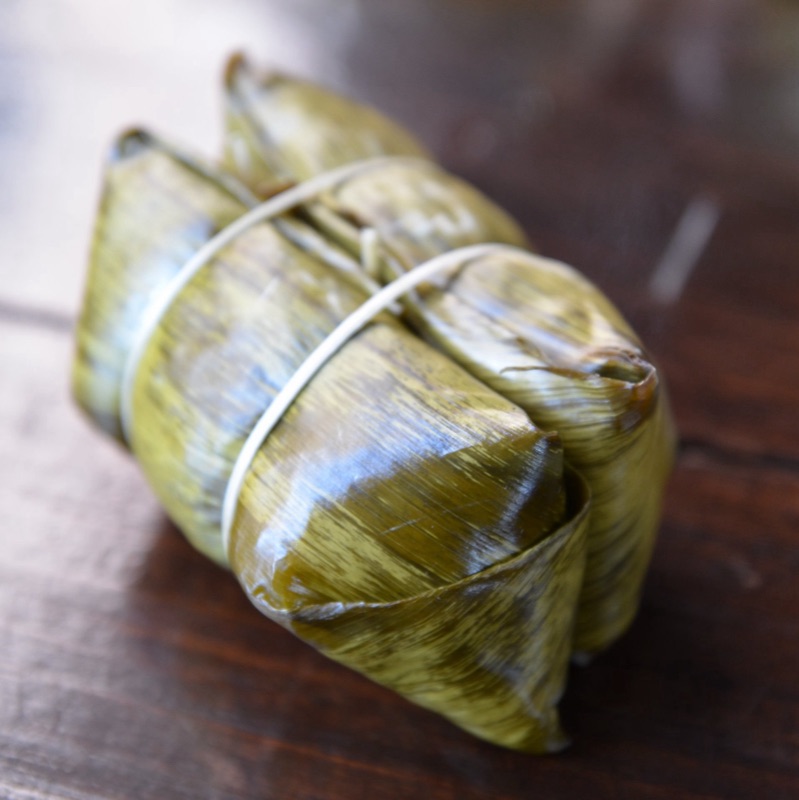
The method in the dictionary is short and clear. Fry sticky rice in coconut milk until half-cooked, put banana (often nam wa) or beans inside, and wrap it in bai tong (ไบตอฯง, read bai tong), banana leaf, then "join it in a pair, tie it tight with bamboo strips and steam it". The banana leaf is both the wrapper and the dish for this sweet. You can read more in Bai Tong, from our Kham Mueang Word of the Week series.
Khao tom mat and the end of the rains retreat
Elsewhere in Thailand, rice parcels wrapped in leaves with a tail left on one side are called khao tom luk yoi (also khao tom hang). They are a sweet commonly made for the almsgiving at the end of the rains retreat (ok phansa). Thai PBS (October 2023) reports that they are wrapped with a pointed top and a long tail to make them easy to place in an alms bowl. The Kamphaeng Phet–Tak database describes them as similar to khao tom mat but much smaller.
In Lanna, the sources we read for this post do not tie khao tom mat to the end of the retreat in particular, so we leave it as an observation only. If you know the custom of your own family or temple, tell us.
Khao nom: sweets in merit-making
Khao nom (เขั้าห฿นฯม, read khao nom) is defined in the dictionary as "food that is not eaten with rice, usually sweet, made from flour or rice with sugar, some with coconut milk". The word khao tom khao nom (เขั้าต้฿มฯ เขั้าห฿นฯม, read khao tom khao nom) means "khao tom and sweets, sweets of all kinds".
The documents we read only say that "sweets" or "all kinds of old-fashioned sweets" go in the basket and do not say which. So we do not say which kind must be used. What we can say is that the dictionary records many local sweets, for example:
- khao nom chok (เขั้าห฿นฯมจัอฯก, read khao nom chok): khanom thian, a pyramid parcel in banana leaf, steamed
- khao nom kuai (เขั้าห฿นฯมก้ลฯวฯ, read khao nom kuai): banana cake, wrapped in banana leaf, topped with grated coconut and steamed
- khao nom wong (เขั้าห฿นฯมว฿งฯ, read khao nom wong): sticky rice shaped into rings, fried and drizzled with thick cane syrup
- khao nom phat (เขั้าห฿นฯมปาดฯ, read khao nom phat): rice flour with coconut milk, stirred until set and cut in pieces
Another offering: tan khao mai
Not every offering goes in a salak basket. The dictionary records tan khao mai (ทาฯนฯเขั้าไห่มฯ, read tan khao mai) as the offering of "rice newly harvested that year, to dedicate merit to the guardian spirits of the water source and to the grandparents who passed the rice fields down, an important rite to be done before eating the new rice". The heap of rice brought together for the offering is called doi ngoen (ดอฯเงินฯ, read doi ngoen).
For the secret nighttime giving, read Tan Tot.
What dates fall in 2026?
Summary
- Khua tan are the temple offerings. What goes in a salak basket is not fixed; it follows the giver's faith and means.
- The documents we read name many items: rice, chillies, shallots, salt, fish sauce, fruit (bananas, pomelo, sugarcane), betel, miang, candles, flowers, khao tom mat and sweets.
- Five reasons are stated clearly: fruit is ripening, the rice barns are running low, goods the monks can use, banana leaf to line the basket, and money for the temple. For khao tom mat, sweets and betel, the sources give no reason.
- Khao tom mat (khao tom kathi) is sticky rice fried in coconut milk with banana or bean filling, wrapped in bai tong, joined in a pair, tied with bamboo strips and steamed.
- Khao tom luk yoi is a sweet of the almsgiving at the end of the retreat, but the Lanna sources we read do not tie khao tom mat to that day, so we do not conclude for Lanna.
Look up more words for offerings in the Moradok Lanna dictionary (in Thai), and read the origin and steps of this merit in Tan Kuay Salak.
Sources
- Moradok Lanna dictionary (in Thai): คัวตาน · ก๋วยสลาก · เข้าต้มกะทิ · เข้าหนม · เหมี้ยง · ตานเข้าใหม่ · ฮอมคัว
- Payap University Library, Northern Information Centre. Tan kuay salak (citing Manee Payomyong. (1986). Prapheni sip song duean Lanna). In Thai.
- Chamnan Kerdchor. (2024). Tan kuay salak: Buddhist culture in Nan province. Journal of Thai Language and Culture 10(2) (citing the Fine Arts Department, Music Division, 2022). In Thai.
- Kamphaeng Phet–Tak local database, Kamphaeng Phet Rajabhat University. (2022). Tan kuay salak, an ancient tradition. In Thai.
- Northern Learning Promotion Institute online knowledge base. (2018). Lanna tradition: tan kuay salak. In Thai.
- Thai PBS. (October 2023). "Khao tom luk yoi" keeps the Tak Bat Thewo tradition alive on Ok Phansa. In Thai.
- Moradok Lanna calendar (2026 dates)
Practise the words from this article
Flip through 36 flashcards of the Lanna words used in this article.


