
Photo: CEphoto, Uwe Aranas / Wikimedia Commons (CC BY-SA 4.0)
Buat Luk Kaew: Lanna Novice Ordination
Buat luk kaew (บวฯชลูกแก้วฯ, Kham Mueang reading buat luk kaew) is how the Kham Mueang people of Lanna ordain a boy as a novice monk. The dictionary explains that before the ceremony, Lanna families like to celebrate with a parade, the boy "riding an elephant, a horse or on someone's shoulders, as the family can afford", to the homes of relatives and respected elders.
For a northern family in the past, ordaining a son was a great act of merit, one that parents planned from their wedding day on. The temple was also the first school a boy ever went to, where he learned to read Lanna script. This article walks through buat luk kaew step by step, with the Kham Mueang words used along the way.
Who is the luk kaew?
Luk kaew (ลูกแก้วฯ, read luk kaew) means "novice candidate" in the dictionary: a boy whose head has been shaved, ready to be ordained as a novice. Some are dressed like a prince and ride a horse or sit on someone's shoulders in a parade to relatives' homes. The word nak (นาฯคฯ) is defined as a person who goes to stay at the temple, dressed all in white, to prepare for ordination.
The celebration is called poi luk kaew (พอฯยฯลูกแก้วฯ, read poi luk kaew). Poi (พอฯยฯ) means a festival or celebration. An ordination party can also be called poi noi (พอฯยฯห้นฯอฯยฯ) or poi buat pha (พอฯยฯบวฯชระฯพ), and the dictionary even has a word for going to enjoy one: aeo poi noi (แอ่วฯพอฯยฯห้นฯอฯย).
Kham Mueang keeps ordaining a novice and ordaining a monk clearly apart.
| Lanna script | Reading | Meaning |
|---|---|---|
| บวฯชระฯพ | buat pha | to be ordained as a novice (plain buat บวฯช also means this) |
| เพัก์ขฯ | pek | to be ordained as a monk |
| พอฯยฯเพัก์ขฯ | poi pek | the ordination party for someone who is already a novice and now becomes a monk |
| ทุ | tu | a monk |
| ระฯพห้นฯอฯยฯ | phra noi | a young novice, a small novice |
Under tu jao (ทุเจั้า) the dictionary notes that this word is used for monks; a novice is called pha.
Before ordination: going to the temple as a khayom
A record of old Chiang Mai customs by the Chiang Mai Culture and Tradition Conservation Club (1996) tells how, before ordination, parents took their son to the abbot, in Kham Mueang tu jao hua wat (ทุเจั้าห฿วฯวัดฯ). The abbot taught him to read and write the Lanna script, in those days with a slate and a stick of chalk, and then taught him the chants and novice rules until he could recite every one by heart.
A boy living at the temple like this is a khayom (ขโย฿มฯ, read khayom), a temple pupil. Handing him over is called khao wat (เขั้าวัดฯ). Under khayom noi (ขโย฿มฯห้นฯอฯยฯ) the dictionary explains that in old Lanna, when children finished the fourth grade of primary school, at about 10–11 years old, they were sent to the temple to prepare for novicehood, and the first thing they learned was tua mueang (ต฿วฯเมิอฯง), the Lanna script, so they could chant and read palm-leaf texts.
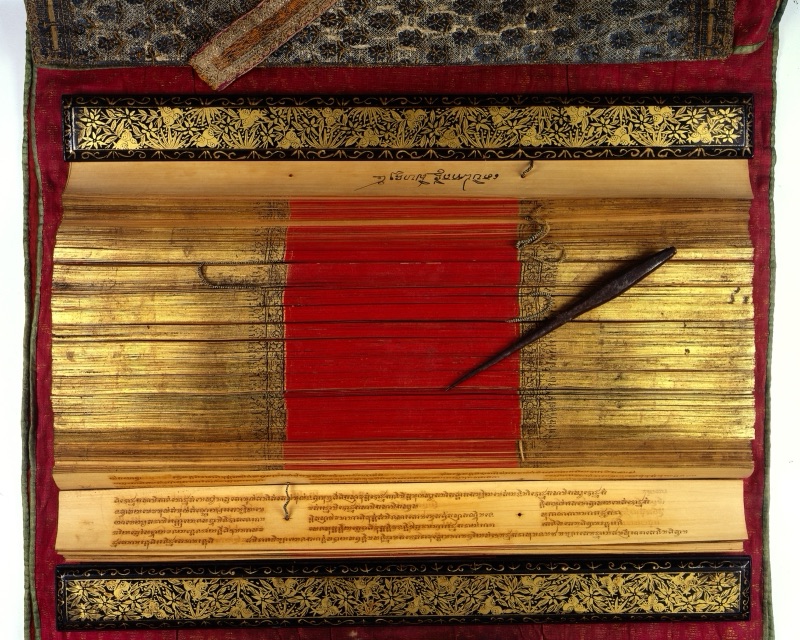
Want to start reading Lanna script like a khayom of old? See the course map at Learn Lanna Script from Zero.
Po ok, mae ok and jao sattha
Once the abbot has chosen an auspicious day, the parents prepare a flower tray and go to invite their relatives to share in the merit. A buat luk kaew is an event for the whole extended family, not just one household.
The man who sponsors the ordination is called po ok (พํอฯออฯก, read po ok): a lay supporter who hosts a novice or monk ordination. A woman sponsor is mae ok (แม่ออฯก, read mae ok). The two words are used as a pair.
Those who donate the offerings are called jao sattha (เจั้าสัทธฯาฯ) in the dictionary. At a poi luk kaew the boy receives the eight requisites of a monk, such as the bat (บาฯระฯต, alms bowl), prepared by the jao sattha.
The hae luk kaew parade and wrist-tying
The liveliest part of the event is hae luk kaew (แห่ลูกแก้วฯ, read hae luk kaew). Hae (แห่) means a large group on the move, with music and festive decoration. The luk kaew khi (ขี่, rides) a jang (ช้างฯ, elephant), a ma (ม้า, horse) or sits on an adult's shoulders, as the family can afford, and visits relatives and respected elders to invite them to share in the merit.
According to the Club's record, two or three days before the ordination the family takes the luk kaew round to relatives, who tie his wrists with thread to strengthen his spirit and give him their blessings. Kham Mueang calls this mat mue (มัดฯมื, read mat mue), part of a su khwan (สู่ขัวฯร) rite that calls the spirit back into the body. Read more about khwan in Hong Khwan.
On the ordination day the parade goes to the temple to the sound of long drums, which the dictionary calls kong sing mong (กลฯอฯงสิ้งฯห้มฯอฯง, read kong sing mong). The Club's record adds that relatives also had to prepare many things for the new novice or monk, such as a mat, pillows, a blanket, sitting and sleeping cloths, and sandals.
Which months?
The Club's record says buat luk kaew is usually held in the 6th, 8th and 9th months (northern count), roughly March to June. All three months fall before the Buddhist Lent. Learn how the northern months are counted in Duean Nuea.
- 6th northern month: 8 March – 6 April 2027
- 8th northern month: 6 May – 4 June 2027
- 9th northern month: 5 June – 3 July 2027
- Start of Buddhist Lent (Khao Phansa): 19 July 2027 (1st waning day of the 10th northern month)
The actual ordination day at each temple depends on the auspicious day the abbot chooses.
Buat luk kaew and Poy Sang Long
The Tai (Shan) people who share the land of Lanna hold a similar novice ordination, called Poy Sang Long. Both come from the same belief: ordaining a son is a great merit for his parents. The luk kaew and the sang long are both dressed up, carried on shoulders or ridden on horseback in a parade, and both have their wrists tied by relatives.
What differs are the names and the details. The Kham Mueang candidate is a luk kaew, his sponsors are po ok and mae ok, and after leaving the robes he is called "Noi". Poy Sang Long runs over several days with its own Tai terms. See the side-by-side table in Poy Sang Long.
After leaving the robes: from luk kaew to "Noi"
When a novice leaves the robes, Kham Mueang calls it sik (สิก์ขฯ, written sik). The dictionary records that in the old days monks and novices left the robes before dawn and walked out through the temple gate facing an auspicious direction, which Lanna people believed would bring good fortune to their life.
A man who has left novicehood gets the title Noi, and a man who has left the monkhood is called Nan (หนฯานฯ). Under noi nan (น้อฯยฯหนฯานฯ) the dictionary explains that he is called "Noi" (little) because a novice has studied only a little of the Dhamma. So Noi and Nan tell you that a man was once ordained. Read more titles in Kham Mueang Family Words.
Kham Mueang words at a buat luk kaew
| Kham Mueang | Lanna script | Meaning |
|---|---|---|
| buat luk kaew | บวฯชลูกแก้วฯ | Lanna novice ordination, with a parade before it |
| luk kaew | ลูกแก้วฯ | a boy with a shaved head about to become a novice |
| poi luk kaew | พอฯยฯลูกแก้วฯ | the celebration of a buat luk kaew |
| hae luk kaew | แห่ลูกแก้วฯ | the parade of the luk kaew to relatives' homes |
| poi noi | พอฯยฯห้นฯอฯยฯ | an ordination party |
| aeo poi noi | แอ่วฯพอฯยฯห้นฯอฯย | to go and enjoy an ordination party |
| po ok | พํอฯออฯก | male lay sponsor of an ordination |
| mae ok | แม่ออฯก | female lay sponsor, paired with po ok |
| jao sattha | เจั้าสัทธฯาฯ | donor of the offerings at a merit-making |
| khayom | ขโย฿มฯ | temple pupil, temple boy |
| mat mue | มัดฯมื | to tie the wrists to welcome the khwan |
| buat pha · pek | บวฯชระฯพ · เพัก์ขฯ | ordained as a novice · as a monk |
| noi · nan | น้อฯยฯหนฯานฯ · หนฯานฯ | a man who left novicehood · the monkhood |
Summary
- Buat luk kaew is the Kham Mueang ordination of a boy as a novice; the candidate is a luk kaew and the party is a poi luk kaew or poi noi.
- In the past a boy would khao wat, become a khayom, and learn Lanna script and the chants from the abbot before ordination.
- The sponsors are po ok and mae ok; relatives mat mue (tie his wrists), and the hae luk kaew parade takes him to relatives on an elephant, a horse or someone's shoulders.
- Ordinations were usually held in the 6th, 8th and 9th northern months, before Buddhist Lent.
- After leaving novicehood a man is called Noi.
Look up more ordination words in the Moradok Lanna dictionary (in Thai), and read about the Shan novice ordination in Poy Sang Long.
Sources
- Moradok Lanna dictionary (in Thai): บวชลูกแก้ว · ลูกแก้ว · ปอยลูกแก้ว · ป้อออก · ขะโยมหน้อย · สิ๋กข์ · น้อยหนาน
- ชมรมอนุรักษ์วัฒนธรรมประเพณีเชียงใหม่ [Chiang Mai Culture and Tradition Conservation Club]. (1996). ประเพณีเก่าเชียงใหม่ ๗๐๐ ปี [Old Chiang Mai Customs: 700 Years]. Cited in Payap University Library, การทำบุญบวชลูกแก้ว [Merit-making at a Buat Luk Kaew] (Northern Thailand Information Center)
- Moradok Lanna Lanna calendar: northern month dates and Khao Phansa 2027 (https://moradoklanna.com/calendar/)
Practise the words from this article
Flip through 35 flashcards of the Lanna words used in this article.
Look up "บวชลูกแก้ว" in the Moradok Lanna dictionary (in Thai)


