
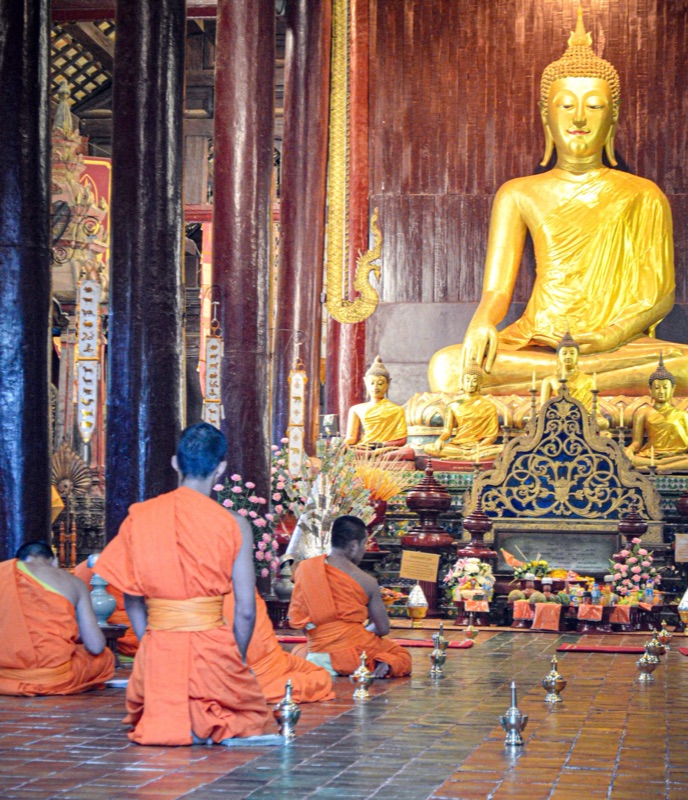
Photo: Donavanik / Wikimedia Commons (CC BY-SA 4.0)
Kham Mueang Family Words: Po, Mae, Pi, Ai, Ui and Pronouns
Many kinship terms in Kham Mueang (Northern Thai) sound like central Thai, but some differ so much that they are easy to misunderstand: po liang does not mean stepfather, and luk chai does not mean son. The word that holds the whole family together is pi nong (พี่น้อฯง, Kham Mueang reading pi nong), which means elder and younger siblings, relatives, and "people who respect one another as kin".
This lesson goes through the kinship terms from the grandparents' generation down to the great-great-great-grandchildren, then looks at which pronouns to use with whom. Every word and meaning comes from the Moradok Lanna dictionary.
Three generations and up: po ui, mae ui, po, mae
In Kham Mueang the paternal and maternal grandfather share one word, po ui, and both grandmothers share mae ui. The dictionary explains that ui (อุ้, Kham Mueang reading ui) is what you call the parents of your parents, or anyone of the same standing.
| Kham Mueang | Lanna script | Meaning (from the dictionary) |
|---|---|---|
| po ui | พํ่อฯอุ้ย | maternal grandfather (mother's father), paternal grandfather (father's father); also an old man |
| mae ui | แม่อุ้ | paternal or maternal grandmother, and female relatives of the same generation |
| po | พํอฯ | father; also a title before male relatives or positions, to show respect |
| mae | แม่ | mother, the one who gave birth or raised you; also a woman in a trade, e.g. mae kha (market woman) |
| pa | ป้า | the elder sister of your father or mother, or a woman older than your parents |
| a · ao | อา · อาวฯ | your mother's younger sibling; your father's is ao, though today a is used for both sides |
| na | นาฯ | your mother's younger sibling |
The word lung (uncle) is common in Kham Mueang, but the dictionary does not list it as a headword; it appears only inside examples such as "lung noi si" under the entry for noi nan.
Brothers and sisters: ai, pi, nong
Kham Mueang clearly separates elder brothers from elder sisters.
| Kham Mueang | Lanna script | Meaning (from the dictionary) |
|---|---|---|
| ai | อ้ายฯ | eldest brother; a man older than yourself; and the word a man uses for himself when talking to someone younger |
| pi | พี่ | elder sister, a woman older than you; for a man use ai (also oei) |
| yai | ไห้ยฯ | elder sister, used in Phrae province |
| pi ai | พี่อ้ายฯ | eldest brother |
| nong | น้อฯง | a younger sibling of the same parents; also how you address someone younger |
Children and grandchildren: five generations down
The dictionary says that "in Lanna, kin are counted as luk, lan, len, lit, li", so five generations down.
| Kham Mueang | Lanna script | Meaning (from the dictionary) |
|---|---|---|
| luk | ลูก | child, born of a father and mother |
| lan | หลฯานฯ | grandchild; also a nephew or niece |
| len | เหลฯร | great-grandchild (child of a grandchild) |
| lit | หีลฯด | great-great-grandchild (child of a len) |
| li | หี้ลฯ | great-great-great-grandchild (child of a lit) |
| luk bao | ลูกบ่าฯวฯ | son |
| luk kao | ลูกเคั้าฯ | eldest child, first-born |
| luk la | ลูกห้ลฯา | youngest child (la means last, at the end) |
Husbands, wives and in-laws
| Kham Mueang | Lanna script | Meaning (from the dictionary) |
|---|---|---|
| phua · mia | ผ฿วฯ · เมยฯ | husband · wife |
| luk khoei · luk chai | ลูกเขิยฯ · ลูกชายฯ | son-in-law, a daughter's husband |
| nong chai | น้อฯงชายฯ | younger brother-in-law |
| po na · mae na | พํอฯนาฯ · แม่¢ | stepfather (your mother's husband who is not your father) · stepmother (your father's wife who is not your mother) |
| luk liang | ลูกล้ยฯง | a dependant in one's care, a stepchild brought by a spouse, or an adopted child |
| po hang · mae hang | พํอฯร้างฯ · แม่ร้างฯ | a man · a woman who has separated from a spouse and not yet remarried |
- Po liang (พํอฯล้ยฯง) is not a stepfather but a well-off man, a man of property, a capitalist, and mae liang (แม่ล้ยฯง) is a woman with a lot of money or influence. For a stepfather or stepmother in the central Thai sense, Kham Mueang uses po na and mae na.
- Luk chai is not "son" but son-in-law. A son in Kham Mueang is luk bao.
- Po chai (พํอฯชายฯ) is not "father" but a man or boy of any age, from a baby to an old man.
People outside the family, called like kin
| Kham Mueang | Lanna script | Meaning (from the dictionary) |
|---|---|---|
| siao | ส่ยฯว | someone born in the same year as you; a close friend |
| po siao | พํอฯส่ยฯว | your father's friend of the same age (siao is used only for people born in the same year) |
| po luang · mae luang | พํอฯหลฯวฯง · แม่หลฯวฯง | village headman · the headman's wife |
| tu · tu pi | ทุ · ทุพี่ | a monk · a monk older than the speaker, or one addressed so out of respect |
| bao · sao | บ่าฯวฯ · สาวฯ | an unmarried young man · an unmarried young woman |
Pronouns: who says what to whom
Kham Mueang pronouns mark closeness and respect more finely than you might expect.
| Kham Mueang | Lanna script | How it is used (from the dictionary) |
|---|---|---|
| kha chao | ข้าเจั้า | the polite "I" for a woman speaker, for any age and with anyone; when a younger person uses it with an elder it sounds especially sweet |
| chao | เจั้า | a polite sentence ending, like "ka"; today mostly used by women, though in the past men used it with nobles and senior monks |
| kha | ข้า | "I" for men and women, usually between men of similar age or close friends; today men mostly use central Thai phom and khrap |
| poen | เพิ่นฯ | "I", only between people who are close, such as close friends or husband and wife; also "he, she, they", e.g. poen pai laeo, "he has gone" |
| tua | ต฿วฯ | "you", between close friends or lovers, paired with poen |
| hao · mu hao | เรัา · หู่เรัา | we · us, our own crowd, informally |
| su | สู | you (respectful), you all |
The dictionary spells out the pairs: close friends use poen–tua, and a wife speaking to her husband uses poen–tua or poen–ai. That is why the pair turns up so often in Kham Mueang songs, such as the song Noi Chaiya.
Noi and nan: names that show a man was ordained
A Lanna man who has been ordained carries a title before his name, as the dictionary explains under noi nan (น้อฯยฯหนฯานฯ).
- Noi: a man who has left the novicehood, because he has studied the Dhamma only a little. A former novice named Si is called noi si, pi noi si or po ui noi si, depending on his age.
- Nan (หนฯานฯ): a man who has left the monkhood, which requires being at least 20 years old, e.g. nan ma, po nan ma.
The dictionary also quotes the saying "noi bo di pen pu chan, nan bo di pen chang so": a noi should not be a temple lay leader, and a nan should not be a so singer.
Try it: a grandchild talks with grandma
This short dialogue is our own teaching example, built from sentences and patterns the dictionary gives under kha chao, chao, ka and khing.
Mae ui: Lan, kin khao laeo ka? (Have you eaten yet, dear?)
Granddaughter: Kin laeo chao. (I have, grandma.)
Mae ui: Lan, pai nai? (Where are you off to?)
Granddaughter: Kha chao pai hong hian chao. (I'm going to school.)
The granddaughter calls herself kha chao and ends every sentence with chao, so to the elder she sounds well brought up. To go and ask an elder's blessing at the Lanna New Year, read on at Dam Hua.
Summary
- Po ui is grandfather on either side and mae ui grandmother on either side; Kham Mueang counts descendants five generations deep: luk, lan, len, lit, li.
- An elder brother is ai, an elder sister pi, a son luk bao, the eldest child luk kao and the youngest luk la.
- Po liang is a man of property, luk chai a son-in-law and po chai simply a male; stepparents are po na and mae na.
- A woman says "I" politely with kha chao and ends with chao; khing–ha are only for close friends.
- Noi and nan go before the names of men who left the novicehood or the monkhood.
Look up more kinship terms in the Moradok Lanna dictionary (in Thai), practise market words in Going to the Kat Like a Khon Mueang, and read about asking elders for blessings in Dam Hua.


