

Photo: FredTC / Wikimedia Commons (CC BY-SA 4.0)
Poy Sang Long: The Tai Novice Ordination in Lanna
Poy sang long is the group novice ordination of the Tai people, or Tai Yai (Shan), who have lived in the land of Lanna for many generations. The boys to be ordained are called sang long (ส่างฯลอฯง, Kham Mueang reading sang long). They are dressed splendidly like princes and carried on adults' shoulders in processions all over town under golden umbrellas for several days, before they take off all their finery and put on the yellow robe.
This tradition does not belong directly to the Khon Mueang (Northern Thai people) of Lanna, but to neighbours who have long shared the same land, and the Moradok Lanna dictionary records the word. This article introduces poy sang long and compares it with the buat luk kaeo, the novice ordination of the Khon Mueang, to see how they are alike and how they differ.
What is poy sang long?
The dictionary explains a sang long as "a Tai Yai candidate about to be ordained, usually a boy dressed as a prince", while the word poy (พอฯยฯ, Kham Mueang reading poi) means a celebration, a festivity. Poy sang long therefore means the celebration of a sang long's ordination.
A study by Phra Athit Phukham and colleagues (2020), citing the Encyclopedia of Thai Culture: Northern Region, explains the origin of the name as follows:
| Word | Meaning in the Tai Yai language |
|---|---|
| poy | a festival, holding a festival |
| sang | from "sang", meaning a novice |
| long | from "alaung", meaning a bodhisattva, a Buddha-to-be, or a royal offspring |
A Naewna news article (2023) explains that "alaung" means of royal lineage. Both meanings point the same way: the boy to be ordained is honoured like a prince blessed with merit.
The Tai: the Tai Yai in the land of Lanna
The dictionary explains the word Tai (ไท, Kham Mueang reading tai) as meaning the Tai Yai people, who "call themselves Tai", while Thai and Lao people call them Ngiao (ง้ยฯว). The Tai live in Thailand, Myanmar, Laos and southern China; in Thailand they are found in Chiang Mai, Chiang Rai, Mae Hong Son and Phetchabun.
In the dictionary, the word khon tai (ฅ฿นฯไท, "Tai people") also covers several Tai groups: the Tai Khoen, Tai Yai, Tai Lue, Tai Nuea, Tai Yuan and Tai Yong. The Tai Yuan are the Khon Mueang of Lanna themselves, so the Khon Mueang and the Tai Yai are relatives in language and culture.
The study by Phra Athit Phukham and colleagues (2020) tells that Tai Yai people travelled to trade in Lanna, and some settled around the city of Chiang Mai, from around 1814–1914. Today Wat Pa Pao and Wat Ku Tao (Wat Weluwanaram) in the city of Chiang Mai are the centres of Tai Yai traditions, including poy sang long.
Where: Mae Hong Son is the best known, for example at Wat Klang Thung, Wat Pha Bong Nuea and Wat Pang Lo, and in Khun Yuam, Pai, Mae Sariang and Pang Mapha districts. It is also held in the Tai Yai communities of Chiang Mai.
Status: the Ministry of Culture registered it as a national intangible cultural heritage in 2018 (Thai Post, 2019).
Why are the sang long dressed as princes?
Knowledgeable people in different places tell different stories about the costume. A study by Anurak Sakaeo and Phra Maha Thanakon Suphawaso (2020), carried out in Chiang Tung (Kengtung), collects two legends, and Naewna (2023) adds one more.
Being a sang long means imitating Prince Siddhartha while he lived in Kapilavastu, before he left home to become a monk. Everything done for the sang long during the festival is therefore done as if for a king. This legend is found both in the Encyclopedia of Thai Culture: Northern Region and in accounts from Chiang Tung.
When the Buddha came down from the Tavatimsa heaven after preaching to his mother, 4 deities (2 gods and 2 goddesses) came down with him because they wanted to see the festivities of humans. The four deities were splendidly dressed and wore crowns, and danced with the villagers, so the sang long dress like the four deities of the legend.
Naewna (2023) says that some legends tell of King Ajatashatru, who had his son dressed like a king and then took him to be ordained under the Buddha.
Behind all of this is the story of Rahula, the son of Prince Siddhartha, who was ordained at the age of 7 and is counted as the first novice in Buddhism (Anurak Sakaeo and colleagues, 2020). Boys ordained as sang long are mostly about 7–15 years old, according to the study in Chiang Mai, while in Chiang Tung they are usually ordained from the age of 10 upward.
The steps of poy sang long
Poy sang long can last from 3 to 7 days, depending on what each community can manage, so sources name the days differently. This table follows the order Posttoday (2018) recorded at the 4-day festival at Wat Klang Thung, Mae Hong Son.
| Day | Name | What happens |
|---|---|---|
| 1 | Wan rap sang long (receiving the sang long) | Before dawn the boys' heads are shaved (but not their eyebrows) and they are dressed, receive the precepts and blessings from the monks, then the ta pae carry them on their shoulders to pay respects at the city pillar shrine, the village shrine and the houses of senior relatives |
| 2 | Wan kham khaek (receiving guests) | Relatives visit, tie blessing strings on the sang long's wrists and help prepare the offerings |
| 3 | Wan hae khrua lu (procession of offerings) | The sang long are carried round town in procession with the offerings; in the evening they return to the temple for a khwan-calling ceremony and eat 12 kinds of food, their parents feeding them their last meal |
| 4 | Wan kham sang (ordination day) | The most important day: the boys circle the ordination hall 3 times and are then ordained as novices |
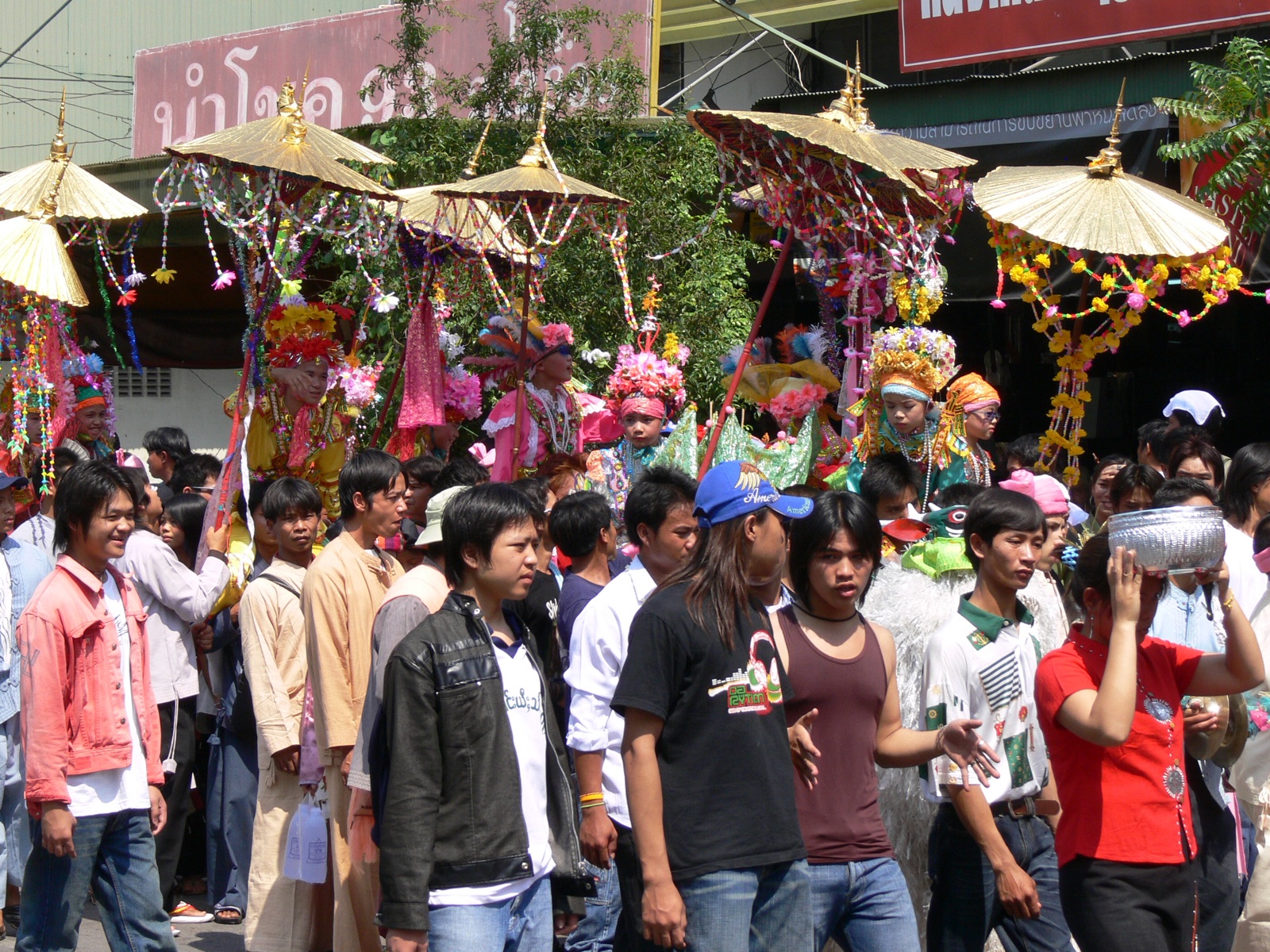
The ta pae, who carry the little princes
Throughout the festival the sang long hardly ever walk. A ta pae, a minder, carries each one on his shoulders everywhere and dances with him in the procession (Posttoday, 2018). Beside each sang long walks an umbrella-bearer called the thi kham, holding a golden umbrella over him. Villagers along the way join the procession and scatter rice and flowers in welcome.
The sang long's costume
Posttoday (2018) describes the sang long costume: a brightly coloured chong kraben (wrapped lower garment) with a long tail hanging behind, a silver or naga-patterned belt, a long-sleeved shirt embroidered with flowers, and a cloth turban decorated with flowers of many colours, together with necklaces, bracelets and rings, drawn eyebrows, red lips and white socks.
Ordination day
In Chiang Tung, Anurak Sakaeo and colleagues (2020) record that on arriving at the temple the sang long ask permission to be ordained from a senior monk, take the Five Precepts, recite the request for ordination and ask for the Ten Precepts, then change from the prince's costume into the saffron robe. The monks give them new names; a boy called Saeng, for example, becomes "Novice Saeng". According to belief, a new novice must stay within the temple grounds for 3 full days before he may go outside.
Two ways of holding the ordination, and sponsors
- Kham dip: the simple way. Parents shave their son's head at the temple or at home, he is dressed in white, and they take the offerings to the temple for the ordination (TruePlookpanya, 2021).
- Sang long: the grand way, with processions over several days; this is the more popular form.
- Pho kham mae kham: a sang long ordination is expensive, so families without means entrust their son to well-off people who want to make merit but have no son of their own, as sponsors called pho kham mae kham (the deputy governor of Mae Hong Son, in Thai Post, 2019). The festival thus brings together those who have and those who have not.
The sound of the mong soeng and the dancing in the procession
The sang long processions are made lively by Tai Yai music: gong sets, cymbals and the mong soeng (มอฯงเซิงฯ, Kham Mueang reading mong soeng) (Anurak Sakaeo and colleagues, 2020). The dictionary explains the mong soeng as "a double-headed drum of the Tai Yai, like the Thai taphon but larger", played with the palms of the hands.
Along the way, Tai Yai dance troupes join the procession (Naewna, 2023). The Moradok Lanna dictionary records several Tai Yai dance arts, such as the fon king kala (ฟ้อฯรกิงฯกห่ลฯา, Kham Mueang reading fon king ka-la), which imitates the kinnara, the mythical half-bird beings, and the fon ngiao (ฟ้อฯรง้ยฯว), which blends Tai Yai and Lanna dance movements.
Poy sang long and the Khon Mueang's buat luk kaeo
The Khon Mueang of Lanna have a similar tradition called buat luk kaeo (บวฯชลูกแก้วฯ, Kham Mueang reading buat luk kaeo), the ordination of the "jewel sons", and the celebration is called poy luk kaeo (พอฯยฯลูกแก้วฯ). The dictionary explains that before becoming novice candidates, "the Lanna people like to celebrate with a procession, riding on elephants, on horses or on people's shoulders, according to their means", which is called hae luk kaeo, going round to the houses of relatives and people they respect.
| Topic | Tai Yai (poy sang long) | Khon Mueang (poy luk kaeo) |
|---|---|---|
| The boy to be ordained | sang long | luk kaeo (ลูกแก้วฯ) |
| The procession | on the shoulders of a ta pae, under a golden umbrella | on an elephant, a horse or shoulders, according to means (hae (แห่) luk kaeo) |
| Sponsors | pho kham mae kham | pho ok (พํอฯออฯก, read po ok) · mae ok (แม่ออฯก) |
| Wrist-tying blessing | relatives tie strings on the sang long's wrists | mat mue (มัดฯมื), the welcoming wrist-tying |
| Called after leaving the order | sang | noi |
The deputy governor of Mae Hong Son himself has compared poy sang long with the Lanna buat luk kaeo (Thai Post, 2019). Both traditions come from the same belief: having a son ordained is a great merit for his parents. Those who join in the merit-making are called by the dictionary chao sattha (เจั้าสัทธฯาฯ), the owners of the offerings at a merit-making event.
Value and challenges today
The study in the communities of Wat Pa Pao and Wat Ku Tao, Chiang Mai (Phra Athit Phukham and colleagues, 2020) found that poy sang long helps train children in discipline, helps young Tai Yai people know their roots, and brings relatives together during the holidays.
Problems the study found, and its suggestions
- There is little time to prepare, because it can only be held during the summer school holidays, and there are not enough teaching monks and mentor monks for the number of sang long.
- Costs are higher than necessary: food for guests, venues and the monks' requisites.
- The ceremonies take a long time, and processions around the city moat cause traffic jams and noise in the community.
- Tai Yai and Khon Mueang ordination rites are mixing more and more, so that some sang long do not know the core of the original rite.
- Suggestions: government and private organisations should plan together; the steps of the rite should be explained to the sang long before ordination; the rite should follow the original Tai Yai form; guests should be invited to wear Tai Yai dress; and the festival should be alcohol-free.
Although poy sang long has become a festival that more and more tourists come to watch, for Tai families this is the day their son steps from little prince to the saffron robe. Visitors should therefore respect the ceremony, not block the procession, and ask permission before taking close-up photographs.
Summary
- Poy sang long is the group novice ordination of the Tai or Tai Yai (Shan) people, held around March–April both in Mae Hong Son and in the Tai Yai communities of Chiang Mai.
- The name comes from the Tai Yai language: poy = festival, sang = novice, long (alaung) = a Buddha-to-be or a royal offspring.
- The sang long dress as princes, following the legend of Prince Siddhartha or of the four deities of Tewo day. They are carried on the shoulders of a ta pae, and the processions resound with the mong soeng.
- The festival lasts 3–7 days and ends on wan kham sang, the day they are ordained as novices.
- The Khon Mueang of Lanna have a sister tradition, buat luk kaeo, while the word "sang" in Kham Mueang means someone who has left the novicehood, whom people in Lanna call "noi".
Look up more words about ordination and the Tai people in the Moradok Lanna dictionary (in Thai), and read about the traditions of the Khon Mueang of Lanna in the article Yi Peng, Pi Mai and tung.
Sources
- The Moradok Lanna dictionary (in Thai): ส่างลอง · ไต · ลูกแก้ว · มองเซิง
- พระอาทิตย์ ภู่คำ, โผน นามณี และพระครูสมุห์ธนโชติ จิรธมฺโม [Phra Athit Phukham, Phon Nammani and Phra Khru Samu Thanachot Chirathammo]. (2020). แนวทางการอนุรักษ์ประเพณีปอยส่างลองในเขตอำเภอเมือง จังหวัดเชียงใหม่ [Guidelines for preserving the poy sang long tradition in Mueang District, Chiang Mai]. วารสารพุทธศาสตร์ศึกษา [Journal of Buddhist Studies] 11(1) (citing สารานุกรมวัฒนธรรมไทย ภาคเหนือ [Encyclopedia of Thai Culture: Northern Region], 1999). In Thai.
- อานุรักษ์ สาแก้ว และพระมหาธนกร สุภวโส [Anurak Sakaeo and Phra Maha Thanakon Suphawaso]. (2020). การศึกษาประวัติความเป็นมาของประเพณีปอยส่างลองในเมืองเชียงตุง ประเทศเมียนมาร์ [A study of the history of the poy sang long tradition in Chiang Tung, Myanmar]. วารสารวิทยาลัยสงฆ์นครลำปาง 9(1). In Thai.
- กาญจน์ อายุ [Kan Ayu]. (2018, 14 April). เรื่องปอยส่างลอง แม่ฮ่องสอน [About poy sang long, Mae Hong Son]. Posttoday. In Thai.
- แนวหน้า [Naewna]. (2023, 30 April). คอลัมน์ภูมิบ้าน ภูมิเมือง (เรื่องปอยส่างลอง) [Phum Ban Phum Mueang column (on poy sang long)]. In Thai.
- ไทยโพสต์ [Thai Post]. (2019, 6 March). วธ. ผนึก จ.แม่ฮ่องสอน ยกระดับประเพณี 'ปอยส่างลอง' [Ministry of Culture joins Mae Hong Son to raise the profile of the 'poy sang long' tradition]. In Thai.
- ทรูปลูกปัญญา [TruePlookpanya]. (2021). ประเพณีวัฒนธรรมไทย ภาคเหนือ [Thai traditions and culture: the North]. In Thai.


