
Photo: Chainwit. / Wikimedia Commons (CC BY-SA 4.0)
The Emerald Buddha in Lanna
The Emerald Buddha is one of the most revered Buddha images in Thailand. Today it sits in Wat Phra Si Rattana Satsadaram in Bangkok, but long before it travelled to Lan Xang and Bangkok, it first appeared in recorded history in Lanna. Kham Mueang calls a Buddha image carved from a precious stone a phra kaeo (ระฯพแก้วฯ, phra kaeo), and the Moradok Lanna dictionary gives the Emerald Buddha as the very first example of the word.
This article tells the tamnan (ตํานาฯ, legend) of the Emerald Buddha in Lanna: from a chedi in Chiang Rai struck by lightning, to an elephant that would not walk to Chiang Mai, to a niche high on the Great Chedi. It compares the dates and versions openly, and collects the Kham Mueang words hidden in the story.
Phra kaeo: a Buddha image made of "kaeo"
In Kham Mueang, kaeo (แก้วฯ, kaeo) has many meanings. One of them in the dictionary is "a hard, clear stone: gems of every kind". A Buddha image carved from a precious stone is therefore a phra kaeo, like the Emerald Buddha and the Phra Kaeo Khao (White Crystal Buddha), the personal image of Queen Chamadevi of Hariphunchai.
Despite the name, many sources, such as MGR Online, describe the image as carved from a green, jade-like stone, not from emerald. The word "emerald" comes from its green colour, khiao (ขยฯว), rather than from the kind of stone. An article in Panidhana Journal notes that at the time, the Emerald Buddha was the only Buddha image carved from "a large block of green stone"; the stone images Lanna made later were usually much smaller.
Khai tamnong: the legend before Chiang Rai
Lanna stories often begin with khai tamnong (ไขทำนอฯง, khai tamnong), "telling what the story is about". The legend of the Emerald Buddha starts far from Lanna, as told in the Jinakalamali and the Ratanabimbavamsa (summarised by Phra Phongrawi Uttarabhaddo and colleagues in Panidhana Journal, 2022):
- The monk Nagasena wished to make a Buddha image from the finest material. The god Indra sent the divine craftsman Vissukamma to ask for the mani-jot jewel on Mount Vepulla.
- The jewel's guardians could not give it, because it belonged to a universal monarch (chakravartin), so they gave this green stone instead.
- Vissukamma carved a beautiful Buddha image, and Nagasena placed seven relics of the Buddha inside it.
- The legend says the image then passed through many cities, such as Pataliputra, Lanka, Kamboja, Ayodhya and Kamphaeng Phet, until Thao Maha Phrom, younger brother of King Kue Na, brought it to Jiang Hai (ชยฯงรายฯ, Jiang Hai, Chiang Rai).
This part is legend. Scholars point out that the history we can hold on to begins when the image appeared in Chiang Rai. Professor Sakchai Saising (2004) suggests the image is most likely Lanna work, close to the sandstone Buddha images of the Phayao school, rather than an image from India as the legend says.
The legend of the phra kaeo in Lanna
The story below is retold in our own words, following the popular telling, and compared with the Jinakalamali in the next box.
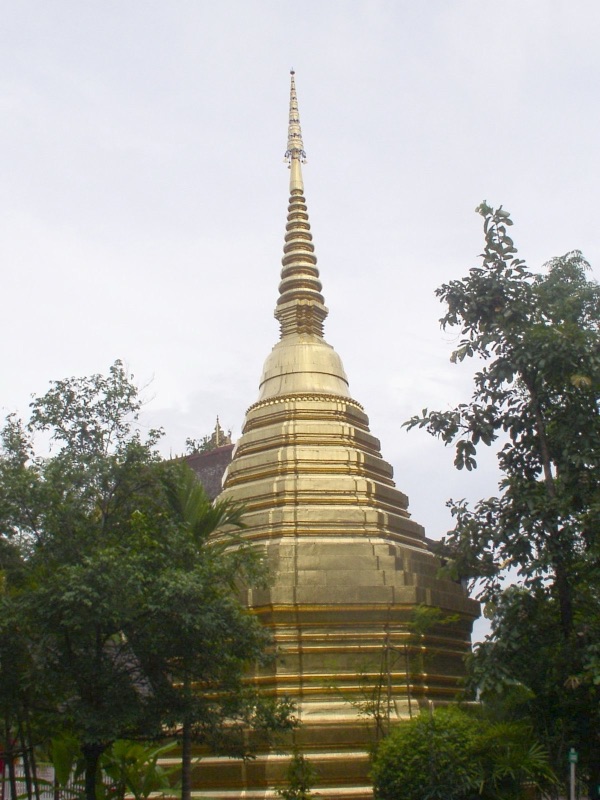
In Jiang Hai there was an old temple called Wat Pa Yia. In it stood an old chedi (เจดียฯ ฿ฯ, jedi), which the people of Lanna call a that (ธาฯตฯ, that). One day lightning, fa pha (ฟ้าผ่า), struck the chedi and it collapsed. Inside was a Buddha image coated in plaster, pun (ปูร), and covered all over in gold leaf, which Kham Mueang calls kham (ฅำ, kham). The people moved it into the hall, thinking it was an ordinary plaster image.
Not long after, the plaster at the tip of the nose flaked off. The abbot saw green stone underneath, so the plaster was carefully removed from the whole image. Only then did people see (han, หันฯ) that it was a Buddha image carved entirely from green stone. News of the jewel image spread across Lanna.
The phaya (พญา, phaya, king) of Jiang Mai (ชยฯงไห่มฯ, Jiang Mai, Chiang Mai), named in the popular telling as Phaya Sam Fang Kaen, sent a procession of elephants, jang (ช้างฯ), to bring the image to his capital. But when the procession (hae, แห่) reached a fork in the road, the elephant carrying the image on its back took fright and headed for Lampang (ลำพางฯ, Lampang), and would not walk to Jiang Mai. People took this as the wish of the image itself, so it was enshrined in Lampang.
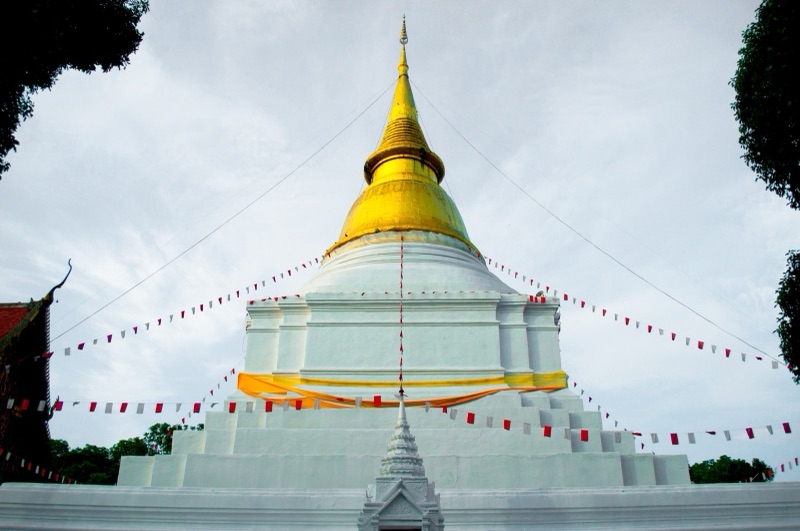
In Lampang the image stayed at the temple now called Wat Phra Kaew Don Tao Suchadaram, on the Wang River. The popular telling says it remained there for 32 years, until the reign of King Tilokarat, who finally brought it to Jiang Mai. This part of the legend ends with bo ya ja lae (บ£าช¦, bo ya ja lae): "and so it was".
- Year of the discovery: general books and media, such as MGR Online (Rom Bunnak, 2022), give 1434 CE (BE 1977). The Jinakalamali (Saeng Manavidura's translation, as quoted in Panidhana Journal) gives late 1436 CE (BE 1979).
- Year it went to Chiang Mai: the figure most often repeated is 32 years after the discovery. The Jinakalamali says King Tilokarat brought it from Lampang in the Year of the Ox, Chula Sakarat 843 (1481 CE), and the MGR Online article gives 1488 CE. The numbers differ by several years between sources.
- How the elephant chose: most tellings say the elephant took fright at the fork and ran towards Lampang. Some say lots, salak (สๆลฯากฯ, salak), were drawn and Lampang came up.
- Who sent the elephants: the popular telling names Phaya Sam Fang Kaen, but some sources say King Tilokarat invited the image from the start.
Jang: the elephant that chose the way
An elephant in Kham Mueang is jang: the Thai ch becomes j, following the Kham Mueang sound rules. Sitting on an elephant's back is khi (ขี่, khi), and the dictionary gives "ride a horse, ride an elephant" as its examples. The elephant that would not go to Jiang Mai is the part of this story people remember most, and other Lanna legends also let an elephant "choose the place", such as the elephant that carried the Buddha relic up Doi Suthep in the time of King Kue Na.
Panidhana Journal suggests that the image's stay in Lampang may be linked to the political power of Muen Lok Nakhon, the lord of Lampang and King Tilokarat's uncle. This is a scholar's interpretation, not something the legend itself says. Read more about the city in Lampang: Khelang Nakhon.
King Tilokarat and the niche on the Great Chedi
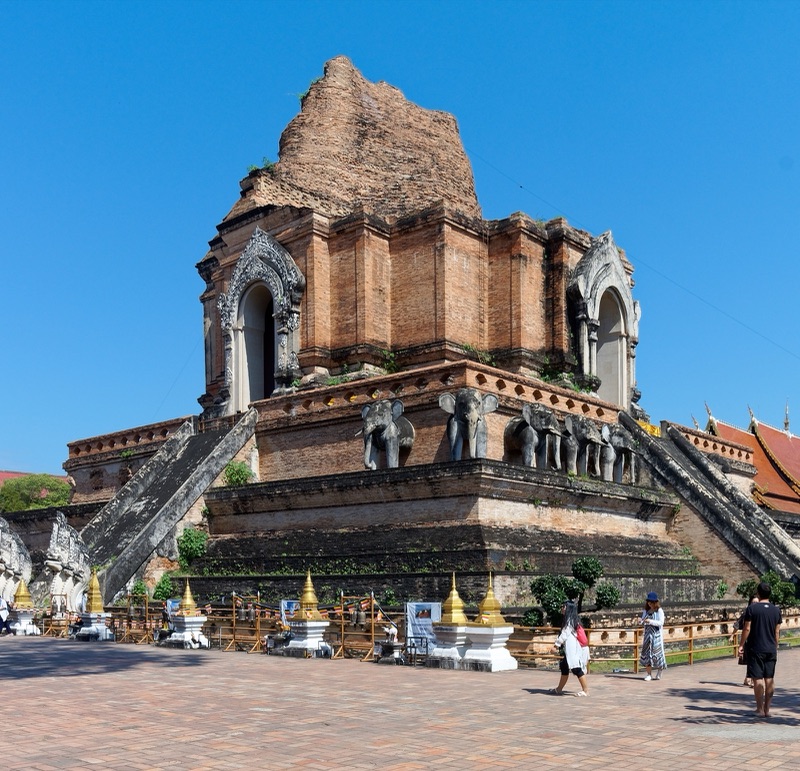
King Tilokarat's birth name was Thao Lok. The dictionary explains under lok (ล฿กฯ, lok) that in old times a sixth son was called "lok", and he was the sixth son of King Sam Fang Kaen. Once on the throne of Jiang Mai, he enlarged the Great Chedi until it was the tallest in Lanna (read more in King Tilokarat).
According to Panidhana Journal's summary of the Jinakalamali, King Tilokarat brought the image from Lampang to Jiang Mai. At first it stayed for about a year in a khong (โข฿งฯ, khong), a niche or pavilion-cage, in the middle of the great wihan (วิหารฯ, wihan, image hall) of Wat Chotikaram, today's Wat Chedi Luang. Then it was raised into the eastern niche of the Great Chedi. Luang (หลฯวฯง, luang) in Kham Mueang means "big, great", so the Chedi Luang is simply the city's "great chedi".
Scholars' view: why the Great Chedi?
- Phra Phongrawi Uttarabhaddo and colleagues (2022) read the placing of the image on the Great Chedi as an expression of the universal monarch (chakravartin) ideal. In the legend, the image's stone stands in for the mani-jot jewel that belongs to a universal monarch, so whoever keeps the image can be likened to one.
- The same study notes that the Buddha image in the northern niche of the Great Chedi closely resembles the Emerald Buddha in its proportions and the position of its hands.
- Read about the Pali chronicle that records this image's history in the Jinakalamali.
From Lanna to Lan Jang and Bangkok
The Emerald Buddha stayed in Jiang Mai for several decades. Near the end of the Mangrai dynasty, King Setthathirat (Chaiyachettha), who ruled both Chiang Mai and Lan Jang (ล้านฯช้างฯ, Lan Jang, the Lao kingdom of Lan Xang), returned to Luang Prabang around 1551 and took the image with him. It was later moved to Vientiane, around 1564, and stayed there for more than two hundred years.
In the Thonburi period, around 1778–1779, the Emerald Buddha was brought to Thonburi, and in 1784 King Rama I had it enshrined at Wat Phra Si Rattana Satsadaram, where it remains today. The exact year of each move differs slightly between sources.
Following the phra kaeo in Lanna today
| City | Temple | What to see |
|---|---|---|
| Jiang Hai | Wat Phra Kaew (formerly Wat Pa Yia) | The chedi, and the Phra Yok Chiang Rai, a jade Buddha image the people of Chiang Rai made to take the original's place, enshrined in the Jade Buddha Hall in 1991 to mark the 90th birthday of the Princess Mother, Somdet Phra Srinagarindra |
| Lampang | Wat Phra Kaew Don Tao Suchadaram | The chedi and halls by the Wang River where the image is said to have stayed |
| Jiang Mai | Wat Chedi Luang Worawihan | The eastern niche of the Great Chedi, where the image once sat |
Phra jao (ระฯพเจั้า, phra jao) is also how Kham Mueang refers to a Buddha image. When you pay respect at temples in Lanna, you will hear older people call an image "phra jao" followed by its name.
All three are working temples where monks live. Dress modestly with shoulders and knees covered, take off your shoes before entering a hall, and keep your voice low. If you meet a tu jao (ทุเจั้า, tu jao), a monk, politely make way. See Lanna temple etiquette for more.
Kham Mueang words from the legend
| Kham Mueang | Lanna script | Reading | Meaning (from the dictionary) |
|---|---|---|---|
| phra kaeo | (see above) | phra kaeo | a Buddha image made of a precious stone |
| kaeo | (see above) | kaeo | a hard, clear stone; gems |
| jedi / that | (see above) | jedi / that | a chedi; the people of Lanna call it that |
| fa pha | (see above) | fa pha | lightning strike |
| pun | (see above) | pun | lime plaster |
| kham | (see above) | kham | gold |
| han | (see above) | han | to see, to find |
| jang | (see above) | jang | elephant |
| khi | (see above) | khi | to ride, sit astride, e.g. ride an elephant |
| hae | (see above) | hae | to go in a procession |
| khong | (see above) | khong | a niche, a cage, an arched gateway |
| luang | (see above) | luang | big, great |
Summary
- The Emerald Buddha first appears in history in Chiang Rai, when an old chedi at Wat Pa Yia was struck by lightning and collapsed, revealing a plastered, gilded Buddha image inside.
- When the plaster at the tip of the nose flaked off, people saw that the whole image was carved from green stone.
- The legend says the elephant carrying it would not go to Chiang Mai and headed for Lampang instead, so it stayed at Wat Phra Kaew Don Tao for about thirty years.
- King Tilokarat (Thao Lok) brought the image to Chiang Mai and placed it in the eastern niche of the Great Chedi.
- The dates differ between sources: the Jinakalamali gives late 1436 for the discovery and 1481 for the move to Chiang Mai, while popular accounts give 1434 and 32 years in Lampang.
Look up phra kaeo and more temple words in the Moradok Lanna dictionary (in Thai). Read more Lanna legends in Wiang Nong Lom and Chao Luang Kham Daeng.
Sources
- Moradok Lanna dictionary: พระแก้ว · แก้ว · จ๊าง · เจ๋ดีย์ · ลก · โขง
- Phra Phongrawi Uttarabhaddo (Holimchayachotikul), Phrakhru Samu Thanachot Jirathammo and Prateep Phuetthonglang. (2022). เจดีย์หลวงมหาธาตุกลางเวียง: ภาพสะท้อนคติจักรพรรดิราชในรัชสมัยพระเจ้าติโลกราช [The Great Chedi at the heart of the city: the universal-monarch ideal in the reign of King Tilokarat]. Panidhana Journal, 18(1), 111–139 (quoting the Jinakalamali, Saeng Manavidura's translation, Fine Arts Department 1958, and Sakchai Saising 2004)
- Rom Bunnak. (2022, 23 March). การเดินทางครั้งสุดท้ายของพระแก้วมรกต [The last journey of the Emerald Buddha]. MGR Online
- Burapha Chotchuang. (2021, 8 January). ครั้งหนึ่ง "พระแก้วมรกต" ประดิษฐานวัดพระแก้วดอนเต้าฯ ลำปาง [When the Emerald Buddha stayed at Wat Phra Kaew Don Tao, Lampang]. Siam Rath
- TrueID Travel. (2021, 8 March). ไหว้พระ วัดพระแก้ว ที่เที่ยวเชียงราย [Paying respect at Wat Phra Kaew, Chiang Rai]
Practise the words from this article
Flip through 27 flashcards of the Lanna words used in this article.


