
Photo: Stefan Fussan / Wikimedia Commons (CC BY-SA 3.0)
Lanna Temple Etiquette: Do's, Don'ts and Temple Words
Lanna temple etiquette is the first thing to learn before you visit Chiang Mai, Lamphun, Lampang or Nan. A wat (วัดฯ, Kham Mueang wat), or temple, in Northern Thailand is a living place of worship where people still come to make merit every day, and it is also some of the finest Lanna art you will ever see. This guide gathers the do's and don'ts, together with the Kham Mueang (Northern Thai) words you will hear inside the temple grounds, so you can visit with confidence and show respect to the people who look after these places.
Kham Mueang words for the parts of a temple
You walk in through the khong (โข฿งฯ, khong), the arched temple gateway, into the khuang wat (ข่วฯงวัดฯ, khuang wat), the temple courtyard. The building most visitors enter to pay respect to the Buddha is the wihan (vihara). The chedi, the tall pointed stupa, is simply called that in Kham Mueang; the dictionary gives "that Doi Suthep" for the great relic chedi of Doi Suthep.
| Kham Mueang | Lanna script | Meaning (from the dictionary) |
|---|---|---|
| wihan | วิหารฯ | vihara: the hall that houses the main Buddha image |
| bot | โบส฿ถฯฯ | ubosot: the ordination hall where monks perform their rites |
| that | ธาฯตฯ | chedi, relic stupa |
| jedi | เจดียฯ ฿ฯ | chedi (in Lanna usually called that) |
| ku | กู่ | chedi or stupa holding ashes |
| ho tham | หํอฯธัม์มฯ | scripture library, where palm-leaf manuscripts are kept |
| ho la-kang | หํอฯรฆังฯ | bell tower |
| tung | ทุง | Lanna banner, offered in worship |
| sing | สิง์หฯ | singha, a mythical lion of great strength |
| nak | นาฯคฯ | naga, the great serpent |
| hua nak | ห฿วฯนาฯคฯ | the naga's head at the foot of a naga staircase |
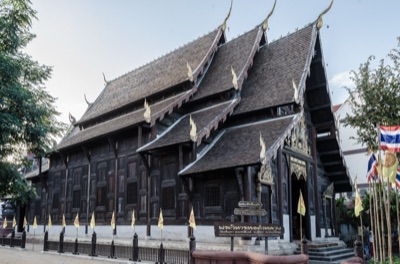
Photo: Vichitsilp / Wikimedia Commons (CC BY-SA 3.0)
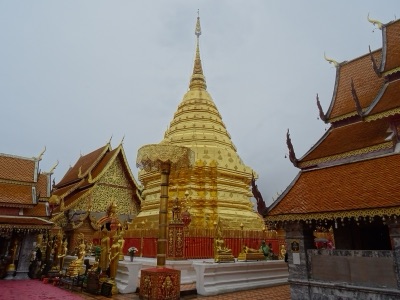
Photo: Christophe95 / Wikimedia Commons (CC BY-SA 4.0)
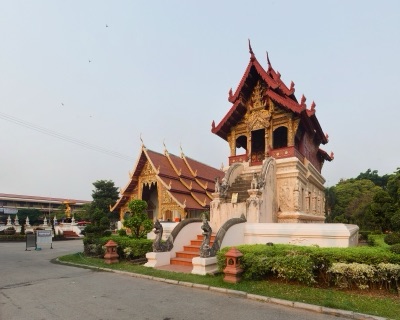
Photo: JJ Harrison / Wikimedia Commons (CC BY-SA 3.0)
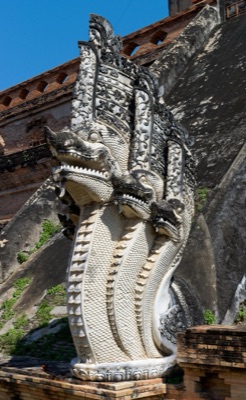
Photo: Jakub Hałun / Wikimedia Commons (CC BY-SA 4.0)
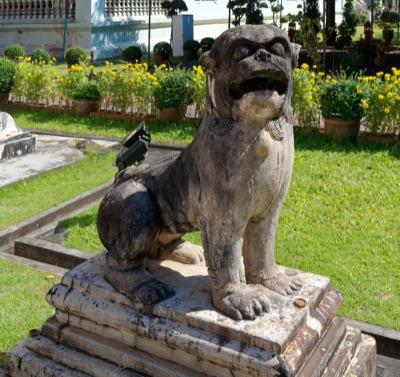
Photo: Jakub Hałun / Wikimedia Commons (CC BY-SA 4.0)
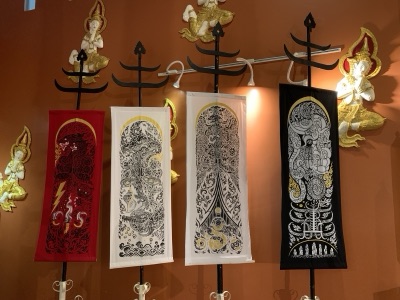
Photo: Chainwit. / Wikimedia Commons (CC BY 4.0)
The banners are explained in Tung: Lanna Banners, and the palm-leaf manuscripts kept in the scripture library in Pap Sa: Lanna Palm-Leaf Manuscripts.
Dress modestly and take off your shoes
The Tourism Authority of Thailand (TAT) asks visitors to dress modestly at temples. For men that means a shirt with sleeves and long trousers or shorts that cover the knees; for women, a top with sleeves (not spaghetti straps) and a skirt longer than knee length. If you are wearing a sleeveless top, just drape a shawl over your shoulders. In Kham Mueang a shawl is a pha tum (ผ้าทุ้ม, pha tum).
Traditional Lanna dress is perfect for a temple visit. Women wear the sin (สิ้นฯ, sin), the Lanna tube skirt, and men wear tiao (ต่ยฯว, tiao), trousers; read more in Sin Tin Chok: the Lanna Skirt. Take off your kup (กุบ, kup), your hat, and your sunglasses before you go inside.
Every temple has a place for shoes outside its buildings, and TAT notes that everyone enters a temple barefoot. Shoes or sandals are koep (เกิปฯ, koep); to take them off is thot (ถอฯด, thot) koep, and to put them back on is sup koep (สุบเกิปฯ, sup koep).
At the door of the vihara there is a raised wooden threshold, the tot pa-tu (ทอฯดระฯบตู, tot pa-tu). Many Thai people, northern and central alike, avoid stepping on a threshold because they believe it is watched over by mae pa-tu (แม่ระฯบตู, mae pa-tu), the goddess of the threshold, so they kham (ข้ามฯ, kham), step over it, instead. The dictionary itself gives "step over the threshold" as its example for kham.
Inside the vihara: how to sit and where your feet go
Inside the vihara, sit with your legs folded to one side, what Kham Mueang calls nang po la mae (นั่งฯปํอฯหลฯะแห้มฯ, nang po la mae), so that your tin (ตีนฯ, tin), your feet, point backwards and never towards a Buddha image or a monk. TAT also advises never to turn your back on a Buddha image, never to place yourself higher than it, and always to walk clockwise around it or any other sacred object, keeping it on your right.
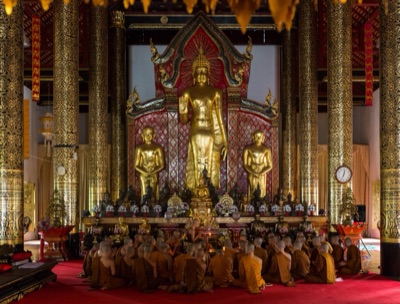
Photo: Diliff / Wikimedia Commons (CC BY-SA 3.0)
To pay respect with the palms pressed together is wai (ไห้วฯ, wai), just as in central Thai, and Kham Mueang also has san sa (สานฯสา, san sa), to raise the joined palms in a wai.
Keep your voice low. Kham Mueang has a gentle reminder: "u koi koi" (ค่อฯยฯๆฯ, koi koi), speak softly. Or more directly, ja pai u dang (จะไพอู้ดังฯ, ja pai u dang): "don't speak loudly" (ja pai means "don't" in Kham Mueang; see Ja Pai Means "Don't").
Monks, novices and what women should know
Northern Thais call a monk tu jao (ทุเจั้า, tu jao), or simply tu (ทุ, tu). A novice is a pha (ระฯพ; the dictionary spells it พระ but it is read pha). Monks, novices and Buddha images are counted with the word ton (ต฿นฯ, ton), as in "five novices, ha ton".
An elder monk whom people especially revere may be honoured as a khru-ba (ระฯคูบาฯ, khru-ba), a title the dictionary says is used only in Lanna culture, as with Khruba Siwichai. Women who live at a temple in white robes and keep the eight precepts are mae chi (แม่ชี, mae chi), also called mae khao.
In the early morning you will see people sai bat (ไส่บาฯระฯต, sai bat), giving alms to monks. Before giving, they often raise the food above their heads, which Kham Mueang calls jo sai hua (โจอฯะไส่ห฿วฯ, jo sai hua). If you would like to join in, take off your shoes, dress modestly, and stand or kneel quietly.
Lanna also has the custom of sai bat peng put (ไส่บาฯระฯตเพ็งฯพุธ์, sai bat peng put), giving alms before dawn on peng put (เพงฯพุธ์, peng put), a full-moon day that falls on a Wednesday. The dictionary explains that Lanna Buddhists believe the monk Upagupta rises from his meditation to receive alms in the darkness before that dawn.
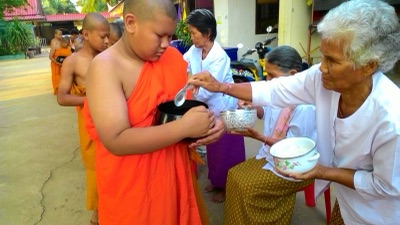
Photo: Donavanik / Wikimedia Commons (CC BY-SA 4.0)
Why are some halls closed to women?
Many visitors are surprised by signs reading "Ladies not allowed" in northern temples. The rule applies only to particular buildings, not to whole temples, and women may pay respect everywhere else in the same temple. The best-known examples are:
- The Inthakhin vihara, the shrine of the Chiang Mai city pillar at Wat Chedi Luang: women may not go up into the shrine and pay respect from outside (Thanaphon Ruankham and Prathip Phuetthonglang, 2024). See also Sai Khan Dok.
- The Buddha footprint pavilion at Wat Phra That Lampang Luang, where the inverted image of the chedi can be seen: the temple opens it to men only, while women can see the chedi's reflection in the Wihan Phra Phut (MGR Online, 2009).
- The silver ubosot of Wat Sri Suphan, Chiang Mai, where a sign at the stairs reads "สุภาพสตรี ห้ามเข้า / MAN ONLY".
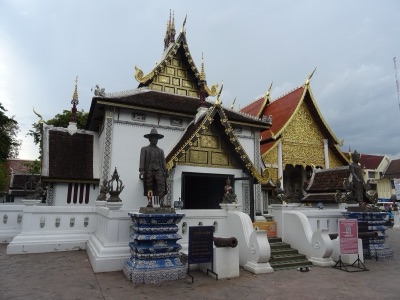
Photo: Christophe95 / Wikimedia Commons (CC BY-SA 4.0)
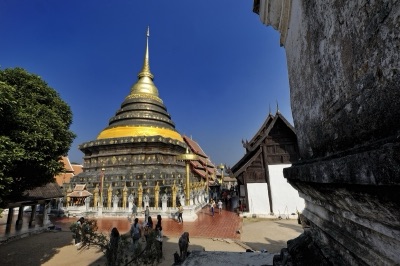
Photo: Mr.Peerapong Prasutr / Wikimedia Commons (CC BY-SA 4.0)
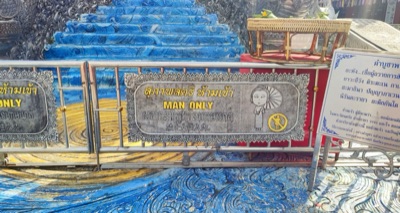
Photo: Jtorquy / Wikimedia Commons (CC BY-SA 4.0)
Several explanations have been offered. Chiang Mai News (2021), drawing on a Matichon Weekly column by Phensupha Sukkhata Jai-in, sums them up like this:
- Monastic discipline. Monks may not touch women, so the ordination hall, where monks perform their formal rites, is often set apart.
- Sacred objects beneath the ground. Many chronicles say the great relics of the North are buried underground, with protective yantras laid around them, and it was believed that menstrual blood weakens such charms.
- The Inthakhin pillar. Many offerings are buried beneath the pillar, so the presence of a menstruating woman was seen as disrespectful.
The same article stresses that all of these are "only hypotheses", a mix of Buddhist and folk-magic ideas that became Lanna custom over time. Northern Thais call such long-held custom hit (รีตฯ, hit). You don't have to agree with every rule, but please follow the temple's signs: these are community spaces.
Joining in merit-making respectfully
If you'd like to make merit, the Kham Mueang word is tan (ทาฯนฯ, tan), giving or donation, and to join others in giving is hom tan (รอฯมทาฯนฯ, hom tan). Bun (บุญ, bun), merit, is the same as in central Thai. Someone who goes to the temple often is praised as khao wat khao wa (เขั้าวัดฯเขั้าวาฯ, khao wat khao wa).
| Kham Mueang | Lanna script | Meaning (from the dictionary) |
|---|---|---|
| pu ja | ปู่ชา | to worship, to pay homage |
| khan dok | ขันฯดอฯก | a footed flower bowl |
| khan kaeo tang sam | ขันฯแก้วฯทังฯสามฯ | a large triangular footed tray for flowers, incense and candles offered to the Buddha in the vihara |
| tian | ทยฯร | candle |
| tian sae | ทยฯรแส้ | incense stick |
| dok mai | ดอฯกไม้ | flower |
| tit kham | ติดฯฅำ | to apply gold leaf to a Buddha image |
| tan tung | ทาฯนฯทุง | to offer a tung banner |
| jedi sai | เจดียฯซายฯ | sand chedi, decorated with flags and banners at Songkran |
| khon sai khao wat | ข฿นฯซายฯเขั้าวัดฯ | to carry sand into a temple to build sand chedis, as merit |
| mai kam sa-li | ไม้คําฯระฯสี | forked props for the bodhi tree, offered at Songkran to extend one's life |
| wan sin | วันฯสีลฯฯ | Buddhist holy day |
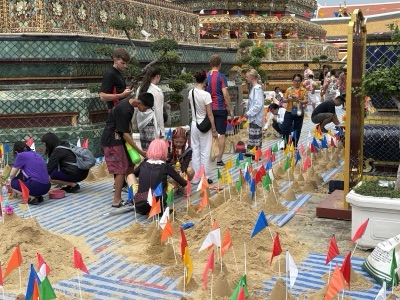
Photo: Chainwit. / Wikimedia Commons (CC BY 4.0)
In Chiang Mai, anyone can join Sai Khan Dok, and there are big merit festivals such as Tan Kuay Salak and Poy Luang. For sand chedis and bodhi-tree props, read Wan Phaya Wan.
When the monks finish their blessing, everyone answers together sa-tu (สาทุ, sa-tu), that is sadhu: "well done, so be it". If you make a mistake without meaning to, say kho su-ma (ขํอฯสูมา, kho su-ma): "I'm sorry, please forgive me".
Quick list: do's and don'ts
| Do | Don't |
|---|---|
| Dress modestly, covering shoulders and knees | Wear spaghetti straps or shorts above the knee into a vihara |
| Take off your shoes and hat before going inside | Step on the threshold |
| Sit with legs folded to the side, feet pointing back | Point your feet at a Buddha image or a monk |
| Walk clockwise around chedis and sacred objects | Climb on or sit on a Buddha image's base for a photo |
| Speak softly and silence your phone | Talk loudly or play music in the temple |
| Women: offer things to monks through a man or on a cloth | Women: touch a monk or his robes |
| Follow the temple's signs, such as areas closed to women | Enter an area the temple asks you not to |
Test yourself (answers in bold)
- What do Northern Thais call a chedi? — that
- What does "ja pai u dang" mean? — don't speak loudly
- What is the difference between a tu jao and a pha? — a tu jao is a monk; a pha is a novice
- How should a woman offer something to a monk? — hand it to a man to pass on, or place it on the monk's cloth
- What do people say when the monks finish their blessing? — sa-tu
Summary
- In Kham Mueang a chedi is a that, the scripture library is the ho tham, a monk is a tu jao and a novice is a pha.
- Cover your shoulders and knees, take off your shoes and hat before entering, and step over the threshold.
- Sit with your legs folded to the side, feet away from the Buddha, and speak softly: u koi koi.
- A few places, such as the Inthakhin shrine and the Wat Sri Suphan ubosot, are closed to women by Lanna custom (hit); please follow the temple's signs.
- Join in merit-making with tan and hom tan, and answer the blessing with sa-tu.
Look up more temple words in the dictionary (in Thai), and read about Chiang Mai's city-pillar festival in Sai Khan Dok.
Sources
- The Moradok Lanna dictionary (in Thai): วัด · ธาตุ · ธาตุปีเกิด · ตุ๊เจ้า · สาตุ๊
- Tourism Authority of Thailand. (2018, August 29). Observing temple and sacred site etiquette while in Thailand. TAT Newsroom
- Thanaphon Ruankham and Prathip Phuetthonglang. (2024). วัดเจดีย์หลวง: สัปปายะอารามเพื่อการท่องเที่ยวเชิงพุทธศาสนาในจังหวัดเชียงใหม่ [Wat Chedi Luang: a suitable monastery for Buddhist tourism in Chiang Mai]. Methi Wichai Journal 1(1)
- MGR Online. (2009, May 4). แอ่ววัดล้านนา เอาธรรมนำหน้า [Touring Lanna temples, Dharma first]
- Chiang Mai News. (2021, December 8). ไขข้อสงสัย เสาหลักเมืองเชียงใหม่ ทำไมห้ามผู้หญิงเข้า? [Why are women not allowed into Chiang Mai's city pillar shrine?] (citing Phensupha Sukkhata Jai-in in Matichon Weekly)


