

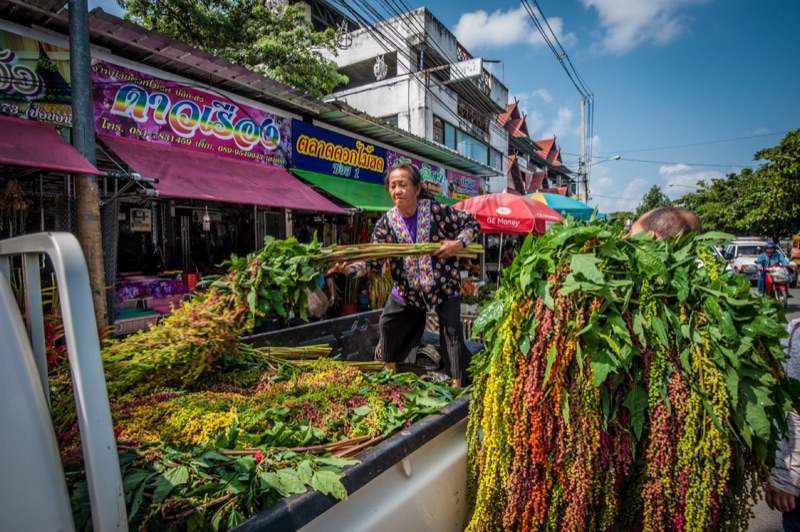
Photo: Department of Tourism Thailand: LannaPhoto / Wikimedia Commons (CC BY-SA 3.0)
Going to the Kad: Kham Mueang Words for the Market
Kad (กาดฯ, kat) is the Lanna word for market. When a Khon Mueang (Northern Thai person) says "pai kad", they simply mean "going to the market". But the markets of Lanna come in many kinds, named by time of day, size and what they sell. This article gathers the names of markets and the Kham Mueang (Northern Thai) words you need when shopping, from asking the price and tasting to saying thank you, from the Moradok Lanna dictionary.
What each kind of kad is called
| Name | Lanna script | Meaning (from the dictionary) |
|---|---|---|
| kat chao | กาดฯเชั้า | a market held only in the morning |
| kat laeng | กาดฯแลงฯ | a market held only in the evening |
| kat nat | กาดฯนัดฯ | a market where people agree to meet and trade on certain days |
| kat mua | กาดฯหั้฿มฯวฯฯ | a fresh market open all day long |
| kat luang | กาดฯหลฯวฯง | a large market with every kind of goods, usually the big market in the city centre, such as Kad Luang in Chiang Mai |
| kat kom | กาดฯก้อฯม | a small market where few people come to buy and sell |
| kat bae puen | กาดฯแบพื้นฯ | a market where goods are laid out flat on the ground |
| kat li | กาดฯลี | a shop; a market that is always there, all day |
| kat wai | กาดฯวาฯยฯ | the market near closing time, when buyers and sellers have almost all gone home |
Buying, selling, paying and pae
The basic words for buying and selling in Kham Mueang, with their meanings and Lanna spellings from the dictionary:
- sue (ซื้), to buy — to exchange money for something you want
- khai (ขายฯ), to sell — to exchange goods for money
- chai (จ่ายฯ), to pay — to buy, as in chai kap khao (to shop for food), or to settle with money
- pae (แปะ) — to buy on credit (to buy now and pay later); also sue pae
Asking the price: tao dai and paeng
Tao dai (เทัาฯฯได) means how much?, used to ask the price (tao hue is also used).
Paeng (แพงฯ) means costly, high in price, and it can also mean dearly loved.
Ka (คาฯ) goes at the end of a sentence to make it a question, meaning "or? / yet? / isn't it?", as in maen ka: is that right?
Saying it's delicious: lam
Lam (ลำ, adj.) means delicious, tasty, to one's liking. Kham Mueang gives you several levels to choose from:
| Say | Lanna script | Meaning |
|---|---|---|
| lam ko | ลำกํ่อฯ | is it tasty? |
| lam | ลำ | tasty |
| lam tae | ลำแท้ | really tasty, very tasty |
| chat lam | ชาดฯลำ | very tasty, just to my liking |
| bo lam | บลำ | not tasty, tasteless |
นี้กิ๋นลำ (ni kin lam) — this is delicious (example sentence from the dictionary, under the word ni, "this")
Thanking the seller: yin di
When they have finished shopping, Khon Mueang say thank you with yin di (ยินฯดี), meaning pleased, thanks, thank you (you can also say yin di yin ban).
More words used at the kad
- pho (ผํอฯ) — to look, to watch, to look after
- kin กิ๋น — to eat
- kat ngua kat khwai (กาดฯง฿วฯกาดฯฅวฯายฯ) — a market mainly for buying and selling cattle and buffaloes
- kat saeng (กาดฯแสงฯ) — a market for buying and selling gems
Words you can use right away at the kad
| Situation | Kham Mueang |
|---|---|
| going to the market | pai kat |
| asking the price | tao dai |
| it's expensive | paeng |
| asking if it's tasty | lam ko |
| praising it as very tasty | lam tae / chat lam |
| thank you | yin di |
Look up more words about the kad in the Moradok Lanna dictionary (in Thai), and read about the beetles that Khon Mueang love to keep for fighting in the article Kwang Lanna.


