

Photo: yeowatzup / Wikimedia Commons (CC BY 2.0)
Kiang Kaeo: Kham Mueang from a Lamphun Grandmother Song
Kiang Kaeo is a Kham Mueang (Northern Thai) song by OverNormal that tells the story of a mae ui (แม่อุ้, Kham Mueang reading mae ui), a grandmother of Lamphun, in the voice of her grandchild. The lyrics are simple but full of the Kham Mueang that people really use at home, which makes the song ideal for practising reading and listening to the Lanna language.
This article is part of the series Kham Mueang through songs and literature. It reads the lyrics line by line, translates them, points out the Kham Mueang words worth remembering, and looks at how the song rhymes.
What is the song Kiang Kaeo about?
The words and music are by Jarus Soontornsing (Toni Maxx) (จรุส สุนทรสิงห์), released on OverNormal. According to the lyrics, grandmother Kiang Kaeo lives in a wooden huean (เริอฯร, read huean, house) near a temple in the town of La Pun (หลฯะพูร, read la-pun), the Kham Mueang name for Lamphun Province.
She gets up before dawn, steams the rice, raises ten children, and carries flowers and all kinds of goods to sell at the kat (กาดฯ, read kat, market). The song goes on to tell how in 1968 she took a ride to Kat Ton Lamyai market and a great fire broke out. This matches the record in MGR Online (2011) that in that year a fire broke out around Warorot Market and Ton Lamyai Market in Chiang Mai. The last part is the voice of the grandchild singing this song for the grandmother.
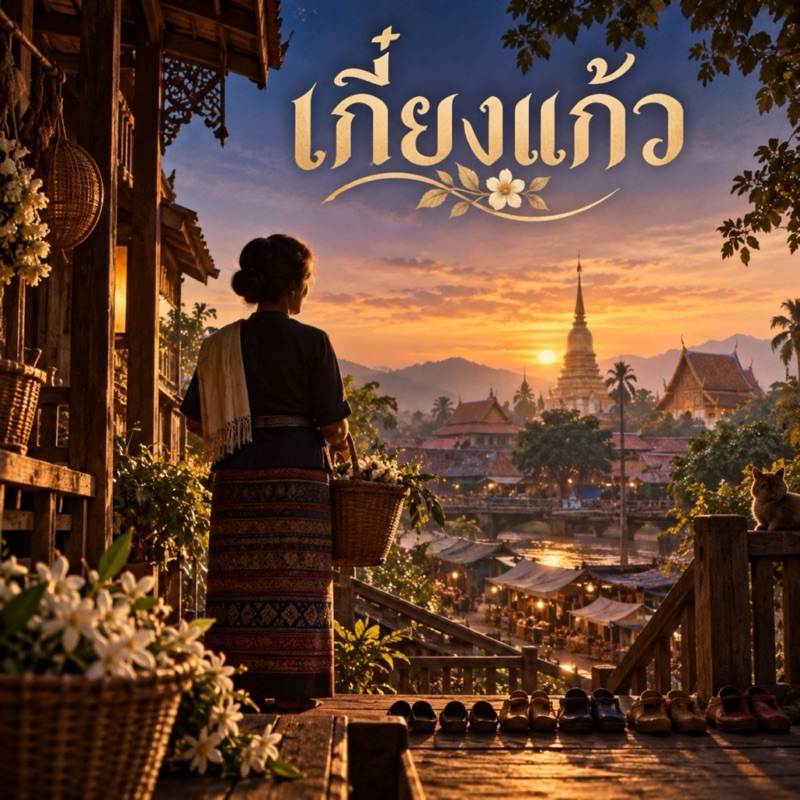
Listen to the full song with lyrics at overnormal.com/play/kiang-kaeo (the song does not have a video on YouTube yet).
The opening: "People have told it down the years"
เปิ้นเล่ากั๋นมา เรื่องแม่อุ๊ยของหมู่เฮา เกี๋ยงแก้วคนงาม แห่งเมืองหละปูนขุนเขา เฮือนไม้อยู่ใกล้วัด ผ่านวันผ่านคืนเนิ่นเนา เรื่องของแม่อุ๊ยวันนี้...หลานจะเล่าหื้อฟังเบาๆ — Kiang Kaeo (Intro), lyrics: Jarus Soontornsing
| Line | Meaning in English |
|---|---|
| poen lao kan ma, rueang mae ui khong mu hao | People have told it down the years, the story of our grandmother |
| kiang kaeo khon ngam, haeng mueang la-pun khun khao | Kiang Kaeo the beautiful, of Lamphun, the land of mountains |
| huean mai yu klai wat, phan wan phan khuen noen nao | Her wooden house stands near the temple, through many long days and nights |
| lan cha lao hue fang bao bao | Her grandchild will tell it to you softly |
- poen (เพิ่นฯ, read poen) has several uses. The dictionary explains that it can stand for "I" between close friends, and for someone at a distance, as in "poen pai laeo" ("they have gone"). In this line poen lao therefore means "people tell".
- mu hao (หู่เรัา, read mu hao) means "we, us, our own people".
- hue (หื้, read hue) means "to give, to let"; it is one of the most frequently heard words in Kham Mueang.
The market verse: "Whatever she could sell"
เจ๊าตรู่ออกกาด หอบดอกไม้ไปวางพาด ใผเปิ้นอยากได้แห แม่จัดไว้ขายบ่หื้อได้ขาด อะหยังตี้ปอขายได้ แม่เก็บไปขายตึงจิ๊นตึงผักกาด กอยเก็บกอยฮอมกั๋น... เป๋นสะมุดเป๋นกระดาษ — Kiang Kaeo (Verse 2)
| Line | Meaning in English |
|---|---|
| chao tru ok kat, hop dok mai pai wang phat | At first light she goes to market, carrying flowers to lay out for sale |
| phai poen yak dai hae, mae chat wai khai bo hue dai khat | If anyone wants a fishing net, she keeps them for sale so they never run out |
| a-yang ti po khai dai, mae kep pai khai tueng chin tueng phak kat | Whatever she could sell, she took to sell, both meat and mustard greens |
| koi kep koi hom kan... pen sa-mut pen kradat | Saving bit by bit, gathering it together... it became notebooks and paper (her children's schooling) |
- chao (เชั้า, read chao) means morning. The dictionary explains that it means the time before sunrise, while the later morning after sunrise is called we-la ngai.
- phai (ไผ, read phai) means "who". The lyrics spell it ใผ, but the dictionary spells it with the vowel sign mai malai (ไผ).
- a-yang (อหัยฯง, read a-yang) means "what"; ti (ที่, read ti) means "that, which", and po (พํอฯ, read po) means "enough".
- chin (ชิ้นฯ, read chin) does not mean "piece" (as the similar central Thai word does) but meat, as in chin kai (chicken) and chin khwai (buffalo meat).
- hom (รอฯม, read hom) means to join in, to save up, to gather together, as in hom tan, to join in making merit.
Key words of the song: tueng…tueng and ko
The chorus has a sentence pattern that Khon Mueang (Northern Thai people) use every day.
แม่อดแม่อยากบ่ว่า ขอหื้อลูกอิ่มทุกค่ำเจ๊า เหนื่อยเต้าใดก่อตึงสู้... แม่ฮับไว้ตึงหนักตึงเบา — Kiang Kaeo (Chorus)
In English: Mother went without and did not complain, as long as her children were fed every evening and morning; however tired, she kept fighting... she took it all on, the heavy and the light.
Tueng (ทึงฯ, read tueng) is a small but much-used word. The dictionary gives its meaning as every, as in pai tueng wan (go every day), and when repeated, tueng… tueng… means both… and…, as in tueng wan tueng khuen (all day and all night). So the song has tueng chin tueng phak kat (both meat and mustard greens) and tueng nak tueng bao (both the heavy and the light).
Ko (กํอฯ, read ko) here means also, then (central Thai ko). Tao dai (เทัาฯฯได, read tao dai) means "how much", so nueai tao dai ko tueng su means "however tired, she still kept fighting". Hap (รัปฯ, read hap) means to receive, to take on, and bo (บ, read bo) is used for negation, like "not".
Kham Mueang sounds that differ from central Thai
The words in the song show clearly how Kham Mueang sounds differ from central Thai.
| Central Thai | Kham Mueang in the song | What to notice |
|---|---|---|
| ruean, rap, ru, rong | huean, hap, hu, hong | r becomes h |
| chao, chue | chao, chue (written with จ) | ช becomes จ (both written ch in RTGS) |
| thi, thang | ti, tueng | th becomes t |
| pho | po | ph becomes p |
| pi, chon, tam | pi, chon, tam (with the mai chattawa mark) | words beginning with p, ch (จ) and t are written with a rising-tone mark |
All of these words are in the dictionary, for example hu (รู้, to know), chue (ชื่, name), pi (ปี, year), chon (จ฿นฯ, until) and tam (ตามฯ, to follow).
Hong (ร้อฯง, read hong) is especially worth remembering, because the dictionary gives it two meanings: to cry out, to sing (to make a sound, as in hong phleng, to sing a song) and to call (as in mae hong luk, a mother calls her child). The last line of the song, yang ku hong chue mae ok ma, therefore means "still calling out mother's name".
How the song rhymes: one verse, one end sound
Kiang Kaeo is not composed in the verse form of khao. Instead it uses a method common in contemporary songs: every line in a verse ends with the same vowel sound.
| Verse | Last words of the lines | Rhyming sound |
|---|---|---|
| Opening | hao, khao, nao, bao | -ao |
| Market verse | phat, khat, kat, kradat | -at |
| Chorus | hao, kao, chao, bao | -ao |
| Bridge | ko, to, no, no | -o |
Within the lines there are also paired repetitions that make the song catchy, such as phan wan phan khuen · koi kep koi hom · tueng nak tueng bao · taek king taek no · sip king sip kan. This "A B A C" pattern is a good way to remember Kham Mueang, because changing one word gives you a new phrase.
The song also mixes in central Thai words and graceful Pali and Sanskrit words, such as metta (kindness), suriya (the sun) and ura (the breast, the heart), and uses the central Thai khrai ("who") in verse 4 instead of phai. This shows that contemporary Kham Mueang songs choose words from both languages to fit the rhythm and the rhyme.
Summary
- Mae ui means grandmother, and mu hao means "we, our own people".
- Tueng means every, and tueng… tueng… means both… and…; ko means "also, then", or makes a question at the end of a sentence.
- Hong means both to cry out and to call, and hue means to give, to let.
- Many Kham Mueang sounds shift from central Thai systematically, such as r→h, ช→จ and th→t.
- The song uses one end sound for every line of a verse, and paired repetitions like tueng nak tueng bao.
Look up more words from the song in the Moradok Lanna dictionary (in Thai), and read the Kham Mueang used at the market in the article Going to the Kat Like a Khon Mueang.
More in this series: Kin Lam Kin Lam · Lanna, Lanna, or see the whole series at Kham Mueang through songs and literature (in Thai).
Sources
- Moradok Lanna dictionary (in Thai): แม่อุ๊ย · ตึง · ฮ้อง · หื้อ · ก้อย
- จรุส สุนทรสิงห์ (Toni Maxx) [Jarus Soontornsing (Toni Maxx)]. เกี๋ยงแก้ว (เนื้อเพลง) [Kiang Kaeo (lyrics)]. OverNormal. In Thai.
- ทิติยา เถาธรรมพิทักษ์ [Thitiya Thaothamphithak]. (2011). หนึ่งศตวรรษ "กาดหลวง" มนต์เสน่ห์วันวานมิจางหาย [A century of "Kat Luang": the charm of yesterday that never fades]. MGR Online (on the 1968 fire at Warorot Market and Ton Lamyai Market). In Thai.


