
Photo: Adam Jones / Wikimedia Commons (CC BY-SA 2.0)
Asking Questions in Kham Mueang: Ko, Ka, Phai, Sang
Asking questions in Kham Mueang is easier than it looks, because most questions are made by adding one small word to the end of a sentence. The one you hear most is ko (กํอฯ, Kham Mueang reading ko): pai ko means "will you go?". For who, what, where, how and how much, Northern Thai has its own words, such as phai, sang, nai, ja dai and tao dai.
This lesson gathers every kind of question word found in the Moradok Lanna dictionary, sorted by what you want to know, with the dictionary's own examples. It ends with answers, riddles, a short dialogue and an exercise. The dictionary even has an old word for "question" itself: pesana (เบสนาฯ), meaning "a question" or "to ask".
Ko, ka, bo: asking "…?" and "…yet?"
Questions that can be answered "yes" or "no" need only a few sentence endings, as the dictionary explains.
| Kham Mueang | Lanna script | Meaning (from the dictionary) | Dictionary examples |
|---|---|---|---|
| ko | กํอฯ | sentence ending that makes a question | pai ko (will you go?) · lam ko (is it tasty?) · maen ko (is that right?) |
| ka | คาฯ | or, yet?, isn't it?; added to make a question | ap nam laeo ka (have you bathed yet?) · bo muan ka (isn't it fun?) · luem ai laeo ka (have you forgotten me already?) |
| bo | บํอฯ | turns a verb into a question or an invitation | kin bo (will you eat?) · pai bo (are you going yet?) |
| wuea | เหิ่วฯอฯอ | ending that confirms what was said; also used to ask | kin khao wuea (will you eat?) · khao ao mia laeo wuea (he's married, you know) |
Some phrases ending in ko are so common that the dictionary lists them as entries of their own.
| Kham Mueang | Lanna script | Meaning |
|---|---|---|
| kin ko | กินฯกํอฯ | will you eat? do you eat? |
| maen ko | แม่นฯกํอฯ | is that right? e.g. khon ni maen ko (is this the one?) |
| dai ko | ได้กํอฯ | can you? is it OK? |
| han ko | หันฯกอฯ | do you see? |
| hu chak ko | รู้จักฯกํอฯ | do you know (them)? |
| hu khing ko | รู้ฅิงฯกํอฯ | are you conscious? can you feel it? |
Judging by the dictionary's examples, ko is the plain "…?" question, while ka usually asks "…yet?" (ap nam laeo ka) or asks in surprise, "…really?" (bo muan ka, luem ai laeo ka).
Phai: asking "who?"
| Kham Mueang | Lanna script | Meaning (from the dictionary) | Dictionary examples |
|---|---|---|---|
| phai | ไผ | who, which person | khong phai (whose?) · phai pen khon yia (who did it?) |
Sang, yang, a-yang: asking "what?"
"What" has several forms in Kham Mueang, and the dictionary says they can all replace one another.
| Kham Mueang | Lanna script | Meaning (from the dictionary) | Dictionary examples |
|---|---|---|---|
| a-yang | อหัยฯง | what, which thing (also sang, yang, a-sang, a-hang) | a-yang ha (what is it?) |
| sang | สังฯ | what, how, in what way | pho sang (what are you looking at?) · pen sang (how is it?) · yia sang (what are you doing?) |
| yang | หัยฯง | what; also why | |
| a-sang · a-hang | อสังฯ · อหังฯ | other forms of a-yang | |
| pen sang · pen yang | เปนฯสังฯ · เปนฯหัยฯ | what's the matter? what is it? | |
| ya yang · yia yang | ยหัยฯง · เยยฯะหัยฯง | what are you doing? |
Yang, yai, phoi: asking "why?"
| Kham Mueang | Lanna script | Meaning (from the dictionary) | Dictionary examples |
|---|---|---|---|
| yang | หัยฯง | what, why | |
| yai | ไอยฯ | why, how come | yai bo pai (how come you didn't go?) |
| phoi | พ้อฯยฯ | how come, why | |
| a-yang cha · yang cha | อหัยฯงชา · หัยฯงชา | what is it? why is that? (also sang cha, a-sang cha) | |
| a-yang yang an | อหัยฯงอยฯางฯอั้นฯ | what's all that? why is it like that? | |
| khang wai yia yang | ขางฯไว้เยยฯะหัยฯง | why keep it to yourself? | |
| wae yia yang | แว่เยยฯะหัยฯง | why stop by? |
The last two show that yia yang, "what are you doing?", can also mean "…why?" when it comes at the end of a sentence.
Nai, that dai, luk nai ma: asking "where?"
| Kham Mueang | Lanna script | Meaning (from the dictionary) |
|---|---|---|
| nai | ไหนฯ | which, where; joins other words to make a question, e.g. which story, go where, which day |
| that dai | ทัดฯได | where exactly? which spot? |
| luk nai ma | ลุกไหนฯมา | where have you come from? |
| thuek nai | ทึกฯไหนฯ | how far? up to where? |
| haeng | แห่งฯ | place, spot; "where are you going?" can be asked with haeng dai |
The dictionary has no separate entry for "when?". It says nai joins other words, as in wan nai ("which day?"), so you can ask about time with nai.
Ja dai, yang hue: asking "how?" and "which kind?"
| Kham Mueang | Lanna script | Meaning (from the dictionary) | Dictionary examples |
|---|---|---|---|
| ja dai | จได | how, in what way; a question ending | pen ja dai (how is it?) · yia ja dai (how do you do it?) |
| cha dai · ja dai · cha dai | ชได · จได · ชาได | in what way, which way; three other spellings of ja dai | |
| yang hue | อยฯางฯรฤ | how; used in questions | |
| san dai | สันฯได | in what way, in what manner | |
| tua dai | ต฿วฯได | which one? | |
| chuea dai | เชิ้อฯอได | which kind, which type, what level | |
| yueang dai | เยิ่อฯงได | which kind |
Ja dai means "how?", while ja pai + verb means don't, as in ja pai kin (don't eat). Read more in Ja Pai Means "Don't".
Tao dai, ki, mok dai: asking "how much?"
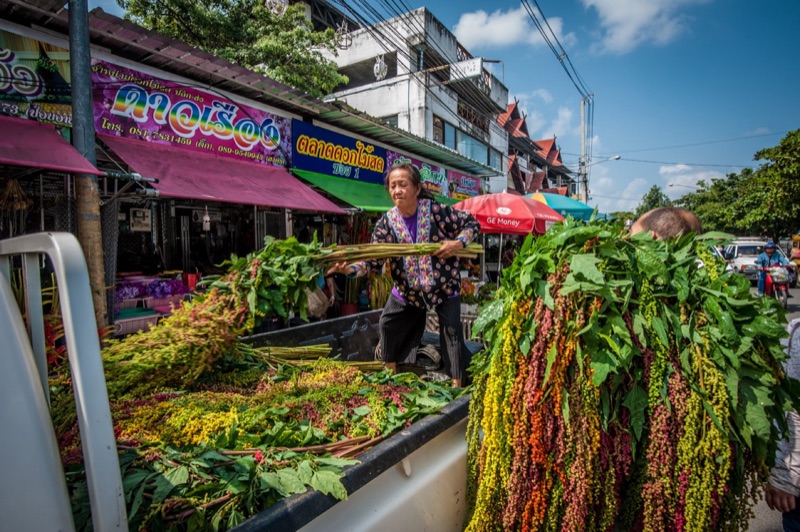
These are the questions you will use most at the market.
| Kham Mueang | Lanna script | Meaning (from the dictionary) |
|---|---|---|
| tao dai | เทัาฯฯได | how much? (also tao hue) |
| tao hue | เทัาฯฮื | what price? |
| ki | คี่ | how many (number, amount), how much |
| mok dai · mok hue | มอฯกได · มอฯกรื | how much, how big, to what extent |
| sak mok dai | สักฯมอฯกได | about how big? |
| thuek tao dai | ทึกฯเฯทั่าฯได | how much outright? e.g. "how much is this house, outright?" |
Tae ka, cha lue: asking "really?"
When surprised or unsure, Khon Mueang have several endings. Many contain cha or lue, which the dictionary glosses as "or".
| Kham Mueang | Lanna script | Meaning (from the dictionary) | Dictionary examples |
|---|---|---|---|
| tae ka | แท้คาฯ | really? | ngam tae ka (is she really pretty?) |
| tae i | แท้อี้ | really? (teasing) | hak nong tae i (do you really love me?) |
| cha lue | ชรฤ | is that so? | ngam cha lue (is it really pretty?) |
| an cha lue · an cha | อั้นฯชรฤ · อั้นฯขา | is that so? like that? | "it has been around since ancient times, is that so?" |
| wa an ka | ว่าฯอั้นฯคาฯ | did (they) say so? isn't it? | khao wa an ka (is that what they said?) |
| ni cha | นี้ชา | this one? an ending showing doubt | |
| cha | ชา | or, how come | pen yang an cha (is it like that?) |
| ha | หา | an exclamation of doubt or asking | a-yang ha (what is it?) |
| lue | รฤ | or, what |
Answering "like this", "like that": cha i, cha an
Once you can ask, you need to answer. These words pair with ja dai (how?) and nai (where?).
| Kham Mueang | Lanna script | Meaning (from the dictionary) |
|---|---|---|
| cha i · yang i | ชาอี้ · อยฯงฯอี้ | like this, this way |
| cha an · yang an | ชาอั้นฯ · อยฯงฯอั้นฯ | like that |
| i | อี้ | this, e.g. cha i (this way) |
| an | อั้นฯ | that, like that, e.g. cha an ko ngam di (that way is pretty too) |
| han | หั้นฯ | that, there |
| ti han | ที่หั้นฯ | over there, at that spot |
A-yang o: Kham Mueang riddles
The most fun question of all is the kam twai (คําฯทวฯาฯยฯ), a riddle, which often opens with a-yang o (อหัยฯงโออฯะ, "what is it?") and dares the listener with twai pho lo (ทวฯาฯยฯผํอฯลํอฯ, "go on, guess!"). The dictionary gives two examples. Try to guess before opening the answers.
A-yang o, ti bo dang, yong dang? (answer)
The answer is glasses (spectacles).
A-yang o, yao tao sok, tha tat khon ok, klai pen wa? (answer)
"What is a forearm long, but once you cut the hair off it becomes an arm-span long?" The dictionary's answer is an axe.
Try it: meeting at the market
This dialogue was written as a teaching example, using question words and sentence patterns from the dictionary.
Grandchild: Ui, luk nai ma chao? (Grandma, where have you come from?)
Grandma: Luk kat ma. (From the market.)
Grandchild: Phak mat ni tao dai chao? (How much is this bunch of greens?)
Grandma: Sip baht. Kin khao laeo ka? (Ten baht. Have you eaten yet?)
Grandchild: Yang chao. Ui yia yang kin chao? (Not yet. What are you cooking, Grandma?)
Grandma: Kaeng phak, kin ko? (Vegetable curry. Will you eat?)
Grandchild: Kin chao, lam tae ka? (Yes, please. Is it really tasty?)
The dialogue uses luk nai ma, tao dai, ka, yia yang, ko and tae ka. Swap in other words and practise asking your own questions.
Exercise
Translate these questions into English, then open the answers.
- Phai pen khon yia?
- Pho sang?
- Yai bo pai?
- Ban lang ni khai thuek tao dai?
- Ngam tae ka?
- To ask "have you bathed yet?", do you end with ko or ka?
Answers
- Who did it?
- What are you looking at?
- How come you didn't go? (Why didn't you go?)
- How much is this house, outright?
- Is it really pretty?
- Ka. The dictionary's example is ap nam laeo ka.
Summary
- For a plain "…?" question use ko (pai ko, lam ko); for "…yet?" or a surprised "…really?" use ka; there are also bo and wuea.
- Who = phai · what = sang, yang, a-yang · what are you doing = yia yang, ya yang · why = yang, yai.
- Where = nai, that dai · where from = luk nai ma · how = ja dai, yang hue · how much = tao dai, tao hue.
- Really? = tae ka, cha lue; answer "like this / like that" with cha i, cha an.
- Don't mix up ja dai (how?) with ja pai (don't).
Look up more question words in the Moradok Lanna dictionary (in Thai), practise the verbs that go with them in Everyday Kham Mueang Verbs, and learn how to say "don't" in Ja Pai Means "Don't".


