
Photo: Department of Tourism Thailand: LannaPhoto / Wikimedia Commons (CC BY-SA 3.0)
Kham Mueang Sentence Endings: Jao, Ko, Ka, Lae
Kham Mueang sentence-ending particles are the small words at the end of a sentence that make speech sound instantly Northern. The one heard most often is jao (เจั้า, Kham Mueang reading jao), a polite ending: kin laeo jao means "I've eaten" said politely. Change the ending and the same sentence turns from a statement into a question, an invitation or a firm "it's true".
This lesson gathers every entry in the Moradok Lanna dictionary described as a sentence ending and sorts them into six groups: polite endings, question endings, emphasis, inviting and urging, the endings that close a section of a palm-leaf legend, and the endings of klong poetry. Every word and example comes from the Moradok Lanna dictionary.
One sentence, eight meanings
See how kin (กินฯ, to eat) and khao (เขั้า, rice, a meal) change meaning with a different ending. Every sentence in the table is an example from the dictionary.
| Kham Mueang | Ending | Meaning |
|---|---|---|
| kin laeo jao | เจั้า | I've eaten (polite statement) |
| kin khao wuea | เหิ่วฯอฯอ | Will you eat? (question) |
| lam ko | กํอฯ | Is it tasty? (question) |
| ap nam laeo ka | คาฯ | Have you bathed yet? (question) |
| kin lae | แล่ | Go on, eat! (invitation) |
| kin sia toe | เสยฯเทิอฯะ | Do eat it, please (coaxing) |
| kin khao hia | เหยฯ | Eat up now (telling someone to finish) |
| bo dai kin tuea | เทิ่อฯอ | I haven't eaten yet (negative "not yet") |
Polite endings: jao and ko kha lae
| Kham Mueang | Lanna script | Meaning (from the dictionary) |
|---|---|---|
| jao | เจั้า | ending that shows humility, today used mostly by women, e.g. kin laeo jao (I've eaten), bo ao jao (no, thank you) |
| ko kha lae | คํข้า¦ | respectful ending used when a commoner speaks to a high official, for example |
Jao has several meanings in the dictionary. It is a title for descendants of the Lanna princes and also means lord or master. At the end of a sentence it works like the polite central Thai kha or jao kha. Ko kha lae is an old ending for speaking to people of high rank.
Question endings: ko, ka, wuea, cha lue
Kham Mueang does not ask with central Thai mai or rue; it uses these endings instead. A full lesson on asking questions is at Asking questions in Kham Mueang.
| Kham Mueang | Lanna script | Meaning (from the dictionary) |
|---|---|---|
| ko | กํอฯ | turns a sentence into a question, e.g. pai ko (will you go?), lam ko (is it tasty?), maen ko (is that right?) |
| ka | คาฯ | or? yet? right?, e.g. ap nam laeo ka, bo muan ka (isn't it fun?), maen ka (right?), luem ai laeo ka (have you forgotten me?) |
| wuea | เหิ่วฯอฯอ | asks a question, e.g. kin khao wuea (will you eat?); also confirms a statement (see the next group) |
| ja dai | จได | how? in what way?, e.g. pen ja dai (what is it like?), yia ja dai (how do you do it?) |
| cha dai · cha dai · ja dai | ชได · ชาได · จได | how, which way: the same word as ja dai in other spellings |
| cha lue | ชรฤ | is that so?, e.g. ngam cha lue (is she really beautiful?) |
| an cha lue | อั้นฯชรฤ | like that? is that so?, e.g. mi ma tae kao kon an cha lue (has it been around since ancient times, then?) |
| an cha · an cha lue | อั้นฯขา · อั้นฯชารฤ | the same word as an cha lue |
| wa an ka | ว่าฯอั้นฯคาฯ | is that what they said? right?, e.g. khao wa an ka (did he say that?) |
| ni cha | นี้ชา | this one? an ending that shows doubt |
| tae i | แท้อี้ | really? a teasing question, e.g. hak nong tae i (do you really love me?) |
Emphasis: wuea, bo ya, tiang tae di li
| Kham Mueang | Lanna script | Meaning (from the dictionary) |
|---|---|---|
| wuea | เหิ่วฯอฯอ | confirms what was said, e.g. khao ao mia laeo wuea (he's married, you know) |
| bo ya | บ£า | isn't it? it can't be otherwise; an ending that stresses a thought or an action |
| tiang tae di li | ท่ยฯงแท้ดีลฯฯ | it is surely so |
| lae na | แลฯนาฯ | that's how it is, you see |
| lae | แลฯ | with, and; that's it |
| tuea | เทิ่อฯอ | ends a negative sentence: "not yet", e.g. bo dai kin tuea (haven't eaten yet), yang bo laeo tuea (not finished yet) |
Tiang tae di li is built on tae (แท้), "real, true", as in u tae, to speak the truth. As an ending it insists that something is truly so.
Inviting and urging: lae, woei, jim toe, hia kam
| Kham Mueang | Lanna script | Meaning (from the dictionary) |
|---|---|---|
| lae | แล่ | go on, do, an inviting ending, e.g. kin lae (go on, eat), pai lae (off you go), fang lae (listen!) |
| woei | เวิ่ยฯ | ending that invites or dares, e.g. pai woei (let's go!) |
| jim toe | จิ่มฯเทิอฯะ | please, do, an ending for asking a favour, e.g. pai jim toe (let's go together), kho su ma jim toe (please forgive me) |
| jim | จิ่มฯ | with, too, again: joins in, adds or asks a favour, e.g. chuai jim (help me, please), ma jim noe (come again!) |
| dae toe | แด่เทิอฯะ | please; let it be so |
| sia toe · hia toe | เสยฯเทิอฯะ · เหยฯเทิอฯะ | do it, please: coaxing or pleading, e.g. kin sia toe (do eat it) |
| hia | เหยฯ | added after a verb to press for it to be done, e.g. kin khao hia (eat up now), pai hia (get lost) |
| hia kam | เหยฯคำฯ | just once, for a moment, e.g. pho hia kam (take a look), len hia kam (have a go) |
| sak kam | สักฯคำฯ | once, a moment, a while (also hia sak kam) |
Closing a section of a legend: cha lae, bo ya cha lae, dai
| Kham Mueang | Lanna script | Meaning (from the dictionary) |
|---|---|---|
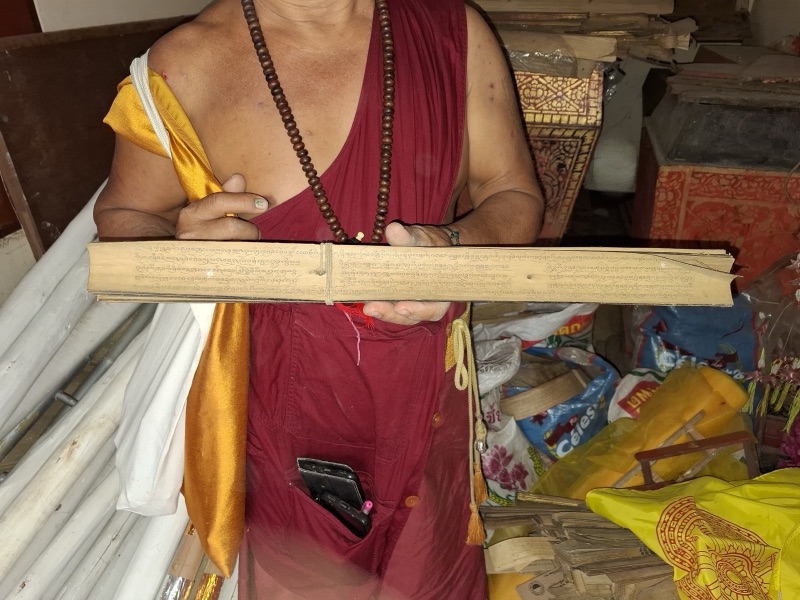
| cha lae | ช¦ | that is how it was: ends each section, like the end of a paragraph in a palm-leaf manuscript |
| bo ya cha lae | บ£าช¦ | stresses a thought or event and marks the end of a passage, often found in legends (tamnan) |
| dai | ด่ายฯ | ends a clause before a new one begins, like a pause; found in legends |
Palm-leaf manuscripts have no paragraphs as modern books do, so scribes used these words to tell the reader that a section had ended. The dictionary quotes this use of dai: "when the monks had finished preaching, dai, the villagers rejoiced, dai."
Endings in klong poetry: e, yoe, na
| Kham Mueang | Lanna script | Meaning (from the dictionary) |
|---|---|---|
| e | เอยฯ | ending of a klong verse, like central Thai "hoei" (sometimes read yoe) |
| yoe | เอยฯ | ending of a klong verse, like central Thai "hoei" (usually read e) |
| na | หํนฯา | ending of klong verse, close to "na" or "nana" |
These are not used in everyday talk, but they appear often in Lanna klong poems, and knowing them makes the verse easier to follow.
Try it: dinner at home
This short dialogue is our own teaching example, built from the dictionary's example sentences.
Mother: kin khao laeo ka (Have you eaten yet?)
Child: bo dai kin tuea jao (Not yet.)
Mother: kin lae (Go on, eat!)
Child: lam ko (Is it good?)
Mother: lam tae (It's really good.) kin sia toe (Do eat it.)
This little exchange uses six endings: ka, tuea, jao, lae, ko and sia toe.
Test yourself
Answers (try first, then open)
- To ask a friend "shall we go?", which ending? ko (pai ko)
- To ask "have you bathed yet?": ka (ap nam laeo ka)
- A friendly "go on, eat": lae (kin lae)
- To say "I haven't eaten yet": tuea (bo dai kin tuea)
- The word that closes a section in a palm-leaf legend: cha lae
- What does "hak nong tae i" mean? "Do you really love me?" (teasing)
Summary
- The everyday polite ending is jao (today used mostly by women); ko kha lae is an old ending for people of high rank.
- Ask with ko (do you?), ka (yet? is it?) and wuea, and ask "really?" with cha lue, an cha lue and tae i.
- Invite with lae, woei, jim toe, sia toe and hia kam, but beware pai hia, "get lost".
- Tuea at the end of a negative sentence means "not yet", as in bo dai kin tuea.
- Palm-leaf legends close sections with cha lae, bo ya cha lae and dai; klong poems end with e, yoe and na.
Look up more endings in the Moradok Lanna dictionary, learn the verbs that go with them in Everyday Kham Mueang verbs, and Northern "don't" sentences in Ja pai means "don't".


