
Photo: Takeaway / Wikimedia Commons (CC BY-SA 4.0)
Everyday Kham Mueang Verbs: Kin, Yang, Pho, U, Han
Many Kham Mueang verbs are written like central Thai but sound a little different, such as kin (กินฯ, Kham Mueang reading kin), "to eat". Others belong to Northern Thai alone and puzzle visitors from other regions: pho means "to look", and han does not mean "to turn" as in central Thai, it means to see.
The Moradok Lanna dictionary holds more than 5,000 verbs. This lesson picks about 60 of the ones heard most often in daily life, sorts them into five groups, and ends with how to say "not", how to ask a question, and a short dialogue at the market. Every word and meaning comes from the Moradok Lanna dictionary.
Pai, ma, yang, lon: verbs of movement
| Kham Mueang | Lanna script | Meaning (from the dictionary) |
|---|---|---|
| pai · ma | ไพ · มา | to go, move away from a place · to come, the opposite of go |
| yang | ย่างฯ | to walk, to step forward |
| tiao | ทยฯว | to walk (also tiao chon, yang, yok yang) |
| lon | ล่฿นฯ | to run, to move by stepping quickly |
| nang | นั่งฯ | to sit |
| yuen | อยฯนฯ | to stand, with the feet on the ground and the body upright |
| luk | ลุก | to get up from sitting or lying, to wake up; also "to succeed", e.g. yia bo luk – could not get it done |
| non | นอฯร | to lie down |
| lap | หัลฯบ | to sleep, to rest the body for a while |
| tuen | ตื่นฯ | to wake up |
| khi | ขี่ | to ride astride, e.g. khi ma (a horse), khi chang (an elephant); also to travel as a passenger |
| pik | พิกฯ | to return, to go back |
| muea | เมิอฯอ | to go, to return, to go back |
| aeo | แอ่วฯ | to go out, to visit, to travel for fun |
U, pho, han, fang: verbs of speech and the senses
| Kham Mueang | Lanna script | Meaning (from the dictionary) |
|---|---|---|
| u | อู้ | to speak, to talk, to chat |
| pho | ผํอฯ | to look, to watch, to look after |
| han | หันฯ | to see, to find, to come across, e.g. koei han ko – have you ever seen it? |
| fang | ฟังฯ | to listen, to hear |
| tham | ถามฯ | to ask, to speak in order to get an answer |
| bok | บอฯก | to tell, to tell someone about something |
| hong | ร้อฯง | to cry out, to make a loud sound; also "to call", e.g. mae hong luk – the mother calls her child |
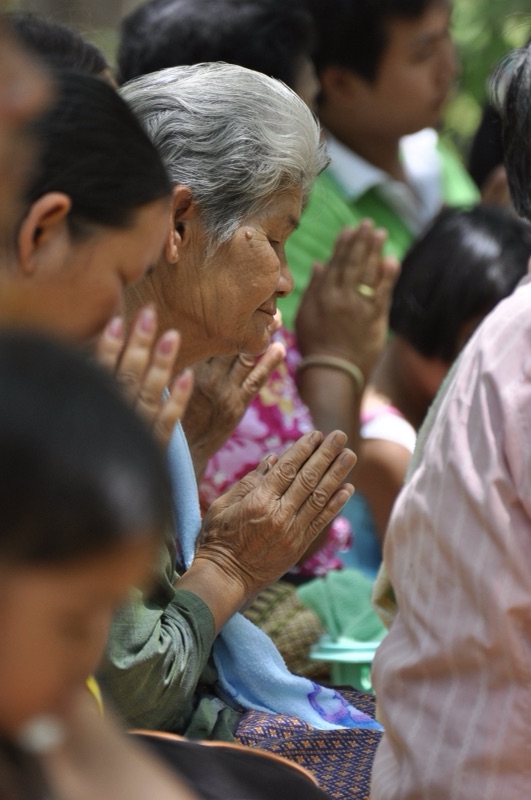
| wai | ไห้วฯ | to pay respect by raising the palms pressed together |
| khai hua | ไฅ่ห฿วฯ | to laugh |
| ywai | ย้วฯายฯ | to smile, to beam |
| hai | ไห้ | to cry, to weep |
Kin, hung, tam, chi: verbs in the kitchen and at home
Kin covers far more than in central Thai. The dictionary gives kin khao (to eat rice, a meal), kin laeng (to eat the evening meal), kin nam (to drink water) and kin ya (to take medicine), so in everyday speech people in the North hardly use a separate word for "drink".
| Kham Mueang | Lanna script | Meaning (from the dictionary) |
|---|---|---|
| kin khao | กินฯเขั้า | to eat rice, to have a meal |
| hung | หุง | to cook by boiling or simmering, e.g. hung khao – to cook rice |
| tam | ตำ | to pound with a pestle, e.g. tam nam phik – to pound a chilli dip |
| chi | จี่ | to roast on red-hot embers, turning until done, e.g. chi khao, chi phrik num (once cooked: khao chi, phrik num chi) |
| ping | ปิ้งฯ | to toast over a fire, quicker than grilling, usually for dried or small things |
| tom | ต้฿มฯ | to boil |
| suai | ซ่วฯยฯ | to wash with water, e.g. suai phak – to wash vegetables, suai tin – to wash the feet |
| sak | ซักฯ | to wash, to clean with water |
| ap | อาปฯ | to pour water over the body to wash it, i.e. to bathe (ap nam) |
| chet | เชัดฯ | to wipe clean or dry |
| yia · ya | เยยฯะ · ยะ | to do, to make, to create (ya is a worn-down yia, e.g. ya na = yia na – to farm rice) |
| paeng | แปลฯง | to make, to build, to create |

Photo: Takeaway / Wikimedia Commons (CC BY-SA 3.0)
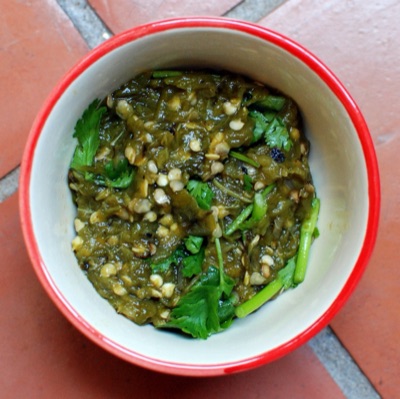
Photo: Takeaway / Wikimedia Commons (CC BY-SA 3.0)
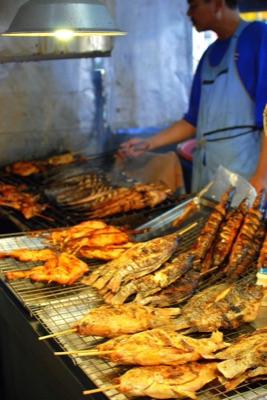
Photo: Takeaway / Wikimedia Commons (CC BY-SA 3.0)
Hu, kuet, hak, kua: verbs of thinking and feeling
| Kham Mueang | Lanna script | Meaning (from the dictionary) |
|---|---|---|
| hu | รู้ | to know, to understand |
| kuet | คึดฯ | to think, to consider |
| kuet toeng | คึดฯเทิงฯ | to miss, to long for |
| ngom ha | ง่อฯมหา | to miss someone dearly, e.g. ai ngom ha nong tae tae – I miss you so much |
| chue | จื่ | to remember, to keep in mind |
| luem | ลืมฯ | to forget |
| hak | รักฯ | to love, to care for, to be fond of |
| hum | หุม | to love, to like, to enjoy, e.g. hum kin hum tan – to love making merit |
| chang | ชังฯ | to hate, to dislike |
| kua | ก฿ลฯวฯ | to be afraid, e.g. kua phi – to be afraid of ghosts |
| khai yak | ไระฯค่อยฯากฯ | to want, to desire; also to be hungry, e.g. for rice or water |
| it | อิดฯ | to be tired, worn out, exhausted |
| im | อิ่มฯ | to be full, to have had enough |
Sue, khai, chai, pan: verbs at the market
| Kham Mueang | Lanna script | Meaning (from the dictionary) |
|---|---|---|
| sue · khai | ซื้ · ขายฯ | to buy · to sell |
| chai | จ่ายฯ | to buy, e.g. chai kap khao – to buy food for a meal; to pay |
| laek | แลกฯ | to exchange, to trade one thing for another |
| yuem | อยฯมฯ | to borrow |
| kho | ขํอฯ | to ask for |
| hue · pan | หื้ · ปันฯ | to give, to hand over · to give, to share out |
| ao | ´า | to want, to take, to accept, to bring along |
| so | โซอฯะ | to look for, to search, e.g. pai so het – to go mushroom hunting |
| tha | ถ้า | to wait, e.g. tha yu ni – wait right here |
| chuai | ช่วฯย | to help |
Bo, ko, ka: saying "not" and asking questions
Once you know the verbs, a few small words turn them into sentences.
- Bo (บ) goes before a verb to make it negative: bo kin (not eat), bo u (not speak), bo yia (not do). The dictionary notes it can also be said ba, as in ba kin.
- Ko (กํอฯ) ends a sentence to make it a question: pai ko (are you going?), lam ko (is it tasty?), maen ko (is that right?).
- Ka (คาฯ) ends a sentence to ask "yet?" or "isn't it?": ap nam laeo ka (have you bathed yet?), bo muan ka (isn't it fun?).
- Laeo (แลฯวฯ) marks a finished action: kin khao laeo ko pai hong hian (after eating I go to school).
- Cha pai + verb does not mean "going to", it means don't. The dictionary's examples: cha pai kin = don't eat, cha pai pai = don't go, cha pai u = don't speak.
- Han means to see, e.g. koei han ko – have you ever seen it?
- Tha as a verb means to wait, e.g. tha yu ni – wait right here.
- Hio (หิวฯ) in Kham Mueang means broke, without strength, faint. To say you are hungry, use khai yak khao or yak khao.
Try it: shopping at the market
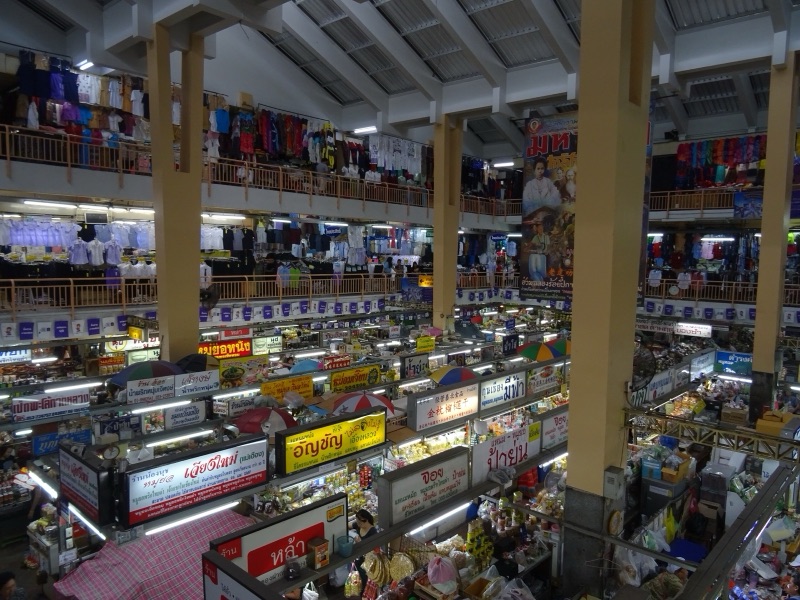
This short dialogue is our own teaching example, built from words and sentence patterns the dictionary gives under ko, khai dai (ไระฯค่ได้, to want to get), ao, tha, cha, bo and the polite ending chao (เจั้า).
Customer: Pa, khai ba muang ko chao? (Auntie, do you sell mangoes?)
Vendor: Khai chao, khai dai ki kilo? (I do. How many kilos would you like?)
Customer: Ao song kilo chao. (Two kilos, please.)
Vendor: Tha yu ni, cha pai pai nai. (Wait right here, don't go anywhere.)
Customer: Bo pai nai chao. (I'm not going anywhere.)
The dialogue has a question with ko, a negative with bo, and the Kham Mueang way of saying "don't", cha pai…. For more words to use at the market, read Going to the Kat Like a Khon Mueang.
Summary
- Core verbs: kin (eat, drink), yang · tiao (walk), lon (run), pho (look), u (speak), han (see), hu (know), yia · ya (do).
- Going home is pik or muea, going out for fun is pai aeo, and tha means to wait.
- Feelings: hak · hum (love, like), kuet toeng · ngom ha (miss), kua (be afraid), it (be tired).
- Say "not" with bo, ask with ko or ka, and say "don't" with cha pai + verb.
- Careful: hio in Kham Mueang means broke or faint, not hungry.
Look up more verbs in the Moradok Lanna dictionary (in Thai), learn family words in Kham Mueang Family Words, and body words in Kham Mueang Body Words.


