

Photo: Takeaway / Wikimedia Commons (CC BY-SA 3.0)
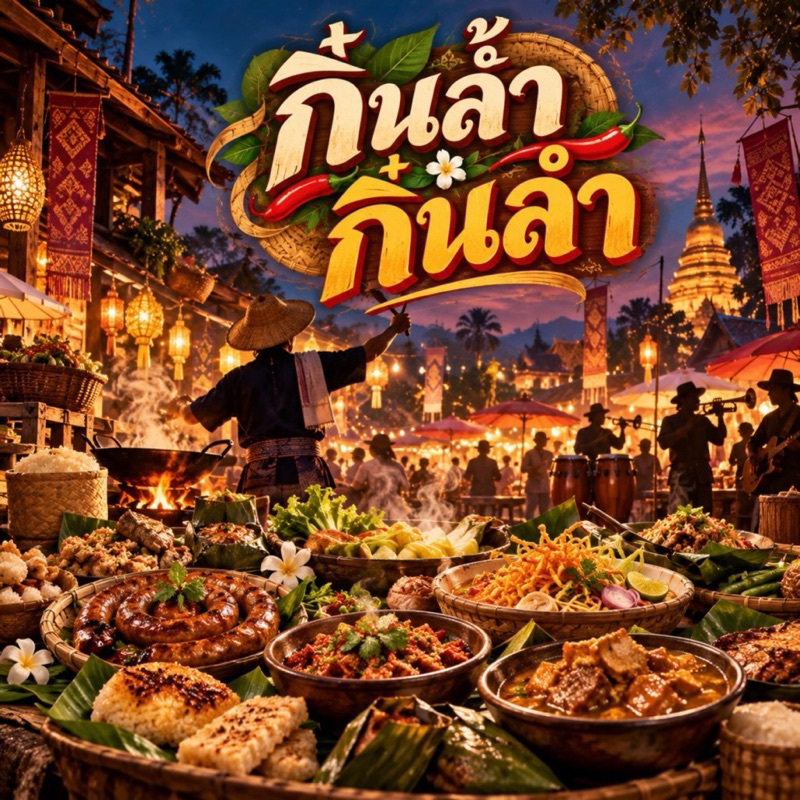
Kin Lam Kin Lam: Learn Kham Mueang Food Words from a Song
Kin Lam Kin Lam is a Kham Mueang (Northern Thai) song by Toni Maxx on OverNormal. It invites listeners to visit the North and then reels off more than ten local dishes in its rap verses. The key words of the song are kin (กินฯ, Kham Mueang reading kin), meaning "to eat", and lam (ลำ, read lam), meaning "delicious".
This lesson reads the chorus and the first verse line by line, looks at how Kham Mueang sounds differ from central Thai, and compares the food names in the song with the words recorded in the Moradok Lanna dictionary.
What wordplay is in the title Kin Lam Kin Lam?
The title pairs two words that sound almost the same: lam with a high tone (ลํา, read lam, written ล้ำ) and lam (ลำ), which differ only in tone. The dictionary gives the meaning of the high-tone lam as "exceedingly, overflowing", as in ngam lam, "exceedingly beautiful", while lam means delicious, tasty, to one's liking.
Heard together, "kin lam kin lam" means both "eat to the full" and "eat something delicious". The chorus also ends its first line with the word loet lam ("superb"), so the high-tone lam comes back once more.
The chorus, line by line
กิ๋นล้ำกิ๋นลำของกิ๋นเมืองเฮาเลิศล้ำ! จัดมาเลยชุดใหญ่ฟินโดนใจ๋กู้กำ! ลองทายดูแล่มีกี่เมนูหื้อต้องจ๋ำ! โยกย้ายออกสะเต็บม่วนแต๊ๆขอบอกย้ำ!
— Chorus of Kin Lam Kin Lam by Toni Maxx (OverNormal)
| Kham Mueang word in this chorus | Lanna script | Meaning (from the dictionary) |
|---|---|---|
| khong kin | ขอฯงกินฯ | food, things to eat |
| hao | เรัา | we, our (khong kin mueang hao = the food of our home) |
| chai | ไจ | heart, mind |
| ku | คู่ | every, each |
| kam | คําฯ | a word, a mouthful (ku kam = every bite) |
| lae | แล่ | a final particle urging someone to do something, like "go on" (kin lae = go on, eat) |
| hue | หื้ | to give; to let, to make (someone do) |
| cham | จำ | to remember, to keep in one's mind |
| muan | ม่วฯร | fun, enjoyable, pleasant to hear |
| tae | แท้ | true, real (muan tae tae = really, really fun) |
In central Thai, the chorus says: "Eat to the full, the food of our home is superb. A big set has been laid out, every bite hits the spot. Go on, guess how many dishes there are, so you'll have to remember them. Move and step out, it's really fun, I'll say it again."
The first verse: come and visit the North
มาแอ่วเมืองเหนือของกิ๋นลำมีนักหนา ตึงต้มผัดแก๋งทอดรสเด็ดเกินพรรณนา อาหารปื๊นบ้านล้วนเต็มเปี่ยมด้วยคุณค่า เตรียมต๊องฮื้อพร้อมรับรองว่าต้องตื่นต๋า
In English: Come and visit the North, where delicious food abounds; boiled, stir-fried, curried and fried, the flavours are beyond words; local food, all full of goodness; get your stomach ready, you're sure to be amazed.
- aeo (แอ่วฯ, read aeo) — to go out, to visit, to travel for fun
- tueng (ทึงฯ, read tueng) — both, all of (tueng tom phat kaeng thot = boiled, stir-fried, curried and fried alike); it can also mean "every", as in pai tueng wan = go every day
- kaeng (แกงฯ, read kaeng) — curry
- puen ban — local, home-style (central Thai phuen ban). The dictionary records the word puen (พื้นฯ, read puen), which corresponds to phuen, "floor, ground"
- tong (ท้อฯง, read tong) — stomach (triam tong = get your stomach ready)
- ta (ตา, read ta) — eye (tuen ta = wide-eyed, amazed)
Changing sounds: from central Thai to Kham Mueang
The words in this song show several repeating patterns. Try matching the central Thai words with the Kham Mueang words as the dictionary records them.
| Central Thai | Kham Mueang | What to notice |
|---|---|---|
| kin, kaeng, chai, ta, cham (กิน · แกง · ใจ · ตา · จำ) | kin, kaeng, chai, ta, cham (กิ๋น · แก๋ง · ใจ๋ · ต๋า · จ๋ำ) | rising tone (written with the mai chattawa mark) |
| phi, phuen (พี่ · พื้น) | pi พี่, puen (ปี้ · ปื้น) | ph (พ) becomes p (ป) |
| thong, thae, thuai, thueng (ท้อง · แท้ · ทวย · ทึง) | tong, tae, tuai ทวฯยฯ, tueng (ต๊อง · แต๊ · ตวย · ตึง) | th (ท) becomes t (ต) |
| rao, rak, rueat (เรา · รัก · เรือด) | hao, hak รักฯ, hueat เริอฯด (เฮา · ฮัก · เฮือด) | r (ร) becomes h (ฮ) |
| khao (ข้าว) | khao เขั้า (เข้า) | the vowel changes, and the tone differs from central Thai |
| ma (มะ), before fruit names | ba (บ่า) | e.g. jackfruit, khanun = ba nun บ่าฯหนฯร |
The word tuai ("following, along with") is in the line khayap tuai changwa (move along with the beat), and hak ("love") is in the line hak phuk phan (love and bonds). The pair pi nong (พี่น้อฯง, "brothers and sisters, kin") is in the lyrics of the opening of the song.
The food names in the rap verses, by the dictionary
The seven rap verses speed up as they go and list Northern dishes almost without a breath. This table picks the dishes found in the dictionary for comparison.
| In the song | Kham Mueang | Lanna script | What it is (from the dictionary) |
|---|---|---|---|
| (ไส้อั่ว) | sai ua | ไส้อ่฿วฯ | Northern sausage: minced pork mixed with seasonings, stuffed into pork casing, then fried or grilled |
| (น้ำพริกอ่อง) | nam phik ong | นาฯระฯพิกฯอ่อฯง | an orange chilli dip of tomatoes and dried chillies, simmered until thick |
| (แก๋งฮังเล) | kaeng hang le | แกงฯฮังฯเล | hang le curry: large pieces of pork belly simmered until the sauce reduces |
| (แก๋งโฮะ) | kaeng ho | แกงฯโร฿ะ | a mixed curry, mainly hang le curry, with glass noodles and pickled bamboo shoots added |
| (หนมเส้นน้ำเงี้ยว) | khao nom sen · nam ngiao | เขั้าห฿นฯมเส้นฯ · นาฯง้ยฯว | rice noodles, with a broth of minced pork, tomatoes and cotton-tree flowers |
| (จิ๊นส้ม) | chin som | ชิ้นฯส้฿มฯ | fermented pork sausage (naem); (chin, ชิ้นฯ, means meat) |
| (ส้าจิ๊น) | sa chin | ส้าชิ้นฯ | thinly sliced meat tossed with chilli paste |
| (ไข่ป่าม) | khai pam | ไข่ป่ามฯ | eggs beaten fluffy, put in a banana-leaf cup and grilled over a fire |
| (จอผักกาด) | cho phak kat | ชํอฯผักฯกาดฯ | flowering mustard greens cooked in the cho way |
| (ข้าวกั๊นจิ๊น) | khao kan chin | เขั้าคั้นฯชิ้นฯ | rice mixed with meat and blood, wrapped in banana leaf and steamed; a Tai Yai (Shan) dish |
| (ผักเฮือด) | phak hueat | ผักฯเฮิอฯด | the young leaves of the liap fig tree |
| (น้ำปู๋) | nam pu | นาฯปู | paddy-crab juice simmered until thick and black, used to season food |
| (ข้าวแต๋น) | khao taen | เขั้าแตนฯ | puffed rice cakes: sticky rice tossed with cane sugar syrup and fried |
End rhymes: which sound each verse uses
The song gives every line of a verse the same end sound, so it is easy to remember, as in rap.
- Chorus: lam, kam, cham, yam (ล้ำ · กำ · จ๋ำ · ย้ำ; the -am sound)
- First verse: na, na, kha, ta (หนา · นา · ค่า · ต๋า; the -a sound)
- Rap verse 1: ro, chot cho, bo po, no (รอ · จดจ่อ · บ่อปอ · น่อ; the -o sound)
- Rap verse 4: rai, mak mai, krachai, sabai (ราย · มากมาย · กระจาย · สบาย; the -ai sound)
- Rap verse 5: klong, mong, kong, hong (กล่อง · มอง · กอง · ห้อง; the -ong sound)
- Rap verse 6: kan, san, phan, mahatsachan (กั๋น · สันต์ · พัน · มหัศจรรย์; the -an sound)
- Rap verse 7: du, ru, chu, ru (ดู · หรู · ชู · รู้; the -u sound)
- Bridge: ban, chan, kan, sanan (บาน · จาน · ก๋าน · สนาน; the -an sound, long vowel)
The ending: who guessed right?
The song closes with the spoken line im tae im wa... wa tae ta-ki mi khong kin ki yang, phai thai thuk phong! ("So full, so very full... but how many dishes were there just now? Did anyone guess right?"). This single sentence has several Kham Mueang words to learn.
- ta-ki (ตกี้, read ta-ki) — a moment ago, just now (also said ต่ากี้ or ต๋ากี้)
- phai (ไผ, read phai) — who, whoever
- phong (ระฯพ่อฯง, read phong) — some, some people, some of it (phai thai thuk phong = did anyone guess right?)
- im tae im wa — really full; used in the same way as lam tae lam wa (ลำแท้ลำว่าฯ), which the dictionary defines as "really delicious, very delicious"
Listen to the whole song with lyrics at Kin Lam Kin Lam on OverNormal, then try counting how many dishes there are in the rap verses.
Summary
- Kin means to eat and lam means delicious; the title plays on the sounds of the high-tone lam (exceedingly) and lam (delicious).
- The chorus teaches common words: hao, chai, ku kam, lae, hue, cham, muan tae.
- Kham Mueang sounds shift from central Thai in sets: ph becomes p, th becomes t, r becomes h, khao (rice) has its own tone, and ma becomes ba.
- Hue (หื้อ, to give) and hue (ฮื้อ, an exclamation) are different words.
- Many of the dishes in the song have their own Kham Mueang names in the dictionary, such as nam phik ong, khao soi and chin som.
Look up more Northern food names in the Moradok Lanna dictionary (in Thai), learn the words used when buying food in the article Going to the Kat Like a Khon Mueang, or read about grilled sticky rice and bamboo-tube rice in Tan Khao Mai.
More in this series: Kiang Kaeo · Lanna, Lanna · Phak Kat Cho, or see the whole series at Kham Mueang through songs and literature (in Thai).


