

Photo: Hartmann Linge / Wikimedia Commons (CC BY-SA 4.0)
King Kawila: Who Revived a Deserted Chiang Mai
King Kawila (Phra Chao Kawila) was the first chao luang (เจั้าหลฯวฯง, Kham Mueang reading chao luang), or ruler, of Chiang Mai in the dynasty known as the Chao Chet Ton ("the Seven Princes"). He led people back to settle Chiang Mai after the city had stood empty for about 20 years because of the wars with Burma. His reign is known as the era of "gathering vegetables into the basket, gathering people into the city" (kep phak sai sa kep kha sai mueang, เกัปฯผักฯไส่ซ้าเกัปฯข้าไส่เมิอฯง), and many things people in Chiang Mai still see every day, from the city walls to the Inthakhin pillar at Wat Chedi Luang, are linked to him.
Who was King Kawila?
Samran Phondi (สำราญ ผลดี, 2019) writes in the Journal of Liberal Arts, Mahidol University that King Kawila was born in Chula Sakarat 1104, a Year of the Dog (1742). He was the eldest son of Chao Fa Luang Chai Kaeo, ruler of Lampang (ลำพางฯ), and Mae Chao Chanthara Rachathewi, and the first grandson of Phraya Chai Songkhram (Thip Chang), founder of the Thipchak dynasty.
King Kawila and his younger brothers were seven royal brothers, so the dynasty came to be called the Chao Chet Ton. Samran Phondi (2019) notes that princes of this dynasty went on to rule Chiang Mai, Lampang and Lamphun.
The Moradok Lanna dictionary explains chao luang as "the word for the highest leader of a major principal city, namely Chiang Mai, Lamphun, Lampang, Phrae and Nan", and gives the example: "Chao Luang Kawila was the first ruler, and Major General Chao Kaeo Nawarat was the last (the ninth) ruler of Chiang Mai."
Fuen man: rising against Burma
Before King Kawila's time, Lanna had been under the power of the man (ม่านฯ), the Burmese, for about 200 years. Kham Mueang has a special word for rising up against them: fuen man (ฟื้นฯม่านฯ, fuen man), which the dictionary explains as "to rebel against Burma; to act to become independent of Burma".
Samran Phondi (2019) tells how in 1774 Chao Kawila joined Phraya Cha Ban of Chiang Mai in resisting the Burmese and turned his allegiance to King Taksin of Thonburi. When the fighting ended he was made ruler of Lampang.
A deserted Chiang Mai, and the era of the basket
After the wars, Chiang Mai (ชยฯงไห่มฯ) had almost no people left. Research by Phra Amarin Santidhammo and colleagues (พระอัมรินทร์ สนฺติธมฺโม และคณะ, 2023) in the journal Dhammadhara states that Chiang Mai was practically a deserted city from about 1776 to 1796.
In 1782, after King Rama I came to the throne, Chao Kawila took his relatives down to Bangkok for an audience. Rama I appointed him Phraya Wachiraprakan, ruler of Chiang Mai, at the age of 40 (Samran Phondi, 2019). But the city was still empty, so the first task was finding people to live in it.
The dictionary describes the era of "gathering vegetables into the basket, gathering people into the city" as the time when "people were gathered into the city of Chiang Mai: Chiang Mai people who had fled into the forest were rounded up and brought back to the city, and Tai Lue, Tai Khuen and Tai Yai people from Sipsong Panna and Kengtung began to be moved in to settle in Chiang Mai".
- Sa (ซ้า, sa) is translated in the dictionary as "basket". The name of the era compares gathering people (kha) into the city little by little with picking vegetables into a basket until it is full.
- The people who moved in, such as the Tai Khuen (ฅ฿นฯไทขึนฯ) from Kengtung and the Tai Lue (ชาวฯไทลื้) from Sipsong Panna, became important communities of Chiang Mai that remain to this day.
In central Thai documents, moving whole families like this is often called kwat ton the khrua ("sweeping up whole households"). But take care with the word the khrua in Kham Mueang.
Thai Wikipedia (citing several Lanna history works) states that while he still could not enter Chiang Mai, Chao Kawila stayed at Wiang Pa Sang (today Pa Sang District, Lamphun). In 1791 he managed to settle inside Chiang Mai for only a month before having to return to Pa Sang, because he still did not have enough people.
- The Moradok Lanna dictionary (under kep phak sai sa kep kha sai mueang) gives 1780
- Samran Phondi (2019) says he was appointed ruler of Chiang Mai in 1782
- Phra Amarin and colleagues (2023) say he successfully settled in Chiang Mai around 1796
The three dates do not necessarily conflict: one may count from when people began to be gathered, another from his appointment, and the third from when he actually moved into the city.
Rebuilding the city: walls, temples and the Inthakhin pillar
Phra Amarin and colleagues (2023) divide King Kawila's work after entering the city into two phases.
| Phase | What was done |
|---|---|
| 1796–1805 | repaired the moat, city walls, gates and bastions; restored temples inside the walls; moved Buddha images and important objects from abandoned temples outside into the city; then led armies against major towns such as Kengtung and Chiang Saen |
| 1806–1815 | the realm became stable and warfare declined; he supported Buddhist learning and the inscribing of palm-leaf scriptures |
In Kham Mueang the city wall is called mek wiang (เมกฯวยฯง, mek wiang). Wall corners such as Chaeng Katam, in the photo above, are part of the city defences that have been repaired over many periods.
In matters of belief, King Kawila moved the Inthakhin pillar (เสัา±นทฯขีลฯฯ, sao in-tha-khin), the city pillar of Chiang Mai, from Wat Inthakhin, also called Wat Sadue Mueang (สดืเมิอฯง, "temple of the city's navel"), to Wat Chedi Luang. The dictionary says it was moved "around 1800".
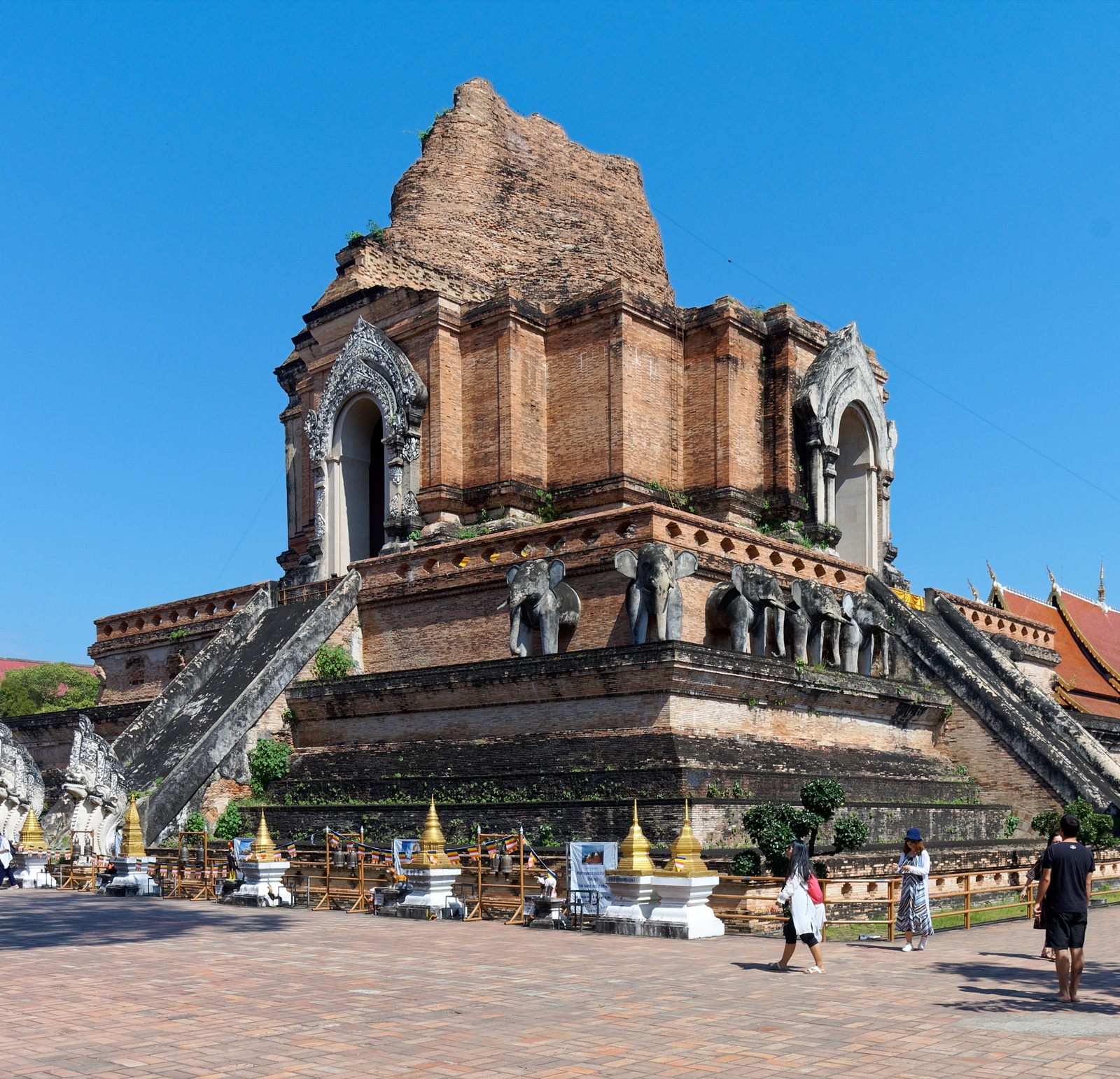
The dictionary also records the term mai mai mueang chiang mai (ไม้หมฯายฯเมิอฯงชยฯงไห่มฯ), "the tree that marks the city of Chiang Mai": "large, tall yang na trees that King Kawila, the first ruler of Chiang Mai, planted near the city pillar of Chiang Mai (the Inthakhin pillar) at Wat Chedi Luang". These yang na trees still stand today. Read about the Inthakhin pillar and the rite of honouring it in the article Sai Khan Dok.
From Phraya Wachiraprakan to King of Chiang Mai
In this era Chiang Mai was a tributary state (prathet rat) of Siam. Samran Phondi (2019) sums up several ways the Bangkok court helped Chiang Mai:
- In 1797 a Burmese army besieged Chiang Mai. Phraya Kawila could not defend the city alone, so Rama I sent the Front Palace (the viceroy) north with an army to help, until the Burmese withdrew.
- He granted weapons when Chiang Mai and Lampang marched against Chiang Saen, a Burmese stronghold, in 1802.
- He granted phrai (ไระฯพ่, commoners), people taken from Mueang Sat, Mueang Pan and Mueang Pu, for Chiang Mai to use in rebuilding the realm.
His merit in war led Rama I to raise Phraya Wachiraprakan to Phra Chao Chiang Mai, "King of Chiang Mai", with honours equal to the ruler of Vientiane, and overlord of 57 towns in Lanna. Samran Phondi cites Prince Damrong Rajanubhab's writings that this appears in the Chiang Mai Chronicle, while Wikipedia gives the date of the ceremony as 14 September 1802.
สมควรจะยกย่องผู้เปนหัวหน้าของชาวมณฑลพายัพในสมัยนั้นด้วย คือเจ้าเจ็ดตนอันเปนต้นตระกูลวงศ์ของเจ้านายเมืองเชียงใหม่ เมืองนครลำปาง และเมืองลำพูน — King Prajadhipok (Rama VII), speech on his visit to Monthon Phayap, 1926 (cited in Samran Phondi, 2019)
(In English: "It is fitting also to honour the leaders of the people of Monthon Phayap at that time, namely the Chao Chet Ton, the founders of the lineage of the princes of Chiang Mai, Nakhon Lampang and Lamphun.")
King Kawila's legacy
King Kawila ruled Chiang Mai until his death. Wikipedia gives the date of his death as 21 November 1815, the 5th day of the waning moon of the 2nd Northern month (duean yi), and the Moradok Lanna Lanna calendar (in Thai) calculates the same date as the 5th waning day of duean yi. The research of Phra Amarin and colleagues also counts his era as 1774–1815.
After him, his younger brothers ruled the city in turn. The dictionary lists all nine rulers of Chiang Mai, beginning with King Kawila, followed by Phraya Thammalangka and Chao Luang Setthi Kham Fan, down to the last, Major General Chao Kaeo Nawarat.
What can still be seen from King Kawila's era
- The many peoples of Chiang Mai, such as the Tai Khuen of the Wat Nantaram community and the Tai Lue, who the dictionary says settled here in the era of "gathering vegetables into the basket, gathering people into the city"
- The Inthakhin pillar at Wat Chedi Luang and the yang na trees, the trees that mark the city of Chiang Mai
- The Sai Khan Dok rite, whose present form some research suggests may have been revived in King Kawila's time (see the article Sai Khan Dok)
- Palm-leaf manuscripts inscribed once the realm was at peace, still kept in temples around Chiang Mai
Summary
- King Kawila (born 1742) was the first ruler of Chiang Mai of the Chao Chet Ton dynasty, grandson of Phraya Chai Songkhram (Thip Chang) of Lampang.
- He joined the fuen man uprising against Burma in 1774 and became ruler of Chiang Mai in 1782, according to Samran Phondi.
- The era of "gathering vegetables into the basket, gathering people into the city" was the resettling of a deserted city. Sources give different starting years (1780 / 1782 / 1796).
- He repaired the city walls, restored temples and moved the Inthakhin pillar to Wat Chedi Luang around 1800.
- He was raised to King of Chiang Mai in 1802 and died in 1815.
Look up more words from this era in the Moradok Lanna dictionary (in Thai), and read about Chiang Mai's city pillar in the article Sai Khan Dok.
Sources
- Moradok Lanna dictionary (in Thai): เก็บผักใส่ซ้าเก็บข้าใส่เมือง · เจ้าหลวง · ฟื้นม่าน · ไม้หมายเมืองเชียงใหม่
- สำราญ ผลดี [Samran Phondi]. (2019). หัวเมืองฝ่ายเหนือกับพระบาทสมเด็จพระพุทธยอดฟ้าจุฬาโลกมหาราช [The northern towns and King Rama I]. Journal of Liberal Arts, Mahidol University 2(2). In Thai.
- พระอัมรินทร์ สนฺติธมฺโม, วิไลพร สุจริตธรรมกุล และพงษ์ศิริ ยอดสา [Phra Amarin Santidhammo, Wilaiphon Sutcharittham and Phongsiri Yotsa]. (2023). คัมภีร์ใบลานยุคพระเจ้ากาวิละ: กรณีศึกษาจากบันทึกท้ายคัมภีร์ใบลานอักษรธรรมล้านนา สำรวจพบ ณ วัดดวงดี อ.เมืองเชียงใหม่ จ.เชียงใหม่ [Palm-leaf manuscripts of King Kawila's era: a case study of colophons of Lanna-script manuscripts found at Wat Duang Di, Mueang District, Chiang Mai]. Dhammadhara Journal of Buddhist Studies 9(2). In Thai.
- พระเจ้ากาวิละ (King Kawila). Thai Wikipedia (Wiang Pa Sang, the date of his elevation and the date of his death; used as a lead and attributed in the text). In Thai.
Look up "เก็บผักใส่ซ้าเก็บข้าใส่เมือง" in the Moradok Lanna dictionary (in Thai)


