

Photo: เอบ บุนนาก, ธานาคา / Wikimedia Commons (Public domain)
Princess Dara Rasmi: Royal Consort Who Revived Lanna Culture
Princess Dara Rasmi (Chao Dara Rasmi) was the daughter of Phra Chao Inthawichayanon, the seventh chao luang (เจั้าหลฯวฯง, Kham Mueang reading chao luang), or ruler, of Chiang Mai. She entered the service of King Chulalongkorn (Rama V) and rose to the rank of Royal Consort (phra ratcha chaya). When she returned to live in Chiang Mai in her later years, she revived Lanna dance, music, theatre and merit-making festivals, and much of this has been handed down to the present day.
Her story is a bridge between Lanna and Siam, and the Moradok Lanna dictionary itself mentions her in several entries, as this article will show.
Daughter of the ruler of Chiang Mai
The Daraphirom Palace Museum of Chulalongkorn University states that Princess Dara Rasmi was born on 26 August 1873 in her father's residence (khum) in Chiang Mai. Her mother was Mae Chao Thep Kraison, according to the research of Phra Waranyu Arinchayo (some sources write Thip Kesorn).
Her father was Phra Chao Inthawichayanon, whom the dictionary counts as the 7th in its list of the nine chao luang chiang mai (เจั้าเจั้าหลฯวฯงชยฯงไห่มฯ, Kham Mueang reading chao luang chiang mai), the rulers of Chiang Mai, spelling his name "Phra Chao Inthrawichaiyanon".
Life at the Bangkok court
Princess Dara Rasmi grew up and was educated in Chiang Mai. At 13 she accompanied her father down to Bangkok, and she entered the Inner Court in 1886 as a royal concubine (chao chom). In those days the journey was made by boat down the Ping River. The dictionary records that a hang maeng pong boat (หางฯแมงฯป่อฯง, Kham Mueang reading hang maeng pong, "scorpion-tail boat") once served as the royal barge on the journey down to "present Chao Dara Rasmi" to the king.
In the Grand Palace she took a great interest in Thai music. Research by Sirinthra Prathumngao and Butri Sukpan (สิรินทรา ประทุมเหง่า และบุตรี สุขปาน, 2024) tells that she learnt the three-stringed fiddle (so sam sai), the krachappi lute and singing. Her favourite instrument was the chakhe (a floor zither), which she named "Unakan", and she put together an ensemble of strings with a piano in the inner palace.
The museum says she had one daughter, who died at only 3 years old. Later, at the age of 35, she was raised to the rank of Royal Consort.
| Year | Event |
|---|---|
| 1873 | born in Chiang Mai (26 August) |
| 1886 | enters the Inner Court in Bangkok |
| about 1908 | raised to Royal Consort (aged 35) |
| 1909 | visits Chiang Mai for about 6 months; builds new stupas at Wat Suan Dok |
| 1910 | death of King Chulalongkorn |
| 1914 | takes leave of King Vajiravudh (Rama VI) and returns to Chiang Mai for good |
| 1926 | presides over the reception of King Prajadhipok (Rama VII) in Chiang Mai |
| 1933 | dies (9 December) |
The northern royal stupas at Wat Suan Dok
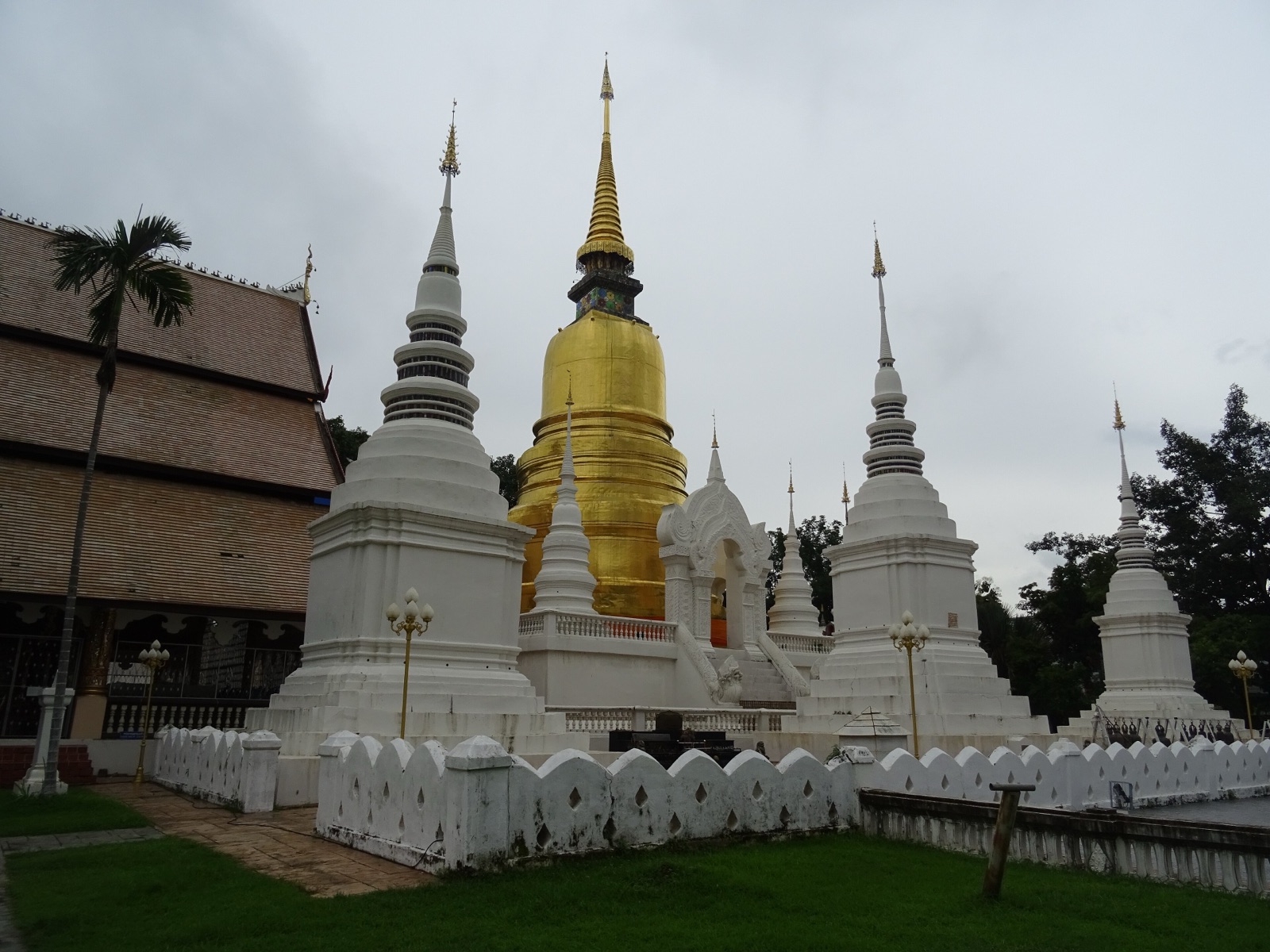
On her first visit to Chiang Mai since going down to Bangkok, she made merit in many places and began an important work: gathering the ashes of her ancestors. In Lanna a ku (กู่, Kham Mueang reading ku) is a chedi or stupa holding the ashes of the dead.
The dictionary explains ku chao nai fai nuea (กู่เจั้านาฯยฯฝ่ายฯเหินฯอฯอ, Kham Mueang reading ku chao nai fai nuea), "the stupas of the northern princes", as stupas holding the royal ashes and ashes of the northern princes, which Princess Dara Rasmi "moved from the area of Kat Luang (Warorot Market) to Wat Suan Dok".
The research of Phra Waranyu Arinchayo found evidence that she herself carried the royal ashes to the new stupas in October 1909, using her own funds together with Chao Inthawarorot Suriyawong, the 8th ruler of Chiang Mai, with a contribution from King Chulalongkorn. A celebration of five days and five nights followed.
The dictionary records another story under Inthanon (±นทฯน฿น์ทฯ, Kham Mueang reading in-tha-non): in 1915 she carried her father's ashes to the summit of the highest mountain in the country. The mountain was formerly called "Doi Ang Ka", and was renamed Doi Inthanon after Phra Chao Inthawichayanon's birth name.
Dance, music and theatre at her residence
After she returned to live permanently in Chiang Mai, she brought dance and theatre from the royal court in Bangkok and blended them with those of Lanna. Sarawut Chankham (ศราวุธ จันทร์ขำ, 2025) explains that she hired drama teachers and dancers from Bangkok to teach at her residence, and refined the movements of the fon lep (ฟ้อฯรเลัปฯ, Kham Mueang reading fon lep), the fingernail dance, also called fon hae khrua tan (the dance leading the procession of offerings), giving it a set form.
The research of Sirinthra and Butri (2024) lists performances that were created or refined in her era, such as:
| Performance | Notes |
|---|---|
| Fon Lep, Fon Tian | movements refined into a set form |
| Fon Man Mui Chiang Ta | formerly called Fon Ka Be (the butterfly dance); she changed the costumes and gave it a new name |
| Fon Man Mae Lae, Fon Yogi Thawai Fai | listed among the performances of the time |
| Rabam So Somphot Chang Phueak | created by her in 1926 |
The Rabam So Somphot Chang Phueak (the so dance celebrating the white elephant) was created when King Prajadhipok and Queen Rambai Barni toured Monthon Phayap in 1926. The Royal Consort presided over the reception, and the Borneo Company, a timber firm, presented a white elephant to the king, so she devised this performance. Its lyrics were written by Thao Sunthon Photchanakit, the poet of her court.
Her best-known work among Khon Mueang (Northern Thai people) is the play Noi Chaiya (น้อฯยฯไชยา, Kham Mueang reading noi chai-ya). The dictionary describes it as a play that Thao Sunthon Photchanakit (Mai Bunma) wrote for her "following the plot she devised", which she allowed to be performed on her 60th birthday at Wat Suan Dok. It was later made into a film, a stage play and songs sung by Jaran Manopetch and Soontaree Vechanont.
Even in the last year of her life, 1933, King Prajadhipok sent a royal telegram asking for dance teachers and piphat musicians from Chiang Mai, to teach Fon Man Mui Chiang Ta in Bangkok. She replied that the teachers who had trained her dancers, Nai Sangat and Khru Lamun Yamakup, had already gone down to Bangkok (Phurada Thirawit and colleagues, 2023, citing Pramet Boonyachai).
Textiles, banana-leaf work and dress
Besides dance and music, Sirinthra and Butri (2024) state that she also revived other Lanna crafts, such as weaving brocade (pha yok), folding banana leaves into bai si offerings, and embroidery.
The Daraphirom Palace Museum still displays the clothes and textiles she designed, which blend Bangkok and Lanna styles, as well as the looms used to weave cloth for her. People at the residence then had many roles; Lanna even has a special word for a woman who served at a royal court or a ruler's residence: nang kom chai (คอฯมไช้, Kham Mueang reading kom chai).
The Suan Chao Sabai garden at Daraphirom Palace
After King Vajiravudh gave her permission to return to Chiang Mai, Daraphirom Palace was built for her in Mae Rim District. It was her last residence and the one she loved most.
She was interested in farming and made an experimental garden at the palace called "Suan Chao Sabai". The museum tells that she grew new varieties of roses (dok ku-lap, ดอฯกกุหลฯาบฯฯ, Kham Mueang reading dok ku-lap) sent to her by a British rose-growers' society, and named her favourite, a fragrant pink rose, "Chulalongkorn" in honour of Rama V.
Princess Dara Rasmi died on 9 December 1933 of a lung disease. King Prajadhipok granted the royal cremation. Part of her ashes was enshrined in the stupas she had built at Wat Suan Dok, and part in the royal cemetery of Wat Ratchabophit in Bangkok.
Chulalongkorn University later bought the palace and restored it, opening it as a museum on 9 December 1999.
Faith in Buddhism
The research of Phra Waranyu Arinchayo (2025) gathers her work for Buddhism in Lanna and divides it into three areas: ceremonies, religious buildings and objects, and religious persons. It finds that ceremonies stand out most, and that she continued to support temples her father and grandfather had patronised.
Examples include the offering celebration at Wat Phra That Si Chom Thong in 1919, held over seven days and seven nights with more than 500 monks and novices from over 70 temples, and the celebration of the great vihara of Wat Phra Singh in 1926, whose building was led by Khruba Siwichai.
How she is remembered today
Sarawut Chankham (2025) records that two commemorations are held in Chiang Mai every year at the Daraphirom Palace Museum:
- 26 August, her birthday
- 8–9 December, Princess Dara Rasmi Day (the anniversary of her death)
Many institutions, such as Chulalongkorn University, Chiang Mai College of Dramatic Arts, Chiang Mai Rajabhat University and the University of Phayao, still teach and create performances "in the style of Princess Dara Rasmi".
Summary
- Princess Dara Rasmi was the daughter of Phra Chao Inthawichayanon, the 7th ruler of Chiang Mai. Born in 1873, she became Royal Consort of King Chulalongkorn (Rama V).
- She gathered her ancestors' ashes in the stupas of the northern princes at Wat Suan Dok, and carried her father's ashes to the summit of Doi Inthanon.
- She revived and gave form to Lanna dance, music and theatre, such as the fingernail dance, the so dance and the play Noi Chaiya.
- She made the Suan Chao Sabai garden at Daraphirom Palace, Mae Rim, and died on 9 December 1933.
Look up more Lanna words about royalty and the court in the Moradok Lanna dictionary (in Thai), and see the fingernail dance at village merit festivals in the article Poy Luang.
Sources
- Moradok Lanna dictionary (in Thai): กู่เจ้านายฝ่ายเหนือ · อินทนนท์ · น้อยไจยา · หางแมงป่อง · เจ้าหลวงเจียงใหม่
- พระวรัญญู อริญฺชโย (ศรีวิชัย) [Phra Waranyu Arinchayo (Siwichai)]. (2025). การศึกษาวิเคราะห์พระกรณียกิจของเจ้าดารารัศมี พระราชชายา ที่มีต่อพระพุทธศาสนาในล้านนา [An analytical study of Princess Dara Rasmi's work for Buddhism in Lanna]. Journal of Lanna Research Review 6(1). In Thai.
- ศราวุธ จันทร์ขำ [Sarawut Chankham]. (2025). สถาบันอุดมศึกษากับการอนุรักษ์และสืบทอดนาฏศิลป์แบบพระราชชายาเจ้าดารารัศมี [Higher education institutions and the conservation and transmission of dance in the style of Princess Dara Rasmi]. Journal of Social Innovation and Lifelong Learning 19(1). In Thai.
- สิรินทรา ประทุมเหง่า และบุตรี สุขปาน [Sirinthra Prathumngao and Butri Sukpan]. (2024). Rabum Sompoach Changpuak of Dara Rasami, the princess consort of Siam. Journal of Music and Performing Arts Khon Kaen University 6(3).
- ภูรดา ธีระวิทย์ สุขสันติ แวงวรรณ และจินตนา สายทองคำ [Phurada Thirawit, Suksanti Waengwan and Chintana Saithongkham]. (2023). ฟ้อนม่านมุยเซียงตา [Fon Man Mui Chiang Ta]. MCU Ubon Review Journal 8(1). In Thai.
- Office of Art and Culture, Chulalongkorn University. Daraphirom Palace Museum.
Look up "กู่เจ้านายฝ่ายเหนือ" in the Moradok Lanna dictionary (in Thai)


