

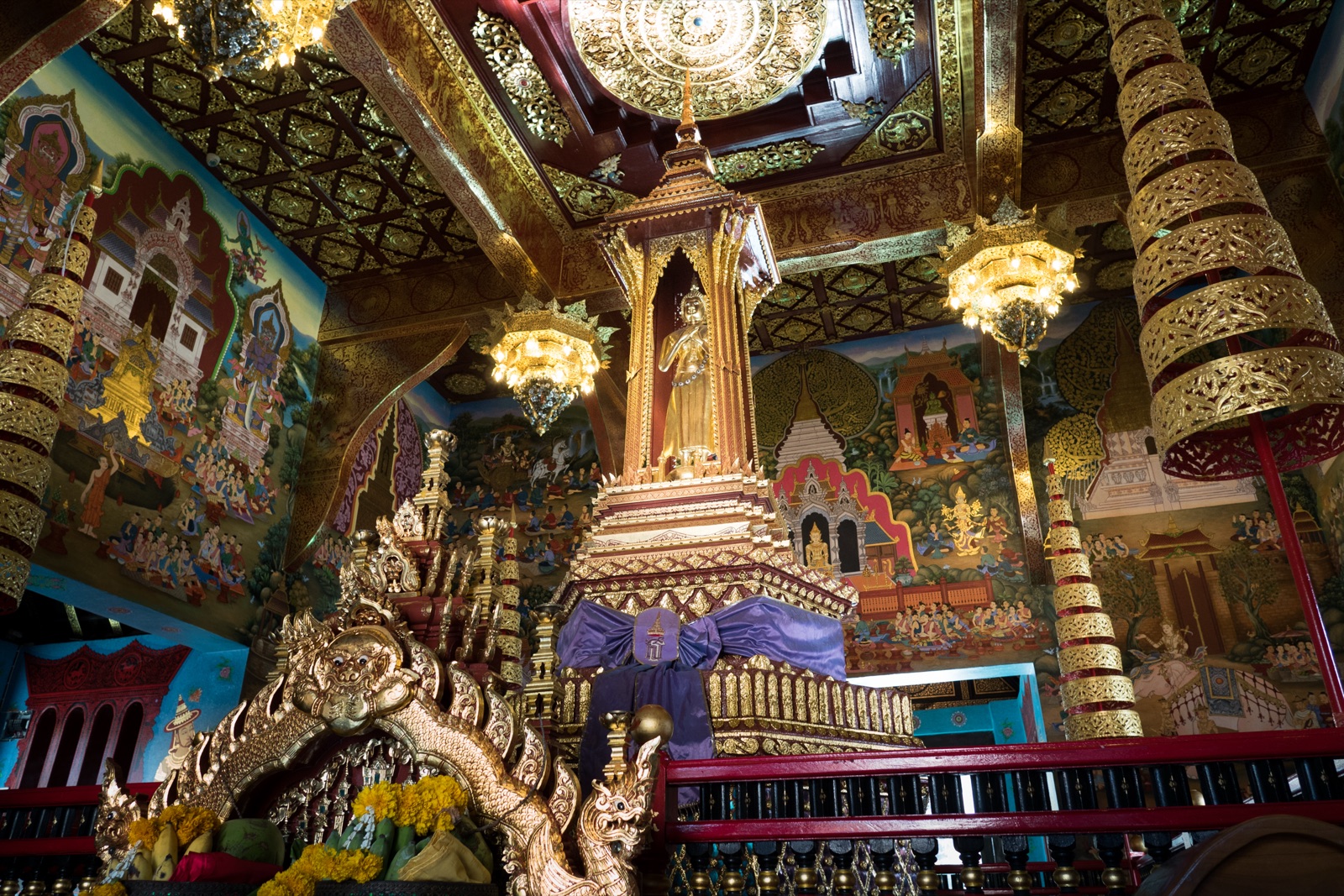
Photo: Dharmadana / Wikimedia Commons (CC BY 4.0)
Liang Phi Pu Ya: Lanna's Ancestral Spirits
Liang phi pu ya (ล้ยฯงผีปู่ย่า, Kham Mueang reading liang phi pu ya) is the offering made to the ancestral spirits of a family in Lanna. Descendants gather to bring food and offerings and speak to the phi pu ya, the "grandparent spirits", asking them to protect the family so that it lives in peace and happiness. This belief binds relatives together, and it is also the framework of the hit, the customs that descendants must keep to this day.
Who are the phi pu ya?
The Moradok Lanna dictionary explains phi pu ya (ผีปู่ย่า, Kham Mueang reading phi pu ya) as "the spirits or souls of ancestors who have passed away, the family spirits revered within the same line of kin". Their role is to link the relationships among relatives and to help settle disputes within the family.
The phi pu ya are not frightening ghosts. They are more like invisible elders of the house. The dictionary records that for those who keep to custom, the phi pu ya help them to be happy and prosper, but if anyone breaks the customs, the phi pu ya will punish them.
There are several other words for the spirits of a house, such as phi huean (ผีเริอฯร, Kham Mueang reading phi huean), the ancestral spirits who protect the people of that house, and phi ban phi huean (ผีบ้าฯนฯผีเริอฯร, Kham Mueang reading phi ban phi huean), the ancestral spirits of each household.
Passed down the female line: kao phi and hing phi
A distinctive feature of the Lanna phi pu ya is that they are passed down the female line. The dictionary explains that when the mother dies, the eldest daughter takes over. If the eldest daughter cannot take them on for any reason, the next daughter takes over instead, and wherever she moves, she must take the phi pu ya with her.
The house of the one who inherits them is called the kao phi (เคั้าฯฯผี, Kham Mueang reading kao phi): "the house where the family spirits or phi pu ya dwell". Inside the house there is a hing phi (หิ้งฯผี, Kham Mueang reading hing phi), a shelf set up as the dwelling place of the ancestral spirits.
The role of women in this rite has drawn scholars' attention. A study by Thipphathu Kritsunthon and Thikhamphon Iamrerai (ทิพย์พธู กฤษสุนทร และทิฆัมพร เอี่ยมเรไร, 2023) of Naresuan University looked at Lanna women and the rite of worshipping the phi pu ya, and found that women act as the senders, the message and the receivers in the rite all at once. The study also points out that the Lanna family system is a factor that strengthens women's power, while nuclear families, the money economy and globalisation are factors that weaken this role.
Liang phi pu ya: when and how
The dictionary divides the offerings to the phi pu ya into 2 kinds: offerings by custom, held every year, and offerings for an occasion, held when a descendant has broken the hit.
Where: at the kao phi, in front of the hing phi, which the dictionary says is usually in the north-east corner of the bedroom.
Offerings and steps
- Preparing: family members prepare flowers, incense and candles, turmeric and som poi water, a pig's head and lao hai kai khu (เหั้ลฯาไหไก่คู่, Kham Mueang reading lao hai kai ku), 1 jar of liquor and 2 chickens. The dictionary records that today a bottle is used instead of a jar.
- Gathering the offerings: descendants bring rice, water, food, sweets and fruit and put them together in containers on a table in front of the hing phi.
- Speaking to the spirits: the one who has inherited the spirits presides and asks the phi pu ya to protect the family so that it is happy and prospers.
This rite is liang phi (ล้ยฯงผี, Kham Mueang reading liang phi), "feeding the spirits", which the dictionary defines as bringing food, liquor and offerings to the spirits to ask them to keep danger away, or to repay them for a vow that was made.
Phit phi: when descendants break the hit
The phi pu ya are the guardians of the hit (รีตฯ, Kham Mueang reading hit), the customs of the family, especially the proper conduct between women and men. The word people in Lanna know well is phit phi (ผิดฯผี, Kham Mueang reading phit phi), "offending the spirits".
The dictionary explains that phit phi is an act considered an offence against a young woman, such as intruding into the woman's private space, touching her, or holding her hand or arm, because the Lanna people have long held that the spirits of the grandparents guard the house and the descendants.
| Lanna word | Lanna script | Meaning (from the dictionary) |
|---|---|---|
| phit phi | ผิดฯผี | to break a custom in a way considered an offence against a young woman |
| kho su-ma | ขํอฯสูมา | to ask forgiveness of the woman's ancestral spirits after committing phit phi |
| sia phi | เสยฯผี | to be fined by the woman's side: the man must bring offerings to speak to the woman's spirits |
| sai phi | ไส่ผี | to give money for the offering to the woman's spirits; there are 2 kinds, sai ao and sai bo ao |
If the offence is minor, the dictionary records that one takes flowers, incense, candles and turmeric and som poi water on a tray to kho su-ma, ask forgiveness. But if it is serious, the spirits must be fed, and the man must sia phi with offerings such as a pig's head, boiled chicken, sweets, khao tom phat (sticky rice wrapped in banana leaf), red cloth and white cloth, together with a sum of money, perhaps 6 baht, 12 baht or more, as the woman's side demands.
Fon phi mot, phi meng: feeding the ancestors with dance
Some families do not only make offerings to the phi pu ya at the shelf. They hold a large event, putting up a pham (ผามฯ, Kham Mueang reading pham), a temporary pavilion, and inviting the phi pu ya to come down into a ma khi (ม้าขี่, Kham Mueang reading ma khi, "the horse that is ridden"), a spirit medium, to dance with the descendants. This rite is called fon phi mot (ฟ้อฯรผีม฿ดฯ, Kham Mueang reading fon phi mot) or fon phi meng, according to the spirit lineage.
Phi mot (ผีม฿ดฯ): the dictionary explains them as ancestral spirits, paired with the phi meng. Every year they are offered rice, water, food, sour and sweet things, and dances performed in bright-coloured costumes such as green and red. The work of Manop Manasaem (มาณพ มานะแซม, 1998) explains that the phi mot are an ancient spirit lineage, and that the word "mot" means a healer or a learned person.
Phi meng (ผีเมงฯ, sometimes written ผีเม็ง): the dictionary explains them as the ancestral spirits of the Mon people, or possibly of the Tai Yuan. In the rite, a tube of fermented fish (pla ra) hangs in front of the "castle", a fire is kept burning with a pot of food cooking the whole time, and the dancers must swing on a cloth both at the start and at the end of the dance.
Manop Manasaem (1998) explains this as a lineage born of marriage between a phi mot family and a phi meng family. This term is not yet in the Moradok Lanna dictionary.
The dictionary says the phi mot dance "is usually held in the dry season before rice planting". Manop Manasaem's work (2012) found that spirit dances are still widely held in Chiang Mai, Lamphun and Lampang, and that the costumes follow strict customs.
Spirit dances are a living belief for many families. If you are invited to one, dress modestly, ask permission before taking photographs, and do not enter the pham or the spirit house without permission.
A story from a phi mot family in Lampang
Natthaphat Surinwong (ณัฐภัทร์ สุรินทร์วงศ์, 2015), who was born into a family that reveres the phi mot, writes from direct experience that the phi mot differ from ordinary phi pu ya in that they have a hierarchy, can be counted and have names. Ordinary phi pu ya are the family elders who have passed away, from the parents' generation down, whose names cannot be traced far back. Families who revere the phi mot often call their spirits respectfully phi pu ya chao nai, "noble ancestral spirits".
In the author's family, the phi mot dance used to be held twice a year, as a custom of the 5th and 9th months. Later, as descendants scattered to earn their living, they asked the phi pu ya to change it to once every three years, and by before 1957 only the offering at the phi pu ya shrine in the 5th and 9th months remained. Today they dance only to fulfil a vow.
Scholars' views: the phi pu ya and the city spirits
- Anan Kanjanapan (อานันท์ กาญจนพันธุ์, 2012), cited by Natthaphat Surinwong (2015), suggests that the phi mot and phi meng dances developed from the rulers' offerings to their own phi pu ya: when the rite of feeding the city spirits was abolished, the descendants of the rulers of Chiang Mai, Lamphun and Lampang went on feeding their phi pu ya as family spirits.
- Amarit Muensitha and Kreangkrai Kirdsiri (อมฤต หมื่นสีทา, 2015) studied the "pham fon phi", the spirit-dance pavilion, and found many kinds of pham according to the spirit lineage, such as phi mot, phi meng, phi mot son meng, guardian spirits and phi chao nai. Today some places use tents or permanent pavilions instead of the traditional bamboo pham.
- Kritsanakan Thararattanakan (กฤษณะกาญจน์ ธารารัตนะกาญจน์) and colleagues (2023) studied the phi meng dance in Lamphun and found 3 Buddhist principles in the rite: gratitude, unity and generosity. The rite also helps keep descendants from committing phit phi.
From house spirits to city spirits
Lanna belief in spirits does not stop at the house. The spirits who look after places are called collectively phi suea (ผีเสิ้อฯอ, Kham Mueang reading phi suea), which the dictionary explains as guardian spirits or spirits of a locality, such as phi suea ban (of the village), phi suea doi (of the mountain), phi suea mueang (of the city) and phi suea wat (of the temple).
| Lanna word | Lanna script | Meaning (from the dictionary) |
|---|---|---|
| phi suea ban | ผีเสิ้อฯอบ้าฯนฯ | the guardian spirit of a village: the spirit of the lord who ruled the village |
| ho suea ban | หํอฯเสิ้อฯอบ้าฯนฯ | the shrine of the guardian deity who looks after the village |
| phi mueang | ผีเมิอฯง | the guardian spirit of a city |
| suea mueang | เสิ้อฯอเมิอฯง | the guardian spirit who protects and looks after the city |
| phi chao nai | ผีเจั้านาฯยฯ | guardian spirits who were important figures in legend, honoured as guardian deities |
The dictionary records that every year villagers make offerings to the phi suea ban of a pig's head, a whole boiled chicken, white liquor, red liquor, flowers, incense and candles before the Buddhist Lent, the same season as each household's offering to its phi pu ya, asking for protection so that the people of the village live in peace and happiness.
For the city of Chiang Mai, one of the most important city spirits is Pu Sae Ya Sae, the ancestral spirits of the Lua people, for whom villagers at the foot of Doi Kham still hold the "liang dong" rite every year. Read the whole story in the article Pu Sae Ya Sae.
Summary
- The phi pu ya are a family's ancestral spirits, who bind relatives together and watch over the hit, the customs of the house.
- The phi pu ya are passed down the female line, with the eldest daughter taking over. The house where they dwell is called the kao phi, and it has a spirit shelf (hing phi) inside.
- The yearly liang phi pu ya is usually held before the Buddhist Lent, around the 9th northern month, with liquor and a pair of chickens, a pig's head and food.
- If a descendant commits phit phi, he must ask forgiveness (kho su-ma), and the man must pay the spirit fine (sia phi) to the woman's spirits.
- Some families feed their spirits with the phi mot and phi meng dances in a pham, while villages and cities are protected by the phi suea ban and the phi mueang.
Look up more Lanna words about spirits and beliefs in the Moradok Lanna dictionary (in Thai), and read about Chiang Mai's city spirits in the article Pu Sae Ya Sae.
Sources
- The Moradok Lanna dictionary (in Thai): เลี้ยงผีปู่ย่า · ผีปู่ย่า · ผิ๋ดผี · ผีมด · ผีเมง
- กฤษณะกาญจน์ ธารารัตนะกาญจน์, อินทร์วงค์ อิสฺสรภาณี และไพรินทร์ ณ วันนา [Kritsanakan Thararattanakan, Inwong Issarabhani and Phairin Na Wanna]. (2023). ศึกษาหลักพุทธธรรมที่ปรากฏในพิธีกรรมการฟ้อนผีในล้านนา [A study of Buddhist teachings in Lanna spirit-dance rites]. วารสารปัญญา 30(1) (citing มาณพ มานะแซม, 1998). In Thai.
- ณัฐภัทร์ สุรินทร์วงศ์ [Natthaphat Surinwong]. (2015). ผีปู่ย่าประจำตระกูลกับพิธีกรรมฟ้อนผีมดในทัศนะแบบเอสโซเทริค [Family ancestral spirits and the phi mot dance from an esoteric perspective]. มนุษยศาสตร์สังคมศาสตร์ปริทัศน์ 3(2) (citing อานันท์ กาญจนพันธุ์, 2012). In Thai.
- ทิพย์พธู กฤษสุนทร และทิฆัมพร เอี่ยมเรไร [Thipphathu Kritsunthon and Thikhamphon Iamrerai]. (2023). อำนาจและปัจจัยที่ส่งผลต่อการดำรงอยู่ของผู้หญิงล้านนา ในพื้นที่สื่อพิธีกรรมบูชาบรรพบุรุษ (ผีปู่ย่า) [Power and factors affecting the existence of Lanna women in the ritual space of ancestor worship (phi pu ya)]. วารสารสันติศึกษาปริทรรศน์ มจร 11(2). In Thai.
- ทิพย์พธู กฤษสุนทร และทิฆัมพร เอี่ยมเรไร [Thipphathu Kritsunthon and Thikhamphon Iamrerai]. (2023). การสื่อสารของผู้หญิงล้านนาเพื่อเสริมสร้างอำนาจ ในสื่อพิธีกรรมบูชาบรรพบุรุษ (ผีปู่ย่า) [Lanna women's communication for empowerment in the ritual of ancestor worship (phi pu ya)]. วารสารสันติศึกษาปริทรรศน์ มจร 11(3). In Thai.
- มาณพ มานะแซม [Manop Manasaem]. (2012). รูปแบบเครื่องแต่งกายในพิธีกรรมฟ้อนผีของชาวล้านนา [Costume styles in the spirit-dance rites of the Lanna people]. วารสารวิจิตรศิลป์ มหาวิทยาลัยเชียงใหม่ 3(2). In Thai.
- อมฤต หมื่นสีทา และ Kreangkrai Kirdsiri [Amarit Muensitha and Kreangkrai Kirdsiri]. (2015). "ผามฟ้อนผี" เวทีแห่งพิธีกรรมความเชื่อ กับการปรับตัวในบริบทสังคมร่วมสมัย ["Pham fon phi": the stage of ritual belief and its adaptation in contemporary society]. NAJUA: Architecture, Design and Built Environment 29. In Thai.
Look up "เลี้ยงผีปู่ย่า" in the Moradok Lanna dictionary (in Thai)


