

Photo: Boudewijn Huysmans / Unsplash
Tan Khao Mai: Lanna's New Rice Offering
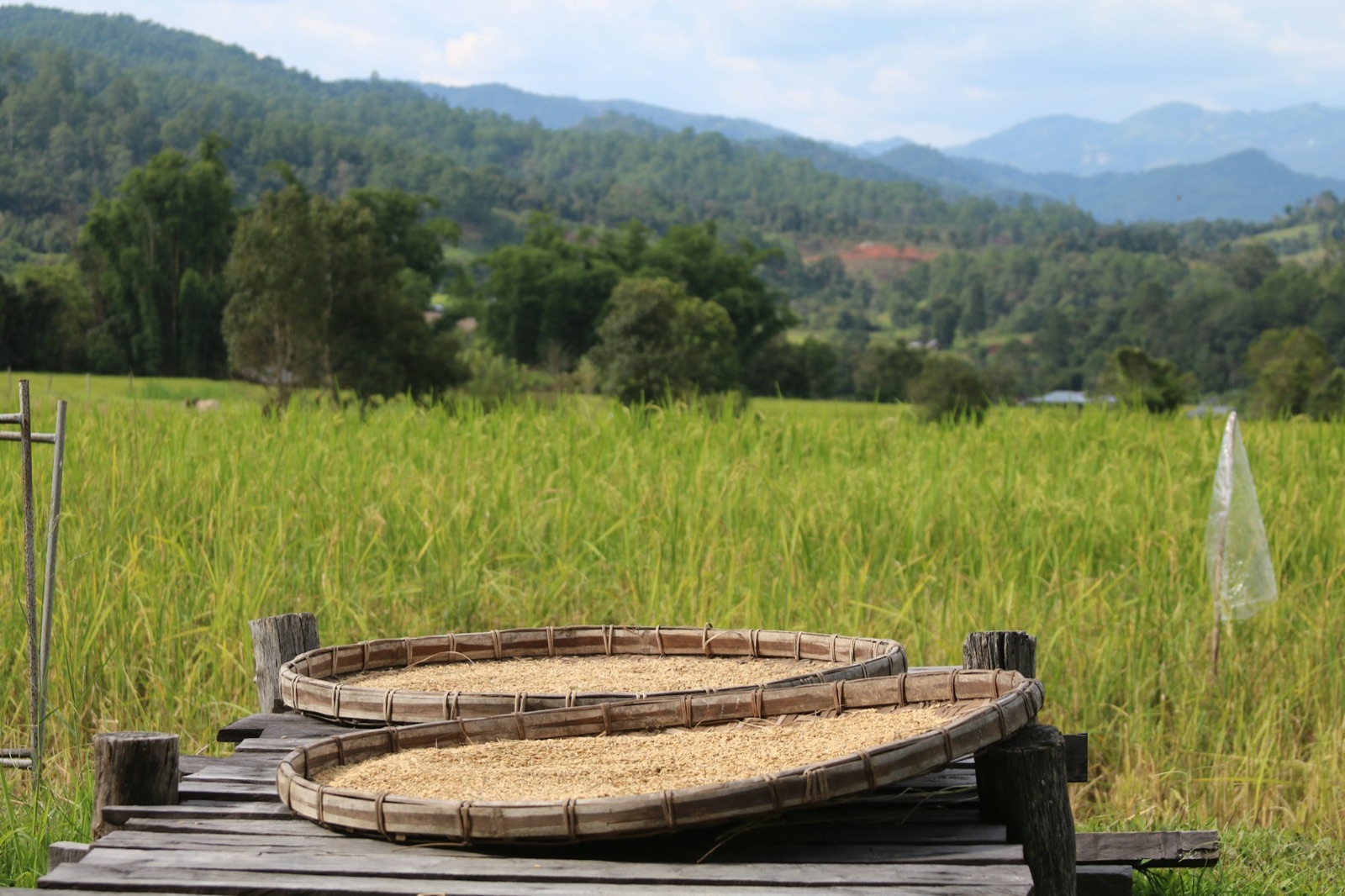
Tan khao mai (ทาฯนฯเขั้าไห่มฯ, Kham Mueang reading tan khao mai) is the tradition of offering the rice newly harvested that year to the Triple Gem, before the owners of the field eat any of the new rice themselves. The Moradok Lanna dictionary explains it as "an important ceremony that must be done before that new rice is eaten". This merit-making falls on si peng, the full moon of the 4th northern month, in the middle of the cold season, and it often comes together with another tradition just as warm: hing fai phra chao, "warming the Buddha by the fire".
What is tan khao mai?
The word tan (ทาฯนฯ, Kham Mueang reading tan) is given in the dictionary as "help, giving, donating", the same as the word than (dana, giving) in Thai. So tan khao mai literally means offering the new rice.
The dictionary goes on to say that the offering is made "to dedicate the merit to the deities who guard the headwaters and to the ancestors who handed down the rice fields". It remembers both the phi khun nam (ผีขุรนาฯ, Kham Mueang reading phi khun nam), the guardian spirit of the headwaters who sends water to feed the fields, and the ancestors who first cleared the fields that their descendants still farm.
The new rice goes to the Buddha first
A study by Phra Khru Phisan Piyatham and colleagues (2025), citing the Encyclopedia of Thai Culture: Northern Region, explains that after the rice harvest (kiao khao, ก่ยฯวเขั้า, Kham Mueang reading kiao khao) and after the unhusked rice (khao pueak, เขั้าเปิลฯอฯก, Kham Mueang reading khao pueak) has been carried up into the rice granary (long khao, หลฯอฯงเขั้า, Kham Mueang reading long khao), the household will not yet pound or mill that rice to eat until they have taken it to the temple for tan khao mai.
This belief fits the Lanna custom of khao phra chao (เขั้าระฯพเจั้า, Kham Mueang reading khao pha chao), the small tray of rice offered to the Buddha image every morning, for which the dictionary records the teaching "bo di kin kon tu kon phra": don't eat before the monks and novices.
Rice itself has a spirit, a khwan, in the beliefs of Lanna rice farmers. The dictionary explains that ya khwan khao (ย่าขัวฯรเขั้า, Kham Mueang reading ya khwan khao) is Mae Phosop, the rice goddess, who dwells in the rice plants and grains, and that after the harvest there is a su khwan khao ceremony (สู่ขัวฯรเขั้า, Kham Mueang reading su khwan khao) to invite the spirit of the rice from the fields to rest in the granary. Offering the new rice is therefore both merit-making and a way of giving thanks to what sustains life.
When is tan khao mai? Si peng, the full moon of the 4th month
Tan khao mai is one of the traditions of the twelve months of Lanna. It is usually held on the 15th waxing day of the 4th northern month, the wan duean peng (วันฯเดิอฯรเพงฯ, Kham Mueang reading wan duean peng, full-moon day) of the fourth month, so people in Lanna simply call it "si peng" ("four full").
This year: the Moradok Lanna Lanna calendar (in Thai) calculates that the next si peng falls on Friday 22 January 2027 (the full moon of 24 December 2026 is still the full moon of the 3rd month).
Season: sources differ slightly. The dictionary says "around January", the Fine Arts Department says around December to January, and the study from Phayao gives both December–January and January–February. All of this depends on whether the year has an extra (intercalary) month.
The steps of the ceremony
The study by Phra Khru Phisan Piyatham and colleagues (2025) looked at 3 temples in Yuan Subdistrict, Chiang Kham District, Phayao, and found that all of them still follow the same 7 steps:
- Prepare new rice from the household's best field.
- Gather at the temple before dawn, around 5:00 a.m.
- Light incense and candles in homage to the Triple Gem.
- Request and receive the Five Precepts.
- Recite the kham wen tan, the words offering the new rice.
- The monks give thanks and blessings.
- Offer food to the monks.
Each temple also has its own details. Wat Yuan, for example, holds an offering to the phi suea wat (the spirit who looks after the temple) before offering the new rice, and uses a long, beautiful offering text in the Lanna language, while newer temples use a Pali offering formula with a translation, so that the younger generation can understand it easily.
Khao chi and khao lam: offerings on the morning of si peng
The new rice is not offered only as grain. Villagers often turn it into food that suits the cold weather. The dictionary records the phrase tan khao chi khao lam (ทาฯนฯเขั้าจี่เขั้าหลฯามฯ, Kham Mueang reading tan khao chi khao lam), meaning "to offer grilled sticky rice and bamboo-tube rice on the full moon of the 4th northern month … after the rice has been harvested".
| Lanna word | Lanna script | Meaning (from the dictionary) |
|---|---|---|
| khao chi | เขั้าจี่ | sticky rice shaped into a ball and grilled over the fire |
| khao lam | เขั้าหลฯามฯ | uncooked sticky rice soaked in water or coconut milk, packed into a bamboo tube and roasted until cooked |
| tan khao chi khao lam | ทาฯนฯเขั้าจี่เขั้าหลฯามฯ | to offer grilled rice and bamboo-tube rice on the full moon of the 4th northern month |
The study from Phayao (citing Bamphen Rawin, 1999) tells that khao chi is made of steamed sticky rice pressed onto the end of a bamboo stick and grilled over the fire, sometimes sprinkled with salt or dipped in egg for fragrance. It is then shaped into small balls, put into leaf cups and placed before the Buddha image in the temple, or put into the monks' alms bowls. Some households also roast khao lam to offer.
Khao thip: another ceremony of the new rice
The same study records that some temples hold a ceremony of stirring khao mathupayat (milk rice), which some places call khao thip, "divine rice": rice cooked in milk mixed with honey, made with the new rice after the harvest. The ceremony follows the episode in the life of the Buddha in which Sujata cooked milk rice and offered it to the Buddha before his enlightenment, so the khao thip is usually shaped into 49 balls, the number Sujata offered. Some temples follow it with a chanting ceremony to celebrate the Buddha image.
Tan khao lon bat, or tan doi ngoen doi kham
Another way of offering the new rice is tan khao lon bat (ทาฯนฯเขั้าล้฿นฯบาฯระฯต, Kham Mueang reading tan khao lon bat), "rice overflowing the bowl". The dictionary explains it as "merit-making after the rice harvest season, putting unhusked or milled rice into an alms bowl until it overflows into a heap of rice", also called tan doi ngoen doi kham (ทาฯนฯดอฯยฯเงินฯดอฯยฯฅำ, Kham Mueang reading tan doi ngoen doi kham), "offering the silver mountain and the gold mountain".
The name "doi ngoen doi kham" comes from the 2 heaps of rice that rise like mountains:
- Doi ngoen (ดอฯเงินฯ, Kham Mueang reading doi ngoen), the "silver mountain", is the heap of milled rice, white like silver.
- Doi kham (ดอฯฅำ, Kham Mueang reading doi kham), the "gold mountain", is the heap of unhusked rice, yellow like gold.
The study from Phayao (citing Bamphen Rawin, 1999) describes the steps. In front of the principal Buddha image in the vihara (wihan, วิหารฯ, Kham Mueang reading wihan), mats are laid out in 2 places, one for unhusked rice and one for milled rice, with an alms bowl set in the middle of each. Villagers bring their rice and pour it into the bowl. As the heap rises, the bowl is lifted up and set on top of the heap, until the rice overflows the bowl, which is where the name comes from. Some places therefore call it the "doi khao" (rice mountain) tradition.
After the ceremony at the temple, villagers take trays of food to their parents and grandparents who live in other houses. As for the rice the temple receives, the temple committee keeps part of the milled rice to cook for the monks and novices, and sells the rest to support the temple.
Hing fai phra chao: firewood to keep the Buddha warm
In the same si peng month, Lanna also has the tradition of hing fai phra chao (หิงฯไฟระฯพเจั้า, Kham Mueang reading hing fai pha chao). Its full name is tan lua hing fai phra chao (ทาฯนฯห฿ลฯวฯหิงฯไฟระฯพเจั้า, Kham Mueang reading tan lua hing fai pha chao).
The name can be taken apart word by word:
| Word | Meaning |
|---|---|
| tan | to offer, to give alms |
| lua (ห฿ลฯวฯ, read lua) | "firewood, a log of firewood", according to the dictionary |
| hing fai (หิงฯไฟ, read hing fai) | to warm oneself by the fire |
| phra chao | the Buddha, and Buddha images |
The dictionary tells the origin: in the 4th northern month "the weather is very cold, and the faithful felt that the Buddha (the Buddha image) must be cold too", so they brought logs of firewood to offer and heaped them together to light fires around the vihara or wherever a Buddha image is enshrined. The firewood offered is called lua hing fai phra chao (ห฿ลฯวฯหิงฯไฟระฯพเจั้า, Kham Mueang reading lua hing fai pha chao), while ordinary firewood for warming oneself in the cold season is called mai lua hing fai (ไม้ห฿ลฯวฯหิงฯไฟ, Kham Mueang reading mai lua hing fai).
The steps of hing fai phra chao
Before the day, the abbot sends monks, novices and temple boys to gather firewood in the forest, and villagers help find wood too. The wood is cut to about 1 wa (an arm-span) or the height of the person cutting it, then tied into bundles. The preferred wood is mai chi (called mai khon tha in central Thailand), a thorny tree with white wood that catches fire easily. Today forest wood is hard to find, so wood from orchards is used instead.
Villagers prepare 1 bundle of firewood together with a tray of puffed rice, flowers, incense and candles. They pay homage to the Buddha, receive the precepts and recite the offering words, then present the firewood before the principal Buddha image in the vihara. If it is offered in the morning or at midday, food must be offered to the monks too; if it is offered in the evening, no food is needed.
Before dawn, around 4:00–5:00 a.m., the abbot lights the first fire and strikes a gong 3 times, so that villagers know and can rejoice in the merit. As the fire flares up, the bamboo pushed into the woodpile bursts with loud cracks that carry far, a signal for villagers to get up and prepare food to take to the temple.
The steps above are compiled from an article by the Fine Arts Department (Rungnapha Sa-nguansaksri) and from Maejo University's Sansai Discovery project (2024), which interviewed Noppadon Phimason (นพดล พิมาสน). The two sources agree on the essentials. The latter adds that some villages tie as many sticks as the 80 years of the Buddha's life, or more according to their faith, and stack the firewood into a tent shape.
The wisdom behind the fire
In the same interview, Noppadon Phimason explains that lighting a fire "so the Buddha image is no longer cold" was a kusalopai, a skilful device of earlier generations. In those days there were no warm clothes like today, so the fire gave real warmth to the monks and to the sattha (สัทธฯาฯ, Kham Mueang reading sattha), the faithful villagers who came to make merit and offer alms on cold mornings, and the cracking bamboo woke the whole village to come to the temple together.
The Fine Arts Department sums up the value of this tradition in 3 ways: it supports Buddhism, builds unity between villagers and monks, and brings happiness and peace of mind to those who take part.
Traditions that are fading
Both tan khao mai and hing fai phra chao can still be seen in many communities. In January 2023, for example, Wat Sung Men in Phrae held a 3-day festival called "Tak Tham, Tan Khao Mai, Hing Fai Phra Chao" (Naewna, 2023). But in many places things have begun to change.
For tan khao mai, the study from Phayao found a similar trend: the ceremony is getting shorter, most participants are elderly, fewer young people take part, and its purpose is gradually shifting from customary merit-making towards heritage preservation and community tourism. Noppadon Phimason gives a similar view: people today go to the temple less, and it is hard to find people to carry the tradition on.
Buddhist teachings in tan khao mai
The study by Phra Khru Phisan Piyatham and colleagues (2025) analyses tan khao mai as reflecting several of the bases of meritorious action (bunkiriyawatthu), such as:
- Danamaya, giving: offering the new rice, the best produce of the year
- Silamaya, morality: receiving and keeping the Five Precepts on the day
- Bhavanamaya, mental cultivation: paying homage and chanting
- Apacayanamaya, humility: humbleness, and remembering the kindness of the ancestors who farmed so that their descendants have rice to eat
The researchers conclude that this tradition helps instil gratitude, generosity and an appreciation of the value of rice in the community.
Summary
- Tan khao mai (read tan khao mai) is the offering of newly harvested rice to the Triple Gem before the owners of the field eat the new rice themselves, dedicating the merit to the deities who guard the headwaters and to the ancestors who owned the fields.
- It is held on the 15th waxing day of the 4th northern month, "si peng", around January; this year it falls on 22 January 2027.
- The offerings include khao chi and khao lam and tan khao lon bat, also called tan doi ngoen doi kham (doi ngoen = the heap of milled rice, doi kham = the heap of unhusked rice).
- Hing fai phra chao is the offering of firewood (lua) to make a fire so the Buddha images are no longer cold, which also warms the monks and villagers.
- Both traditions are adapting, both to the haze problem and to a younger generation that goes to the temple less.
Look up more Lanna words about rice and merit-making in the Moradok Lanna dictionary (in Thai), and read about the other meaning of Doi Kham in the article Pu Sae Ya Sae.
Sources
- The Moradok Lanna dictionary (in Thai): ตานเข้าใหม่ · ตานเข้าล้นบาตร · ตานเข้าจี่เข้าหลาม · ตานหลัวหิงไฟพะเจ้า · หลัว
- พระครูพิศาลปิยธรรม (บุญโรจน์ เชียงพรม), วันชัย พลเมืองดี และนภาพร หงษ์ทอง [Phra Khru Phisan Piyatham (Bunrot Chiangphrom), Wanchai Phonmueangdi and Naphaphon Hongthong]. (2025). วิเคราะห์หลักพุทธธรรมที่ปรากฏในประเพณีทำบุญตานข้าวใหม่ของอำเภอเชียงคำ จังหวัดพะเยา [An analysis of Buddhist teachings in the tan khao mai merit-making tradition of Chiang Kham District, Phayao]. วารสารธรรมวัตร 6(2) (citing ศรีเลา เกษพรหม and บำเพ็ญ ระวิน in สารานุกรมวัฒนธรรมไทย ภาคเหนือ [Encyclopedia of Thai Culture: Northern Region], 1999). In Thai.
- รุ่งนภา สงวนศักดิ์ศรี [Rungnapha Sa-nguansaksri]. (n.d.). ประเพณีทานหลัวหิงไฟพระเจ้า : ความเชื่อและความศรัทธาในพระพุทธศาสนา [The tan lua hing fai phra chao tradition: belief and faith in Buddhism]. Office of Literature and History, Fine Arts Department. In Thai.
- Porakamol Massamer. (2024, 14 February). “ตานหลัวหิงไฟพระเจ้า” ประเพณีที่มอบความอบอุ่นในเดือนสี่เป็ง ["Tan lua hing fai phra chao": a tradition that gives warmth in the si peng month]. Sansai Discovery, Maejo University (interviews with นพดล พิมาสน and พระครูจันทสรการ). In Thai.
- แนวหน้า [Naewna]. (2023, 5 January). วัดสูงเม่นจัดงานประเพณี 'ตากธัมม์ ตานข้าวใหม่ หิงไฟพระเจ้า' [Wat Sung Men holds the "Tak Tham, Tan Khao Mai, Hing Fai Phra Chao" festival]. In Thai.
- Moradok Lanna Lanna calendar: full moon of the 4th month, 22 January 2027. In Thai.
Look up "ตานเข้าใหม่" in the Moradok Lanna dictionary (in Thai)


