

Photo: Blowing Puffer Fish / Wikimedia Commons (CC BY 2.0)
Pu Sae Ya Sae: Chiang Mai's Guardian Giants and Liang Dong
Pu Sae Ya Sae (ผีปู่แสะย่าแสะ, Kham Mueang reading pu sae ya sae), "Grandfather Sae and Grandmother Sae", are the guardian spirits of the city of Chiang Mai according to the Moradok Lanna dictionary, and the ancestral spirits of the Lua people. Legend tells that they were a husband-and-wife pair of man-eating giants who, on meeting the Buddha, became guardians of the forest and the city. Every year the villagers at the foot of Doi Kham still hold the Liang Dong rite, making offerings to the two of them, as they have done to this day.
Who are Pu Sae Ya Sae?
The dictionary explains the word sae (แสะ, sae) as "the name of the ancestral spirits of the Lua, also accepted as the guardian spirits of the city of Chiang Mai". The Lua (ลวฯะ, lua) are a people of the Mon–Khmer family who lived in the Lanna region before the Tai Yuan arrived, and who still live in Lanna today.
In academic work, Asa Khampha (2012) studied this legend and ritual and concluded that Pu Sae Ya Sae are among the oldest and most important guardian city spirits of Chiang Mai.
| Lanna word | Lanna script | Meaning (from the dictionary) |
|---|---|---|
| phi mueang | ผีเมิอฯง | the guardian spirit of a city |
| suea mueang | เสิ้อฯอเมิอฯง | the guardian spirit that protects and watches over a city |
| phi chao nai | ผีเจั้านาฯยฯ | a guardian spirit who was an important figure in legend, honoured as a guardian deity |
| kao phi | เคั้าฯฯผี | the house where the clan spirits or ancestral spirits dwell |
| yak | ยัก์ขฯ | a non-human being in the Jataka tales, very large, with long fangs, fond of eating raw flesh |
The legend: the giants who met the Buddha
The legend appears in several old documents, such as the Chiang Mai Chronicle (Tamnan Phuen Mueang Chiang Mai), the Tamnan Chiang Mai Pang Doem and the Tham Tamnan Wat Nantharam, and it is also passed on by word of mouth, with differing details.
The city of Ramingkha Nakhon (Buppha Nakhon) was a city of the Lua, lying between the Ping River and Doi Oi Chang. Three giants, a father, a mother and a child, caught and ate the townspeople every day, until the people had to flee.
The Buddha came to teach them, showed miraculous powers and preached. The three giants gained faith and took the Five Precepts, but asked to go on eating human flesh, since it was the food of giants. When this was refused, they asked to eat one buffalo a year instead, to which the Buddha gave no answer.
So the giants went to ask the Lua ruler of the city. He agreed to give them one buffalo a year, on condition that the giants protect Buddhism for the full 5,000 years and guard the townspeople so they could live in peace. This is the origin of the yearly buffalo offering to Pu Sae Ya Sae.
The Buddha gave the giant couple Doi Kham and Doi Oi Chang, today's Doi Suthep, to look after. Their child was ordained as a monk, later left the monkhood and practised austerities as a hermit named Suthep Ruesi in the Hermit's Cave behind Doi Suthep, where the remains of a well that villagers call "Bo Ruesi" (the hermit's well) can still be seen.
The 32 children: ancestors of Chiang Mai's city spirits
Every version of the legend honours Pu Sae Ya Sae as the kao phi, the ancestors of the important spirits of Chiang Mai. They had as many as 32 children; well-known ones include:
| Child of Pu Sae Ya Sae | Domain |
|---|---|
| Chao Luang Kham Daeng | supreme over all the spirits of Lanna |
| Chao Soi | Mueang Mae Chaem (Mae Chaem District) |
| Chao Buaraphan | Mueang Haeng (Wiang Haeng District) |
| Chao Sompha Mit | Dong Mae Khanin (Hang Dong District) |
The Moradok Lanna dictionary gives Phi Chao Luang Kham Daeng as an example under the word ผีเจ้านาย, and gives the shrine of Pu Sae Ya Sae and the shrine of Chao Pho Kham Daeng as examples under the word ศาล.
The Liang Dong rite
Dong (ด฿งฯ, dong) means dense forest, and liang phi (ล้ยฯงผี, liang phi) means bringing food and offerings to spirits to ask for their protection. Liang Dong, "feeding the forest", is therefore the rite of feeding the spirits of Pu Sae Ya Sae, guardians of the forest. Villagers believe the two still dwell in the forests of Doi Kham and Doi Suthep, and help the rains come in their season so that the rice crop succeeds.
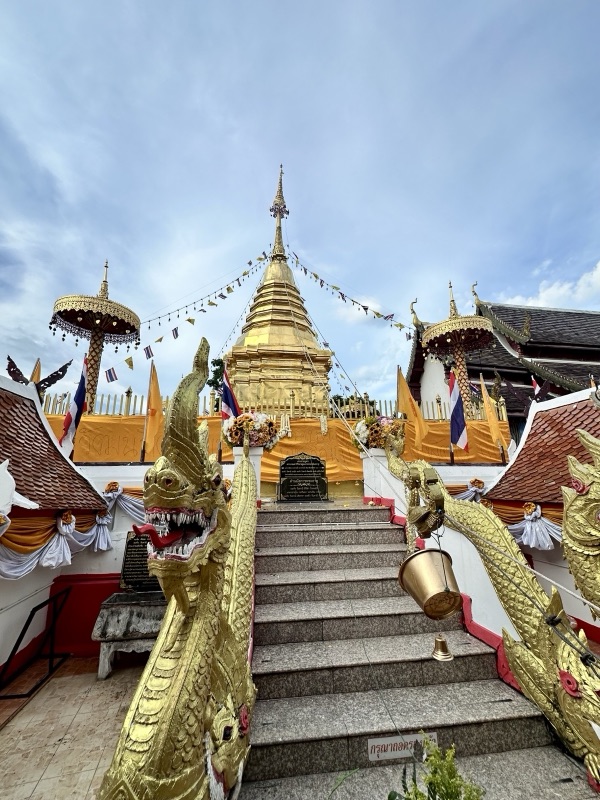
Where: the Liang Dong ground at Doi Suthep–Pui National Park Protection Unit 4 (Mae Hia), Mae Hia Subdistrict, Mueang Chiang Mai District. The dictionary records that the shrine of Pu Sae Ya Sae was originally in a village at the foot of Doi Suthep, and is now at Wat Doi Kham, behind Royal Park Rajapruek.
The steps of the rite
- Procession of the phra bot: villagers bring an ancient phra bot (ระฯพบ฿ฏฯฯ, phra bot), a cloth painted with an image of the Buddha, from a community temple and hang it at the ritual ground, standing for the Buddha of the legend. Villagers believe the cloth stirring in the wind is a sign that the Buddha is aware of the rite.
- Offerings at the shrine: offerings of puffed rice, flowers and savoury and sweet food are made at the shrine of Pu Sae Ya Sae by the path up to Wat Phra That Doi Kham.
- Inviting the spirits into the mediums: a pho nan (nan, หนฯานฯ, nan, is a man who has left the monkhood) invites the spirits of Pu Sae Ya Sae and their 32 children to enter the ma khi (ม้าขี่, ma khi), the spirit mediums.
- The offering: a male buffalo, in the dictionary's words "a khwai kok or khwai thaeo", a male buffalo whose horns are only as long as its ears (thaeo, แถ่วฯ, thaeo, means adolescent, a young lad).
- Blessings: the medium of Ya Sae comes to bow before the phra bot, the mediums walk among the participants giving blessings, and the buffalo meat is cooked and shared among the villagers.
What does this legend tell us?
Scholars' views
- Asa Khampha (2012) explains that the rite was originally part of the rite of feeding the city spirits, to protect the city, once held at many places around Chiang Mai in the 8th–9th months. With the centralisation of power from the reign of King Rama V, the city-level rites gradually disappeared, but villagers kept this one alive under the name "Liang Dong", and it reflects the blending of spirit beliefs with Buddhism.
- Nahathai Saenmongkhon, an independent scholar, interprets the legend as explaining how the original inhabitants (the Lua) had to make way for a new group (the Tai Yuan). Pu Sae Ya Sae thus stand for the Lua people, and the legend helped the two groups live together.
- Asst. Prof. Dr. Phiphat Krajaejun (2022), who has studied the rite, stresses that understanding cultural beliefs is a delicate and complex matter.
พิธีกรรมนี้คือส่วนหนึ่งของต้นรากทางประวัติศาสตร์ของเมืองเชียงใหม่ ("This ritual is part of the historical roots of the city of Chiang Mai.") — Asst. Prof. Dr. Phiphat Krajaejun (THE STANDARD, 2022)
Summary
- Pu Sae Ya Sae (read pu sae ya sae) are the ancestral spirits of the Lua people and the guardian spirits of the city of Chiang Mai.
- Legend tells that they were giants who gave up eating people after meeting the Buddha, in exchange for one buffalo a year and a promise to protect the religion and the city.
- They had 32 children, such as Chao Luang Kham Daeng; another giant child became the hermit Suthep Ruesi on Doi Suthep.
- The Liang Dong rite is held every year around the 8th–9th northern months at Mae Hia, at the foot of Doi Kham, to ask for the rains to come in their season.
Look up more Lanna words about spirits and beliefs in the Moradok Lanna dictionary (in Thai), and read about other Lanna traditions in the article Yi Peng, Pi Mai and tung.
Sources
- The Moradok Lanna dictionary (in Thai): ผีปู่แส๋ะย่าแส๋ะ · แส๋ะ · ลัวะ · ม้าขี่
- ปู่แสะย่าแสะ [Pu Sae Ya Sae]. Thai Wikipedia (the legend, the 32 children and the places, citing the Chiang Mai Chronicle and other documents). In Thai.
- อาสา คำภา [Asa Khampha]. (2012). ปู่แสะย่าแสะ กับประเพณีเลี้ยงผีเมืองเชียงใหม่ [Pu Sae Ya Sae and the tradition of feeding the city spirits of Chiang Mai]. วารสารสังคมศาสตร์ มหาวิทยาลัยเทคโนโลยีสุรนารี [Journal of Social Sciences, Suranaree University of Technology] 6(2). In Thai.
- ชลธิชา ปะโมนะตา [Chonthicha Pamonata]. (2023). ปู่แสะย่าแสะ: ความเชื่อและพิธีกรรม จะคงอยู่หรือเสื่อมสลาย [Pu Sae Ya Sae: will the belief and the ritual survive or fade?]. Faculty of Mass Communication, Chiang Mai University. In Thai.
- พิพัฒน์ กระแจะจันทร์ [Phiphat Krajaejun]. (2022). พิธีเลี้ยงดง [The Liang Dong rite]. THE STANDARD. In Thai.
- THE STANDARD. (2026, 30 May). ประเพณีเลี้ยงดง บวงสรวงปู่แสะ–ย่าแสะ [The Liang Dong tradition: offerings to Pu Sae and Ya Sae]. In Thai.
Look up "ผีปู่แส๋ะย่าแส๋ะ" in the Moradok Lanna dictionary (in Thai)


