

Photo: Wellcome Collection / Wikimedia Commons (CC BY 4.0)
Pap Sa and Palm Leaves: The Books of Lanna Literature
Pap sa (พัปฯสา, Kham Mueang reading pap sa) is a book made of mulberry paper, and bai lan (ไบลานฯ, read bai lan) are the leaves of the talipot palm used for inscribing scriptures. For several hundred years these two were the "books" of the Lanna people. The chronicles, Jataka tales, khao poems, medical manuals and astrology that we can still read today all reached us through pap sa and palm leaves.
What is a pap sa?
The Moradok Lanna dictionary explains pap sa as "a folding book or book made of mulberry paper, such as manuals or scriptures", also called pap nang sa. Pap (พัปฯ) means "a book folded in layers, like a khoi-paper book", and nang sa (หันฯงสา) is paper made from the bark of the paper mulberry tree, which in central Thai is called kradat sa (ระฯกดาษฯฯสา), mulberry paper.
A pap sa therefore looks like the samut khoi folding books of central Thailand: a long strip of paper folded back and forth in layers. Lanna also has names for the parts of the book, for example:
| Lanna word | Lanna script | Meaning (from the dictionary) |
|---|---|---|
| na pap kao | ห้นฯาพัปฯเคั้าฯ | front cover |
| na pap pai | ห้นฯาพัปฯปลฯายฯ | back cover |
| tua hai | ต฿วฯร่ายฯ | a copy, a copied manuscript |
Palm leaves: from the talipot palm to the scripture
The talipot palm (ton lan, ต้฿นฯลานฯ) is a tree similar to the sugar palm. The dictionary records it as "the plant with the largest leaves in the world", and its leaves are used to inscribe scriptures and to make fans, hats, rice boxes and even children's toys. A text inscribed on palm leaves is called tham bai lan (ธัม์มฯไบลานฯ, read tham bai lan).
Preparing palm leaves for inscription takes a long time. An article in Chiang Mai CityLife (2016) says that cutting and curing the leaves until they are ready often takes several weeks to several months. Leaves of each size also have names according to the number of lines per side, for example:
- lan ha (ลานฯห้า), a palm leaf that takes 5 lines a side
- lan hok (ลานฯห฿กฯ), a palm leaf that takes 6 lines a side
Inscribing: writing with iron, not ink
Lanna people did not "write" palm leaves: they chan (จารฯ, Kham Mueang reading chan), which the dictionary explains as "to write letters, patterns or incised marks on palm leaves or stone with a pointed iron". The tool is called a lek chan (เหัลฯกจารฯ, Kham Mueang reading lek chan), a pointed steel stylus with a handle. The scribe places the original on a kang khian tham (ค้าฯงฯขยฯรธัม์มฯ, read kang khian tham), a stand that holds the original for copying onto palm leaves.
The script inscribed is tua mueang (ต฿วฯเมิอฯง), the Lanna (Tai Tham) script. The dictionary records that it was used both for religion, as in palm-leaf scriptures and pap sa, and for secular writing such as literature, magic, astrology and medical texts. The numerals in the scriptures also have their own forms, called lek nai tham (เลขฯในธัม์มฯ(๐๑๒๓๔๕๖๗๘๙)).
The scribe presses the stylus into the surface of the palm leaf to make deep marks. At first the marks are faint white lines that are hard to read.
The Thai Encyclopedia for Youth, volume 32, explains that a cloth pad dipped in soot mixed with resin oil is rubbed back and forth over the leaf so that the black soot settles into the grooves of the letters.
Fine sand, roasted or sun-heated until hot, is sprinkled on and rubbed back and forth with a clean pad. The surface of the leaf comes up clean and pale, leaving only the black letters in the grooves. The encyclopedia records that some places in the Northeast use termite-alate oil mixed with coconut-husk soot instead.
Phuk, sai sayong and mai prakap
Once inscribed, the palm leaves are strung together into sets. The Moradok Lanna dictionary has a word for each of these parts:
| Lanna word | Lanna script | Meaning (from the dictionary) |
|---|---|---|
| phuk | ผูก | a set of many palm leaves of a scripture strung together with a sai sayong cord |
| sai sayong | สายฯสๆยฯอฯง | the cord that strings palm leaves into a phuk (also sai sanong) |
| mai prakap | ไม้ระฯบกัปฯ | wooden boards placed on either side of a palm-leaf text so the leaves do not bend or break easily |
| mai banchak | ไม้บัญัชฯก | a wooden tag inscribed with the title of a palm-leaf text, attached to its wrapping (also mai lap) |
| kam-pi tham | กัมีภฯร์ธัม์มฯ | a wrapper for palm-leaf scriptures |
| hit tham | หีดฯธัม์มฯ | a chest for scriptures, often lacquered or vermilion-painted and decorated with patterns |
The image at the top of this article shows a palm-leaf text with lacquered and gilded covers and a wrapping cloth, but according to the Wellcome Collection it is a Thai manuscript from the first half of the 19th century, not identified as a Lanna one.
The ho tham: home of the scriptures
The ho tham (หํอฯธัม์มฯ, Kham Mueang reading ho tham) is the Tipitaka hall, the building in a temple where palm-leaf scriptures are kept. In central Thai it is usually called a ho trai.
Offering scriptures to a temple is a great merit for Lanna people, called tan tham (ทาฯนฯธัม์มฯ, Kham Mueang reading tan tham), "offering palm-leaf scriptures to a temple". Scriptures therefore built up in the ho tham of temples throughout the North, and temples were also where children learned to read. The dictionary tells of this under kha-yom (ขโย฿มฯ, temple boy): a child placed in a temple as a pupil "first had to learn the Lanna tua mueang script until he could read and write, so as to recite chants and read palm-leaf scriptures".
In a lecture by Dr Direk Injan of Chiang Mai Rajabhat University (2025), palm leaves and pap sa served different purposes:
- Long palm-leaf texts mostly record Buddhist teachings and are kept in temples.
- Short palm-leaf texts and pap sa usually record ritual chants, astrology, medicine and other knowledge. They were personal property, so they are found both in temples and in homes.
Colophons: the voice of the scribe
At the end of many palm-leaf bundles is a short note written by the scribe, saying when and where it was inscribed, who inscribed it and why. Phra Amarin Santidhammo and colleagues (2023) studied the colophons of 8 palm-leaf manuscripts from Wat Duang Di, Chiang Mai, inscribed between 1800 and 1815 in the time of King Kawila, and found several interesting points:
- Inscribed by day: the notes give times by the Lanna watches, from "yam tut chao" (about 6–7 a.m.) to "yam laeng long ha kham" (about 3–4 p.m.). No inscribing at night was found; the researchers suggest this was because there was not enough light.
- Inscribed as a group: a monk of ecclesiastical rank led, while lay Buddhists helped to inscribe and sponsor the work.
- Prayers: for example, "made to uphold the Buddha's teaching for 5,000 years … and for as long as the palm leaves last".
- Humility: some scribes ask the reader to forgive their handwriting, for example, "the writing is not beautiful; please look kindly on it".
Conservation and the digital library
Many palm-leaf manuscripts have been damaged over time. The Chiang Mai CityLife article (2016) names the main threats as temple fires, termites and neglect, as well as manuscripts borrowed for copying and never returned. The same article reports that of about 4,200 items microfilmed at 53 temples between 1987 and 1991, roughly half have since been lost.
Surveys of northern manuscripts have gone on for decades. Dr Direk Injan's lecture notes (2025) sum them up as follows:
A timeline of northern manuscript surveys
- 1971–1974 Harald Hundius and Singkha Wannasai
- 1975 Sommai Premchit
- 1975–1978 the Siam Society under Royal Patronage
- 1976–1978 the National Library
- 1979–1990 the Social Research Institute, Chiang Mai University, registered manuscripts at temples across the North and microfilmed some of them
- 1987–1991 the Center for the Promotion of Arts and Culture, Chiang Mai University, with support from the German Foreign Office
- Today several organisations continue to survey, conserve and digitise
These microfilms and photographs became the Digital Library of Northern Thai Manuscripts, open to everyone online. A SOAS Library blog post (2016) reported that at its launch it held images of more than 4,200 items, in collaboration with the University of Pennsylvania and the National Library of Laos, using microfilms from the northern manuscript preservation project with permission from Chiang Mai University Library.
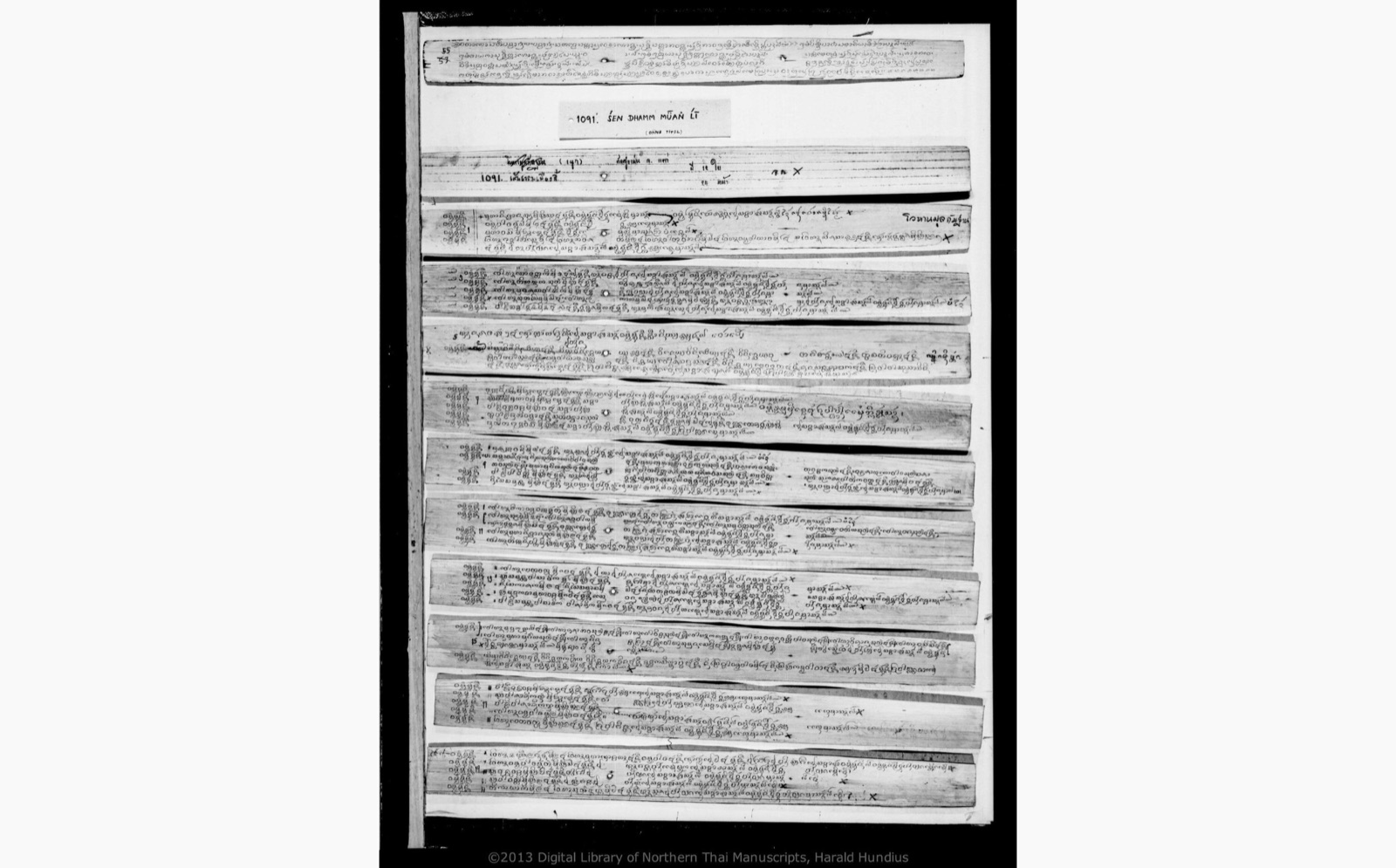
Communities also look after their own manuscripts. The research of Phra Maha Chatthep Buddhajato (2020) studied conservation at Wat Sung Men in Phrae, which the study describes as holding one of the largest collections of palm-leaf manuscripts. The conservation steps are surveying, cleaning, classifying, registering, digital photography, wrapping in cloth and labelling each manuscript with a code. The study also cites Phra Maha Suthit Abhakaro and colleagues (2015) in saying that the tak tham tradition, in which villagers bring the scriptures out together to air them, is a key reason Wat Sung Men has been able to preserve so many.
Summary
- A pap sa is a folding book made of mulberry paper, while bai lan are talipot-palm leaves used for inscribing scriptures, strung into a phuk with a sai sayong cord and held between mai prakap boards.
- Palm leaves are not written with ink but inscribed (chan) with an iron stylus, then rubbed with soot to make the letters black.
- Long texts are usually teachings kept in the ho tham, while pap sa and short palm-leaf texts are usually personal manuals.
- Colophons tell of the scribe's time, place and prayers.
- Thousands of northern manuscripts have been photographed for the Digital Library of Northern Thai Manuscripts, but many of the originals have already been lost.
Look up more words about scriptures and inscribing in the Moradok Lanna dictionary (in Thai), and read about a tradition that uses palm-leaf scriptures directly in the article Tang Tham Luang.
Sources
- Moradok Lanna dictionary (in Thai): ปั๊บสา · ใบลาน · หอธรรม · เหล็กจาร
- พระอัมรินทร์ สนฺติธมฺโม, วิไลพร สุจริตธรรมกุล และพงษ์ศิริ ยอดสา [Phra Amarin Santidhammo, Wilaiporn Sucharitthammakul and Pongsiri Yodsa]. (2023). คัมภีร์ใบลานยุคพระเจ้ากาวิละ: กรณีศึกษาจากบันทึกท้ายคัมภีร์ใบลานอักษรธรรมล้านนา สำรวจพบ ณ วัดดวงดี อ.เมืองเชียงใหม่ จ.เชียงใหม่ [Palm-leaf manuscripts of King Kawila's time: a case study of Lanna Tai Tham colophons found at Wat Duang Di, Chiang Mai]. Dhammadhara 9(2). In Thai.
- พระมหาฉัตรเทพ พุทฺธชาโต [Phra Maha Chatthep Buddhajato]. (2020). รูปแบบการอนุรักษ์คัมภีร์ใบลานของวัดและชุมชนในประเทศไทยด้วยกระบวนการทางวัฒนธรรมและเทคโนโลยี [Models for conserving palm-leaf manuscripts by temples and communities in Thailand through cultural and technological processes]. Journal of MCU Ubon Review 5(2). In Thai.
- Asien-Afrika-Institut, Universität Hamburg. (2025). The State of Northern Thai Manuscripts (1970–2025): Online Lecture by Direk Injan
- ทรูปลูกปัญญา [TruePlookpanya]. (2017). การลบใบลาน [Blackening palm leaves] (from the Thai Encyclopedia for Youth, vol. 32). In Thai.
- Pim Kemasingki. (2016). Uploading 500 Years of Lanna Manuscripts. Chiang Mai CityLife
- Jotika Khur-Yearn. (2016). Newly Launched Digital Library of Northern Thai Manuscripts. SOAS Library


