

Photo: Supanut Arunoprayote / Wikimedia Commons (CC BY 4.0)
The Chiang Mai Chronicle: A History on Palm Leaves
The Chiang Mai Chronicle (Tamnan Phuen Mueang Chiang Mai) is one of the most important historical documents of Lanna. Inscribed on palm leaves in the Lanna (Tai Tham) script, it tells the story of Chiang Mai and the Lanna kingdom in chronological order. The word tamnan (ตํานาฯ, Kham Mueang reading tam nan) in its name does not mean "a fantastic tale": it means a story recorded and handed down. For anyone who wants to understand the history of Chiang Mai, this chronicle is the first door to open.
What is the Chiang Mai Chronicle?
The Moradok Lanna dictionary explains tam nan as "a story handed down over a long time" and gives, as its very example, "the chronicle of Chiang Mai". Tam nan (ตำนาฯ) with a different tone is another reading of the same word.
The word phuen mueang (พื้นฯเมิอฯง, Kham Mueang reading puen mueang) means "of a particular town, local". In Lanna the word "phuen" also carries the sense of origins, as in nam phuen (นาฯพื้นฯ, Kham Mueang reading nam puen), which the dictionary translates as "background, history, how something came to be". Put together, Tamnan Phuen Mueang Chiang Mai means the record of how the town of Chiang Mai (ชยฯงไห่มฯ) came to be.
The chronicle is inscribed on palm leaves (bai lan, ไบลานฯ) in tua mueang (ต฿วฯเมิอฯง), the Lanna (Tai Tham) script, which the dictionary records was used both for religious texts, such as palm-leaf scriptures, and for secular writing, such as literature and manuals.
Script and language: Lanna (Tai Tham) script, in the Lanna language (Kham Mueang)
Length: the manuscripts used for both main editions run to 8 bundles (phuk)
Content: the history of Lanna from the founding of its towns to the early Rattanakosin (Bangkok) period
Compiled: around 1827, according to the study by David K. Wyatt
What it tells
The preface to the Office of the Prime Minister edition (1971) sums up the chronicle as the history of how the Lanna kingdom was built "from the beginning down to the Rattanakosin period", linked also with the stories of Sukhothai, Ayutthaya, Thonburi and Rattanakosin.
Parit Chiwarak (2023), an independent scholar of Lanna history, points out that the chronicle is arranged systematically in chronological order, beginning with the life of the Buddha and only then moving on to the story of the towns. This is the same pattern as the Buddhist chronicles of Sri Lanka, not the "superstition of village folk" that many people assume.
Its most important figure is Mangrai (มังฯรายฯ, Kham Mueang reading mang lai), whom the dictionary records as the first king of the Mangrai dynasty, founder of Chiang Rai in 1262 and of Chiang Mai in 1296. The dictionary also notes that the Yonok Chronicle and later documents often write "Mengrai".
The English edition from Silkworm Books explains that the chronicle was compiled around 1827 to tell of the growth and strength of a Lanna centred on Chiang Mai, looking ahead to a prosperous future after a generation of war.
From palm leaf to book: manuscripts and printed editions
The Chiang Mai Chronicle does not exist in a single manuscript. In the past, knowledge was kept in tham bai lan (ธัม์มฯไบลานฯ), palm-leaf texts that later generations copied again and again. Each set is divided into phuk (ผูก), bundles of palm leaves strung together into sections. Copies made at different temples and in different periods therefore differ somewhat in wording and detail.
The printed editions that scholars cite most often are:
| Edition | Published | Source of the manuscript |
|---|---|---|
| Notton edition (Camille Notton) | 1932 | the first translation from the Tai Tham script, into French, by a former French consul in Chiang Mai; printed in Paris |
| Office of the Prime Minister edition | 1971 | an 8-bundle manuscript that Sa-nguan Chotsukrat obtained from Phra Maha Kham Muen Wutthiyano of Wat Chedi Luang, transcribed by Thon Tonman |
| Chiang Mai 700 Years edition | 1995 | the subcommittee for checking and revising the Chiang Mai Chronicle; published by the Chiang Mai Provincial Cultural Centre and Chiang Mai Rajabhat Institute |
| New revised edition | 2000 | Aroonrut Wichienkeeo and David K. Wyatt, using an 8-bundle palm-leaf manuscript from Chiang Saen District, Chiang Rai, owned by Dr Hans Penth, thought to have been copied in 1878 |
The new revised edition by Aroonrut and Wyatt came out as a matching set of three: an English translation, a photographic facsimile of the original palm leaves (1996) and a Thai edition, with the page and bundle numbers aligned across all three. Readers can therefore compare the translation with the real palm leaves page by page.
A "tamnan" that is not a fairy tale
When Thai people today hear the word "tamnan", they tend to think of supernatural tales. Parit Chiwarak (2023) argues that calling many Lanna documents "tamnan" creates an unnecessary bias, because many of them were compiled "in the manner of (pre-modern) historiography", close to the Thai word phongsawadan, or "chronicle" in English, and some may even be more reliable than some of the Siamese chronicles.
The same article states that the original name of the Chiang Mai Chronicle was Ratchawongsa Pakon, meaning a text about the kings who succeeded one another as a dynasty; "tamnan" is a name used later.
Temple chronicles and town chronicles
Parit's article cites Sarassawadee Ongsakul's division of these documents into two groups:
- temple chronicles (tamnan fai wat), about the history of Buddhism, temples and relic stupas, written by monks and influenced by the Mahavamsa of Sri Lanka
- town chronicles (tamnan fai mueang), or "phuen mueang", about the history of towns, heroes and dynasties
Parit himself thinks this line is not really needed, because people in the past did not clearly separate worldly and religious matters, and the two groups of documents overlap a great deal.
How scholars use the chronicle
Historians use the Chiang Mai Chronicle alongside other evidence such as inscriptions, maps and archaeological surveys. A vivid example is the study by Surapol Damrikul (2008), "Doi Suthep and the city plan of Chiang Mai", which cites the 1971 edition of the chronicle on how water was once brought into the city from the Huai Kaeo stream: a rang rin, a trough hollowed out of a great log, was laid across the moat at the Hua Lin corner, and the water flowed along channels through the communities inside the city.
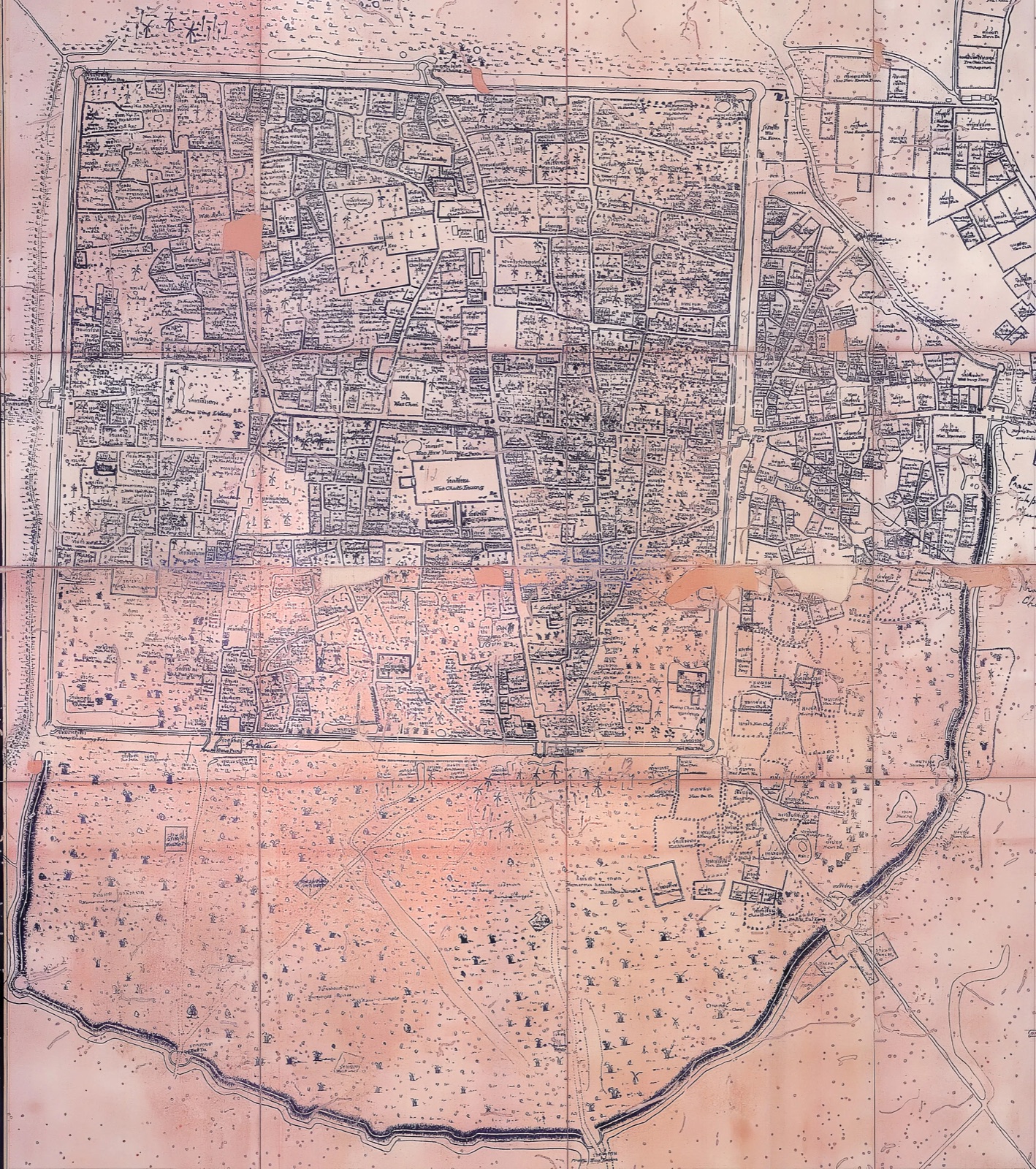
The same study gathers scholars' views on the outer city wall, which curves around the south and east. Some believe it was an older Lua town that existed before; some compare details in the chronicle with aerial photographs and maps and propose that both walls were built together in the time of King Mangrai; others think it was built later. The chronicle is thus both evidence and a question that scholars keep debating.
Articles on the Moradok Lanna blog also draw on the Chiang Mai Chronicle, such as the legend of the giant guardians of the city in Pu Sae Ya Sae and the story of the city pillar in Sai Khan Dok.
Summary
- The Chiang Mai Chronicle is a Lanna chronicle inscribed on palm leaves in the Tai Tham script, telling the story of Chiang Mai and Lanna in chronological order up to the early Rattanakosin period.
- Tam nan means a story handed down, and phuen relates to the origins of a town, not a "fairy tale".
- The main printed editions are the Notton edition (1932), the Office of the Prime Minister edition (1971), the Chiang Mai 700 Years edition (1995) and the new revised edition by Aroonrut and Wyatt (2000).
- Scholars use the chronicle together with inscriptions, maps and archaeology, and you should always state which edition you cite.
Look up more Lanna words about scriptures and palm leaves in the Moradok Lanna dictionary (in Thai), and read a legend that comes from Chiang Mai's old documents in the article Pu Sae Ya Sae.
Sources
- Moradok Lanna dictionary (in Thai): ต่ำนาน · ปื๊นเมือง · ตั๋วเมือง · ผูก
- คณะกรรมการจัดพิมพ์เอกสารทางประวัติศาสตร์ สำนักนายกรัฐมนตรี [Committee for the Publication of Historical Documents, Office of the Prime Minister]. (1971). ตำนานพื้นเมืองเชียงใหม่ (คำนำ) [The Chiang Mai Chronicle (preface)]. Phra Nakhon: Office of the Prime Minister Press (preface text on Wikisource). In Thai.
- คณะอนุกรรมการตรวจสอบและชำระตำนานพื้นเมืองเชียงใหม่ [Subcommittee for checking and revising the Chiang Mai Chronicle]. (1995). ตำนานพื้นเมืองเชียงใหม่ ฉบับเชียงใหม่ ๗๐๐ ปี [The Chiang Mai Chronicle, Chiang Mai 700 Years edition]. Chiang Mai: Chiang Mai Provincial Cultural Centre and Chiang Mai Rajabhat Institute (bibliographic details from works that cite it). In Thai.
- อรุณรัตน์ วิเชียรเขียว และเดวิด เค. วัยอาจ [Aroonrut Wichienkeeo and David K. Wyatt]. (2000). ตำนานพื้นเมืองเชียงใหม่ ฉบับปรับปรุงใหม่ [The Chiang Mai Chronicle, new revised edition]. Chiang Mai: Silkworm Books. In Thai.
- Wyatt, David K. and Aroonrut Wichienkeeo. (1998). The Chiang Mai Chronicle (2nd ed.). Chiang Mai: Silkworm Books
- พริษฐ์ ชิวารักษ์ [Parit Chiwarak]. (2023, 12 February). 'ตำนาน' ไม่ใช่ 'ตำนาน' ในประวัติศาสตร์นิพนธ์ล้านนา ["Tamnan" is not "legend" in Lanna historiography]. The 101 World. In Thai.
- สุรพล ดำริห์กุล [Surapol Damrikul]. (2008). ดอยสุเทพกับผังเมืองเชียงใหม่ [Doi Suthep and the city plan of Chiang Mai]. Journal of Fine Arts, Chiang Mai University 1(2). In Thai.


