

Photo: Dharmadana / Wikimedia Commons (CC BY 4.0)
Khruang Khoen: Lanna Lacquerware of the Tai Khuen
Khruang khoen (เระฯคิอฯงเขินฯ, Kham Mueang reading khueang khoen) is Lanna lacquerware: household vessels shaped from woven bamboo and then coated with lacquer until smooth and glossy. The name comes from the Tai Khuen, people who were moved by force from the city of Kengtung to settle in the Wat Nantharam community of Chiang Mai. Khruang khoen is therefore both a beautiful craft and a story of how people were moved about in Lanna history.
What is khruang khoen?
The Moradok Lanna dictionary explains that khruang khoen is "vessels and household utensils made of woven bamboo, which is polished and then coated with black lacquer and decorated with mother-of-pearl, gold leaf or silver leaf to make beautiful patterns".
The heart of the craft is nam hak (นาฯรักฯ, nam hak), the sap of the lacquer tree, which the dictionary records as "clear and poisonous". It is mixed with soot or vermilion and painted onto the vessel. Coating a surface with lacquer in this way is called long hak (ล฿งฯรักฯ, long hak) by the Khon Mueang (Northern Thai people).
Where does the name "khoen" come from?
The first meaning of the word khoen (เขินฯ, khoen) in the dictionary is "a name for the Tai people of Kengtung, Tai Khoen or Tai Khuen". The Tai Khuen people (ฅ฿นฯไทขึนฯ, khon tai khuen) are "people of the Tai family who live on the plain of the Khuen River, in the city of Kengtung, Shan State", whose spoken and written language is similar to that of the Lanna people.
The name Khuen (spelled ขึน or ขืน in Thai) comes from the river that flows past the city of Kengtung (ชยฯงตุง, Kham Mueang chiang tung). The dictionary explains that this river "flows from south to north", against the direction of most rivers. Both studies used in this article likewise explain that khuen means "going back upstream" or "going against", because the river flows north before joining the Mekong.
From Kengtung to Ban Nantharam
When King Kawila restored Chiang Mai after the years of war, the land was short of people. This began the era known as "gather vegetables into the basket, gather people into the city" (เกัปฯผักฯไส่ซ้าเกัปฯข้าไส่เมิอฯง, kep phak sai sa kep kha sai mueang). The dictionary explains that this was the period when people were gathered back into the city, and the Tai Lue, Tai Khuen and Tai Yai (Shan) were brought by force from Sipsongpanna and Kengtung to settle in Chiang Mai.
Among them were Tai Khuen craftsmen skilled in lacquerwork. The research of Trakunphan Phatcharametha (2019) states that the Tai Khuen were given land between the inner and outer city walls on the south side, the area of today's Wat Nantharam community, Hai Ya Subdistrict, Mueang Chiang Mai District. So the name "khruang khoen" simply means the vessels and utensils of the Khoen people.
The lacquerware craft community: Wat Nantharam community, Hai Ya Subdistrict, Mueang Chiang Mai District.
Thapakon Khruearaya (ฐาปกรณ์ เครือระยา, 2019) suggests that Chiang Mai already made local lacquered bamboo vessels before then, but that the Nantharam incised-design technique probably arose after the Tai Khuen craftsmen arrived, and is the same technique found at Mueang Nong in Shan State.
How khruang khoen is made
Thapakon Khruearaya did fieldwork at Ban Nantharam and concluded that making khruang khoen has 3 main stages. Each piece takes several weeks to several months, because each layer of lacquer must dry before the next.
The craftsman takes mai hia (ไม้เฮ้ยฯ, mai hia), a small, long, thin-walled bamboo, and does chak tok (จักฯตอฯก, chak tok), splitting it into thin, flat strips. The strips are then woven or coiled around a turned wooden mould, which spins like a potter's wheel, until the vessel takes shape. Large vessels usually have their rims bound with split rattan for strength.
Lacquer is applied to the rim first, so that it glues the ends of the strips together. Then a base coat is applied, and the surface is scraped smooth with an iron hook that craftsmen call "ngong". Next, rak samuk (lacquer mixed with brick dust, white clay powder and water) is pressed in to fill the gaps in the weave, sanded with sandpaper, and lacquered again 3–4 more times, each coat left to dry for about a week.
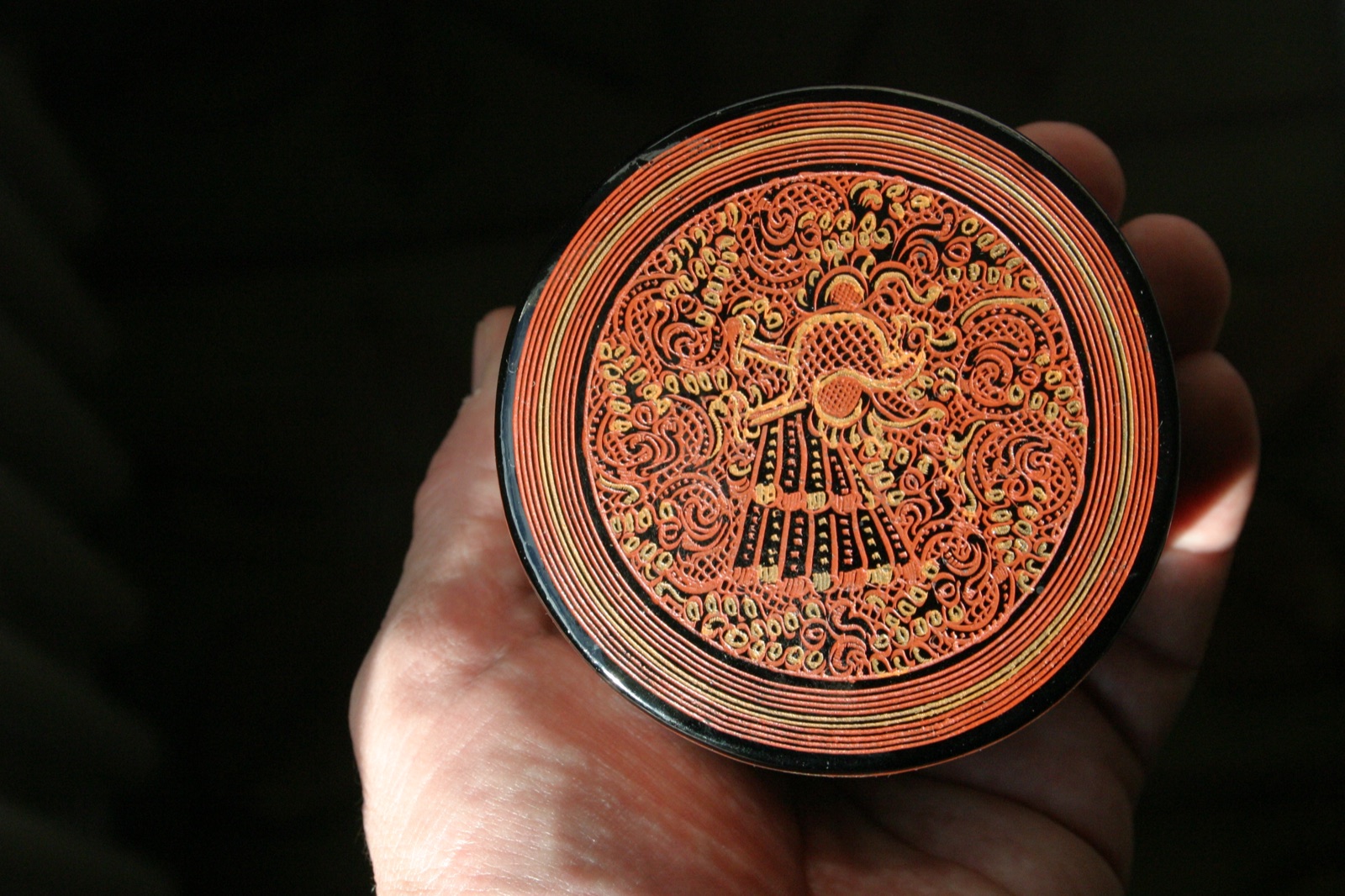
When the lacquer surface is smooth and thoroughly dry, the craftsman uses a pointed iron tool like the stylus used to write palm-leaf manuscripts to incise the design into the surface. The lines are filled with lacquer mixed with red vermilion (chat) and left to dry, then the surface is polished back until red lines show on a black ground, and a final coat of clear lacquer is applied over it.
Hai lai hai dok: red incised designs on black
The Nantharam craftsmen call incising the designs "hai lai hai dok" or "hai dok". Thapakon Khruearaya studied more than 90 old pieces of lacquerware from Chiang Mai, Lamphun and Lampang, chose 57 of them to copy the designs, and divided the designs into 2 roles:
- Main designs occupy the most visible areas. They include flower-scroll designs (such as the rose, ban bai and chi hup designs), single floating flowers (usually on the base of a vessel, such as the eggplant-flower and dok kaeo designs) and rows of flowers (used along the rims, such as the lotus-petal and silk-thread designs).
- Secondary designs reduce the empty space and add more red. There are only 2: the kha toek design and the rambutan-flower design (dok ngo).
Lacquerware vessels used in Lanna homes
Khruang khoen was not decoration but something used in daily life and in rituals. The research of Trakunphan Phatcharametha (2019) gives these examples of vessels typical of Lanna:
| Vessel | Lanna script | What it is used for |
|---|---|---|
| Khan mak | ขันฯหมฯากฯ | holds the things for chewing betel; the dictionary calls it a betel box. The study says Lanna betel boxes are larger than those of other regions, to keep the betel leaves fresh in the drier air |
| Aep mak | แอัปฯหมฯากฯ | a betel box (dictionary); the word aep also means a flat box with a lid |
| Khan dok | ขันฯดอฯก | a footed flower tray for flowers, popped rice, incense and candles offered to the Buddha; regarded as a sacred object |
| Khan tok | ขันฯโต฿กฯ | a tray on a tall foot used as a food tray (khantoke); the study says it is made of turned teak |
| Pung | พุง | a woven vessel like a large basket with a lid, used to store seeds and clothes |
There is also the khan o, for carrying things to the temple to make merit, and the hip pha (clothes chest), which the study says belonged to the groom and was used to carry his clothes when he moved to the bride's house. Villagers only got to see the clothes chest when someone moved house, so its owner took great care over the weaving of the frame and the painted flowers, since it was a matter of pride for the groom.
Nantharam lacquerware today
Thapakon Khruearaya (2019) found that today Nantharam lacquerware made with the traditional techniques and materials survives in only one place. The main reasons are:
- Lacquer sap is hard to find and vermilion is expensive, so villagers struggle to obtain materials.
- The craftsmen have no successors to carry on the knowledge of the old designs.
- Most work is made for tourism, using powder paint, oil paint or fluorescent paint instead of vermilion, without a lacquer coating, so the designs soon flake off.
The study copied the old designs back for the community's craftsmen to learn again, and experimented with small products, such as small water bowls, cups and boxes, that keep the Nantharam identity but take less time and less lacquer.
Craft terms from the research (not in the dictionary)
- Hai lai hai dok / hai dok: incising designs into the lacquer surface with a pointed iron tool
- Khua hak khua hang: a local phrase for utensils coated with lacquer and vermilion
- Rak samuk: lacquer mixed with brick dust, white clay powder and water, used as a base coat and to fill gaps
- Ngong: a pointed iron tool like a small knife with a bamboo handle, used to scrape the surface before polishing
- Kha toek design / rambutan-flower design: the two secondary designs that must not be used together
These terms come from the research of Thapakon Khruearaya (2019) and Trakunphan Phatcharametha (2019). Moradok Lanna has not yet recorded them in the dictionary.
Summary
- Khruang khoen (read khueang khoen) is Lanna lacquerware of woven bamboo, decorated with vermilion, gold, silver or mother-of-pearl.
- The name comes from the Tai Khuen of Kengtung, who moved to the Wat Nantharam community in the era of "gather vegetables into the basket, gather people into the city" under King Kawila.
- The Khon Mueang originally called this craft khua hak khua hang; the word khruang khoen probably came later.
- It is made in 3 stages: shaping the frame from mai hia bamboo, applying many coats of lacquer, and hai lai hai dok, incising designs filled with red vermilion on a black ground.
- Very little traditional work remains today, because lacquer sap is scarce, vermilion is expensive and the craftsmen have no successors.
Look up more Lanna words for vessels and crafts in the Moradok Lanna dictionary (in Thai), and read about the khan dok in the worship of the city pillar in the article Sai Khan Dok.
Sources
- Moradok Lanna dictionary (in Thai): เครื่องเขิน · เขิน · คนไตขึน · น้ำฮัก · เก็บผักใส่ซ้า
- ฐาปกรณ์ เครือระยา [Thapakon Khruearaya]. (2019). ฮายลายฮายดอก เทคนิคงานเครื่องเขินบ้านนันทาราม จังหวัดเชียงใหม่ [Hai lai hai dok: the lacquerware technique of Ban Nantharam, Chiang Mai]. Journal of Fine Arts 10(1). In Thai.
- ตระกูลพันธ์ พัชรเมธา [Trakunphan Phatcharametha]. (2019). เครื่องเขินล้านนา (Lanna Lacquer Ware) [Lanna Lacquer Ware]. Srinakharinwirot Research and Development Journal (Humanities and Social Sciences) 11(22). In Thai.
Look up "เครื่องเขิน" in the Moradok Lanna dictionary (in Thai)


