

Photo: FredTC / Wikimedia Commons (CC BY-SA 4.0)
Jinakalamali: The Pali Chronicle of Buddhism in Lanna
The Jinakalamali (Jinakālamālīpakaraṇa, in Thai ชินกาลมาลีปกรณ์) is a Pali text composed in Chiang Mai in the early 16th century by a Lanna monk named Phra Ratanapanya Thera. It tells the story of the Buddha in chronological order, followed by the history of Buddhism in Sri Lanka, in Hariphunchai and under the Mangrai dynasty. It is therefore both a religious work and one of the sources for Lanna history that scholars cite most often.
Its author belonged to the Hon Pa Daeng school (ห฿นฯป่าแดงฯ, Kham Mueang reading hon pa daeng), the monks who followed the teaching of Wat Pa Daeng, so the stories in the text also reflect the outlook of this group of monks.
What does "Jinakalamali" mean?
The title is made of four Pali words, which Phra Phiyaphop Thanphanali and Sirisak Aphisakmontri (2020) break down as follows:
| Word | Meaning |
|---|---|
| jina | the victor; here, the Buddha |
| kala | time, occasion, period |
| mali | a stringing together, like threading a garland |
| pakarana | a treatise, text, book |
Put together: a text that strings together the story of the Buddha in the order of time.
Who wrote it, where and when
The colophon names the author as Phra Ratanapanya, a monk of 23 rains (years in the monkhood), living in the Ratanamahavihara that King Phra Mueang Kaeo, grandson of King Tilokarat, had built for him (Phra Phiyaphop and Sirisak, 2020). Hans Penth, a scholar of Lanna inscriptions, identifies this monastery as Wat Pa Daeng in Chiang Mai.
The Moradok Lanna dictionary explains hon pa daeng as "monks of the Wat Pa Daeng school, or who follow the teaching of Wat Pa Daeng ... which is of the Lankavamsa lineage". Here hon means a school or community of monks, while a thera (เถรฯ, read then or thera) is a senior monk who has been ordained for 10 years or more.
Place of composition: the Ratanamahavihara, or Wat Pa Daeng, Chiang Mai.
There is much more to tell about Phra Ratanapanya Thera himself; read the article Phra Ratanapanya Thera. This article focuses on the text.
What the text tells
The text is written in prose alternating with verse, and it turns Lanna names of cities, people and rivers into Pali. The study by Phra Phiyaphop and Sirisak (2020) divides its content into two main parts:
- The lineage of Buddhas and the life of the Buddha: from the moment the Bodhisatta resolved to become a Buddha, through the perfections he fulfilled under earlier Buddhas, to his enlightenment and final passing away (parinibbana).
- Buddhism after the Buddha: the councils, King Ashoka, Buddhism in Sri Lanka, in Lamphun (Hariphunchai) and in Lanna, and the history of the Mangrai kings down to the time of writing.
What is not found in the other Lanna texts compared with it is the history of four important Buddha images: the Phra Phuttha Sihing, the Emerald Buddha, the Phra Chao Kao Tue and the Phra Sikhi.
The Phra Sing (ระฯพสิง์หฯ, read phra sing), or Phra Phuttha Sihing, is the Buddha image that the people of Chiang Mai still carry in procession every year to be bathed at the Lanna New Year (pi mai mueang). The Moradok Lanna dictionary records that Phaya (พญา, read pha-ya) Saen Mueang Ma, the seventh king of the Mangrai dynasty, brought it to Wat Li Chiang Phra, which later became Wat Phra Singh.
A lineage of Buddhas longer than the Tipitaka's
The study by Phra Phiyaphop Thanphanali and Sirisak Aphisakmontri (2020) found that the Jinakalamali names 31 Buddhas, three more than the 28 of the Buddhavamsa in the Tipitaka, and tells seven more past lives of the Bodhisatta.
The researchers found that these stories appear earlier in the Sambhara-vipaka, a text composed in Lanna around the late 14th century, and suggest that the Sri Lankan Buddhism that first reached Lanna may have carried some Mahayana ideas with it. This is the researchers' own proposal and needs further study.
Why it praises King Tilokarat and the Hon Pa Daeng
Scholars point out that the text was not written only as a record but with a clear purpose. Phra Phiyaphop and Sirisak (2020) sum it up in three points:
- to explain the lineage of the Buddhas in order
- to link the line of Lanna kings to the Buddha's lineage, showing the legitimacy of the Mangrai dynasty
- to praise King Tilokarat and support the monks of the Wat Pa Daeng school
A clear example is that the text criticises Phaya Sam Fang Kaen, King Tilokarat's father, for having little faith in Buddhism and for worshipping the guardian spirits of mountains and great trees with sacrifices of cattle and buffaloes, while it praises King Tilokarat as a devout Buddhist. Even when it tells of the reign of King Mueang Kaeo, it still calls him the grandson of King Tilokarat.
The spirit worship with cattle and buffaloes that the text criticises is interesting to read alongside the spirit beliefs still handed down in Lanna communities today, such as the liang dong ceremony in the article Pu Sae Ya Sae. Both show that Buddhism and spirit beliefs have long lived side by side in Lanna, even if some periods criticised one another.
The manuscripts travelled from Lanna to Ayutthaya and Bangkok
Something many people do not know is that, to this day, no copy of the Jinakalamali written in the Lanna (Tai Tham) script has been found (Phra Phiyaphop and Sirisak, 2020). The surviving copies are all copies made one after another in central Siam.
Tua mueang (ต฿วฯเมิอฯง, read tua mueang), the Lanna (Tai Tham) script, is the script used for religious texts in Lanna, yet the Jinakalamali manuscripts that survive today are in Khom script (ขอฯม, read khom), which the dictionary explains as the script of the ancient Khmer.
These manuscripts were inscribed on palm leaves (bai lan, ไบลานฯ). Chan (จารฯ, read chan) means writing on a palm leaf with a pointed iron stylus, and a set of palm leaves strung together with a cord is called a phuk (ผูก, read phuk). Lanna people call a text inscribed on palm leaves tham bai lan (ธัม์มฯไบลานฯ, read tham bai lan) and keep them in a ho tham (หํอฯธัม์มฯ, read ho tham), a scripture library.
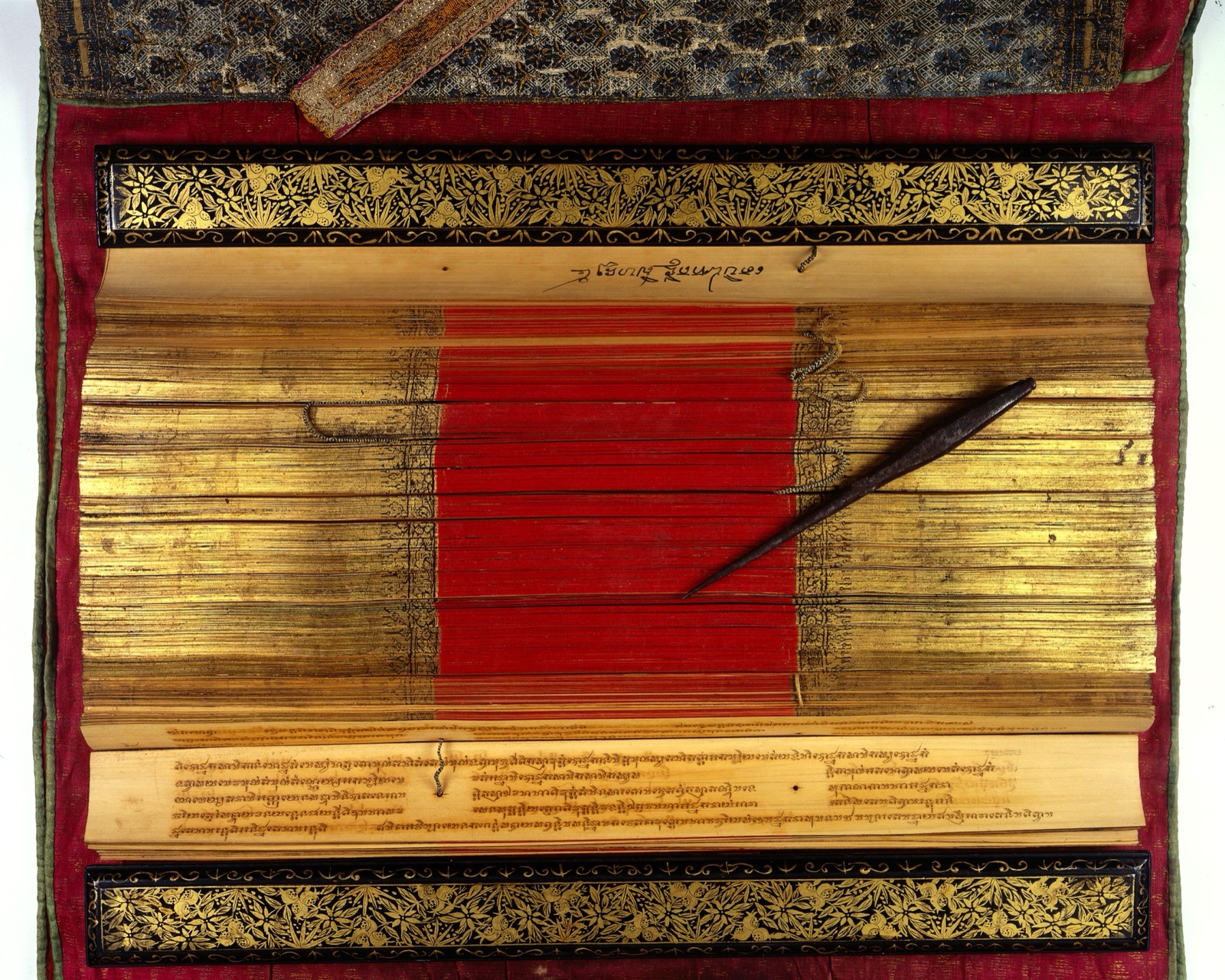
According to Phra Phiyaphop and Sirisak (2020), the oldest copy is an Ayutthaya-period copy in 5 bundles, kept at the Vajirayana Library. Early in the reign of King Rama I a new copy was made in 1788, in Pali written in gold-line Khom script, and kept at the Ho Phra Monthian Tham. Thai Wikipedia states that 11 manuscripts have been found in all: 10 in Khom script and 1 in Mon script.
Translations into Thai and other languages
| Year (CE) | Version | Translator or publisher |
|---|---|---|
| reign of Rama I | Thai translation titled "Chinakanmalini" | five royal scholars, led by Phraya Phimon |
| 1908 | first printing (Pali and Thai), distributed at a royal funeral | reign of Rama V |
| 1925 | French translation with the Pali text | George Cœdès |
| 1955 | Sinhala translation, printed in Sri Lanka | Phra Buddhadatta, a Sri Lankan monk |
| 1958 | new translation with footnotes | Saeng Manavidura (Fine Arts Department) |
| 1968 | English translation | N. A. Jayawickrama (Pali Text Society) |
The version by Saeng Manavidura (1958) is the one scholars cite most widely, because it is considered the least inaccurate and has footnotes explaining the history (Suwin Makdai and colleagues, 2019). The same study also mentions a translation by Sathian Phantharangsi from 1931, but the other sources used for this article do not mention it.
Its value as a historical source
Tam nan (ตํานาฯ, Kham Mueang reading tam nan), "chronicle" or "legend", means a story handed down over time. Many Lanna local documents were copied over many generations, so they may contain errors.
Suwin Makdai and colleagues (2019) explain that the Jinakalamali was written during the late Mangrai dynasty, so historians find it a good tool for checking the accuracy of the chronicles and local histories. It also has information on temples, Buddha images and Buddhist art, such as the casting of the Phra Chao Kao Tue, which is now enshrined at Wat Suan Dok.
The Jinakalamali is also one of the Pali texts composed by Lanna monks in roughly the 15th to 17th centuries, like the Mulasasana and the Camadevivamsa. The three are often used together in the study of Lanna history.
Summary
- The Jinakalamali is a Pali text that strings together the story of the Buddha in chronological order, followed by the history of Buddhism in Sri Lanka, Hariphunchai and Lanna.
- Its colophon names the author as Phra Ratanapanya of the Ratanamahavihara, or Wat Pa Daeng, Chiang Mai. It was finished in 1517, with additions up to about 1527–1528, and the author's identity is still debated.
- The text praises King Tilokarat and the Hon Pa Daeng monks, so it should be read with the author's outlook in mind.
- No copy in the Lanna script has been found. The surviving copies are in Khom script, copied in Ayutthaya and Bangkok, and there are translations into several languages, of which Saeng Manavidura's (1958) is the most widely cited.
Look up more Lanna words about scriptures and monks in the Moradok Lanna dictionary (in Thai), and read about palm-leaf texts and listening to sermons in Lanna in the article Tang Tham Luang.
Sources
- Moradok Lanna dictionary (in Thai): หนป่าแดง · หนสวนดอก · ตั๋วเมือง · ผูก · พระสิงห์
- พระพีร์ญาภพพ์ ธารพนาลี และศิริศักดิ์ อภิศักดิ์มนตรี [Phra Phiyaphop Thanphanali and Sirisak Aphisakmontri]. (2020). วงศ์พระพุทธเจ้าในชินกาลมาลีปกรณ์ [The lineage of the Buddhas in the Jinakalamali]. Journal of Fine Arts, Chiang Mai University 11(1). In Thai.
- สุวิน มักได้ และคณะ [Suwin Makdai and colleagues]. (2019). ศึกษาวิเคราะห์พุทธศิลป์ล้านนาที่ปรากฏในคัมภีร์ชินกาลมาลีปกรณ์ [An analytical study of Lanna Buddhist art in the Jinakalamali]. Journal of Buddhist Studies 10(1). In Thai.
- Penth, Hans. (1995). Which Ratanapañña Composed the Jinakālamālī?. Journal of the Siam Society 83
- ชินกาลมาลีปกรณ์ (Jinakalamali). Thai Wikipedia (number of manuscripts; used as a lead only). In Thai.
Look up "หนป่าแดง" in the Moradok Lanna dictionary (in Thai)


