

Hang Maeng Pong: The Scorpion-Tail Boats of the Ping
Hang maeng pong (หางฯแมงฯป่อฯง, Kham Mueang reading hang maeng pong, "scorpion's tail") is the name of the teak boat of the Ping River, whose stern curves up high like a scorpion's tail. The Moradok Lanna dictionary records that it was the boat commonly used to travel between Chiang Mai and Bangkok in the past, first as the boat of the northern nobility and later as a cargo boat that took months to travel down the Ping and back.
So the story of this boat is a story of a word, of the boatbuilders' craft, and of the trade route that sustained Chiang Mai before the railway came.
The names: hang maeng pong, huea hang maeng pong and huea mae pa
The full name is the scorpion-tail boat (เริอฯอหางฯแมงฯป่อฯง), which the dictionary says is called "huea hang maeng pong" in the Lanna dialect, because Kham Mueang pronounces r as h, as in the word for a boat landing (ท่าฯเริอฯอ), read ta huea.
The name comes from the shape of the stern, which curves up like the tail of a scorpion (แมงฯป่อฯง, maeng pong), the creature that raises a tail with a sting at its tip. Another name recorded in the dictionary is huea mae pa (เริอฯอแม่ปะ, huea mae pa), which is "another name for the scorpion-tail boat". In addition, the National Archives in Chiang Mai records that some people in Chiang Mai call this kind of boat huea si do.
A teak boat that could run the rapids
In the past the Ping River had many islets, rapids and sandbanks (Manager Online, 2009), so its boats had to draw little water and be strong. The dictionary explains that the scorpion-tail boat is made of teak and "floats well and is strong, so it does not break when it strikes the rocks of the rapids". Teak (ไม้สักฯ, read mai sak) is a wood the dictionary describes as "hard and durable".
The work of Arisara Khongprasoet, an archivist at the National Archives in Chiang Mai, gives these details of how the boat was built:
| Part of the boat | Description |
|---|---|
| Hull | a dugout hollowed from a large log, such as teak or takhian (Hopea), with axes, adzes, hammers and chisels |
| Length | about 16–18 metres, with the bow wider than the stern |
| Stern | a curved board rising up like a scorpion's tail |
| Bow | projecting about 30 centimetres, for a crewman to stand on and pole the boat |
| Hood (prathun) | a bamboo roof over the cargo area, with a second, sliding roof against sun and rain |
The backbone of every boat is the keel (ก฿งฯเริอฯอ, read kong huea), which the dictionary explains as "the keel … like the core of the boat".
The scorpion-tail boat was designed to travel down a Ping River full of rocks, because at that time the river was much wider and shallower than it is today. — Kriangkrai Paisankereemas, guide at the Chiang Mai City Arts and Cultural Centre (Citylife, 2018; paraphrased)
Poling and running the rapids: the words of the boatmen
Taking a boat up and down the Ping took human strength and skill, so Kham Mueang has precise words for this work.
| Word | Lanna script | Meaning (from the dictionary) |
|---|---|---|
| Mai tho | ไม้ถํอฯ | a pole for pushing against the bottom to move a boat or raft, made of ruak bamboo |
| Luk tho | ลูกถํอฯ | the person whose job is to push with the pole to move a boat or raft |
| Long kaeng | ล่อฯงแก่งฯ | to travel by boat or raft down the river through the rapids |
| Phai kaeng | ผายฯแก่งฯ | to steer a boat or raft with the current so that it passes the rapids safely |
The boat of the northern nobility
The dictionary records that in the early period the scorpion-tail boat was used by the northern nobility, and that its golden age was the reign of Chao Inthawichayanon, the 7th ruler of Chiang Mai, when a scorpion-tail boat served as the royal barge on the journey to the capital to present his daughter, Chao Dara Rasmi, to King Rama V. The work of Phra Waranyu Arinchayo (2025) states that Chao Dara Rasmi entered the royal inner court in 1886. Read her life story in Chao Dara Rasmi.
The National Archives in Chiang Mai also records that when King Rama V made an informal journey to Kamphaeng Phet, he too used a scorpion-tail boat. A work by Prince Damrong Rajanubhab calls that boat "Suwannawichik", a boat belonging to Phraya Surasi.
The Chiang Mai–Bangkok trade route
Later, the scorpion-tail boat became a cargo boat. Most of the goods carried downstream from Chiang Mai were forest products, such as honey and resin oil, and on the way back the boats brought goods from Bangkok to sell in Chiang Mai (National Archives in Chiang Mai). Citylife (2018) says the goods brought back included salt, dried fish, cloth and tools, which ox-caravan and horse-caravan traders then carried on to the villages in the hills.
The boats disappear from the Ping
The heyday of the scorpion-tail boat was ended by several causes at once.
- The northern railway: the National Archives in Chiang Mai states that construction of the railway began in 1907, the Khun Tan tunnel was finished in 1918, and Chiang Mai railway station opened in 1921. Overland transport was far cheaper, so the river trade came to an end.
- The Bhumibol Dam: the dictionary records that the building of the Bhumibol Dam in Tak Province made the large scorpion-tail boats disappear from the waters of the Ping.
- Scarce teak: Chiang Mai News (2023) points out that the large teak trees used to make dugout boats became scarce because of logging, so damaged boats could not be repaired or replaced.
The dictionary records that what remains are small scorpion-tail boats ferrying passengers across the river at the scorpion-tail boat landing in front of Wat Si Khong, opposite the Chiang Mai municipal office.
The scorpion-tail boat today
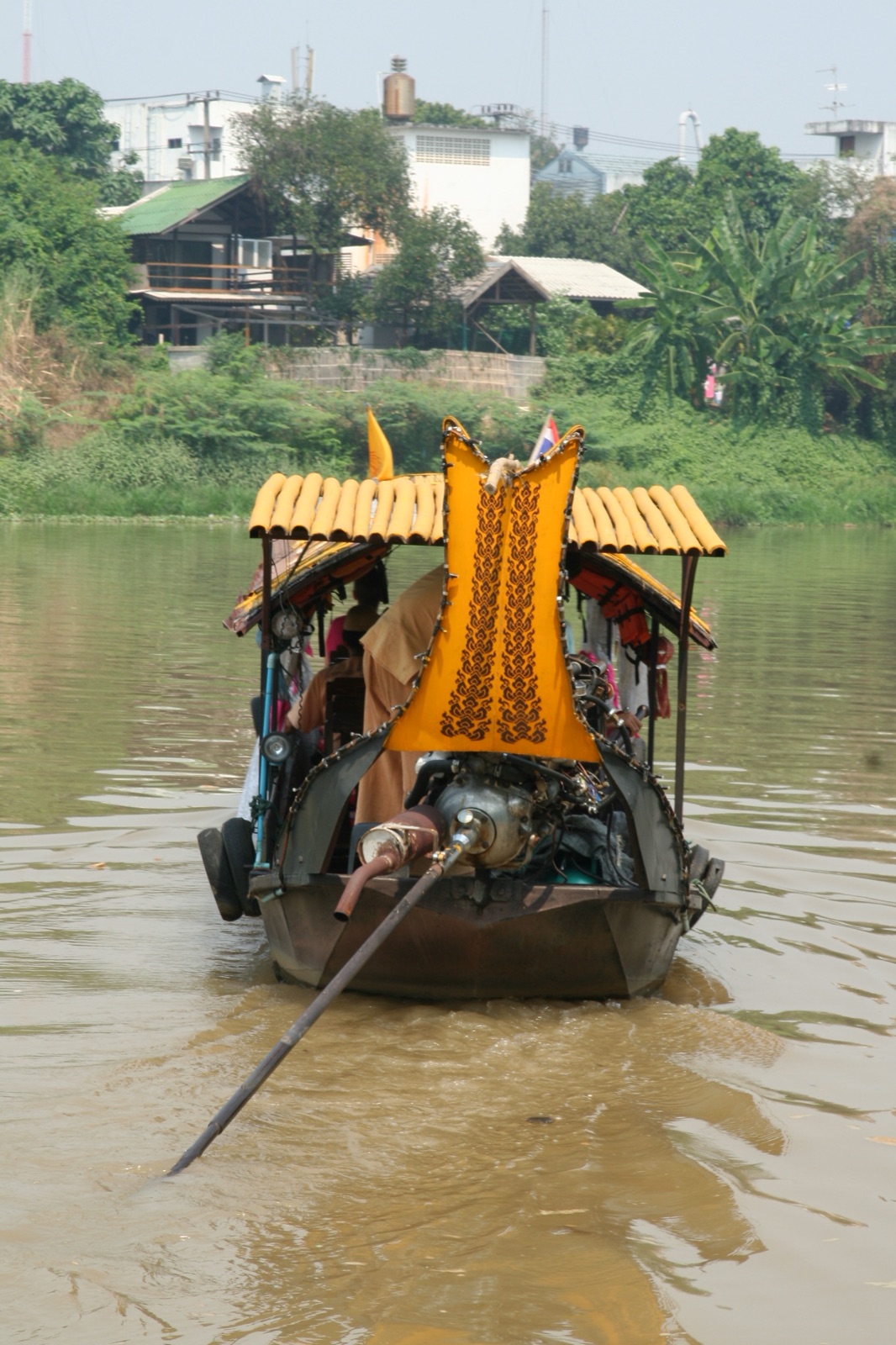
The scorpion-tail boat has returned in the form of replica boats for sightseeing trips on the Ping. Manager Online (2009) relates that the idea began with Songsri Wongwet (ส่งศรี วงษ์เวช), a master's student at Chiang Mai University who researched cultural tourism in the Ping basin in 2001, and who then worked with Ajarn Samak Laosathirawong to build the boats anew. They set out from the Wat Si Khong landing and pass old riverside neighbourhoods along the Ping, such as Wat Ket Karam and Wat Chai Mongkhon.
Those who want to see a boat and its story up close can still visit the Scorpion-Tail Boat Museum at Wat Phra Non Nong Phueng, Saraphi District, Chiang Mai (Chiang Mai News, 2023).
Summary
- Hang maeng pong (huea hang maeng pong, or huea mae pa) is the teak boat of the Ping River with a curved, upswept stern.
- It is a dugout about 16–18 metres long with a hood, drawing little water and strong enough to strike the rapids without breaking.
- Its golden age was the reign of Chao Inthawichayanon, when it served as the royal barge that took Chao Dara Rasmi down to Bangkok.
- It later became a Chiang Mai–Bangkok cargo boat, a journey of about 6–9 months, until the railway reached Chiang Mai in 1921 and the Bhumibol Dam was built.
- Today it can still be seen as replica boats on the Ping and in the museum at Wat Phra Non Nong Phueng.
Look up more words about boats and river travel in the Moradok Lanna dictionary (in Thai), and read about Chiang Mai before the railway in King Kawila.
Sources
- Moradok Lanna dictionary (in Thai): หางแมงป่อง · เรือแม่ปะ · ลูกถ่อ · ล่องแก่ง
- อริสรา คงประเสริฐ [Arisara Khongprasoet]. (n.d.). เรือหางแมงป่อง [The scorpion-tail boat]. National Archives in Chiang Mai, Fine Arts Department (citing ชูสิทธิ์ ชูชาติ [Chusit Chuchat], 2006, พ่อค้าเรือหางแมงป่อง [Scorpion-tail boat traders]). In Thai.
- เชียงใหม่นิวส์ [Chiang Mai News]. (2023, 4 February). "เรือหางแมงป่อง" เรือในตำนานของเชียงใหม่ที่กำลังจะถูกลืม ["Hang maeng pong", Chiang Mai's legendary boat that is about to be forgotten]. In Thai.
- ผู้จัดการออนไลน์ [Manager Online]. (2009, 27 April). ล่อง "เรือหางแมงป่อง" ย้อนรอยแม่ปิง [Riding a "scorpion-tail boat" back through the history of the Ping]. In Thai.
- Citylife. (2018). Lanna's Lifeline: The Ping River and life surrounding it
- พระวรัญญู อริญฺชโย (ศรีวิชัย) [Phra Waranyu Arinchayo (Siwichai)]. (2025). การศึกษาวิเคราะห์พระกรณียกิจของเจ้าดารารัศมี พระราชชายา ที่มีต่อพระพุทธศาสนาในล้านนา [An analytical study of the work of Chao Dara Rasmi, the Royal Consort, for Buddhism in Lanna]. Journal of Lanna Research Review 6(1). In Thai.
Look up "หางแมงป่อง" in the Moradok Lanna dictionary (in Thai)


