

Photo: Iudexvivorum / Wikimedia Commons (CC0)
Huean Kalae: The Lanna Wooden House and Its Beliefs
The huean kalae is the traditional wooden house of the Tai Yuan people of Lanna, named after the kalae (กาแล, Kham Mueang reading ka-lae), the carved boards that cross at the peak of the gable. This kind of house is not only easy to recognise: every part of it has a name in Kham Mueang (Northern Thai), and many parts are bound up with beliefs, from the day the first post is raised to the day the family moves into the new house.
This article walks you up into a huean kalae part by part, with the Lanna words for each part and the beliefs that the people of Lanna hold about building a house.
What is a kalae?
The Moradok Lanna dictionary explains that a kalae is "a piece of house timber that continues from the bargeboards (ปั้นฯล฿มฯ, pan lom) on both sides and crosses above the roof", and that in some places it is called ka-lae (กะแล, written กะแล). The bargeboards are the boards fixed along the edges of the roof at the front of the gable, which in Kham Mueang is called na naep (ห้นฯาแหนฯบ, na naep).
The Northern Thailand Information Center of the Payap University Library describes the kalae of the Ui Phat house as made of boards a little more than "a span" wide and about "one wa" (an arm span) long, carved with designs and joined to the very top of the bargeboards so that they cross. Common designs are the vine scroll, the three-flame kanok and the drifting-cloud design.
Where did the kalae come from? Several theories
The origin of the kalae is still unsettled. The Northern Thailand Information Center at Payap University has gathered several views:
- To keep birds away: some say it was made to stop vultures and crows from landing on the roof, which the people of Lanna regarded as khuet (inauspicious).
- A rule from the past: some say the Burmese forced people to make it while Lanna was under their rule, so that Lanna houses would look different from Burmese houses.
- The buffalo horns of the Lua: Ajarn Kraisri Nimmanahaeminda suggested that the kalae comes from a custom of the Lua people, who sacrificed buffaloes to their ancestors and then mounted the horns on the roof peak as a sign of status; later the kalae was made in place of the buffalo horns.
- A shared Asian practice: crossed bargeboards or crossed animal horns on the gable peak are found in many places, such as Sumatra, Java, Assam in India and shrines in Japan. The same source therefore suggests that crossing the bargeboards came about because it was convenient and made a strong joint, and was only later carved to be beautiful. What is truly Lanna about the kalae is the carving on it.
Walking up into a huean kalae: the name of each part
According to the Northern Thailand Information Center's description, most huean kalae are twin houses: two buildings set close together, facing south or north. The larger building is usually the sleeping house and the smaller one the kitchen, and there is no toilet in the house.
Walking up the khan dai (ขั้นฯได, khan dai), the front staircase, you reach the chan (ชานฯ, chan), which the dictionary explains as "an open house floor outside the eaves". Beside the terrace is the han nam (ร้านฯนาฯ, han nam), a wooden shelf for the mo nam (หํมฯอฯมฯอฯนาฯ, mo nam), clay pots of drinking water for the household and for guests. Payap University's material notes that some houses also set a water shelf in front of the fence, so that passing travellers could stop for a drink.
Beyond the terrace is the toen (เตินฯ, toen), an area raised about a span above the terrace and under the roof, a multi-purpose hall. The dictionary explains it as "a hall outside the bedroom of a house, used as a reception room; it serves as a place to sit, to sleep and to eat".
| Part of the house | Lanna script | Meaning (from the dictionary) |
|---|---|---|
| Long khao | หลฯอฯงเขั้า | a rice granary |
| Pong | ป่ลฯอฯง | a window; an opening, a gap |
| Fa lai | ฝาไหลฯ | a wall of two overlapping wooden panels that slide open and shut |
| Huean fai | เริอฯรไฟ | the kitchen house, where food is cooked |
| Tom | ท้อฯม | a screened place, a small room, usually meaning a bedroom or a bathroom |
| Nam ton | นาฯต้฿นฯ | a Lanna earthenware water jar, for drinking water and used in rituals |
Between the two buildings is a gutter to catch rainwater, which the dictionary calls hom lin (ร่อฯมลินฯ, hom lin) or hong lin (ร่อฯงลินฯ, hong lin). Payap University's material says this gutter was usually made from a single log with a channel hollowed out along its middle.
The research of Kornchanok Nanthakanok and Somprasong Saeng-in (กรชนก นันทกนก และสมประสงค์ แสงอินทร์, 2026), which collected 71 terms for the parts of the huean kalae, found that the people of Lanna named the parts of a house by comparing them with the body, animals and everyday things, such as lim hang yiao ("hawk-tail wedge", a wooden tenon shaped like a hawk's tail), saphan nu ("mouse bridge") and sao laeng ma ("dog post"), which Payap University's material explains is the front-most post beside the staircase, used to tie up the guard dog.
Ham yon: above the bedroom door
Ham yon (หำย฿น์ตฯ, ham yon) is defined in the dictionary as "hamyon: a carved wooden panel decorating the space above a bedroom door". Payap University's material calls it the talisman of the house, explaining that the people of Lanna believe it protects those in the bedroom from being disturbed by ghosts and spirits.
The bedroom of a huean kalae is usually a single large room, because the whole family sleeps together, and it has few or small windows. The same material says that some think this is because the North was colder in the past than it is today.
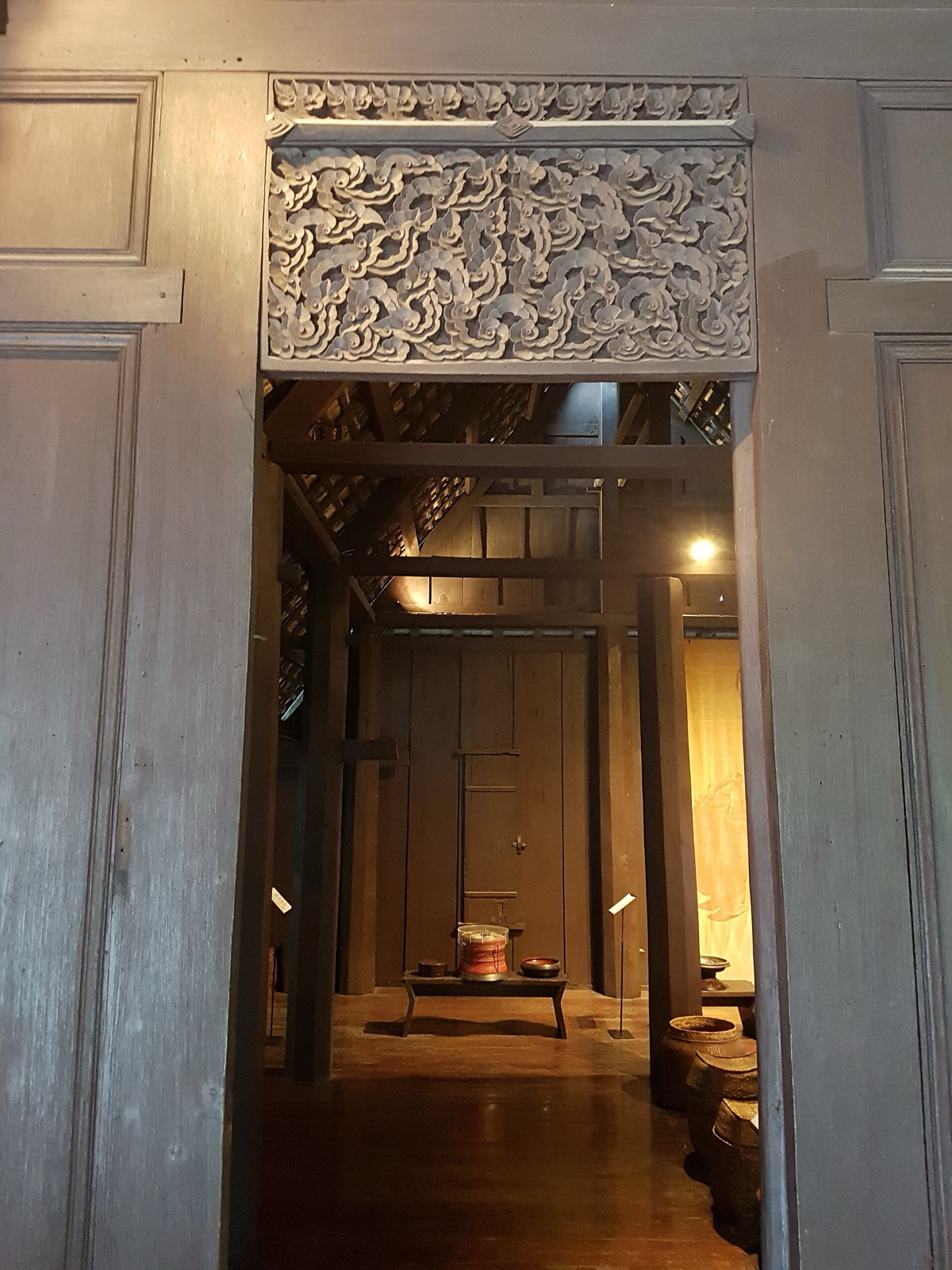
Not every Lanna house has a kalae and a ham yon. Payap University's material gives the example of the Phaya Pong Langka house in the city of Chiang Mai (built around 1896), which has a huean kalae roof but no kalae at the gable peak and no ham yon above the bedroom door.
Shelves for the Buddha and the spirits, and life on the toen
A Lanna house usually has a hing pha-chao (หิ้งฯระฯพเจั้า, hing pha-chao), which the dictionary explains as a shelf placed high, but within reach, for a Buddha image, usually facing east or north. There is also a place for the phi huean (ผีเริอฯร, phi huean), "the ancestral spirits who protect the people living in that house".
The toen is the heart of life in the house. Payap University's document on the huean kalae (Phaya Wong house) describes it as a place for work and rest, and where the sons slept once they were young men. One wall was built in line with the bedroom to give the daughters a private place to sit and work, called fa lap nang, and in the evenings the young women would come out to spin cotton while exchanging kham kao kham khruea (Lanna courting verses) with young men who came to visit.
Sao mongkhon and sao nang: beliefs about building a house
Building a Lanna house begins with pok sao ban (ป฿กฯเสัาบ้าฯนฯ, pok sao ban), raising the house posts, supervised by a sa-la (ส่ๆลฯา, sa-la), a skilled craftsman. The two most important posts are:
- Sao mongkhon (เสัาม฿ง฿คฯล์, sao mongkhon, "the auspicious post"), the principal post, which the dictionary says is also called sao pha-ya (เสัาระฯพยฯา, sao pha-ya).
- Sao nang (เสัานาฯงฯ, sao nang, "the lady post"), the second post, raised as a pair with the sao mongkhon.
Manee Payomyong (มณี พยอมยงค์, 1986), in the book Prapheni Sipsong Duean Lanna Thai ("The Twelve-Month Traditions of Lanna Thai", cited by the Northern Thailand Information Center at Payap University), records that people of old held that in a house built without the ceremony of raising both posts, "those who live there will never find happiness", and compared the sao mongkhon to the father and the sao nang to the mother.
- When: an astrologer chooses an auspicious time. Posts are usually raised in an even month, that is the 6th and 8th northern months; nothing is done in month 10, which is considered inauspicious. It is usually done early in the morning.
- Offerings to the guardian spirits: a pit is dug in the middle of the plot and filled with rice, bananas and savoury and sweet foods as offerings to the spirit of the land or the naga king.
- Dressing the posts: a coconut, a banana shoot, a sugarcane shoot and bai ngoen bai thong leaves are tied to the sao mongkhon, together with a man's lower garment, while a woman's skirt cloth is tied to the sao nang.
- Who carries the posts: villagers with auspicious names, such as Kaeo (gem), Kham (gold), Ngoen (silver), Thong (gold), Man (firm) or Kaen (heartwood), are asked to help carry and lower the posts into their holes.
- Order: the sao mongkhon goes in first, then the sao nang and the other posts. The sao mongkhon stands at the head end of the sleeping area and the sao nang at the foot end.
In some places a tham khwan ceremony is also held for the sao mongkhon before it is raised: a ritual master recites the words that call the khwan (life spirit), then sprinkles turmeric and som poi water over the post and the household (read more about calling the khwan in Hong Khwan). When the house decays or is pulled down, the sao mongkhon must be kept separately and must never be reused for anything else, or it becomes khuet (ขึดฯ, khuet), which the dictionary explains as a cursed thing that brings decline.
Days not to build, and wood not to use for posts
The Moradok Lanna dictionary records several words that reflect beliefs about khuet in house building, both about days and about wood.
| Lanna word | Lanna script | Meaning (from the dictionary) |
|---|---|---|
| Wan ang lueat | วันฯอ่างฯเลิอฯด | a day on which a house must not be built, or there will be beatings and bloodshed in the house |
| Wan huean hang | วันฯเริอฯรห่างฯ | a day on which a house must not be built, or the house will become deserted and the family scattered |
| Mai ngam ngao | ไม้งำเงัา | a tree that leans so its reflection shows in the water; must not be used for house posts |
| Mai song nang | ไม้สอฯงนาฯงฯ | a tree whose trunk splits into two stems of unequal size; must not be used for house posts |
| Mai tai khan | ไม้ตายฯขานฯ | trees that have died standing in a row; must not be used for house posts |
| Mai tai phak | ไม้ตายฯผากฯ | a tree that has died on one side; must not be used for house posts |
When the house is finished, the owner holds a khuen huean mai (ขึ้นฯเริอฯรไห่มฯ, khuen huean mai) merit-making ceremony, the housewarming, before actually moving in.
Where to see a huean kalae
Several genuine huean kalae have been taken down and moved to be preserved for later generations to study, such as:
- The huean kalae (Ui Phat house): a small huean kalae with 48 posts and a roof of paen klet (wooden shingles), originally in Chom Thong District, Chiang Mai, thought to have been built around 1917. It was moved and rebuilt in the grounds of the Center for the Promotion of Arts and Culture, Chiang Mai University, in 1994 (according to Payap University).
- Kamthieng House: the house in the photo at the top of this article. The Siam Society states that it was built in Chiang Mai around the middle of the 19th century on the east bank of the Ping River, was given to the Siam Society in 1963, moved and rebuilt in Bangkok, and opened as a museum on 21 November 1966. Its roof is decorated with V-shaped kalae.
Summary
- The huean kalae is named after the kalae, the bargeboards that cross at the gable peak. There are several theories about the origin of the kalae, but the carving on it is distinctively Lanna.
- The main parts of the house include the khan dai, the chan, the han nam, the toen, the bedroom and the huean fai, each with a Kham Mueang name still in use.
- The ham yon is the carved panel above the bedroom door, believed to be a talisman against ghosts and spirits.
- Building a house begins by raising the sao mongkhon (like the father) and the sao nang (like the mother) at an auspicious time, avoiding forbidden days and wood regarded as khuet.
Look up more Lanna words about houses in the Moradok Lanna dictionary (in Thai), and read about the ancestral spirits who protect the house in the article Liang Phi Pu Ya.
Sources
- Moradok Lanna dictionary (in Thai): กาแล · หำยนต์ · เติ๋น · เสามงคล
- ศูนย์ข้อมูลภาคเหนือ สำนักหอสมุดมหาวิทยาลัยพายัพ [Northern Thailand Information Center, Payap University Library]. เรือนกาแล (พญาวงศ์) [The huean kalae (Phaya Wong house)] · เรือนกาแล (อุ๊ยผัด) [The huean kalae (Ui Phat house)] · เรือนพื้นบ้านล้านนา (อุ๊ยแก้ว) [The Lanna vernacular house (Ui Kaeo house)] · เรือนชาวเวียงเชียงใหม่ (พญาปงลังกา) [The town house of Chiang Mai (Phaya Pong Langka house)] (compiled from the work of ฐาปนีย์ เครือระยา [Thapanee Khruearaya] and colleagues, Center for the Promotion of Arts and Culture, Chiang Mai University). In Thai.
- กรชนก นันทกนก และสมประสงค์ แสงอินทร์ [Kornchanok Nanthakanok and Somprasong Saeng-in]. (2026). กลวิธีการสร้างคำเรียกส่วนประกอบเรือนกาแลล้านนา [How the terms for the parts of the Lanna huean kalae are formed]. Fa Nuea Journal 17(1). In Thai.
- มณี พยอมยงค์ [Manee Payomyong]. (1986). ประเพณีสิบสองเดือนล้านนาไทย [The Twelve-Month Traditions of Lanna Thai]. Cited in the Northern Thailand Information Center, Payap University, ประเพณีปลูกเรือนใหม่ [The tradition of building a new house]. In Thai.
- The Siam Society. Kamthieng House Museum


