

Photo: Chainwit. / Wikimedia Commons (CC BY 4.0)
Queen Chamadevi of Hariphunchai: Legend and History
Queen Chamadevi (Phra Nang Chamadevi) was the first ruler of Hariphunchai, the ancient city that is today Lamphun Province, which Khon Mueang (Northern Thai people) call La Pun (หลฯะพูร, Kham Mueang reading la pun). Legend tells that she came up the Ping River from the city of Lavo, bringing monks, craftsmen and Buddhism to the Ping River valley.
Her story is the opening chapter that Lanna people have told for several hundred years, but it is also a story where scholars still debate which parts are history and which are legend. This article tells both sides and keeps them clearly apart.
Who was Queen Chamadevi?
The Moradok Lanna dictionary explains la pun as "Lamphun, formerly the city of Hariphunchai, an ancient city", and the province's motto still includes the phrase "Chamadevi, glorious Hariphunchai". Her name has stayed bound to this city to this day.
In the scriptures and chronicles she is the daughter of the king of Lavo, or La Wo (หลฯะโว้, Kham Mueang reading la wo), which the dictionary explains is "the old name of the city of Lopburi". She came to rule Hariphunchai at the invitation of hermits, and had twin sons who continued the dynasty.
Her name: "Chamadevi" is not a headword in the dictionary, so it is written only in Thai script.
The legend according to the Camadevivamsa
The oldest account of her life is in the Camadevivamsa (Chamthewiwong), a Pali text composed by Phra Bodhiramsi, a monk of Hariphunchai. It is divided into 15 chapters (pariccheda), from the founding of the city to the reign of King Athittayarat (Phra Maha Inwong Issarabhani, 2022).
The text tells that the hermit Vasudeva, who had once been a monk and then left with his companions to practise austerities, founded several cities for children he had raised to rule. But many of these cities fell because their rulers did not live by moral principles, so together with the hermit Sukkadanta he founded the new city of Hariphunchai (Chanin Phongsawat, 2015).
The two hermits decided that the new city needed a righteous ruler, so they sent envoys to ask the king of Lavo for his daughter, Chamadevi, to come and rule the city. Local versions of the chronicle say that the king of Lavo sent 500 monks and several groups of craftsmen with her.
While her twin sons were still young, war broke out with the chief of the Lua people, whom the text calls Khun Luang Milakkha and local tales call Khun Luang Wilangkha. The two princes won, and the chief gave them his daughters as consorts, which scholars interpret as the Lua submitting to the power of Hariphunchai.
Later Khelang Nakhon (Lampang) was built for the younger prince to rule, while the elder, Chao Mahantayot, ruled Hariphunchai. The Wat Tha Kat version of the chronicle says she stayed at Khelang for 6 months, then returned to Hariphunchai and died there.
The Lua (ลวฯะ, read lua) who appear in this legend the dictionary describes as "a people of the Mon-Khmer family who still live in the Lanna region today". A hermit (ruesi) is called la-si in Lanna (รสี, Kham Mueang reading la-si).
The twin sons and Khelang Nakhon
The name of the elder son, Chao Mahantayot, is the same in many sources: chapter 8 of the Camadevivamsa is about "the coronation of King Mahantayot". The younger son is named differently in different documents; the Wat Tha Kat chronicle, from Mae Tha District, calls him Chao Inthawara (Suwipha Champawan and Naren Panyaphu, 2017).
The younger son's city is Lampang (ลำพางฯ, Kham Mueang reading lam pang). The dictionary records that Lampang "was built in 680, together with the city of Hariphunchai, and named Nakhon Khelang". This is the year the dictionary gives, and it depends on the dates in the chronicles, as the next section explains.
Dates still in dispute
The years often given for her reign at Hariphunchai, about 657–661, come from a single source, as Chaloemwut Takhami (2021) points out: the Jinakalamali, which was written later, and whose author, Phra Ratanapanya, admits that he calculated the dates from the sequence of kings. The Camadevivamsa itself gives no dates at all.
| Source | Date given |
|---|---|
| Jinakalamali, translation by Phraya Photchana Phimon | Hariphunchai founded about 657 |
| Jinakalamali, translation by Saeng Manavidura | 661 |
| Chiang Mai Chronicle (2010 transcription) | Chamadevi born in Chula Sakarat 418 (1056) and came up from Lavo in Chula Sakarat 458 (1096) |
| Camadevivamsa | no dates |
The figures differ by more than 400 years, so the author argues that rushing to conclude she lived in about the 7th century "is something that should be carefully reconsidered".
What the historical evidence says
On the archaeological side, a study by Khomsi Saenchit (2010) in the Damrong Journal found that Hariphunchai was inhabited in three phases between the 8th and 14th centuries CE, and that the founding stories in inscriptions and chronicles match the archaeological evidence only in part, so documents alone should not be relied on.
As for inscriptions, Chaloemwut Takhami (2021) points out that among 17 Mon-language inscriptions of the Hariphunchai period and 197 inscriptions of the Lanna period, only one names Chamadevi: the Wat Phra That Doi Noi inscription, inscribed in 1554, several hundred years after the Camadevivamsa was composed.
When was the Camadevivamsa composed?
- Suwipha Champawan and Naren Panyaphu (2017) state that Phra Bodhiramsi composed it in about 1402–1442.
- Chaloemwut Takhami (2021) compares it with the Sihinga Nidana, another work by Phra Bodhiramsi composed in the reign of King Sam Fang Kaen (1401–1441), and concludes that the Camadevivamsa must have been written before 1457, and may be "a work of political literature and Buddhist politics".
- Phra Maha Inwong Issarabhani (2022) states that the manuscript "does not show the year of composition", and finds that many parts of its content were newly composed and are not in the Tipitaka, although most of the Dhamma teachings woven into it agree with the Tipitaka.
- The first Thai translation was by Phraya Pariyattham Thada (Phae Talalak) and Phra Yanawichit, and Princess Dara Rasmi had it printed for distribution in 1920 (Chanin Phongsawat, 2015).
None of this means that she did not exist. It means that most of what we know about her comes from chronicles written later, so we should always separate "according to legend" from "according to the evidence". As the dictionary puts it, tam nan (ตํานาฯ, Kham Mueang reading tam nan) means "a story handed down over a long time".
Traces of the queen in Lamphun and Chiang Mai
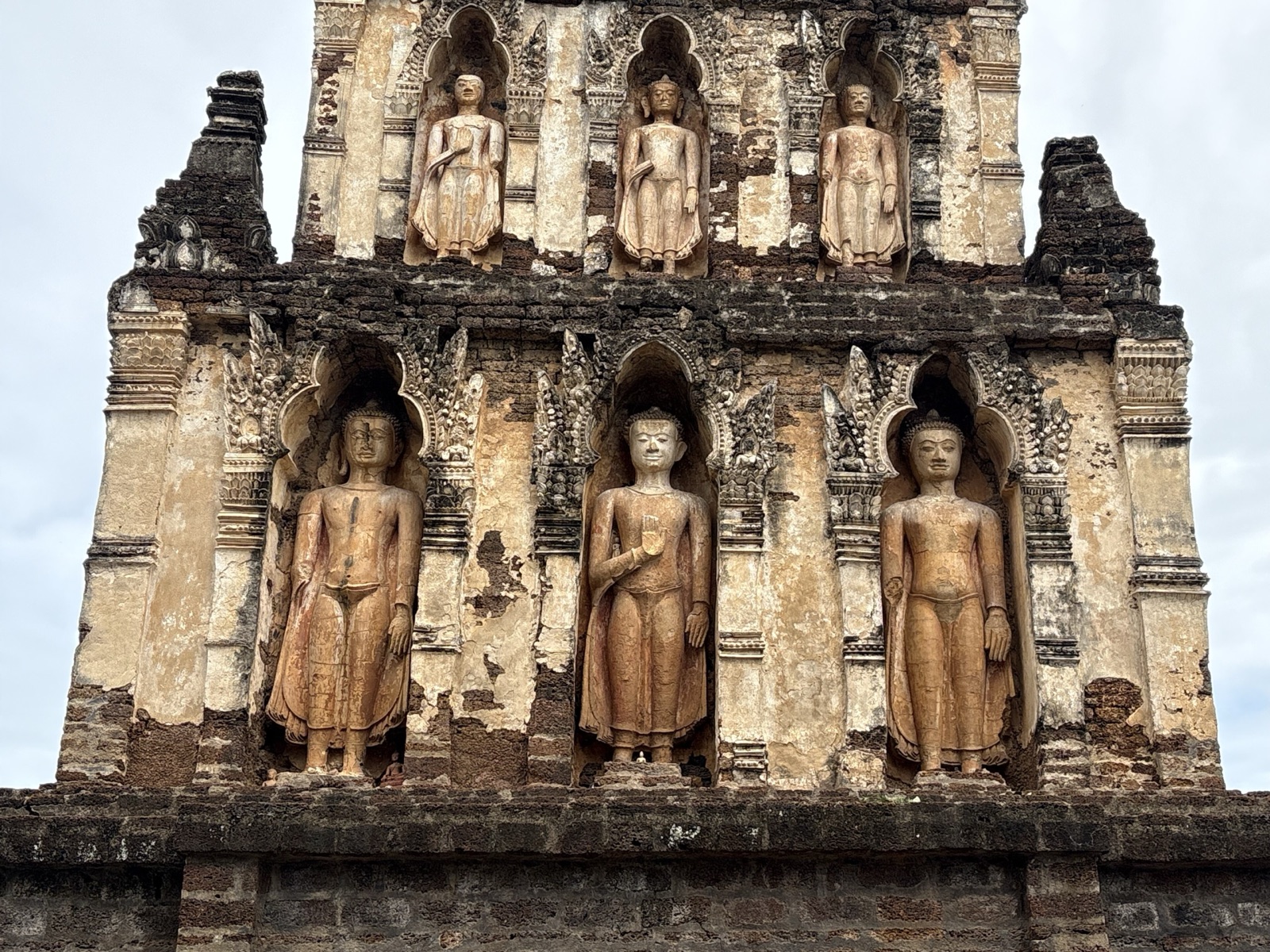
A ku (กู่, read ku) is a chedi or stupa built as a memorial or to hold the ashes of the dead. At Wat Chamadevi in Lamphun stands Ku Kut, which the dictionary explains as "the stupa or ku with a broken-off top that enshrines the relics of Queen Chamadevi".
Another trace is the Phra Kaeo Khao (ระฯพแก้วฯขาวฯ, Kham Mueang reading phra kaeo khao), the White Crystal Buddha, which the dictionary explains as "the personal Buddha image of Queen Chamadevi", brought from Lavo. It stayed in Lamphun for several hundred years until Phaya Mangrai moved it to Wat Chiang Man in Chiang Mai, and it still joins the procession at the Lanna New Year (pi mai mueang).
The queen in villagers' memory
Besides the scriptures, there are many local versions of the chronicle, such as the Wat Tha Kat version from Mae Tha District, Lamphun (inscribed in Chula Sakarat 1271, or 1909). Local chronicles say she was born from a lotus flower as the daughter of a rich man of Ban Nong Du, a Mon community on the Ping River, before the hermit Vasudeva sent her downriver on a raft until she became the daughter of a city's ruler. (The Wat Tha Kat version calls that city Lawarat, while the story recorded by Prince Damrong Rajanubhab calls it Lavo.) (Suwipha Champawan and Naren Panyaphu, 2017)
The Mon of Ban Nong Du still feel close to this story. The same study cites Pensupa Sukkata as saying that the community's ceremony of offerings to Queen Chamadevi began after 1934, replacing the fon phi mot phi meng spirit-dance tradition that had died out. In the dictionary, meng (เมงฯ, Kham Mueang reading meng) means "a people who were the ancestors of the Mon"; read more about the phi mot phi meng spirits in Liang Phi Pu Ya.
ตัวตนของพระนางจามเทวีถูกสร้างขึ้นทั้งในรูปแบบที่อิงประวัติศาสตร์และอุดมคติ — เฉลิมวุฒิ ต๊ะคามี (วารสารข่วงผญา, ๒๕๖๔)
["The figure of Queen Chamadevi was constructed both in a form based on history and as an ideal." Chaloemwut Takhami, Khuang Phaya Journal, 2021]
Chaloemwut Takhami (2021) also finds two currents in the stories about her. Besides the stories that honour her, some communities tell of her in a negative light, linked with the tales of Khun Luang Wilangkha. The author suggests that if we believe she existed, we should also study Khun Luang Wilangkha as a contemporary figure.
Summary
- Queen Chamadevi was the first ruler of Hariphunchai (La Pun, or Lamphun) according to Phra Bodhiramsi's Camadevivamsa.
- Legend says she came from Lavo at the invitation of the hermit Vasudeva and had twin sons: Chao Mahantayot ruled Hariphunchai and the younger son ruled Khelang Nakhon.
- The dates 657–661 come from the later Jinakalamali, while the Chiang Mai Chronicle differs by more than 400 years.
- Archaeological evidence confirms that Hariphunchai really existed, but it matches the legend only in part.
- Traces you can still see include Ku Kut at Wat Chamadevi and the Phra Kaeo Khao at Wat Chiang Man.
Look up more Lanna words about towns and ancient sites in the Moradok Lanna dictionary (in Thai), and read the legend of Chiang Mai's guardian spirits in the article Pu Sae Ya Sae.
Sources
- Moradok Lanna dictionary (in Thai): หละปูน · กู่กุด · พระแก้วขาว · ลำปาง
- เฉลิมวุฒิ ต๊ะคามี [Chaloemwut Takhami]. (2021). จามเทวี: ตัวตนและอุดมคติ [Chamadevi: identity and ideal]. Khuang Phaya Journal 15(1). In Thai.
- พระมหาอินทร์วงค์ อิสฺสรภาณี [Phra Maha Inwong Issarabhani]. (2022). แนวคิดทางด้านพระพุทธศาสนาที่ปรากฏในคัมภีร์จามเทวีวงศ์ [Buddhist concepts in the Camadevivamsa]. Panya Journal 29(1). In Thai.
- ชนินทร์ ผ่องสวัสดิ์ [Chanin Phongsawat]. (2015). จามเทวีวงศ์: ความผสมผสานระหว่างเรื่องเล่าเชิงประวัติศาสตร์และเรื่องเล่าเชิงพุทธศาสนา [The Camadevivamsa: a blend of historical and Buddhist narrative]. Vannavidas 15. In Thai.
- สุวิภา จำปาวัลย์ และนเรนทร์ ปัญญาภู [Suwipha Champawan and Naren Panyaphu]. (2017). การรับรู้เรื่องราวประวัติศาสตร์ท้องถิ่น "พระนางจามเทวี" สู่แนวทางการพัฒนาในจังหวัดลำพูน [Perceptions of the local history of "Queen Chamadevi" and approaches to development in Lamphun Province]. Journal of Fine Arts 8(2). In Thai.
- Khomsi Saenchit. (2010). Haripunjaya: An Archaeological and Literary Account. Damrong Journal 9(1)


