
Photo: Thaveesc / Wikimedia Commons (CC BY-SA 4.0)
Sky, Rain and Wind: Kham Mueang Weather Words
Fa (sky, ฟ้า), fon (rain, ฝ฿นฯ) and lom (wind, ล฿มฯ) are basic words that Kham Mueang shares with central Thai. But when it comes to the details of sky, rain and wind, Kham Mueang has many words of its own. Lightning is fa maep, light drizzle is fon tok sui sui, the storm at the start of the rains is lom luang, and frost on the mountains is moei khap. These words reflect life in the northern valleys, where people watched the sky and the rain to farm their rice.
This article gathers more than 100 nature and weather words from the Moradok Lanna dictionary: the sky, sun, moon and stars; rain and thunder; wind; water, streams and rivers; weirs and canals; dew and mist; earth, rock, mountains and forest; fire; and words for hot and cold weather.
Sky, sun, moon and stars
Central Thai calls the sun tawan, but in Kham Mueang it is ta wan (ตาวันฯ) or tha-wan (ถหัวฯร). The moon is duean (เดิอฯร), the same word as "month". East and west are named after the rising and setting sun: wan ok (วันฯออฯก) and wan tok (วันฯต฿กฯ).
| Kham Mueang | Lanna script | Meaning (from the dictionary) |
|---|---|---|
| fa | ฟ้า | the part above that covers the land; heaven; the air |
| fa bot | ฟ้าบ฿ดฯ | overcast sky, clouds blocking the sky, hazy sky |
| fa yok | ฟ้าย฿กฯ | dawn, the first light of day (also tin fa yok) |
| fa ham | ฟ้าร่ามฯ | the glow of light shooting up over the eastern horizon at dawn |
| ta wan | ตาวันฯ | the sun |
| tha-wan | ถหัวฯร | the sun (also ta wan) |
| ta wan maen | ตาวันฯแมนฯ | the sun appearing over the horizon; sunrise |
| ta wan tok din | ตาวันฯต฿กฯดินฯ | sunset |
| chak khat tue wan | จักฯฅาดฯทืวันฯ | solar eclipse, "Rahu swallowing the sun" |
| wan ok | วันฯออฯก | east |
| wan tok | วันฯต฿กฯ | west |
| duean | เดิอฯร | the moon; also a month of the year |
| duean chaeng | เดิอฯรแจ้งฯ | a bright moonlit night; brilliant moonlight |
| dao | ดาวฯ | star, a point of light in the night sky |
| dao wi kai noi | ดาวฯวีไก่ห้นฯอฯ | the Pleiades ("the chicks") |
| dao ngon thai | ดาวฯง้อฯรไถ | the Plough stars (central Thai dao thai) |
| dao mu kong | ดาวฯหูคอฯง | the morning star (Venus) |
| dao yuat | ดาวฯ£วฯาดฯ | meteor, shooting star (also dao lon, phi pung sao) |
| mek | เมฆฯฯ | cloud, water vapour gathered in masses floating in the air |
The sky is also part of how Kham Mueang tells time: fa yok and fa ham mean the dark early morning before sunrise. Sunlight, too, has several names depending on how strong it is.
| Kham Mueang | Lanna script | Meaning (from the dictionary) |
|---|---|---|
| daet | แดดฯ | sunlight |
| daet bot | แดดฯบ฿ดฯ | sunlight behind clouds |
| daet dam | แดดฯดำ | sunlight when the sky is dim |
| daet khi fon | แดดฯขี้ฝ฿นฯ | sunshine after rain, usually hot and muggy |
| daet phae lae | แดดฯแผ้แห้ลฯ | glaring sunlight (also daet sae lae) |
| daet luang | แดดฯล้วฯง | sunlight reaching in under a roof, e.g. into a house |
| daet hon daet won | แดดฯร้อฯรแดดฯวอฯร | scorching sun |
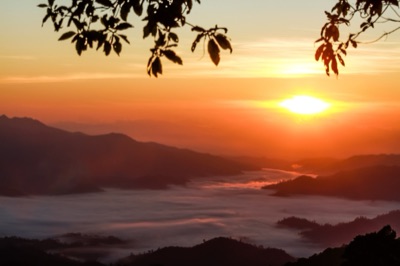
Photo: Piith.hant / Wikimedia Commons (CC BY-SA 4.0)
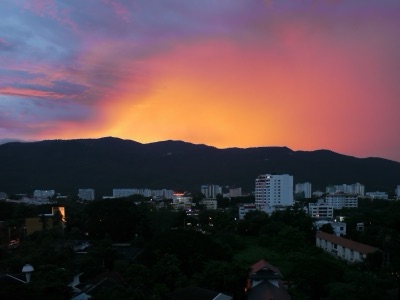
Photo: FredTC / Wikimedia Commons (CC BY-SA 3.0)
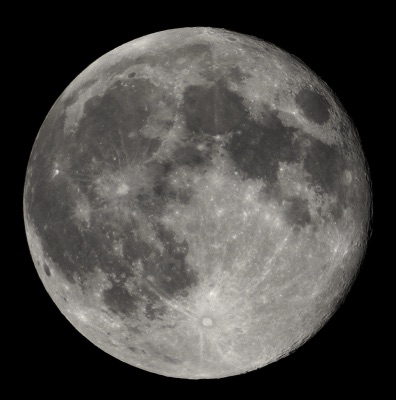
Photo: Luc Viatour / Wikimedia Commons (CC BY-SA 3.0)
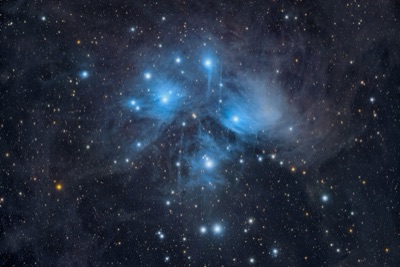
Photo: Luc Viatour / Wikimedia Commons (CC BY-SA 4.0)
Rain, lightning and thunder
Kham Mueang describes rain by strength and length in more detail than central Thai. Rain that is just starting is fon oi (ฝ฿นฯอ่อฯยฯ), drizzle is fon tok sui sui (ฝ฿นฯต฿กฯสุๆ), heavy rain is fon tok ba ba (ฝ฿นฯต฿กฯบัะๆ), and when the rain stops people say fon uean (ฝ฿นฯเอิ้อฯร).
| Kham Mueang | Lanna script | Meaning (from the dictionary) |
|---|---|---|
| fon oi | ฝ฿นฯอ่อฯยฯ | rain starting to drizzle |
| fon tok sui sui | ฝ฿นฯต฿กฯสุๆ | drizzle |
| fon tok si si | ฝ฿นฯต฿กฯซิๆ | light rain that goes on for a long time |
| fon tok sueng | ฝ฿นฯต฿กฯซึงฯ | rain that keeps falling for several days |
| fon tok ba ba | ฝ฿นฯต฿กฯบัะๆ | heavy rain |
| ha fon | ห่าฝ฿นฯ | a single fall of rain, one shower |
| fon yat | ฝ฿นฯอยฯดฯ | the rain has stopped |
| fon uean | ฝ฿นฯเอิ้อฯร | the rain stops |
| fa maep | ฟ้าแมลฯบ | lightning, a flash in the sky |
| fa hong | ฟ้าร้อฯง | thunder, the loud sound after lightning |
| fa pha | ฟ้าผ่า | a lightning strike, a sudden violent discharge from cloud to ground |
| ba hep | บ่าฯเหัปฯ | hailstones (also means a tick, the insect) |
| i hung | อี่รุง | rainbow (also phi i hung) |
| phi ngueak hung | ผีเงิอฯกรุง | rainbow |
The dictionary also records fon ha kaeo (ฝ฿นฯห่าแก้วฯ), which is not real rain but an image from the northern Vessantara (Maha Chat) sermon: a shower of jewels falling from the sky like rain.
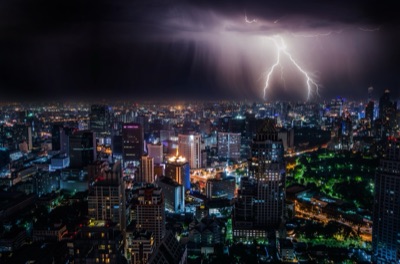
Photo: Dominik QN / Wikimedia Commons (CC0)
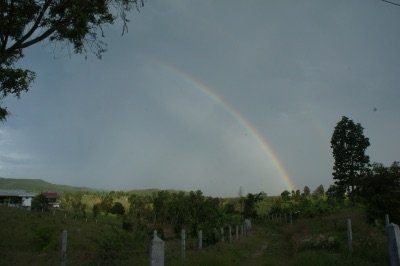
Photo: Maxim Cruiser / Wikimedia Commons (CC BY 3.0)
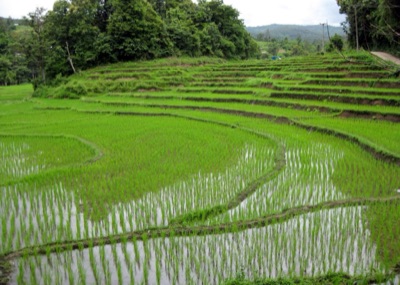
Photo: echiner1 / Wikimedia Commons (CC BY-SA 2.0)
Wind
A strong wind or storm, usually at the start of the rainy season, is lom luang (ล฿มฯหลฯวฯง). The small whirlwinds that lift dust into the air in the hot season have several names, such as lom kwit kwio (ล฿มฯกิวฯดกิวฯ) and lom phat ta kai (ล฿มฯผัดฯตาไก่).
| Kham Mueang | Lanna script | Meaning (from the dictionary) |
|---|---|---|
| lom choi | ล฿มฯชอฯยฯ | a gentle breeze |
| lom luang | ล฿มฯหลฯวฯง | storm, a strong wind, especially at the start of the rainy season |
| lom hua pi | ล฿มฯห฿วฯปี | see lom luang (the early-rains storm) |
| lom kwit kwio | ล฿มฯกิวฯดกิวฯ | a small whirlwind in the hot season that lifts dust in a spiral, but is not dangerous |
| lom phat ta kai | ล฿มฯผัดฯตาไก่ | see lom kwit kwio |
| bit kio | บิดฯกิวฯ | whirlwind, cyclone |
| lom nguang chang | ล฿มฯงวฯงช้างฯ | "elephant-trunk wind", a tornado reaching down from the base of a cloud |
| lom pit cha-khot | ล฿มฯพิชฌฯขอฯด | in traditional belief, a cutting wind between the human world and heaven (also lom mit khut) |
Water, streams and rivers
A river in Kham Mueang is nam mae (นาฯแม่), the reverse of central Thai mae nam. The source of a river is khun nam (ขุรนาฯ); the dictionary's example is the source of the Ping, at Doi Thuai in Chiang Dao district.
| Kham Mueang | Lanna script | Meaning (from the dictionary) |
|---|---|---|
| nam | นาฯ | water |
| nam mae | นาฯแม่ | river, a large waterway where many streams meet |
| nam ta | นาฯท่าฯ | the water of rivers and canals |
| khun nam | ขุรนาฯ | the source of a river |
| huai | ห้วฯยฯ | a forest stream fed by water from the hills (also hoi) |
| huai laeng | ห้วฯยฯแล้งฯ | a stream that only has water in the rainy season |
| nam tok | นาฯต฿กฯ | waterfall, water falling from a height |
| nam tok tat | นาฯต฿กฯตาดฯ | water falling from a mountain over a cliff |
| nam cho | นาฯโจ้ | water rushing down a slope, but not high enough to be a waterfall |
| nam pu | นาฯพุ | a natural spring gushing from the ground (also nam pung) |
| nam pu hon | นาฯพุร้อฯร | hot spring |
| nam cham | นาฯชำ | seep, water oozing from the ground, usually at a stream's source (also nam chuem) |
| nam ok hu | นาฯออฯกรู | groundwater bubbling up above the surface |
| nong | หนฯอฯง | pond or swamp, larger than a buak, natural or dug |
| buak | บวฯก | wallow, puddle, muddy hollow |
| don sai | ดอฯรซายฯ | sandbar in a river; beach |
Water also has many words for how it flows: still water, whirlpools and floods.
| Kham Mueang | Lanna script | Meaning (from the dictionary) |
|---|---|---|
| nam chiao | นาฯช่ยฯว | a swift, strong current |
| nam puan | นาฯป่วฯร | turbulent water, flowing hard and swirling |
| nam phat ta kai | นาฯผัดฯตาไก่ | whirlpool, water spinning down into a deep hole |
| nam tun | นาฯฯฯทุ่ร | still water, water that does not flow |
| nam loek | นาฯเลิ้กฯ | deep water |
| nam nua | นาฯห฿นฯวฯ | thick, muddy water |
| nam kong | นาฯโค้฿งฯ | a river bend |
| nam thong | นาฯโธ้฿งฯ | the curve of a river |
| nam yueng | นาฯยึ่งฯ | water risen higher than usual |
| nam nong | นาฯนอฯง | water rushing quickly into rivers and canals, a spate |
| nam thuam | นาฯถ้วฯม | flood |
| nam pa | นาฯป่า | a flash flood from the forest or hills that rises fast and drops suddenly |
| nam thu | นาฯถุ | floodwater sweeping things away |
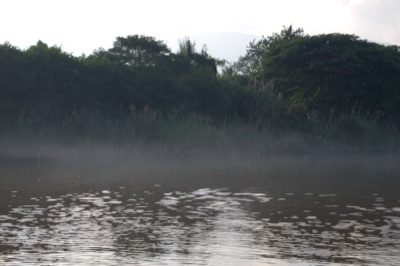
Photo: Vyacheslav Argenberg / Wikimedia Commons (CC BY 4.0)
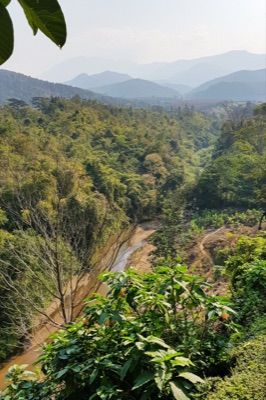
Photo: Takeaway / Wikimedia Commons (CC BY-SA 4.0)
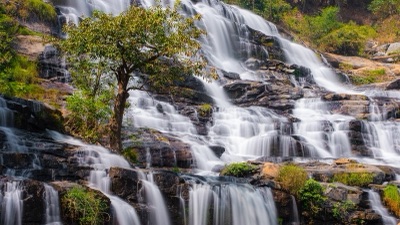
Photo: Aodsikaza1234 / Wikimedia Commons (CC BY-SA 4.0)
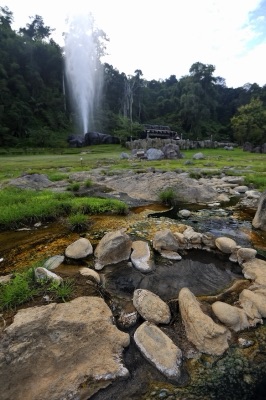
Photo: LannaPhoto / Wikimedia Commons (CC BY-SA 4.0)
Weirs and canals: water for the rice fields
Water for rice fields in Lanna comes from damming streams with a fai (weir, ฝายฯ) to raise the water into a mueang (canal, เหิอฯง), then splitting it into smaller canals until it reaches the fields. The dictionary therefore records many kinds of weir and canal.
| Kham Mueang | Lanna script | Meaning (from the dictionary) |
|---|---|---|
| fai | ฝายฯ | weir, a barrier across a river that raises water into the canals |
| fai hin khwang | ฝายฯหินฯฅ่วฯางฯ | rubble weir, built by piling stones to block the stream and slow its flow |
| fai maeo | ฝายฯแม้วฯ | a small weir framed with tree trunks or bamboo |
| mueang | เหิอฯง | an irrigation canal dug to bring water to farms |
| nam mueang | นาฯเหิมฯอฯง | an irrigation canal (also mueang) |
| mueang luang | เหิอฯงหลฯวฯง | main canal |
| mueang soi | เหิอฯงซอฯ | a branch canal off the main canal (also mueang noi) |
| mueang kin | เหิอฯงกินฯ | a canal that feeds water into the fields |
| mueang khi nam | เหิอฯงนาฯ | a drainage canal that carries water out of the fields |
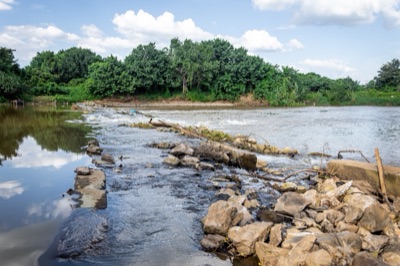
Photo: Supanut Arunoprayote / Wikimedia Commons (CC BY 4.0)
Dew, mist and cold on the mountains
In the cold season on high mountains, the dew can be so heavy that it freezes white on the grass. Dew is moei (เหิมฯอฯย), and frost is moei khap (เหิมฯอฯยขาปฯ), which the dictionary says is usually seen on high mountains in the cold season.
| Kham Mueang | Lanna script | Meaning (from the dictionary) |
|---|---|---|
| moei | เหิมฯอฯย | dew, water vapour that meets the cold and gathers as droplets |
| moei chang | เหิมฯอฯยช้างฯ | dew so heavy it is like drizzle |
| moei khap | เหิมฯอฯยขาปฯ | frost, dew frozen by extreme cold |
| nam moei khap | นาฯเหิมฯอฯขาปฯ | frost, usually seen on high mountains in the cold season |
| moei khaeng | เหิมฯอฯยแขงฯ | snow, water droplets frozen by extreme cold (also moei phong) |
| mok | หมฯอฯก | mist, fog, tiny droplets formed near the ground |

Photo: Massimo brizzi / Wikimedia Commons (CC BY-SA 4.0)
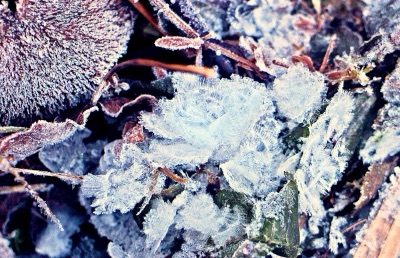
Photo: Yingthipc / Wikimedia Commons (CC BY-SA 3.0)
Earth, rock, mountains and forest
A high mountain is doi (ดอฯย), and a low hill is mon (ม่อฯร). A pass between two mountains is kio doi (กิ่วฯดอฯยฯ), and an open plain between hills is pang (ป่างฯ).
| Kham Mueang | Lanna script | Meaning (from the dictionary) |
|---|---|---|
| doi | ดอฯย | mountain, high mountain; a low one is mon |
| doi ching | ดอฯชิ้งฯ | a steep, high mountain |
| mon | ม่อฯร | hill, hilltop (also mon doi) |
| kio doi | กิ่วฯดอฯยฯ | a mountain pass where two mountains meet |
| pang | ป่างฯ | an open plain between hills (also long) |
| pha | ผา | a great rock on a mountain; a mountain with a sheer rock face is a cliff |
| don | ดอฯร | high ground, a mound, a knoll |
| In-tha-non | ±นทฯน฿น์ทฯ | Doi Inthanon, the highest mountain in Thailand |
| pa | ป่า | forest, a large area of dense trees |
| dong | ด฿งฯ | dense forest |
| pa dong dip | ป่าด฿งฯดิปฯ | evergreen rainforest |
| pa ton nam | ป่าต้฿นฯนาฯ | watershed forest, the source of streams |
Earth and rock also have words for their kinds, from loose soil that grows crops well to mud you sink into.
| Kham Mueang | Lanna script | Meaning (from the dictionary) |
|---|---|---|
| din | ดิ | earth, soil; one of the four elements (also khi din) |
| din phui | ดิระฯพุ่ | loose, crumbly soil (also din fui) |
| din lom | ดิห฿ลฯม | mud, wet sticky earth |
| din chae | ดิแชะ | soggy ground soaked with water (also din mae) |
| din taek khap | ดิแตกฯขาปฯ | cracked, parched earth |
| din dam nam chum | ดิดำนาฯชุ่ม | a place with rich soil and plenty of water |
| sai | ซายฯ | sand |
| hin | หินฯ | rock, stone; a large one is pha |
| hin hae | หินฯแร่ | gravel, small stones (also ba hae) |
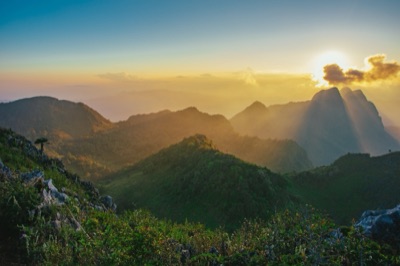
Photo: Nuttasak / Wikimedia Commons (CC BY-SA 4.0)
Fire
Fai (ไฟ) is one of the four elements, earth, water, wind and fire, as in central Thai. Kham Mueang has some memorable words for how fire behaves: flames that flare up suddenly are fai hup (ไฟหูบ), and a fire dying down is fai moi (ไฟมอฯยฯ). (Note that fai, fire, and fai, weir, have different tones and spellings.)
| Kham Mueang | Lanna script | Meaning (from the dictionary) |
|---|---|---|
| fai | ไฟ | fire, one of the four elements; burning that gives heat, light and flame |
| fai hup | ไฟหูบ | flames flaring up and burning something fast |
| fai moi | ไฟมอฯยฯ | a fire dying down, about to go out |
| fai mot | ไฟมอฯด | a fire that has gone out (also fai wot) |
Kham Mueang also has sayings built on fire. Fai mai long khao (ไฟไห้มฯหลฯอฯงเขั้า), literally "fire burning the rice granary", means so hungry your stomach burns, and fai mai kaep (ไฟไห้มฯแกลฯบ) means something creeping up little by little until it is too late.
Photo: Takeaway / Wikimedia Commons (CC BY-SA 3.0)
Hot, cold and the seasons
Kham Mueang words for hot and cold often take an extra word that shows how much. Muggy heat before rain is hon uam (ร้อฯรอวฯม), pleasantly cool weather is nao ot hot (หนฯาวฯอัอฯดฮัอฯด), and a cool, refreshing breeze in the fields is yen sui (เอยฯนฯซุ้ย).
| Kham Mueang | Lanna script | Meaning (from the dictionary) |
|---|---|---|
| hon | ร้อฯร | hot, the feeling of heat on the skin |
| hon uam | ร้อฯรอวฯม | muggy, like the heat before rain |
| hon nak kae | ร้อฯรนักฯแฅ | very hot |
| hon tae hon taen | ร้อฯรแตะร้อฯรแตนฯ | unbearably hot |
| nao ot hot | หนฯาวฯอัอฯดฮัอฯด | bearably cold, pleasantly cool |
| nao kat nao yen | หนฯาวฯกัดฯหนฯาวฯเอยฯันฯ | very cold |
| yen | เอยฯันฯ | cool, cold, no longer hot (of temperature) |
| yen sui | เอยฯนฯซุ้ย | pleasantly cool, like sitting in a field breeze |
| yen cha-chio | เอยฯันฯจจิ้วฯ | bitterly cold, freezing |
| yen chit | เอยฯนฯจีดฯ | ice-cold |
| laeng | แล้งฯ | the dry season; also empty, nothing, parched |
| na na | ห้นฯานาฯ | the rice-farming season |
Hon can describe the heart too: hon chai (ร้อฯรไจ) means anxious, troubled, or in a hurry to get something done.
Summary
- The sun is ta wan or tha-wan, the moon is duean, and east and west are wan ok and wan tok.
- Rain has words for its strength, from fon oi and fon tok sui sui to fon tok ba ba; lightning and thunder are fa maep and fa hong.
- The early-rains storm is lom luang, a small whirlwind is lom kwit kwio, and lom also describes moods: lom khuen means angry.
- A river is nam mae, its source is khun nam, and the fai and mueang weir-and-canal system is the heart of Lanna rice farming.
- Dew is moei, frost on the mountains is moei khap, a high mountain is doi and a low hill is mon.
Look up more nature words in the Moradok Lanna dictionary, or read on about Lanna flowers and Phi in Kham Mueang.


