
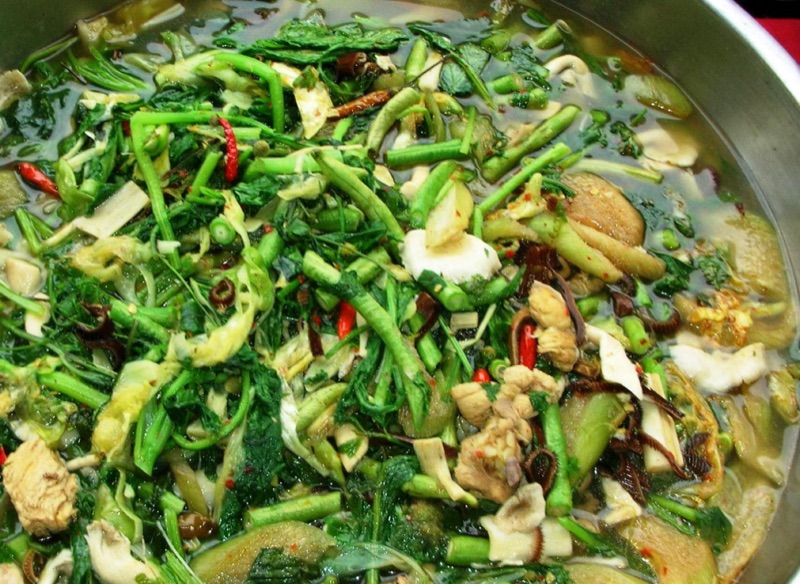
Photo: Takeaway / Wikimedia Commons (CC BY-SA 3.0)
Khong Kin Khon Mueang: Northern Thai Food in a Jaran Song
Khong Kin Khon Mueang ("Food of the Khon Mueang") is a Kham Mueang (Northern Thai) song written by Jaran Manopetch, who sings it as a duet with Soontaree Vechanont. The whole song is a game of naming Northern Thai dishes in turn: the man sings one dish, the woman answers with another, until dozens have been named. The key word of the song is khong kin (ขอฯงกินฯ, Kham Mueang reading khong kin), meaning food, things to eat.
This lesson looks at which dishes are in the song, sorts them by how they are cooked, and then learns the Kham Mueang words hidden in the opening and the ending.
Listen to the song first

Khong Kin Khon Mueang, from the Nititad AOA Official channel. The song is on the album Folk Song Kham Mueang, Chut Amata (1977), Jaran's first official album and the same album as Phak Kat Cho and the song Noi Chaiya. The study by Ueamporn Thipdet and Siriwan Nanthachanthun (2023) groups this song with the songs that picture the Khon Mueang as people who "live simply and sincerely".
The opening: food to make your mouth water
The man opens with "khong kin ban hao, lueak ao toe nai" ("food from our home, take your pick, sir"), then both sing "luan sa pa mak mi" ("all kinds, plenty of it"), before telling the listener "fang khai yak chon phloe, ma luen nam lai".
| Word in the song | Lanna script | Meaning (from the dictionary) |
|---|---|---|
| hao | เรัา | we, our (ban hao = our home) |
| sa pa | ซะพะ | many, of many kinds; thought to come from the Pali sabba (all) |
| fang | ฟั่งฯ | to hurry, to rush |
| khai | ไฅ่ | to want, to desire, to wish for |
| luen | ลืนฯ | to swallow |
| hue | หื้ | to give, to let (fang hue di noe = listen well, now) |
So "fang khai yak chon phloe, ma luen nam lai" means that hearing the list makes you hungry at once, until you swallow without thinking. The word sa pa also appears in the doubled forms sa pa sa pan and sa pa sa pet, which the dictionary gives the same meaning.
The dishes in the song, by category
The dishes in the song are not in any order, but sorted by cooking method they show almost the whole Lanna kitchen: curries, chilli dips, salads, sa, lap and stir-fries. The tables give the Lanna script of the dish name, or of its key word, as recorded in the dictionary.
| In the song | Key word | What it is |
|---|---|---|
| kaeng khae chin ngua | kaeng khae แกงฯแฅ | curry of many vegetables together, with beef (chin ชิ้นฯ = meat · ngua ง฿วฯ = cow) |
| kaeng no mai sang | mai sang ไม้ซางฯ | curry of shoots of the sang bamboo, a large bamboo with thick sections |
| kaeng phak siang da sai pa haeng | phak siang da ผักฯซยฯงดา | phak siang da (gymnema) curry with dried fish (pa ปลฯา = fish) |
| kaeng bon · kaeng tun | bon บอฯร · tun ทุร | curry of taro stems and leaves, and curry of khun (giant elephant ear) stems (also called tun) |
| kaeng yuak kluai | yuak อยฯวฯก | curry of the tender core of the banana trunk |
| kaeng het · kaeng hoi | het เหัดฯ · hoi หอฯยฯ | mushroom curry, and snail or shellfish curry |
| kaeng ma khon kom | ma khon kom บ่าฯฅ้อฯรก้อฯม | drumstick (moringa pod) curry; drumstick pods are ma khon kom in Kham Mueang |
| kaeng om khrueang nai | kaeng om แกงฯอ่อฯม | om curry: offal simmered until tender |
| kaeng phak hueat | phak hueat ผักฯเฮิอฯด | curry of young liap fig leaves |
| kaeng hang le | kaeng hang le แกงฯฮังฯเล | hang le curry: large pieces of pork belly simmered until the sauce reduces |
| kaeng ho | kaeng ho แกงฯโร฿ะ | a mixed curry, mainly hang le curry |
| In the song | Key word | What it is |
|---|---|---|
| nam phrik maengda | maengda แมงฯดา | chilli dip pounded with giant water bugs |
| nam phrik ong | nam phik ong นาฯระฯพิกฯอ่อฯง | tomato and pork chilli dip, orange from tomatoes and dried chillies, simmered until thick |
| nam phrik i ke | i ke อี่เก | a Lanna country chilli dip with a little liquid |
| nam pu | nam pu นาฯปู | paddy-crab juice simmered until thick and black, used to season food |
| nam miang | nam miang นาฯห้มฯง | the water from steaming miang tea leaves, boiled down until thick and sticky, often mixed with roasted rice and seasoned |
| In the song | Key word | What it is |
|---|---|---|
| tam ma nun | ma nun บ่าฯหนฯร | young jackfruit pounded with chilli paste (tam ตำ = to pound) |
| yam tao | tao เทัาฯ | salad of tao, a fine green freshwater alga |
| sa ma khuea phoi | ma khuea phoi บ่าฯเขิอฯอผ่อฯยฯ | brittle eggplant sliced and tossed with chilli paste in the sa style (ส้า) |
| koi pa duk ui | koi ก้อฯยฯ | koi made with native walking catfish; the dictionary notes that koi is a northeastern (Isan) dish |
| yam no mai | yam no ยำหํนฯอฯ | boiled bamboo shoots cut into strips and tossed with a chilli paste that contains nam pu |
| yam chin kai | yam chin kai ยำชิ้นฯไก่ | chicken salad |
| In the song | Key word | What it is |
|---|---|---|
| lap ngua tua lai | lap ลาปฯ | lap of beef from a spotted cow (tua ต฿วฯ = body, animal) |
| lap khwai tua dam | lap khwai ลาปฯฅวฯายฯ | lap of buffalo meat from a black buffalo |
| lap kai | lap | chicken lap |
| lap pa soi | lap | lap of pla soi, small freshwater fish of the carp family; the best known is the white pla soi (Henicorhynchus siamensis), which lives in large schools in rivers, swamps and rice fields |
| In the song | Key word | What it is |
|---|---|---|
| sai ua chin mu | sai ua ไส้อ่฿วฯ | minced pork mixed with seasonings, stuffed into pork casing, then fried or grilled |
| khua ma thua pu | ma thua pu บ่าฯถ฿วฯพู | winged beans stir-fried (in Kham Mueang, to dry-fry is khua ขั้฿วฯ) |
| khua phak kum dong | kum กุ่ม | pickled kum shoots, stir-fried; phak kum grows in wet places along streams |
| nang pong | nang pong หันฯงพอฯง | cow or buffalo skin fried until puffed |
| nam tap | — | a dish made like chin som (fermented pork) but with liver: once cow, buffalo or pork liver, today usually pork liver; often sold together with nam miang |
A duet: passing dishes back and forth
The song is sung as call and response: the man starts a dish and the woman answers with its pair. The lap verse shows it most clearly. The man sings "lap ngua tua lai" (lap of the spotted cow) and the woman answers "lap khwai tua dam" (lap of the black buffalo), a spotted-and-black pair, closing with "lap pa soi ko lam": pla soi lap is delicious too.
- lam (ลำ, Kham Mueang reading lam): delicious, tasty, to one's liking
- ka (คาฯ, read ka): a final particle that makes a question, e.g. ap nam laeo ka = have you bathed yet? Some lyric versions write the end of the lap line as "ko lam ka", which may be a backing shout written into the line.
- kueng dueng (กึ่งฯดึ่งฯ, read kueng dueng): describes a big person or animal lying down, e.g. khwai non kueng dueng, a buffalo lying sprawled. One lyric version records the backing shout after "lap khwai tua dam" as (kueng dueng).
Singing in turns keeps the listener waiting to hear which dish comes back, and keeps a long list of food names from getting dull. The observation about paired dishes is Moradok Lanna's own reading.
The ending: careful what you eat
At the end the song turns from showing off the food to a joking warning. The man sings "kin a yang rawang phong" and the woman answers "lu tong cha wa bo bok".
| Word in the song | Lanna script | Meaning (from the dictionary) |
|---|---|---|
| a yang | อหัยฯง | what, which thing |
| phong | ระฯพ่อฯง | some things, some part (rawang phong = be a bit careful) |
| tong | ท้อฯง | belly, stomach |
| bo | บ | not (bo bok = didn't tell) |
Lu tong (some versions write lu thong) means an upset stomach in Kham Mueang, so the line means "if you get an upset stomach, don't say I didn't warn you": eat too much of these unusual dishes and your stomach may not thank you. The dictionary does not record this phrase (its entry for lu means to reach, to attain, to succeed).
Then the man twists the joke with "suan ban phom kik kok" ("as for my house, it's pretty humble"), and the woman answers "yok kaeng ho tueng wan". Tueng wan (ทึงฯวันฯ, Kham Mueang reading tueng wan) means every day, and the dictionary gives yok (ยอฯก) as doing something, its meaning depending on the word that follows. So a house without much has only kaeng ho every day, the same joke as in Phak Kat Cho, where the poor young man has nothing but phak kat cho at every meal.
How the lyric versions differ
This article compares three groups of lyrics: lyric sites that copy one another as a single family (including the description under the video), SoundHa (archived 2018) and chords.in.th. Words are quoted in the form most versions use, or the form that matches the dictionary.
| In this article | Another version |
|---|---|
| ฟั่งไค่ · ฟังหื้อ (fang khai · fang hue) | ฟั่งใค้ · ฟังฮื้อ |
| คั่วบ่าถั่วปู (khua ma thua pu) | ขั่วบ่าถั่วปู |
| ส้าบ่าเขือผ่อย (sa ma khuea phoi) | ซ้าบ่าเขือผ่อย · ซ่าบะเขือผ่อย |
| น้ำเมี่ยง (nam miang) | น้ำเมี้ยง |
| น้ำพริกอี่เก๋ (nam phrik i ke) | น้ำพริกอีเก๋ |
| ลาบป๋าสร้อยก็ลำ (lap pa soi ko lam) | ลาบป๋าสร้อยก็ลำกา · ลาบปล๋าสร้อยก่ลำ |
| ลุต๊องจะว่าบ่บอก (lu tong cha wa bo bok) | ลุต๊องจะว่าบ่าบอก · หลุท้องจะว่าบ่บอก |
The spellings differ because they were written down by ear. None of them is an official lyric sheet from the songwriter.
Summary
- Khong kin means food. Jaran Manopetch and Soontaree Vechanont's Khong Kin Khon Mueang names Northern Thai dishes in turn.
- The opening teaches sa pa (many), fang (hurry), khai (want) and luen (swallow).
- The dishes cover curries, chilli dips, salads, sa, koi, lap and stir-fries, such as kaeng khae, tam ma nun, yam tao and lap ngua.
- Khai (want) and khai (lemongrass), and hue (give) and hue (an exclamation), are different words.
- The ending warns "kin a yang rawang phong" and closes on a house with only kaeng ho tueng wan, every day.
Look up the dishes in the song in the Moradok Lanna dictionary (in Thai), learn all 99 Northern Thai dishes in Kin Lam Kin Lam, or hear Jaran sing with Soontaree in another song at the song Noi Chaiya.
More in the same series: Phak Kat Cho · Ban Bon Doi, or see the whole series at Kham Mueang through songs and literature (in Thai).
Sources
- Moradok Lanna dictionary (in Thai): ของกิ๋น · ซะป๊ะ · ไค่ · น้ำเหมี้ยง · ตึงวัน
- Nititad AOA Official. ของกิ๋นคนเมือง – จรัล มโนเพ็ชร-สุนทรี เวชานนท์ (Official Music Video) [Khong Kin Khon Mueang – Jaran Manopetch and Soontaree Vechanont]. YouTube.
- เอื้อมพร ทิพย์เดช และสิริวรรณ นันทจันทูล [Ueamporn Thipdet and Siriwan Nanthachanthun]. (2023). ภาพแทนคนเมืองในบทเพลงของจรัล มโนเพ็ชร [Representations of Khon Mueang in the songs of Jaran Manopetch]. Journal of Humanities and Social Sciences, Uttaradit Rajabhat University 10(1), 167–184. In Thai.
- Wikipedia. จรัล มโนเพ็ชร [Jaran Manopetch] · สุนทรี เวชานนท์ [Soontaree Vechanont] (used as leads). In Thai.
- JIRCAS. Pak koom dorng (ผักกุ่มดอง). Thai Fermented Foods Database.
- Lyrics used for comparison (as leads only): เนื้อเพลงของกิ๋นคนเมือง (meemodel) [Khong Kin Khon Mueang lyrics] · SoundHa (archived) · chords.in.th (archived). In Thai.


