
Photo: Chainwit. / Wikimedia Commons (CC BY 4.0)
Lanna Under Burmese Rule, 1558–1804
Lanna under Burmese rule is the span of more than two hundred years between 1558, when King Bayinnaung's army took Chiang Mai, and 1804, when Chiang Saen, the Burmese court's last stronghold in Lanna, was taken back. The Khon Mueang call the Burmese man (man, ม่านฯ), which the dictionary glosses simply as "the Burmese people".
The period is often summed up as a "dark age". Read step by step, though, these two centuries have many faces: times when local lords still ran their own towns, times when Chiang Mai leaned on Ayutthaya, times when the Burmese court sent its own governors, and almost forty years when Chiang Mai was independent.
This article follows the story in order, lets you slide through it on a map to see who held which city, looks at what carried on, and ends with the most common mix-ups. For all 700 years of Lanna see Lanna; the revival after 1775 is told in full in King Kawila.
1558: Chiang Mai under the court of Pegu
The dictionary notes under Jiang Mai (jiang mai, ชยฯงไห่มฯ), Chiang Mai, that the city was an independent state until 1558. By then the Mangrai (manglai, มังฯรายฯ) dynasty was already weak. The Chiang Mai University thesis of Laddawan Saesiao (1994) explains that after 1525 real power lay with groups of Lanna nobles, who took turns choosing princes from elsewhere for the Chiang Mai throne, until the king could no longer control the other lords.
When Bayinnaung of the Toungoo dynasty marched in in 1558, he kept King Mekuti (Thao Mae Ku) on the throne as a vassal ruler. Ken Kirigaya (2015), in the Journal of the Siam Society, cites a Lanna chronicle passage quoted by Sarassawadee Ongsakul: Bayinnaung called the elders to ask about the customs of the land, and said he would rule by the customs of the earlier kings.
Not every town gave way at once. Laddawan (1994) records that the same year the lords of Mueang Pae (mueang pae, เมิอฯงแระฯพ่), that is Phrae, Mueang Nan (mueang nan, เมิอฯงนาฯ่นฯ), Lampang (lampang, ลำพางฯ), Jiang Hai (jiang hai, ชยฯงรายฯ), that is Chiang Rai, and Chiang Khong rose, and were soon put down.
King Mekuti, Queen Wisutthithewi and the end of the Mangrai line
In 1564 Bayinnaung prepared a campaign against Ayutthaya and wanted men from Lanna. Laddawan (1994) says Mekuti refused to lead his troops there; Kirigaya (2015) reads it as a rising together with other lords, Chiang Saen included. Either way Mekuti was taken to Pegu, and Queen Wisutthithewi ruled Chiang Mai in his place from 1564 to 1578. These years agree in Laddawan's thesis and in a 2024 Silpa Wattanatham article summarising the work of Sunait Chutintaranond.
Queen Wisutthithewi was the last of the Mangrai line to rule Chiang Mai. After her death in 1578 Laddawan finds no evidence that the dynasty played any further political role. Bayinnaung sent his son Nawrahta Minsaw (called Mang Norathachaw in Lanna sources) to rule Chiang Mai. Kirigaya quotes the Burmese chronicle's record of Bayinnaung's advice to his son: address the local nobles with respect, do not covet their fine elephants and horses, do not let your people extort the villagers, and keep to the local customs on taxes.
Who ruled which town: Chiang Mai, Chiang Saen and the local lords
A question people rarely ask is what "Burmese rule" meant town by town. Laddawan (1994) explains that rulers appointed directly by the Burmese court sat in only two places: Chiang Mai and, later, Chiang Saen. Other towns such as Lampang, La Pun (la pun, หลฯะพูร), that is Lamphun, Phrae and Nan usually kept their own local lords, under the oversight of Chiang Mai and the Burmese court.
A vassal town's main duties were to send suai (suai, ส่วฯยฯ), which the dictionary explains as "goods the state collected from tributary states or towns under its rule", and to send men for soek (soek, เสิกฯ), war. Laddawan lists tribute Chiang Mai had to send, such as elephants, civet musk, ambergris and silk, and points out that the levy of men for war was the heaviest burden on ordinary people.
Sarassawadee Ongsakul, as quoted by Sujit Wongthes in Silpa Wattanatham, divides the period into two main parts, while Laddawan divides it by the dynasties ruling Burma. Put side by side they give this picture:
| Period | Burmese dynasty | How Lanna was ruled |
|---|---|---|
| 1558–1596 | Toungoo | Chiang Mai a vassal state sending tribute; local nobles still share in government |
| c. 1596–1614 | (Toungoo breaks up) | Chiang Mai breaks with Pegu and turns to Ayutthaya |
| 1614–1663 | Nyaungyan, first phase | Vassal state; local lords strong; a brief Ayutthaya occupation of Chiang Mai |
| from 1664 | Nyaungyan, later phase | The court sends its own governors; Chiang Saen raised as a second centre |
| 1727–1763 | (Chiang Mai breaks away) | Chiang Mai independent; Chiang Saen stays with Burma |
| 1763–1775 | Konbaung | Firm rule returns, until Chiang Mai and Lampang go over to Thonburi |
Slide through the years on the map below to see where Chiang Mai, Lamphun, Lampang, Phrae, Nan and Chiang Saen stood at each point. Each city's colour shows who held it, and every step has a line naming its sources.
Between Pegu and Ayutthaya (c. 1596–1663)
After Bayinnaung's death the court of Pegu weakened and Nawrahta Minsaw in Chiang Mai broke away. Laddawan (1994) dates this to 1596 (B.E. 2139), while W.A.R. Wood's History of Siam (1926) has the ruler of Chiang Mai asking Siam for protection from about 1595. Without Burmese backing, the north-eastern Lanna towns, Nan, Phrae, Chiang Khong and Chiang Saen, supported by Lan Xang, challenged Chiang Mai, and its ruler turned to Ayutthaya. Laddawan and Wood agree that King Naresuan sent his brother Ekathotsarot north to settle the dispute in about 1600.
Chiang Mai was still a trading city. Kirigaya (2015) quotes the English merchant Ralph Fitch, who described it as a large town with brick houses and broad streets, where merchants from China brought musk, gold and silver. Kirigaya also notes that the English East India Company sent men to trade at Chiang Mai in about 1612, and Wood mentions a Company agent who had lived there for some years by about 1614.
Nawrahta Minsaw died in 1607, a year Laddawan and Wood agree on, and a struggle for power among his sons followed. In 1614 King Anaukpetlun of the Nyaungyan dynasty marched in to restore order. All three works agree that the lord of Nan helped the Burmese army and was given Chiang Mai to rule as a vassal. Kirigaya points out that other towns, Chiang Saen included, were also left to local lords.
Early in the reign of King Narai, Ayutthaya attacked Chiang Mai again. Wood says the city fell in March 1662 (B.E. 2205); Laddawan says Ayutthaya held Lanna only until 1663 (B.E. 2206). Kirigaya cites the Burmese chronicle, which says that in the end the people of Chiang Mai themselves drove the Ayutthaya troops out and opened the gates to the Burmese again. The same event is told differently depending on whose sources you read.
1664: governors from Ava, and Chiang Saen as a twin centre
After the war of Narai's time, the Burmese court, now at Ava, changed the way it ruled Lanna. Both Sarassawadee (via Silpa Wattanatham) and Laddawan take 1664 (B.E. 2207) as the dividing line. From then on Chiang Mai had no vassal king but a myowun, a governor sent directly from Ava; local nobles counted for less and taxes were collected more strictly.
The court also raised Chiang Saen as a second centre beside Chiang Mai. Laddawan (1994) and Parit Chiwarak (2023) date to 1700 (B.E. 2243) the point when Chiang Saen got a governor equal in rank to Chiang Mai's; the Sirindhorn Anthropology Centre's archaeology database gives 1701 (B.E. 2244). So in about 1700–01 Lanna was split into an upper and a lower half. The main reason was trade: both sources point to growing overland trade with China, and Chiang Saen on the Mekong had been a major market since King Mangrai's time.
The burden on ordinary people in this period was real. Kirigaya himself accepts that some officials were oppressive, but he also cites records of the court at Ava recalling and punishing officials who caused hardship, and of other officials who were generous patrons of local Buddhism. The picture of the age depends on which evidence you read.
1727–1763: Chiang Mai breaks away, and Nan Thipchang in Lampang
In 1727 (B.E. 2270) a great rising broke out in Chiang Mai, led by Thep Sing, whom Laddawan describes as a ton bun (ton bun, ต฿นฯบุญ), a man of merit revered by the villagers. The myowun of Chiang Mai was killed. Kirigaya calls this the first popular uprising against Burmese officials that the records clearly show. Soon afterwards Ong Kham, of the Lan Xang royal line, ruled Chiang Mai without answering to Ava. Sarassawadee and Laddawan agree that Chiang Mai was independent from 1727 to 1763.
Interestingly, Chiang Saen did not join in. Kirigaya, following the Singhanavati chronicle, relates that when the Chiang Mai force besieged Chiang Saen, its people held them off and then took the Burmese officials back into the town. He explains this by the rivalry between upper and lower Lanna that went back to before the Burmese period.
Lampang, meanwhile, split into small rival towns. The Phra That Lampang Luang chronicle tells how Thao Mahayot of Lamphun attacked Lampang, until a man who had once been a monk, Nan Thipchang, gathered men to free the town. The dictionary explains nan (nan, หนฯานฯ) as the word for a man who has left the monkhood. The year differs by source: the Sirindhorn Anthropology Centre gives 1732 (B.E. 2275) from the chronicle, the Lampang Provincial Commerce Office 1736 (B.E. 2279) (details in Lampang, Khelang Nakhon).
Laddawan points out something often missed. Although the Ping valley was by then free of Burmese control, Lampang's new lord chose to keep his ties with Burma: through the Burmese officer at Jiang Tung (jiang tung, ชยฯงตุง), Chiang Tung, he asked the king of Ava to appoint him formally, to give him legitimacy over local rivals. He founded the Thipchak dynasty, whose grandsons in the Chao Chet Ton line later ruled Chiang Mai, Lampang and Lamphun.
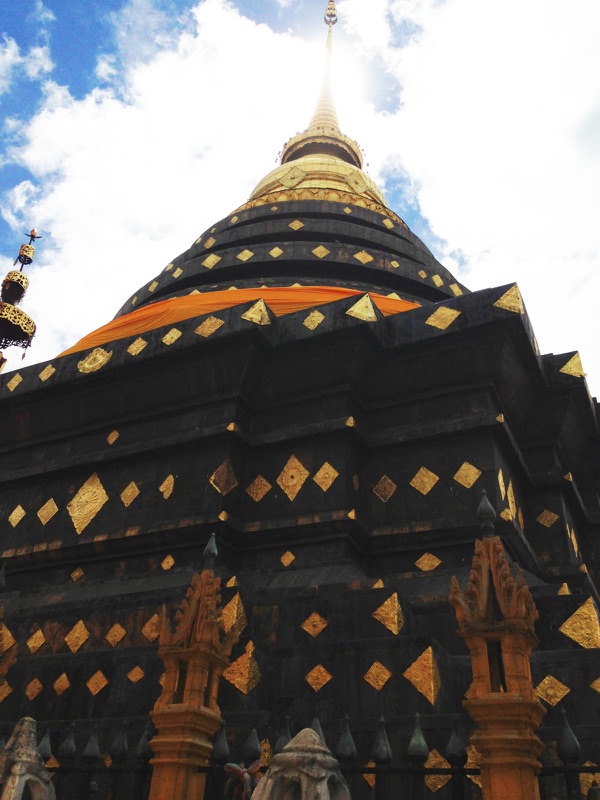
Photo: Woonzen5558 / Wikimedia Commons (CC BY-SA 4.0)
1763–1775: the Konbaung return, and fuen man
Once the Konbaung dynasty had reunited Burma, its army took Chiang Mai again in 1763 (B.E. 2306). Sarassawadee writes that this time the people of Chiang Mai were deported until the city was nearly empty, and men from Lanna were levied for the armies. Kirigaya notes that the army that reached Ayutthaya in 1767 drew men from many towns, Shan, Tai Yuan, Lao and Siam's own northern towns, not only Burmese soldiers.
In B.E. 2316–2317 (1773–75) Burmese officers levied Lanna men heavily for war against Thonburi. Laddawan (1994) relates that this conflict over the levies led Phraya Chaban of Chiang Mai and Phraya Kawila of Lampang to go over to King Taksin of Thonburi. Kham Mueang has a word for that rising: fuen man (fuen man, ฟื้นฯม่านฯ).
In B.E. 2317 (1774–75) the armies of Thonburi and Lanna together took Chiang Mai. Silpa Wattanatham calls that year the turning point of Lanna history, though it took about thirty more years for Burmese power to leave Lanna entirely.
After 1775: an empty city, a revival, and Chiang Saen in 1804
In 1776 a Burmese army returned to besiege Chiang Mai and Phraya Chaban had to lead the people out. King Taksin judged that too few people were left to hold the city and ordered it abandoned. In Prince Damrong's account, quoted by Silpa Wattanatham, Chiang Mai stood empty for more than 15 years; Phra Amarin Santidhammo and colleagues (2023) count the empty years as about 1776–1796.
The revival that followed is the era Kham Mueang calls kep phak sai sa kep kha sai mueang (kep phak sai sa kep kha sai mueang, เกัปฯผักฯไส่ซ้าเกัปฯข้าไส่เมิอฯง). The dictionary explains it as the era of Phraya Kawila, who gathered people back into the town like vegetables gathered into a sa (sa, ซ้า), a basket. King Kawila firmly re-founded Chiang Mai in 1796. The whole story is in King Kawila.
The last town was Chiang Saen. The Sirindhorn Anthropology Centre database relates that in 1803 a Lanna army under the uparat (deputy ruler) of Chiang Mai stormed the southern wall, lower than the others, and that in 1804 (B.E. 2347) King Rama I sent Krom Luang Thepharirak, Phraya Yommarat and Phraya Kawila to take the town. Laddawan likewise says Chiang Saen stayed with Burma until 1804. The west wall still has a gate called Pratu Thap Man, or Tha Man, a name that has kept the word man to this day. Chiang Saen was revived under King Rama V. Read more about the town in Chiang Rai (Jiang Hai).
What carried on: temples, the Lanna script and chronicles
If this age had been completely dark, little evidence from it would survive. The opposite is true. An article in the journal Phasa-Charuek (2024) reads a newly found inscription on the base of a Buddha image in the old ordination hall of Wat Chedi Luang, Chiang Mai. It is written in the Lanna Dhamma script and dated C.S. 949, that is 1587, when Chiang Mai was under Pegu. It names the abbots of Wat Phra Singh, Wat Suan Dok and Wat Chedi Luang taking part in a merit-making. The authors conclude that although politics changed, Lanna's traditions and culture carried on from the end of the golden age.
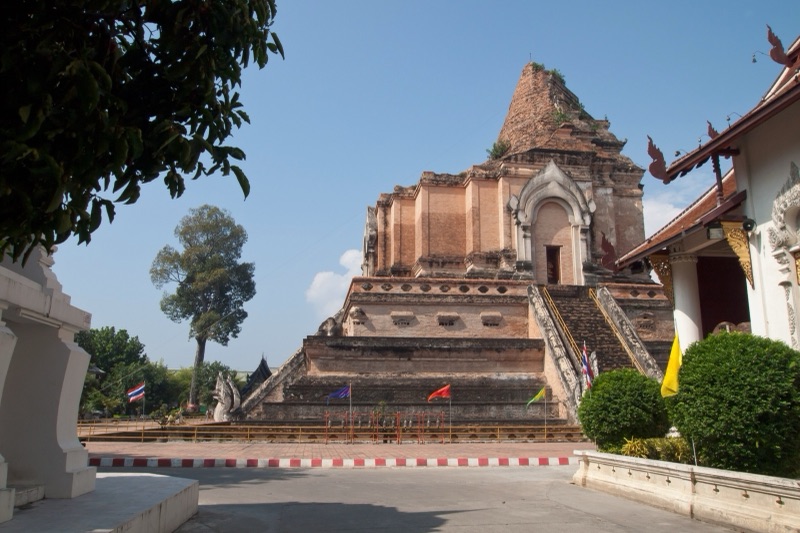
Photo: Vyacheslav Argenberg / Wikimedia Commons (CC BY 4.0)
Tua mueang (tua mueang, ต฿วฯเมิอฯง), the Lanna Dhamma script, stayed in use in the temples and in the work of the rulers. Kirigaya (2015), citing Hans Penth, notes that bronze Buddha images commissioned by the Burmese governor of Chiang Saen carry inscriptions in the Lanna language and script, not in Burmese. He also cites Justin McDaniel (2007): Wat Lai Hin in Lampang, with the second-largest collection of bai lan (bai lan, ไบลานฯ) palm-leaf manuscripts in Northern Thailand, was busiest copying and studying texts in the late seventeenth and early eighteenth centuries, right in the middle of the Burmese period. Poets kept writing too, for example the khlong poem Nirat Doi Koeng, which follows the model of Nirat Hariphunchai.
On religion, Laddawan and Kirigaya both record that several Burmese kings supported Buddhism in Lanna. King Thalun, for example, built and restored temples in Chiang Mai and Chiang Saen and had the Hariphunchai reliquary gilded. Laddawan also found that when people were deported, kha wat (kha wat, ข้าวัดฯ), temple servants, were exempted. The events of the age were written down in tamnan (tamnan, ตํานาฯ), chronicles such as the Chiang Mai Chronicle, although Kirigaya observes that its English translation covers the whole century from 1600 to 1700 in about three pages; on the Burmese side there is also a Burmese-language chronicle of Chiang Mai, the Zinme Yazawin.
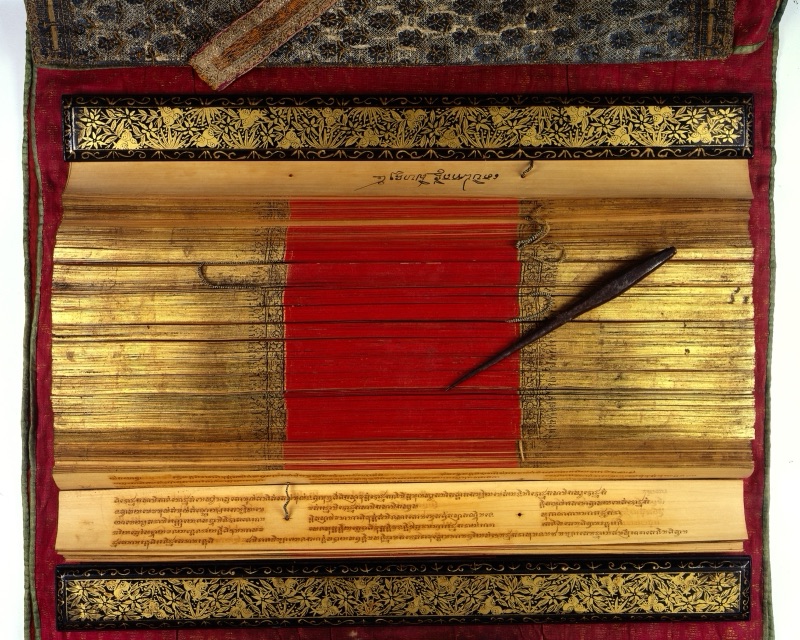
Photo: Wellcome Images / Wikimedia Commons (CC BY 4.0)
Common mix-ups: what the sources show
Stories of the Burmese period are often retold until only one picture is left. Below are beliefs you will often hear, and what the sources used in this article show.
"Burma ruled Lanna without a break for two full centuries"
The sources show several breaks. Chiang Mai broke with Pegu and leaned on Ayutthaya in about 1596–1614, Ayutthaya held Chiang Mai briefly in about 1662–63, and Chiang Mai was independent for almost forty years, 1727–1763. Chiang Saen, on the other hand, stayed with Burma longest, until 1804.
"Every town had a Burmese governor"
Laddawan (1994) and Kirigaya (2015) agree that rulers sent by the Burmese court sat mainly in Chiang Mai and Chiang Saen. Towns such as Lampang, Lamphun, Phrae and Nan mostly kept local lords, who had to send tribute and men for the wars.
"The people of Lanna were always rising against Burma"
Risings did happen, for example in 1558, 1564, 1727 and 1774–75. But Kirigaya points out that after 1564 there was no large joint rising again until the 1720s, and that many conflicts were contests between Lanna towns themselves, such as Chiang Mai against Nan, or Chiang Mai against Chiang Saen. Laddawan reaches a similar conclusion: local lords competed to build up their own power more than they united against the centre.
"The Burmese period was Lanna's dark age"
Scholars disagree. Earlier work, Laddawan's included, stresses the heavier taxes and levies of certain periods. Justin McDaniel (2007), Ken Kirigaya (2015) and Parit Chiwarak (2025) ask whether the "dark age" picture comes more from how history was later divided into eras than from the evidence, since inscriptions, manuscripts, literature and temples from the period survive. The two views are best read together.
"Lampang's Burmese-style temples were built under Burmese rule"
Most Burmese-style temples in Lampang today come from the teak-trade era under King Rama V, almost a century after Burmese rule ended. Muang Boran journal (2021) dates the restoration and building of Wat Si Chum to about 1892–1902; Silpa Wattanatham (2021) gives about 1900 and explains that the Burmese in Lampang at that time came with the British timber firms, not as descendants of the earlier rulers. These workers and merchants settled in Lampang, and the temples they built have been part of the town ever since.
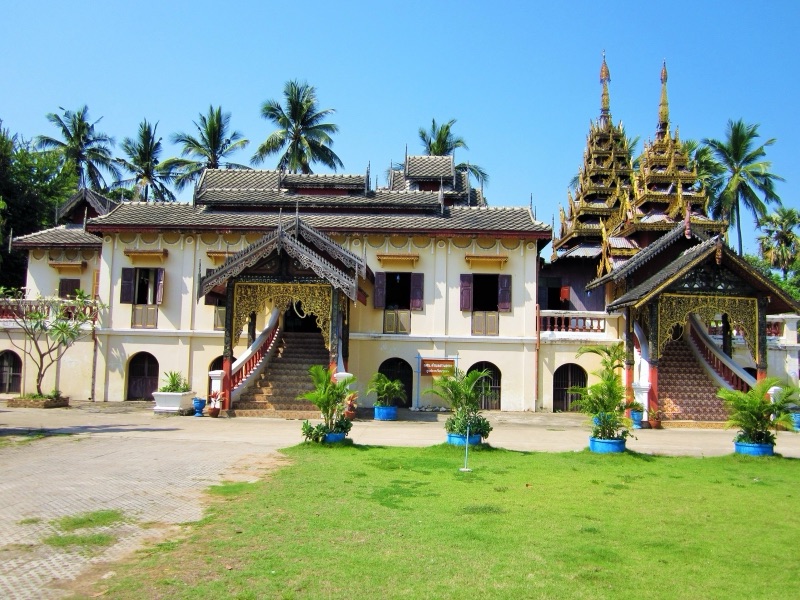
Photo: Srisak pikunkaew / Wikimedia Commons (CC BY-SA 3.0)
"Nawrahta Minsaw was Queen Wisutthithewi's son"
Many books say so, based on one reading of the poem Khlong Mangthra Rop Chiang Mai. But the 2024 Silpa Wattanatham article summarising Sunait Chutintaranond points out that the Burmese chronicles state clearly that Nawrahta Minsaw was the son of another of Bayinnaung's queens. Who Queen Wisutthithewi really was is still answered differently by different historians, so the question stays open.
Test yourself with the quiz below; every answer comes with its source.
Summary
- Lanna under Burmese rule began when Bayinnaung took Chiang Mai in 1558. Most books count to 1774–75 (216 years), but Chiang Saen stayed with Burma until 1804.
- It was not continuous: there were times when Chiang Mai leaned on Ayutthaya, a brief Ayutthaya occupation, and Chiang Mai's independence from 1727 to 1763.
- Rulers appointed by the Burmese court sat mainly in Chiang Mai and Chiang Saen; other towns kept local lords who sent suai (tribute) and men for the wars.
- Kham Mueang keeps the period in words such as man, fuen man and kep phak sai sa kep kha sai mueang.
- Inscriptions, palm-leaf manuscripts, literature and temples from the period survive, so later scholars question the "dark age" picture, while earlier work stresses the burdens on ordinary people. Read both views.
Look up the full meanings of ม่าน and ฟื้นม่าน in the Moradok Lanna dictionary, then read on about the revival in King Kawila.
📚 The whole story of Lanna: Why 'Lanna', not 'Lan Na'? 700 Years in One Song · see provinces, old cities and peoples on one map in Places of Lanna
Sources
- Moradok Lanna dictionary: ม่าน · ฟื้นม่าน · เก็บผักใส่ซ้าเก็บข้าใส่เมือง · ส่วย · ตนบุญ
- ลัดดาวัลย์ แซ่เซียว (Laddawan Saesiao). (1994). การเมืองล้านนาภายใต้การปกครองของพม่า ระหว่างปี พ.ศ. ๒๑๐๑–๒๓๑๗ [Lanna politics under Burmese rule, 1558–1774]. MA thesis in History, Chiang Mai University (chapters 2, 3 and conclusion)
- Kirigaya, Ken. (2015). Lan Na under Burma: A "Dark Age" in Northern Thailand? Journal of the Siam Society 103, 269–296
- Silpa Wattanatham editors. (2021, updated 2025). สภาพหลังพม่ายึดล้านนา ปกครองเมืองเชียงใหม่ ๒๐๐ ปี สู่ยุคเชียงใหม่เป็นเมืองร้าง [Lanna after the Burmese conquest: 200 years of rule over Chiang Mai, to the empty city]. Silpa Wattanatham (from a book by Sujit Wongthes citing Sarassawadee Ongsakul)
- Wood, W.A.R. (1926). A History of Siam, chapters X, XI, XIII. Vajirayana Digital Library
- พริษฐ์ ชิวารักษ์ (Parit Chiwarak). (2023). ความเป็นมาของคำล้านนาและล้านนาไทยโดยสังเขป [A brief history of the words Lanna and Lanna Thai]. Thammasat Journal of History 10(1)
- พริษฐ์ ชิวารักษ์ (Parit Chiwarak). (2025). อาณานิคมกาลเวลา: ปัญหาการแบ่งยุคสมัยในประวัติศาสตร์ล้านนา [Colonization of the Times: A Periodization Problem in Lanna History]. Thai Khadi Journal 22(1)
- Sirindhorn Anthropology Centre. เมืองเชียงแสน [Chiang Saen] (compiled by Thanongsak Loetphiphatwarakun). Archaeological sites database
- เด็กชายผักอีเลิด. (2024). "พระนางวิสุทธิเทวี" ขัตติยนารีราชวงศ์มังรายองค์สุดท้าย เป็นใครกันแน่? [Who was Queen Wisutthithewi, the last of the Mangrai line?]. Silpa Wattanatham (summarising Sunait Chutintaranond, Phama Rop Thai, 2018)
- พระพงษ์ระวี อุตฺตรภทฺโท et al. (2024). คำจารึกที่ค้นพบใหม่ที่พระพุทธรูปในอุโบสถเก่าวัดเจดีย์หลวง จังหวัดเชียงใหม่ [A newly found inscription on a Buddha image in the old ordination hall of Wat Chedi Luang, Chiang Mai]. Phasa-Charuek 1(1), 243–268
- Silpa Wattanatham editors. (2021). "ม่านครองเมือง" เที่ยวชมสถาปัตยกรรมพม่าแห่งนครลำปาง [Burmese architecture of Lampang]. Silpa Wattanatham
- The years of Nan Thipchang, Wat Si Chum (Muang Boran journal) and King Kawila's era (Samran Phondi 2019; Phra Amarin Santidhammo et al. 2023), with full references, are in Lampang, Khelang Nakhon and King Kawila
- Images from Wikimedia Commons, credited under each picture
Practise the words from this article
Flip through 20 flashcards of the Lanna words used in this article.


