
Photo: YingChu Chen / Unsplash
Why 'Lanna', not 'Lan Na'? 700 Years in One Song
"Before there was a name to call it... this land had only mountains and rivers..." — opening speech of the song Lanna, Lanna (words and music: Ajarn Jaree Soontornsing)
Lanna (lan na, ล้านฯนาฯ) is the name the Khon Mueang, the people of the North, have used for their land for more than 700 years. Today it means the eight upper northern provinces of Thailand; in the past it was a kingdom with Chiang Mai as its capital. The short name hides a question. Why is it written ล้าน with a tone mark, when books from our grandparents' time spelled it ลานนา and ลานนาไทย (lan na thai, no tone mark) for decades?
This article answers that from inscriptions and old records, then walks through Lanna history era by era, using Moradok Lanna's song Lanna, Lanna as the thread. Each section opens with the lines of the song that tell its era. For a word-by-word Kham Mueang lesson on the song, see Lanna, Lanna: learn Kham Mueang from the song.
Lanna or Lan Na: where the name comes from
Lan + na = a million rice fields
The Moradok Lanna dictionary defines each part plainly. Lan (lan, ล้านฯ) is "the number ten hundred thousand", and na (na, นาฯ) is "flat land divided by low dikes into plots for growing rice". Lanna therefore means a million rice fields: a land with more paddy than anyone could count.
In its entry for Lanna the dictionary also gives the Pali name, tasalakkhakhettanakhara (ทสลกฺขเขตฺตนครํ): tasa "ten", lakkha "a hundred thousand", khetta "land, field", nakhara "city". Together, "the city of ten hundred thousand fields", in other words, "a million fields". Ten hundred thousand is a million, so the Pali name confirms that the first word is lan, the number, not lan (ลาน) meaning "open ground".
Paired with Lan Xang
Lanna has a twin name, Lan Xang (lan jang, ล้านฯช้างฯ), the Lao kingdom on the Mekong. The dictionary says Lan Xang also has a Pali name, satanakanahuta, meaning "a hundred times ten thousand elephants", that is, "a million elephants". One name counts fields, the other counts elephants.
In those days rank was counted in rice fields. Parit Chiwarak (2023), in the Thammasat Journal of History, notes that the Wat Phra Yuen inscription (1370), the oldest inscription in the Lanna language found so far, calls King Kue Na "lord of two hundred thousand fields", and the Chiang Mai Chronicle says he took the name Kue Na because he was granted a tue (tue, ตื้) of fields, which the dictionary defines as "a hundred million". The numbers saen (saen, แสนฯ, a hundred thousand), lan and tue in these names were a language of rank and power, not a land survey.
The oldest record written ล้านนา
The clearest tone-marked spelling is on the Wat Chiang Sa inscription. The Sirindhorn Anthropology Centre's inscription database describes it as a red sandstone slab shaped like a boundary stone, in Fak Kham script and the Thai language, dated 1553 CE (BE 2096; some catalogues give 1554). It records a king "who reigned over both lands, Lan Chang and Lan Na" giving land and temple servants to Wat Chiang Sa on the Mekong. The stone is now in the Chiang Mai National Museum.
The German scholar Hans Penth published his reading of the inscription in the Journal of the Siam Society in 1980 and showed that the word Lanna is written with the tone mark (as summarised by Parit Chiwarak 2023). The epigraphist Prasert na Nagara wrote in 1983 that both Lanna and Lan Xang are correct, because the old North divided its lands into units of "a thousand fields" (phan na), and because "lan" in the sense of open ground was not a northern word: a temple's open ground was called khuang wat.
- China: the Yuan annals call the kingdom Babai Xifu (八百媳妇), literally "eight hundred wives", first when recording a war in 1292. The Ming later used Babai Dadian (1391), dadian meaning "great rice plain", and called King Tilokarat Tao Lanna, "Lord of Lanna".
- Europe: Giovanni Leardo's world map (1448) shows the name Llana, and Martin Behaim's globe (1494) shows Lanna.
- Burma: the Burmese chronicle of Chiang Mai (Zinme Yazawin) says Chiang Mai had 57 dependent towns; the number became a stock phrase in later Lanna texts, such as "Lanna Thai, 57 towns".
Where ลานนา came from, and why it changed back
The problem starts with the script. The Lanna Dhamma script in palm-leaf texts usually leaves out tone marks, so "lan" (million) and "lan" (open ground) look the same, and later readers could take it either way. Parit Chiwarak (2023) shows that early Bangkok-era Siamese literature, such as the poem Lilit Taleng Phai, already spelled it ลานนา, and when the Yonok Chronicle was printed in 1906, the form ลานนาไทย became widely known to Siamese readers (the book itself mixes ลานนาไทย and ล้านนาไทย). A 1925 geography textbook explained that "Lanna" got its name because it "has much flat land for rice farming".
The phrase Lanna Thai was not a Bangkok invention either: the same study finds it in Lanna's own texts, such as the Chiang Mai Chronicle and the Nan Chronicle, in the phrase "Lanna Thai, 57 towns".
The spelling ลานนา stayed in use for decades, from the Lampang newspaper Thai Lanna (1950) to the pioneering writers on Lanna studies. When Chiang Mai University was founded in 1964, scholars began checking the original documents closely. What followed can be summed up like this:
| Year (CE) | Event |
|---|---|
| 1967 | History and archaeology seminar at Chiang Mai University: Saeng Manavidura and Thin Ratikanok argue that ล้านนา is more likely correct |
| 1980 | Hans Penth publishes the Wat Chiang Sa reading, confirming the tone mark |
| 1983 | Prasert na Nagara proposes ล้านนา instead of ลานนา |
| 1984 | The souvenir book for the opening of the Three Kings Monument in Chiang Mai uses ล้านนา throughout |
| 1987 | The Thai history committee of the Prime Minister's Office rules that the spelling is ล้านนา |
There really were two sides. Those who kept ลานนา cited the old "flat land for farming" explanation and long familiarity; those who chose ล้านนา cited contemporary inscriptions, the Pali name and the northern habit of counting fields by the thousand and hundred thousand. After the 1987 ruling the tone-marked form became the standard in scholarship and everyday life, but traces of ลานนา remain in names given earlier or around the same time, such as Si Lanna National Park (established 1989) and Thai Lanna Road in Lampang.
Tap through all seven eras in this timeline. The bar on top is drawn to scale, and each ◆ is a milestone of the name Lanna.
Before Lanna: Hariphunchai and Yonok
"...this land had only mountains and rivers..."
Before the name Lanna, this land was far from empty. The Ping valley had the city of Hariphunchai, which is La Pun (la pun, หลฯะพูร), today's Lamphun. According to the Camadevivamsa and the Jinakalamali, Queen Chamadevi came up from Lavo to rule it around 661 CE. Its people were Mon, whose ancestors Kham Mueang calls Meng (meng, เมงฯ). The Lua (lua, ลวฯะ), the dictionary says, are a Mon-Khmer people who still live in Lanna today, and in many legends they were here first.
Further north, the Kok valley was home to the Tai the chronicles call Yonok (yonok, โยน฿กฯ). The dictionary explains them as "the Tai Yuan or Tai Yonok ... the largest population group of the Lanna kingdom", the Tai Yuan (tai yuan, ไทยวฯร) who today call themselves Khon Mueang. The legend of Prince Singhanavati says the city of Yonok Nakaphan was dug out with the help of a naga, and the Ngoen Yang dynasty of Chiang Saen is the line King Mangrai came from.
Read more about this era: Queen Chamadevi · La Pun · Singhanavati
King Mangrai builds a kingdom
"...until Lord Mangrai gathered the towns and palaces, from Hariphunchai to Wiang Kum Kam... built Chiang Mai beside the Ping... and melted all of us into one..."
King Mangrai gathered the realms into one great land / and founded Chiang Mai, wide and far, beside the Ping / he joined peoples of many races with his heart / and so the mighty kingdom of Lanna was born
These lines are the core of the song, and they match history almost word for word. King Mangrai (mang lai, มังฯรายฯ) was the son of Lao Meng, king of Hiran Nakhon Ngoen Yang. The dictionary records that he founded Chiang Rai in 1262 CE. He then came down to the Ping valley and took Hariphunchai (sources differ on the year: Prasert na Nagara gives 1281, the Jinakalamali 1292) and built Wiang Kum Kam on the Ping in 1286, according to Monwat Phromrat (2025).
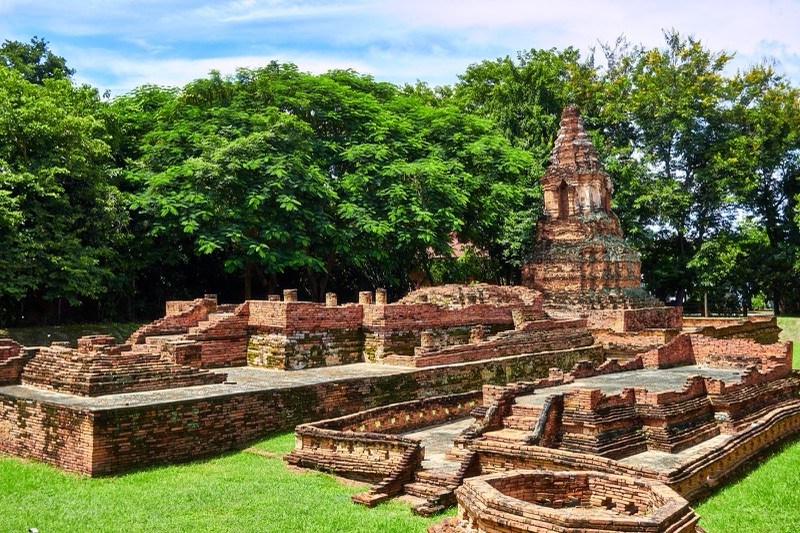
Photo: Mathew Schwartz / Wikimedia Commons (CC BY 3.0)
In 1296 CE King Mangrai founded Chiang Mai, in Kham Mueang Jiang Mai (jiang mai, ชยฯงไห่มฯ), which the dictionary says "was founded in 1296 as the capital of the Lanna kingdom, an independent state until 1558". In the account scholars often cite, he invited two royal friends, King Ngam Mueang of Phayao and King Ram Khamhaeng of Sukhothai, to help choose the site. The city was laid out as a moated square, a wiang (wiang, วยฯง), a word the dictionary defines both as "town" and as "wall, fort".
The song's "joined peoples of many races" has a basis too. The new kingdom brought together the Tai Yuan of the Kok valley, the Mon of Hariphunchai and the Lua who were there before. Jaroon Daennalert and Prayoon Imiwat (2018) sum up that Mangrai took Buddhism from Hariphunchai, ruled with the Mangraisat law code, which may have drawn on Mon legal texts, and sent his sons to govern key towns. According to the chronicles, he died in 1311.
Read next: King Mangrai · Chiang Mai (Jiang Mai) · The Mangraisat · The Chiang Mai Chronicle
The golden age: temples, language and weaving
"Time passed on and on... faith built temples, and the customs shone everywhere..."
Faith built temples that joined people's hearts / and passed Kham Mueang on, everywhere / fine cloth was woven in every village / and Lanna's customs survived the darkest times
Paeng (paeng, แปลฯง) in the spoken line means to make or build, so "faith built temples" is the faith of people raising temples across the land. The period these lines describe most clearly is the two centuries after Mangrai, which scholars call Lanna's golden age.
- 1369, King Kue Na invited the monk Sumana from Sukhothai to spread Sri Lankan-lineage Buddhism, built Wat Suan Dok and, according to legend, enshrined a relic on Doi Suthep.
- 1441–1487, King Tilokarat expanded the kingdom, enlarged the great Chedi Luang, and in 1477 held a council to revise the Tipitaka at Wat Mahabodharam (Wat Chet Yot) in Chiang Mai.
- 1517–1528, the monk Ratanapanya wrote the Jinakalamali, a Pali chronicle of Buddhism down to Lanna that historians still rely on.
The language "passed on everywhere" was both spoken and written. The written form is tua mueang (tua mueang, ต฿วฯเมิอฯง), the Lanna Dhamma script. The dictionary says it was used both for religion, as in palm-leaf scriptures, and for secular works such as literature, astrology and medical texts. Monks and scholars would inscribe (jan, จารฯ) letters onto palm leaves (bai lan, ไบลานฯ) with a pointed stylus and keep them in the temple's scripture library (ho tham, หํอฯธัม์มฯ). Lanna's knowledge survived to this day because of its temples.
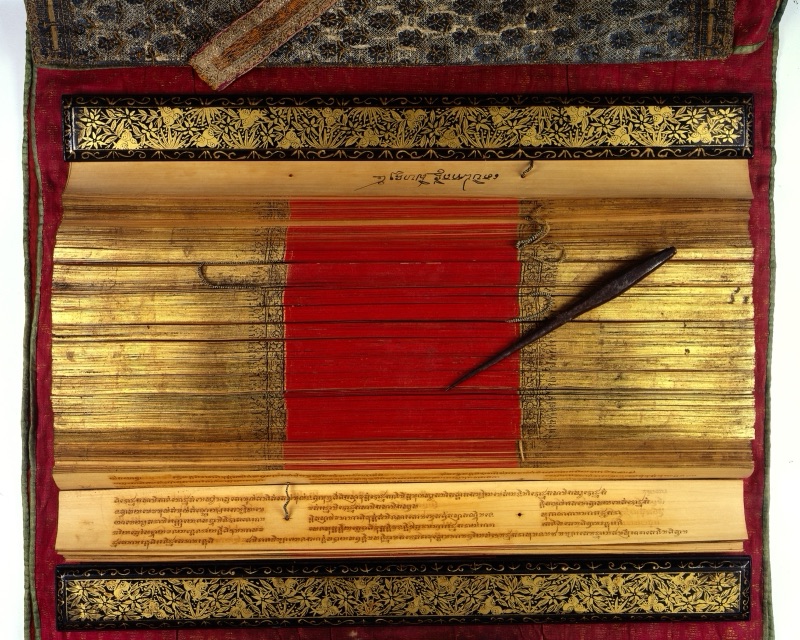
Photo: Wellcome Images / Wikimedia Commons (CC BY 4.0)
The song's woven cloth reflects that every community had its own patterns, such as the hem of a woman's sarong woven in the jok technique, in Kham Mueang the tin jok (tin jok, ตีนฯ). And hit hoi (hit hoi, รีตฯรอฯยฯ) are customs and traditions "set by a group and handed down for a long time", in the dictionary's words. Cloth and weaving words: Lanna cloth and clothing words.
Read next: King Kue Na · King Tilokarat · Phra Ratanapanya Thera · The Jinakalamali · What is Tua Mueang?
Under Burmese rule, and the revival
"Through the years and lifetimes, danger came, and the power of others..."
After the golden age the Mangrai dynasty weakened through struggles at court, and in 1558 the army of King Bayinnaung of Burma took Chiang Mai. Lanna became a vassal of the Man (man, ม่านฯ), the Burmese, for about two hundred years. "The power of others" in the song uses poen, here meaning "them, other people".
Parit Chiwarak (2023) notes that at first Lanna remained one kingdom under a Chiang Mai king appointed by Burma, but its towns drifted apart. In 1700, for example, the court of Ava raised the ruler of Chiang Saen to the same rank as the ruler of Chiang Mai, splitting Lanna into an upper and a lower part, and documents of the time begin to use compounds such as "Lanna Chiang Mai" and "Lanna Chiang Saen".
Fuen man, and gathering vegetables into the basket
Kham Mueang has a word for the uprising that followed: fuen man (fuen man, ฟื้นฯม่านฯ), which the dictionary defines as "to rebel against Burma, to act to become free of Burma". According to Samran Phondee (2019), in 1774 Chao Kawila of Lampang joined Phraya Chaban of Chiang Mai against the Burmese and turned to King Taksin of Thonburi. But the wars left Chiang Mai empty for about twenty years.
"...But our wisdom and our spirit... never left our hearts..."
The song's mu hao (mu hao, หู่เรัา, "we, our own people") who never vanished fits the era Kham Mueang calls kep phak sai sa, kep kha sai mueang (เกัปฯผักฯไส่ซ้าเกัปฯข้าไส่เมิอฯง). The dictionary explains it as King Kawila's era, from 1780, when townspeople who had fled to the forest were gathered back, and Tai Lue, Tai Khuen and Tai Yai people from Sipsong Panna and Chiang Tung were brought to settle, like gathering vegetables into a sa (sa, ซ้า), a basket. Kawila re-established Chiang Mai firmly in 1796 and became the first of the nine rulers of Chiang Mai (chao luang chiang mai, เจั้าเจั้าหลฯวฯงชยฯงไห่มฯ) the dictionary lists.
Many communities in Chiang Mai and Lamphun today, such as the Yong of Lamphun and the Tai Khuen of Chiang Mai, trace their roots to this era. Lanna has been a land of many peoples from the beginning to now. More on the Tai groups: The Tai peoples.
Read next: King Kawila
From tributary state to Monthon Phayap
"...lines were drawn between the lands..."
"Though the borders changed... and the word kingdom is gone..."
After Kawila, the main Lanna cities, Chiang Mai, Lampang, Lamphun, Phrae and Nan, were tributary states (prathet rat) of Siam. Each had its own chao luang (chao luang, เจั้าหลฯวฯง), who, the dictionary explains, "had to have the consent of all the princes" and "had to be appointed by a higher power". Between 1873 and 1933, administration moved step by step into the system of the modern Siamese state. The sequence scholars have recorded is:
| Year (CE) | Event |
|---|---|
| 1873 | First Chiang Mai treaty; Siam then grouped Chiang Mai, Lampang and Lamphun as "the three towns", with a resident commissioner |
| 1883 | Second Chiang Mai treaty; its scope extended to Phrae and Nan, together called "the Lao Chiang towns" |
| 1892 | Organised as "Monthon Lao Chiang" in the monthon (provincial circle) system |
| 1899 | Tributary status ended; renamed the Northwestern Monthon, then "Monthon Phayap", a name meaning "northwest" |
| 1916 | Phrae, Nan and Lampang split off as Monthon Maharat, both grouped as the Phayap region (for about ten years) |
| 1921 | The northern railway reaches Chiang Mai station |
| 1933 | The monthon system is abolished nationwide; provinces report directly to the central government |
Most years in the table come from Parit Chiwarak (2023), who cites government records and Prince Damrong Rajanubhab's work on provincial administration. The year the railway reached Chiang Mai comes from Suttisak Sawangsak (2019, Srinakharinwirot University), who studied how the railway turned the Bangkok to Chiang Mai journey from official travel into tourism.
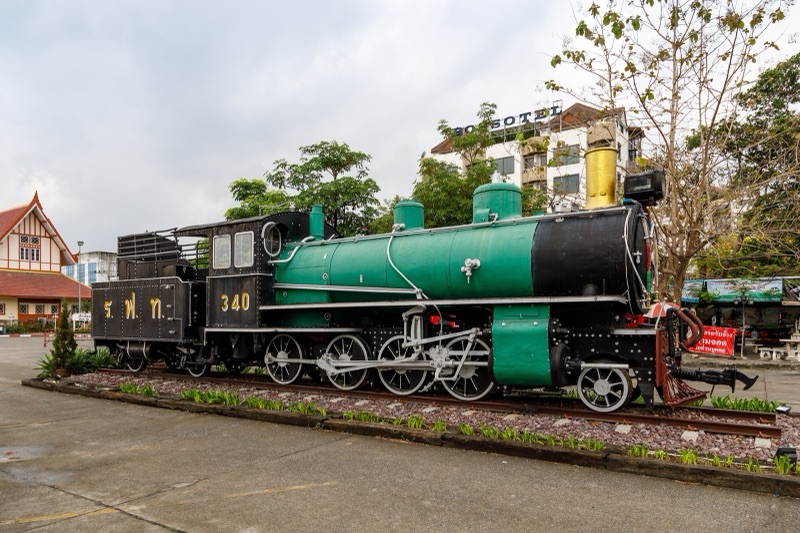
Photo: CEphoto, Uwe Aranas / Wikimedia Commons (CC BY-SA 4.0)
Names for people also reflect the times. Under Lao (lao, ลาวฯ) the dictionary notes that "in the reign of King Rama V the people of Lanna were often called Lao as well". The monthon's change of name from "Lao Chiang" to "Phayap" falls in the same period, while in the books of the time the old land's name lived on as ลานนาไทย, as told in the first section.
Several people stand out in this period of change. Princess Dara Rasmi was born in Chiang Mai in 1873, went to Bangkok in 1886, became a royal consort of King Rama V and later returned to revive Lanna dance, music and culture. Khruba Siwichai led the faith of the Khon Mueang in restoring temples and building the road up Doi Suthep. The dictionary lists nine rulers of Chiang Mai; the last was Major General Chao Kaeo Nawarat, and after him the office was not filled again.
A map of Chiang Mai from this era, made for Chao Inthawichayanon, the seventh ruler, in 1893, still shows the square inner city King Mangrai laid out six hundred years earlier.
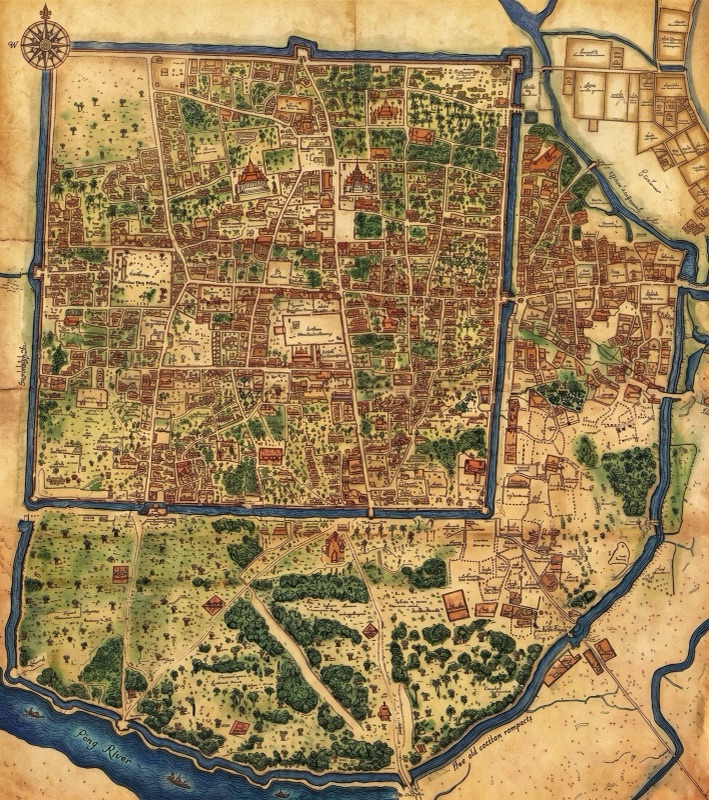
AI-generated illustration; the lettering and small details are not from the original
See the original map: unknown maker / Wikimedia Commons (Public domain)
Read next: Princess Dara Rasmi · Khruba Siwichai · Ngoen Thaep (when Lanna paid in Indian rupees, in the teak-trade era)
Lanna today: still alive in all of us
"...But you all, wait and see... Lanna still lives... in our blood, in the words we call out to one another!"
Lanna, Lanna... so beautiful and so graceful! / ... / Lanna, Lanna... still alive in all of us!
Today the word kingdom is indeed gone, as the song says, but Lanna has not disappeared. The dictionary gives its present meaning as "the area of the eight northern provinces of Thailand: Chiang Mai, Lamphun, Lampang, Chiang Rai, Phayao, Phrae, Nan and Mae Hong Son". Lanna today is a cultural region, the name local people use for their home.
The spoken language of this region is Kham Mueang (kam mueang, คำฯเมิอฯง), which the dictionary says "Thai officialdom calls the Phayap regional dialect or Northern Thai". It is the language of the Tai Yuan, who call themselves Khon Mueang (khon mueang, ฅ฿นฯล้านฯนาฯ), and it has both a spoken form (Kham Mueang) and its own script (Tua Mueang).
Over recent decades the name Lanna has returned to everyday life, from Rajamangala University of Technology Lanna (2005) to shops and events across the North. Tua Mueang, once kept mostly in temples, is taught in schools again, for example in the "U Kham Mueang Lueang Lue Akson" project of the Chiang Mai Primary Education Area Office 1 in 2011.
The traditions carry on every year. Pi Mai Mueang (pi mai mueang, ปีให่มฯเมิอฯง) is the Lanna Songkran, Yi Peng (yi peng, ยี่เพงฯ) is the full moon of the second northern month, and tung (tung, ทุง) are the banners the dictionary describes as "a sign for both the living and the dead". All of these are the "customs that shine everywhere" of the song.
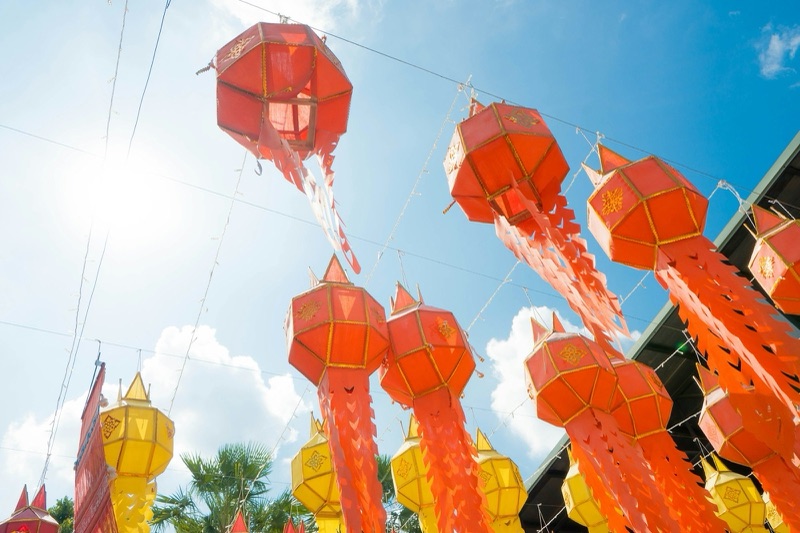
Photo: Mandy H / Unsplash
Read next: The eight Lanna provinces · Places of Lanna · What is Tua Mueang? · Yi Peng, Pi Mai and tung · Lanna tung banners
What the song tells: lines and eras
The song does not list dates like a textbook, but every line points to a real period. This table pairs each line with its era and an article to read next.
| Song line | Era | Read next |
|---|---|---|
| "Before there was a name... only mountains and rivers" | Before Lanna | Queen Chamadevi |
| "gathered the towns from Hariphunchai to Wiang Kum Kam" | Mangrai takes Hariphunchai, builds Wiang Kum Kam | King Mangrai |
| "built Chiang Mai beside the Ping" | Chiang Mai founded, 1296 | Chiang Mai (Jiang Mai) |
| "joined peoples of many races with his heart" | A kingdom of Tai Yuan, Mon and Lua | The Mangraisat |
| "faith built temples" / "passed Kham Mueang on" | Golden age, 1369–1528 | King Tilokarat |
| "danger came, and the power of others" | Burmese rule, 1558–1774 | King Kawila |
| "lines were drawn" / "the word kingdom is gone" | Tributary state to Monthon Phayap | Princess Dara Rasmi |
| "still alive in all of us" | Lanna today | Places of Lanna |
Kham Mueang words in the song's spoken parts, such as hong (hong, ร้อฯง, to call), khan (khan, ขานฯ, to say, to call) and kam u, are explained one by one in the lesson Lanna, Lanna: learn Kham Mueang from the song, a good companion to this article.
Check what you have read with eight questions.
Listen, and the full lyrics
The song Lanna, Lanna (Cinematic Version), words and music by Ajarn Jaree Soontornsing, is published on OverNormal.
🎧 Listen: overnormal.com/play/lanna-lanna-cinematic
Full lyrics: Lanna, Lanna (Cinematic Version), with an English rendering
Lanna, Lanna (Cinematic Version)
Words and music: Ajarn Jaree Soontornsing. The original Thai and Kham Mueang lyrics are on the song page and in the Thai version of this article (in Thai); below is our English rendering.
"Before there was a name to call it... this land had only mountains and rivers... until Lord Mangrai gathered the towns and palaces, from Hariphunchai to Wiang Kum Kam... built Chiang Mai beside the Ping... melted all of us into one... and called it by the name... Lanna..."
King Mangrai gathered the realms into one great land
and founded Chiang Mai, wide and far, beside the Ping
he joined peoples of many races with his heart
and so the mighty kingdom of Lanna was born
"Time passed on and on... faith built temples, and the customs shone everywhere... through the years and lifetimes, danger came, and the power of others... lines were drawn between the lands... but our wisdom and our spirit... never left our hearts..."
Faith built temples that joined people's hearts
and passed Kham Mueang on, everywhere
fine cloth was woven in every village
and Lanna's customs survived the darkest times
Though time turns and changes like a tale
and waves of change keep crashing in
the spirit of our people will never die
and this pride will shine bright and sparkling
"Though the borders changed... and the word kingdom is gone... you all, wait and see... Lanna still lives... in our blood, in the words we call out to one another!"
Lanna, Lanna... so beautiful and so graceful!
The stories of yesterday teach us and polish us!
The smiles of brothers and sisters, warm as a shadow that stays!
Lanna, Lanna... still alive in all of us! (chorus twice)
"Lanna... is not only the past... it is the breath... of every one of us..."
Summary
- Lanna comes from lan (ten hundred thousand) + na (rice field). The dictionary's Pali name, tasalakkhakhettanakhara, means "city of ten hundred thousand fields", and it pairs with Lan Xang, which counts elephants.
- The clearest tone-marked record of ล้านนา is the Wat Chiang Sa inscription (1553). The untoned ลานนา and ลานนาไทย spread in Thai-language books until the Thai history committee ruled for ล้านนา in 1987.
- King Mangrai founded Chiang Mai in 1296. The golden age ran from King Kue Na to King Tilokarat, followed by about two centuries of Burmese rule and King Kawila's revival.
- Between 1873 and 1933 Lanna moved from tributary status into the monthon system, until monthons were abolished in 1933.
- Today Lanna is a cultural region of eight provinces that still speaks Kham Mueang, writes Tua Mueang and keeps its customs, just as the song says: "still alive in all of us".
Look up the full meanings of ล้านนา and ล้านช้าง in the Moradok Lanna dictionary, then learn the song's Kham Mueang in Lanna, Lanna.
📚 The whole series: provinces, old cities and peoples on one map at Places of Lanna: 8 Provinces, Old Cities and Peoples
Sources
- Moradok Lanna dictionary: ล้านนา · ล้านช้าง · ล้าน · ตื้อ · มังราย · เจียงใหม่ · ตั๋วเมือง · ฟื้นม่าน · เก็บผักใส่ซ้าเก็บข้าใส่เมือง · เจ้าหลวง · กำเมือง
- พริษฐ์ ชิวารักษ์ (Parit Chiwarak). (2023). ความเป็นมาของคำล้านนาและล้านนาไทยโดยสังเขป [A Brief History of the Words Lanna and Lanna Thai]. Thammasat Journal of History 10(1), 79–106 (citing the Fine Arts Department's Lanna inscriptions 2008, Penth 1980 JSS 68(1), Kanokporn Numthong 2021, the Prime Minister's Secretariat letter of 15 June 1987 and other records)
- Sirindhorn Anthropology Centre. จารึกวัดเชียงสา (ชม. ๗) [The Wat Chiang Sa inscription]. Inscriptions in Thailand database
- ประเสริฐ ณ นคร (Prasert na Nagara). (written 1983; online 2019). ดร. ประเสริฐ ณ นคร กับเหตุผลที่เสนอให้ใช้คำ "ล้านนา" แทน "ลานนา" [Why Dr. Prasert proposed ล้านนา instead of ลานนา]. Silpa Wattanatham
- สุทธิศักดิ์ แสวงศักดิ์ (Suttisak Sawangsak). (2019). บทบาทของกรมรถไฟหลวงกับการท่องเที่ยวจังหวัดเชียงใหม่ พ.ศ. ๒๔๖๔–๒๕๐๒ [Role of the Royal State Railway on tourism in Chiang Mai, 1921–1959]. Master's thesis, Srinakharinwirot University
- จรูญ แดนนาเลิศ และประยูร อิมิวัตร. (2018). "พญามังราย" ปฐมกษัตริย์แห่งการปกครองแผ่นดินล้านนาโดยธรรม [King Mangrai, first king of Lanna's righteous rule]. Dhonburi Rajabhat University Journal of Humanities and Social Sciences 1(3)
- มนวัธน์ พรหมรัตน์. (2025). มองเชียงใหม่ใหม่: พญามังราย อำนาจ กับภูมิอากาศโลก [Chiang Mai anew: King Mangrai, power and global climate]. Payap University Journal 35(2)
- เฉลิมวุฒิ ต๊ะคามี. (2021). จามเทวี: ตัวตนและอุดมคติ [Chamadevi: identity and ideal]. Khuang Phaya Journal 15(1)
- สำราญ ผลดี. (2019). หัวเมืองฝ่ายเหนือกับพระบาทสมเด็จพระพุทธยอดฟ้าจุฬาโลกมหาราช [The northern towns and King Rama I]. Mahidol University Journal of Liberal Arts 2(2)
- Manager Online. (27 September 2011). ชม.เปิดโครงการ "อู้คำเมืองเลื่องลืออักษร" สอนภาษาล้านนา [Chiang Mai launches a project teaching the Lanna language]
- Jaree Soontornsing (words and music). (2026). ล้านนา ล้านนา (Cinematic Version). OverNormal
- Years of the golden age and of King Kawila's era, with detailed sources, are in the articles linked in each section.
- Images from Wikimedia Commons and Unsplash as credited; the map is an AI recreation by Moradok Lanna.
Practise the words from this article
Flip through 35 flashcards of the Lanna words used in this article.


