
Photo: Chainwit. / Wikimedia Commons (CC BY-SA 4.0)
Phayao: City of the Kwan and Phra Chao Ton Luang
Phayao (พะเยัา, read phayao) is the Lanna province with a lake at its heart. The Moradok Lanna dictionary (in Thai) records that it "was once the site of the city of Phayao (Phayao)", and that it only became a province in 1977, the 72nd province of Thailand. That makes it the youngest of the 8 Lanna provinces, yet its stories are as old as any.
This post takes Phayao one story at a time: the old name Phayao and the Phu Kam Yao range, King Ngam Mueang, friend of King Mangrai and King Ramkhamhaeng, Kwan Phayao, the lake that grew out of an old pond, the fish and the fermented fish of the lakeside villages, Phra Chao Ton Luang of Wat Si Khom Kham, the Tai Lue of Chiang Kham, the ancient town of Wiang Lo, and finally the provincial motto line by line and the provincial flower.
Phayao, Phu Kam Yao and the 72nd province
The name written "Phayao" today was once spelled Phayao (พยาว, พะยาว). Sujit Wongthes explains in his book Where Did Phayao Province Come From? (2009, in Thai) that the oldest evidence of the name is the Wat Si Chum inscription (Sukhothai Inscription No. 2), which writes "Phayao", and the early Ayutthaya poem Samutthakhot Kham Chan spells it the same way.
Nobody knows for sure where the name comes from. Later documents connect it with Phu Yao or Phu Kam Yao, a range running north to south from Phan District in Chiang Rai and sloping down until it ends at the plain by the Ing River, where Phayao stands. The Phan end rises sharply, as if cut off, so villagers call it "Doi Duan" (the cut-off mountain), while the chronicles call it Phu Yao or Phu Kam Yao. A mountain in Kham Mueang is doi (ดอฯย, read doi). Sujit notes that calling a peak phu is a Lan Xang habit; after Phayao joined Lanna, people turned to doi, the Lanna word.
How old the city is depends on the source. The dictionary says the city of Phayao "was founded in the 16th Buddhist century". Sujit writes that Phayao was developing before 1157 CE, and a special report in Silpa Wattanatham magazine (1993) estimates that a community existed at least a little before the 18th Buddhist century (about the 12th century CE). All agree that Phayao is old; no evidence yet gives an exact year.
One district name on that list is a lovely Kham Mueang word. Kham tai (ฅำไต้, read kham tai) in the dictionary is the sweet acacia, a small thorny shrub with yellow pompom flowers that smell sweet all day, and the dictionary also notes that "Dok Khamtai" is the name of a district in Phayao.
King Ngam Mueang: legend, three royal friends and the evidence
Phayao's earliest period lives in legend, which the 1993 Silpa Wattanatham report calls "tales of a mythical kind" that must be read apart from history.
The person the evidence confirms is King Ngam Mueang (Phaya Ngam Mueang). Silpa Wattanatham, citing the Yonok Chronicle, says he was the son of Phaya Ming Mueang, born in Phayao in 1238 CE. At 16 he went to study at Lavo (Lopburi) "under the hermit Sukkathanta", the same teacher as Phra Ruang of Sukhothai, so he and King Ramkhamhaeng were friends from then on. He became ruler of Phayao at 20. As for the name "Ngam Mueang", the legend explains it this way:
"Wherever he went, the sun was not hot and the rain did not pour; if he wished it cloudy, it clouded; if he wished it sunny, it shone. That is why he was called 'Ngam Mueang'." (a legend quoted by Silpa Wattanatham, meaning a man whose power overshadowed the land)
Sworn friends by the Ing River
The story people remember best is the friendship of three kings. Lanna documents tell of a quarrel between Phra Ruang and King Ngam Mueang; King Mangrai made peace between them, and the three swore friendship on the bank of the Ing River at Phayao. The Jinakalamali tells the same event as a meeting "to agree on victory and defeat between them".
The 1993 Silpa Wattanatham report reads this politically: Mangrai was about to march across the mountains to take Hariphunchai, and if Phayao were not a friend, Chiang Rai could be attacked from behind. The oath confirmed the alliance before the campaign. Read more about Mangrai and the founding of Chiang Mai in King Mangrai and about the chronicle in the Jinakalamali.
The story that King Ngam Mueang and King Ramkhamhaeng helped choose the site of Chiang Mai in 1296 is behind the Three Kings Monument in the centre of Chiang Mai. Silpa Wattanatham (2023) also notes that later studies show the three really were allies, but they may not have built Chiang Mai together.
War with Nan, and the curry that broke a home
King Ngam Mueang also tried to bring Nan under Phayao. Silpa Wattanatham, following Sarassawadee Ongsakul's reading of the Nan chronicle, tells that he took Mueang Pua and sent his consort Nang Ua Sim to rule it. One day she cooked him a curry, and he complained it was too sweet and too watery. Hurt, she went back to Mueang Pua and never returned, and before long Nan was independent again. People call this tale "the sweet curry that broke a home". Read more about Nan in Nan.
Silpa Wattanatham records that King Ngam Mueang died in 1318 CE at the age of 80, after about 60 years on the throne. Today his monument stands on the town side of the lake, and the provincial motto has a line "homage to Pho Khun Ngam Mueang".
Phayao in Lanna: from Phaya Kham Fu to an empty city
After Ngam Mueang, the Mangrai dynasty still had its eye on the Ing River plain of Phayao. The 1993 Silpa Wattanatham report says that late in the 19th Buddhist century (the early 1300s CE) Phaya Kham Fu of Chiang Saen joined with the ruler of Nan to attack Phayao from both sides and took Phayao first. From then on Phayao was part of the Lanna kingdom.
Phayao rose again under King Tilokarat. Phraya Yutthitthira, a prince of the Phra Ruang line who ruled Phitsanulok, fell out with Ayutthaya and came over to Lanna; Tilokarat gave him Phayao to rule. The Phra Kaen Chan chronicle says Phraya Yutthitthira built Wat Pa Daeng Luang during that time.
Phayao's craftsmen had a style of their own. The Cloud (2019) explains that Buddha images of the Phayao school were usually carved from local sandstone, while other cities preferred to cast bronze. The Silpa Wattanatham report says sandstone Buddhas, stone inscriptions and ceramics found in Phayao are collected at Wat Si Khom Kham and Wat Li, and that most of the inscriptions are no older than the 21st Buddhist century (the 1500s CE).
After Chiang Mai fell under Burma in 1558, the cities of Lanna declined. The same report notes that the name Phayao almost disappears from Lanna documents, as if the city had been left empty, until Phayao was founded again in the Rattanakosin period. Later, after the administrative reforms, Phayao became a district of Chiang Rai Province, until it was made a province in 1977.
Kwan Phayao: from Nong Iang to a lake in the middle of town
Kwan (ค้วฯาฯนฯ, read kwan) in the dictionary means "a lake, a marsh, a big pond, a place where water swirls, for example Kwan Phayao". Silpa Wattanatham (2019) notes that this word, in the sense of a big pond or marsh, is used only in Phayao, and that it probably comes from kwan (กว้าน), "to gather a great amount".
Kwan Phayao (ค้วฯาฯนฯพะเยัา, read kwan phayao) in the dictionary is the largest freshwater lake in the North. It came into being when the Department of Fisheries built a weir, so that people would have water in the dry season and the rainy-season water would not rush down and flood the fields downstream.
Before it was a lake, this was low ground by the Ing River with many ponds, nong (หนฯอฯง, read nong), linked by channels. The most important was Nong Iang. Silpa Wattanatham says that before 1941 most of it dried up in the dry season, leaving only scattered pools; a 1941 picture book from the Department of Publicity even shows villagers drawing water from a well in the middle of the kwan to sell in town. When the weir on the Ing was built in 1941, the water stayed all year round, as it does today.
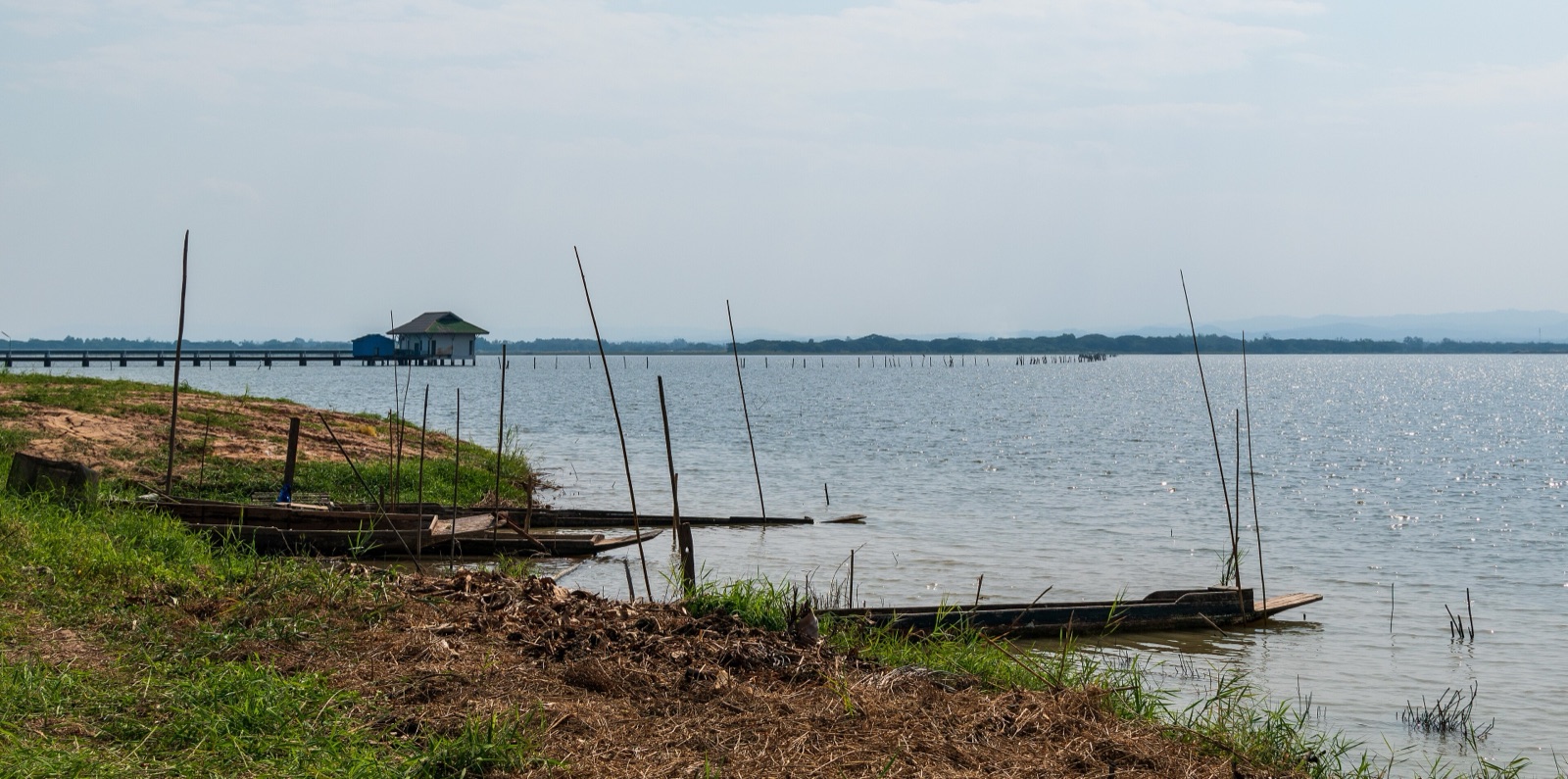
Figures for the size of the lake differ by source and by water level. The dictionary gives 12,831 rai (about 20.5 km²). Silpa Wattanatham gives an average of 17.55 km², about 10,915 rai, and ranks it the third-largest body of water in Thailand, after Nong Han in Sakon Nakhon and Bueng Boraphet in Nakhon Sawan. Phayao's provincial fisheries officer told Thai PBS (2026) that the lake covers about 16,000 rai, 12,000 rai of it a fish-breeding area.
Fish of the lake, by their Kham Mueang names
A fish in Kham Mueang is pa (ปลฯา, read pa). A study by the Faculty of Agriculture and Natural Resources, University of Phayao, published in the Khon Kaen Agriculture Journal, surveyed the lake from December 2016 to October 2017 and found 39 species in 16 families. The carp family was the commonest, and the silver barb had the greatest total weight. A University of Phayao student survey in 2019–2020 found 22 species, with the silver barb first in both number and weight.
- Pa mong ka (ปลฯาโม฿งฯค่าฯ, read pa mong ka) is the silver barb (pla taphian), the lake's leading fish in both surveys.
- Pa kot (ปลฯาก฿ดฯ, read pa kot) is a bagrid catfish (pla kot); the 2019–2020 survey found one kind spread all over the lake.
- Pa ko (ปลฯากํอฯ, read pa ko) is the giant snakehead (pla chado); Phayao's fisheries officer told Thai PBS that it is "the top predator of the food chain" in the lake.
The lake has worries too. Thai PBS (19 July 2026) reported that fishers had begun catching red-claw crayfish, an alien species that eats young fish and shrimp. The Department of Fisheries counted 76 fish species, down from more than 80, and 17 lakeside communities have set aside conservation zones together.
Explore the lake yourself on the map below. Tap the temples, villages and each fish to read the Kham Mueang word and a short, sourced note, then try the catch-the-fish game and name the swimming fish in Kham Mueang.
Pa som and life by the lake
The dictionary records that the lake's wealth of fish "made it a large and famous producer of pa som, which became a well-known product of Phayao". Pa som (ปลฯาส้฿มฯ, read pa som), sour fermented fish, is fresh fish preserved with salt, garlic, cooked sticky rice and other seasonings and fermented until sour. It can be whole fish or chunks, and it is fried or grilled before eating.
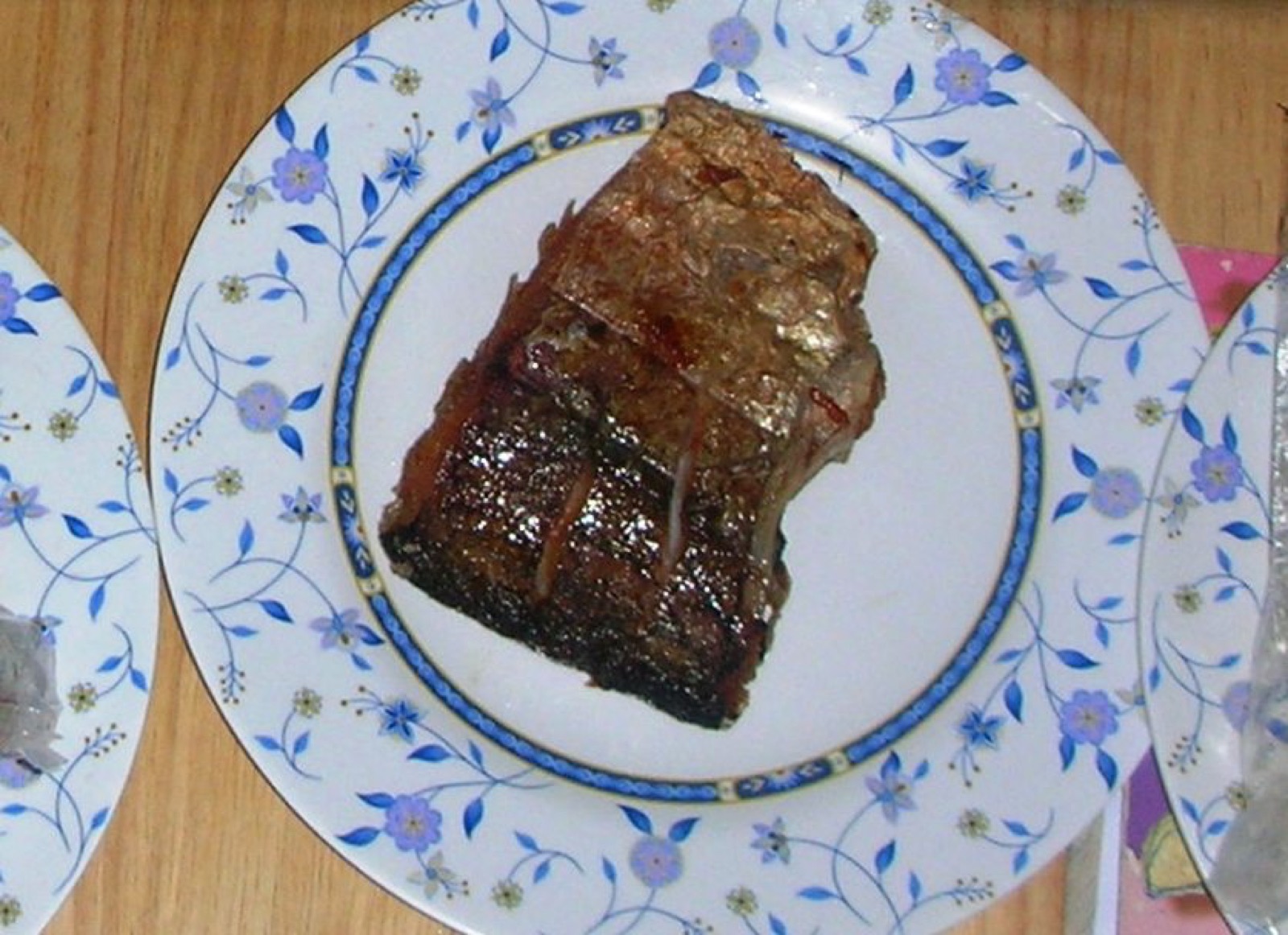
Post Today (2010) visited Ban San Wiang Mai in Tambon Ban Sang, a village on the west side of the lake famous for pa som since long ago. Older makers recalled that Phayao's pa som used to be famous because it was made from lake fish, in many forms: whole fermented fish, chopped fermented fish, fermented roe and khi pa fak. As the lake's fish grew fewer, villagers turned to other fish, above all silver carp ordered from the central provinces. The report says the village used no less than 5,000 kg of frozen silver carp a day, and each house has its own recipe: some use sticky rice the old way, some use ordinary steamed rice.
Khi pa fak (ขี้ปลฯาฟักฯ, read khi pa fak), a name that makes people smile, is explained by the dictionary as fish meat such as silver barb or pa khao, chopped small and fermented with salt, steamed sticky rice and garlic. The khi here is nothing rude. More fish names and fish dishes in Kham Mueang are in Fish names in Kham Mueang.
Words of the fisherfolk
People by the water in Lanna have their own words for fishing gear. These are general Kham Mueang words, not only used at the lake.
| Kham Mueang | Lanna script | Meaning in the dictionary |
|---|---|---|
| hai | ห่ายฯ | a small-mesh net, such as one for trapping fish; a medium net is naeng, a large one nang |
| hae | แห | a cast net, thrown spread out over the water to catch fish |
| sai | ไซ | a fish trap of woven bamboo, cylinder-shaped, with a funnel that closes it |
| sum | สุ่ม | a woven bamboo cover for trapping fish, with an opening on top to reach in and grab them |
| huea | เริอฯอ | a boat, a vehicle on water |
The researchers who surveyed the lake's fish also used gill nets of several mesh sizes, which in Kham Mueang are simply hai. Huea comes from Thai ruea (boat) through the r-to-h rule explained in R becomes H in Kham Mueang.
Phra Chao Ton Luang of Wat Si Khom Kham
Phra Chao Ton Luang (ระฯพเจั้าต฿นฯหลฯวฯง, read phra chao ton luang) is defined by the dictionary as "a very large Buddha image", with the example of the main image in the hall of Wat Si Khom Kham, a royal temple in Mueang Phayao: a Buddha in the posture of subduing Mara, in Chiang Saen style, "the tallest and largest in the land of Lanna". Ton is the Kham Mueang form of ton, the classifier for sacred images, and the dictionary says it may also be called pha chao ton luang.
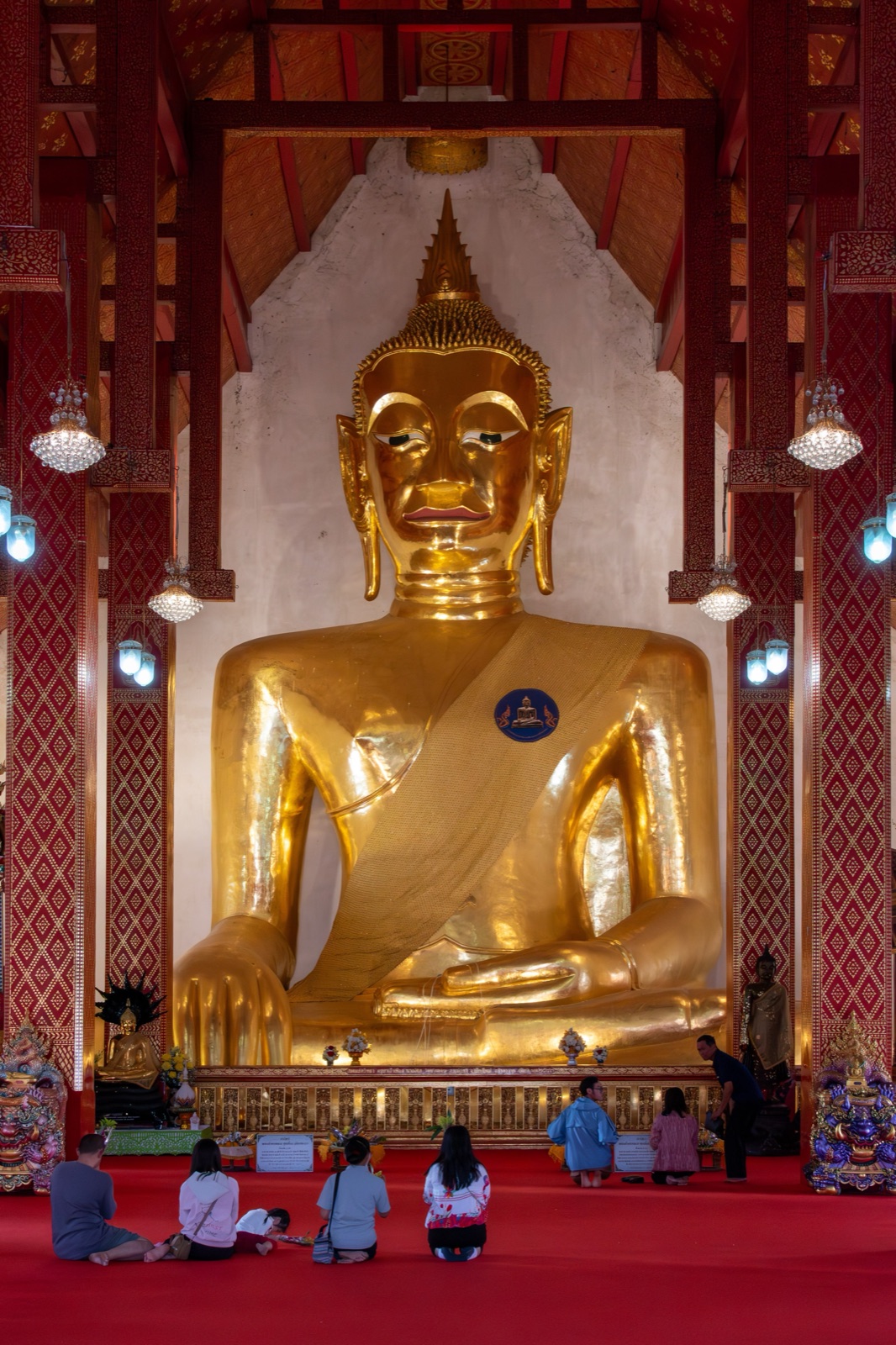
The dictionary records that the image was built in 1491–1524 CE. The Cloud (2019) adds that work began in 1491 under Phra Mueang Yi, ruler of Phayao, and ended in 1524 under Phra Mueang Tu. The Cloud also cites a stone inscription (register no. Lo Pho/29) dated Chulasakarat 885, or 1524 CE, that describes a very large Buddha image, which the writer thinks most likely means this one. Locals call the temple Wat Phra Chao Ton Luang, or Wat Thung Iang after the old Nong Iang pond.
Sources disagree about its size. The dictionary gives 16 m across the lap and 18 m in height, while Khaosod gives 14 m and 16 m. What they agree on is that it is a gilded stucco image, the largest in Lanna, and because it is so large it sits on the floor rather than on a raised pedestal.
The legend of Phra Chao Ton Luang (as told by The Cloud)
According to legend, the Buddha and his arahant disciples came to the city of Phu Kam Yao and rested on a hill beside Nong Iang. A goldsmith of the village offered them food, and the Buddha gave a hair relic to be enshrined in a cave under the hill, which was then named Doi Chom Thong.
The legend goes on that the Buddha tamed a naga in Nong Iang and told it to build a great Buddha image there when half of the religion's span had passed. Later the naga brought gold to an old couple who kept geese; they used it to pay workers to fill in Nong Iang and built the image of brick. Phra Mueang Kaeo, king of Chiang Mai at the time, gave silver and gold to build the hall and named the image "Phra Chao Ton Luang Thung Iang Mueang Phayao".
The hall you see today is the work of Khruba Siwichai. The Cloud tells that in 1922 Phraya Prathet Udon Thit, the last ruler of Phayao, together with monks and the people of Phayao, invited Khruba Siwichai to build the great hall, which was celebrated in 1924. The Cloud explains that the gable shows tigers because the Khruba was born in a Year of the Tiger.
The same temple has an ordination hall in the water, built in 1985, with a mural of the Bodhi tree by National Artist Angkarn Kalayanapong and paintings of the Ten Birth Tales, and the Nithat Culture Hall, which keeps Phayao's antiquities on show.
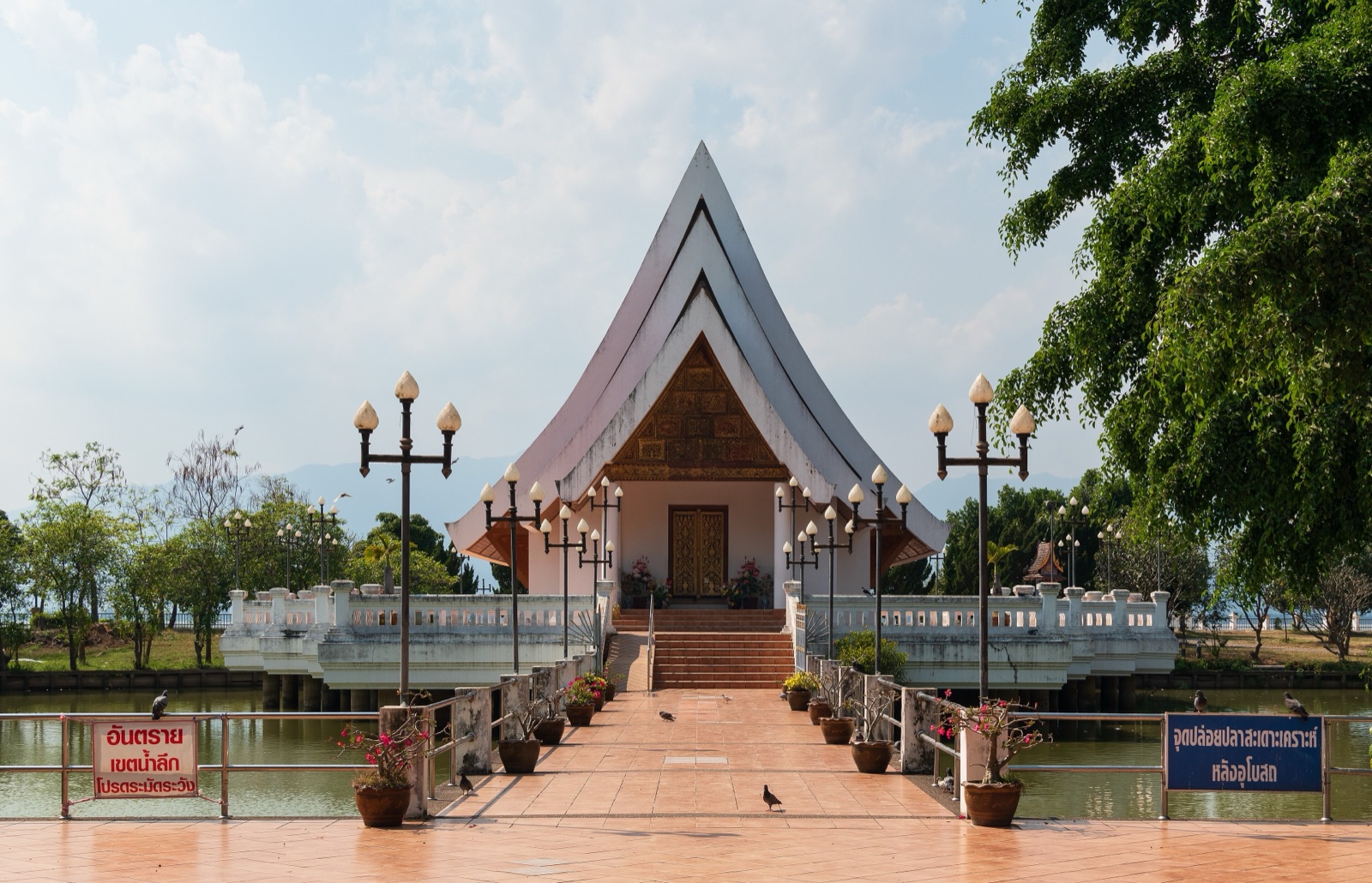
Every year the people of Phayao hold a festival to honour Phra Chao Ton Luang, known as the "Duean Paet Peng" festival, the full moon of the 8th northern month, as The Cloud tells. The same article describes a "Tan Khao Thip Phra Chao Ton Luang" offering on Makha Bucha day, when new rice is offered to Phra Chao Ton Luang, held on the lakeshore by Wat Tilok Aram. Wat Tilok Aram is an old temple in the middle of the lake, with only the base of its hall and a stone Buddha left, reached by boat. On Makha, Visakha and Asalha Bucha days villagers row around this temple in the water in a candle procession.
The programme "Khanchai-Sujit Thodnong Thongthiao" on Matichon TV walks through Wat Si Khom Kham: Phra Chao Ton Luang, the Nithat Culture Hall and the ordination hall in the water (in Thai).

The Tai Lue of Chiang Kham: Ban Yuan, Ban Mang and weaving
In Chiang Kham District, in the east of the province, there is a large Tai Lue community. The dictionary calls these people chao tai lue (ชาวฯไทลื้, read chao tai lue), a people from Sipsong Panna with their own spoken and written language. Their speech is kam lue (คำฯลื้, read kam lue), and the dictionary gives Nan and Chiang Mai as examples of where it is spoken.
The community database of the Princess Maha Chakri Sirindhorn Anthropology Centre says the ancestors of the Chiang Kham Tai Lue came from several towns in Sipsong Panna, Mueang Phong, Mueang Yuan, Mueang Mang, Mueang Yang, Mueang Ngoen and Mueang Chiang Khan, and named their new villages after their old towns, such as Ban Yuan, Ban Mang and Ban La.
| Period | Event, according to the Sirindhorn Anthropology Centre database |
|---|---|
| about 1856 | the ruler of Nan brought Lue people from Mueang La, Mueang Phong, Mueang Mang and Mueang Yuan to Nan, Chiang Muan, Thoeng and Chiang Kham |
| about 1888 | a group who had lived in Chiang Muan for about 15 years, finding too little farmland, moved to Chiang Kham and founded Ban Yuan, Ban That Sop Waen and Ban Mang |
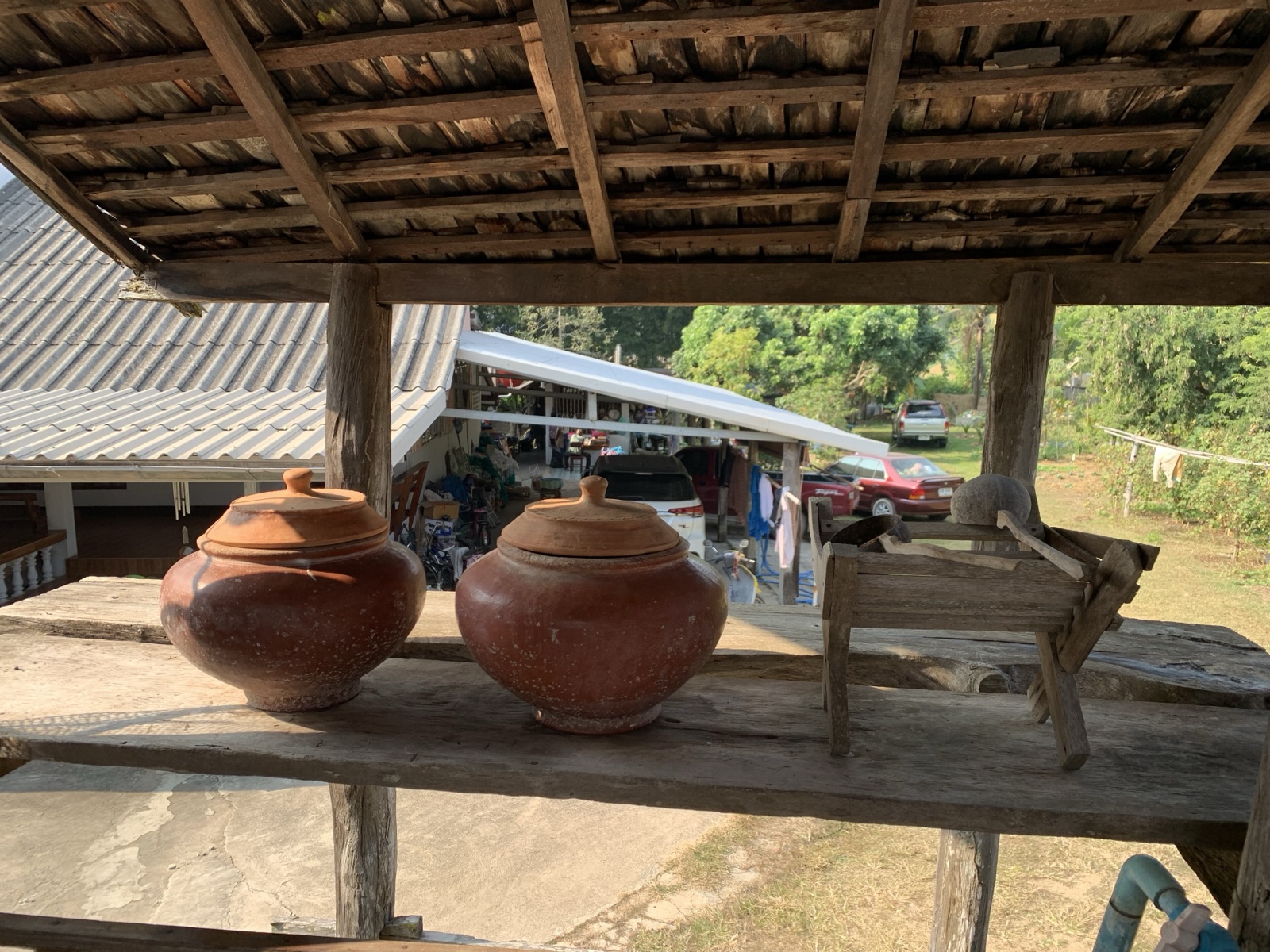
Today Tambon Yuan has a Tai Lue history hall, a traditional Tai Lue house, a Tai Lue cultural centre at Wat Yuan and a weaving group that makes naturally dyed cotton cloth from growing the cotton onwards. The same database says the Tai Lue-Lanna style ordination hall of Wat Saen Mueang Ma was registered as an ancient monument in 1984. A major festival is the Tan Tham sermon festival, with the Vessantara sermon told over three days and three nights.
Read about the Lue alongside the other Tai peoples in The Tai peoples, and about cloth and weaving words in Cloth and clothing in Kham Mueang.
Wiang Lo: an ancient town on the Ing River
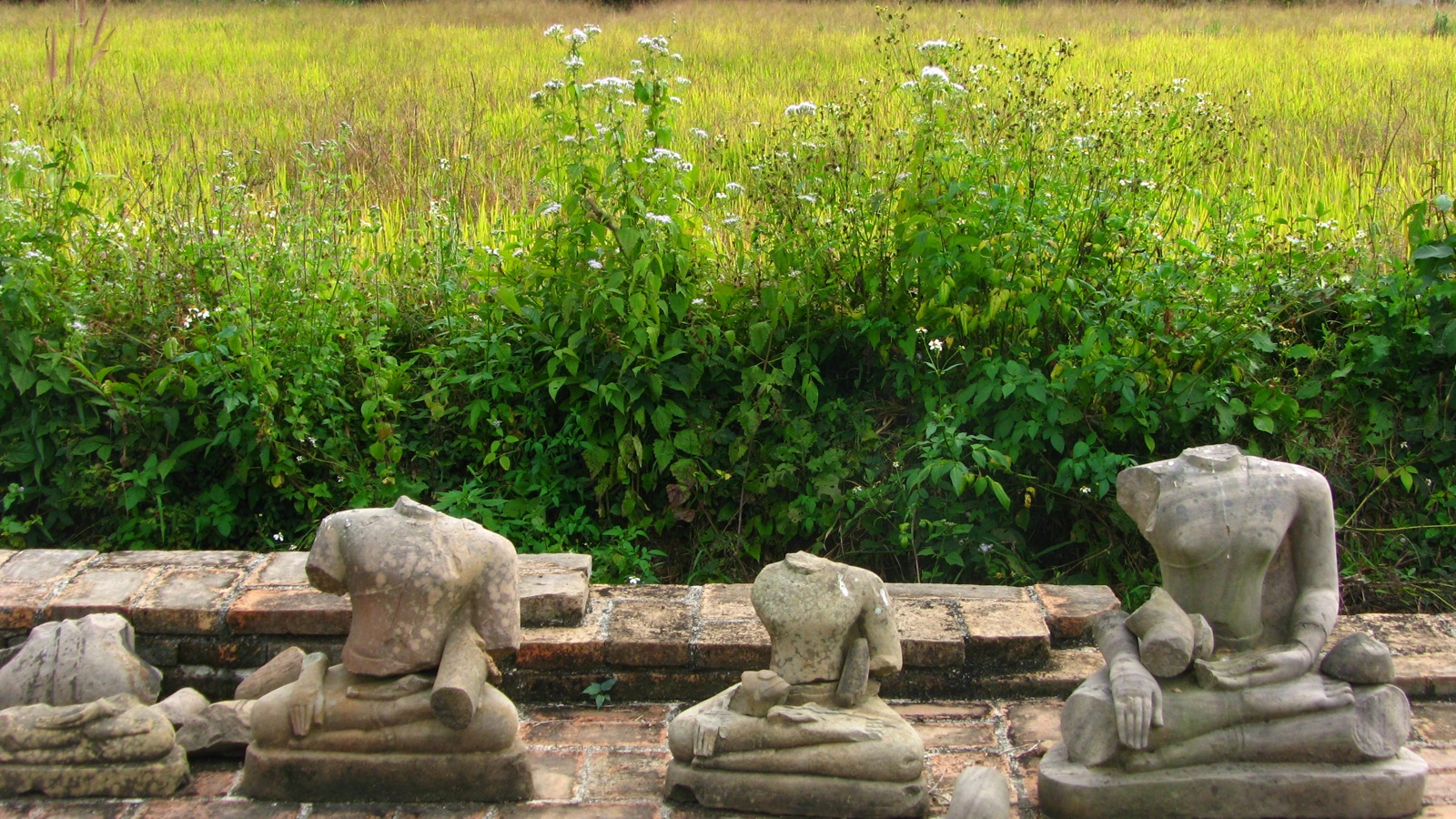
Wiang (วยฯง, read wiang) in the dictionary is a small town or a town wall. In Chun District there is an ancient town called Wiang Lo on the Ing River. Khaosod (5 February 2017) reported that the Fine Arts Office 7, Nan, had been excavating there since 2005 and found burials under the base of the town wall, with bronze ornaments, iron tools and pottery buried with the dead. Archaeologists see this as evidence that people lived here from the Iron Age, long before it became an important town in the east of Lanna.
Many people link Wiang Lo with the classic poem Lilit Phra Lo, but scholars do not agree. Sujit Wongthes writes in Silpa Wattanatham that Wiang Lo has no original evidence of a link with the Phra Lo story, and that the connection is recent. Moradok Lanna will tell Wiang Lo's full story in a later part of the Places of Lanna series.
Phayao's motto line by line, and the saraphi flower
The dictionary records Phayao's motto as "Kwan Phayao, source of life; sacred Phra Chao Ton Luang; homage to Pho Khun Ngam Mueang; famed and beautiful Doi Butsarakham" (the dictionary spells the last word Butsarakham with a final -kham). Its four lines sum up this whole post.
- Kwan Phayao, source of life: the lake that grew from Nong Iang, home of fish and pa som.
- Sacred Phra Chao Ton Luang: the largest Buddha image in Lanna, at Wat Si Khom Kham.
- Homage to Pho Khun Ngam Mueang: the king who was a friend of Mangrai and Ramkhamhaeng.
- Famed and beautiful Doi Butsarakham: a hill west of town. Thai PBS (2023) reported that Wat Analayo Thipayaram stands on it, in Tambon San Pa Muang, Mueang Phayao, about 20 km from town.
The provincial tree is the saraphi (Mammea siamensis), which Khon Mueang call dok sa-la-pi (ดอฯกสาหลฯะพี, read dok salapi). The dictionary describes it as a flowering tree with a dense crown, about 10–15 m tall, with small white four-petalled flowers that smell very sweet and turn yellow as they fade. Khon Mueang use the dried flowers to scent the water for bathing Buddha images at Songkran, or in turmeric and som poi water for the dam hua blessing of elders. Read about dam hua in Dam hua.
Summary
- Phayao was once the city of Phayao (Phayao), a name later documents link to the Phu Kam Yao range. The dictionary says it was founded in the 16th Buddhist century, and it became Thailand's 72nd province in 1977, when 7 districts were separated from Chiang Rai.
- King Ngam Mueang is the Phayao king confirmed by evidence, a friend of King Mangrai and King Ramkhamhaeng; Khun Chom Tham and Khun Chueang belong to legend.
- Kwan, in the sense of a big pond, is a word used only in Phayao. Kwan Phayao grew from Nong Iang when the weir was built in 1941. It holds dozens of fish species, led by pa mong ka, the silver barb, and it gave Phayao its famous pa som.
- Phra Chao Ton Luang at Wat Si Khom Kham, built 1491–1524, is the largest Buddha image in Lanna; the sizes given by different sources do not match.
- The Tai Lue of Chiang Kham have ancestors from several towns in Sipsong Panna and came in the 1800s, and Wiang Lo shows people living there from the Iron Age.
Look up more Kham Mueang words for fish, water and towns in the Moradok Lanna dictionary (in Thai), read the mottos and trees of all 8 provinces in The 8 Lanna provinces, and the story of the name Lanna and its 700 years in Lanna.
📚 The whole series: see the provinces, old cities and peoples on one map in Places of Lanna: 8 provinces, old cities and peoples
Sources
- The Moradok Lanna dictionary (moradoklanna.com/dict, in Thai): พะเยา · กว๊านพะเยา · กว๊าน · พระเจ้าต๋นหลวง · ป๋าส้ม · ดอกสาหละปี and every word in this post, checked 23 October 2026
- พระราชบัญญัติตั้งจังหวัดพะเยา พ.ศ. ๒๕๒๐ [Phayao Province Establishment Act, 1977]. Royal Gazette vol. 94, part 69, special issue, 28 July 1977.
- สุจิตต์ วงษ์เทศ [Sujit Wongthes]. (2009). จังหวัดพะเยามาจากไหน? [Where did Phayao Province come from?]. Matichon. Quoted in จังหวัดพะเยามาจากไหน ได้ชื่อมาจากอะไร?. Silpa Wattanatham.
- Special report. (1993). เมืองพะเยา "รัฐอิสระ" พันธมิตร "พระร่วง" แคว้นสุโขทัย [Phayao, an independent state allied with Phra Ruang of Sukhothai]. Silpa Wattanatham, January 1993.
- Silpa Wattanatham editors. (2023). "พญางำเมือง" สถาปนารัฐพะเยา กับตำนาน "แกงหวานบ้านแตก" [King Ngam Mueang, the Phayao state and the sweet-curry legend].
- Silpa Wattanatham editors. (2019). กำเนิด "กว๊านพะเยา" มาจาก "หนองเอี้ยง" [Kwan Phayao began as Nong Iang].
- สุจิตต์ วงษ์เทศ [Sujit Wongthes]. บ้านเมืองเรื่องพระลอ ไม่มีอยู่จริงในล้านนา [The towns of the Phra Lo story do not exist in Lanna]. Silpa Wattanatham.
- ธนภัทร์ ลิ้มหัสนัยกุล [Thanaphat Limhatsanaikul]. (2019). วัดศรีโคมคำ วัดคู่เมืองพะเยาฝีมือบูรณะครูบาศรีวิชัย [Wat Si Khom Kham, restored by Khruba Siwichai]. The Cloud.
- ข่าวสด [Khaosod]. เปิดตลับพระใหม่: เหรียญเสมา พระเจ้าตนหลวง [Phra Chao Ton Luang medal].
- ข่าวสด [Khaosod]. (5 February 2017). ขุดค้น "โบราณสถานเวียงลอ" [Excavation at the Wiang Lo ancient site].
- สายอรุณ ปินะดวง [Saiarun Pinaduang]. (9 May 2010). ปลาส้มเมืองกว๊านภูมิปัญญาพื้นบ้านอาหารไทย [Pa som of the lake town]. Post Today.
- กัญญาณัฐ สุนทรประสิทธิ์, ดุจฤดี ปานพรหมมินทร์ และลลิตา ข่วงบุญ [Kanyanat Soontornprasit et al.]. โครงสร้างประชาคมปลาและประสิทธิภาพผลจับจากเครื่องมือข่ายในกว๊านพะเยา [Fish community structure and gill-net catch in Kwan Phayao]. Khon Kaen Agriculture Journal, 47(4), 655–666.
- ธชพรรณ เหมยเมืองแก้ว, วธิดา นามมั่น และวริศรา วรรณา [Thachaphan Meimueangkaew et al.]. (2020). โครงสร้างและการแพร่กระจายของประชาคมปลาในกว๊านพะเยา [Structure and distribution of the fish community in Kwan Phayao]. Undergraduate project, University of Phayao.
- Thai PBS. (19 July 2026). สำรวจ "กุ้งเครย์ฟิช-ปลาชะโด" ภัยคุกคามระบบนิเวศกว๊านพะเยา [Crayfish and giant snakehead threaten Kwan Phayao].
- Thai PBS. (2023). ผ่อนผันพื้นที่ลุ่มน้ำชั้น 1A ๑๕ ไร่ตั้งวัดอนาลโยทิพยาราม [Watershed exemption for Wat Analayo Thipayaram].
- Princess Maha Chakri Sirindhorn Anthropology Centre. ไทลื้อเมืองมาง เมืองหย่วน [Tai Lue of Mueang Mang and Mueang Yuan]. Community database.
- The lake outline in the widget is drawn from OpenStreetMap (© OpenStreetMap contributors, ODbL)
Practise the words from this article
Flip through 28 flashcards of the Lanna words used in this article.


