
Photo: Chainwit. / Wikimedia Commons (CC BY-SA 4.0)
Maeng Si Hu Ha Ta: The Lanna Beast That Eats Fire
Maeng Si Hu Ha Ta (แมงฯสี่หูห้าตา, Kham Mueang reading maeng si hu ha ta), "the four-eared, five-eyed beast", is the strange creature in the legend of Wat Phra That Doi Khao Khwai Kaeo in Mueang district, Chiang Rai. It is black and fat like a bear, with two pairs of ears and five eyes. It eats red-hot coals and leaves gold behind. Northern grandparents have told this tale to children for generations, and its ears and eyes hide a Buddhist riddle.
What does Maeng Si Hu Ha Ta look like?
The word maeng (แมงฯ, maeng) is the Kham Mueang word for all insects and bugs, but in this name it means "strange creature". The rest of the name simply describes it: four (สี่, si) ears and five (ห้า, ha) eyes.
The dictionary describes it as looking "like a fat black bear" (หีมฯ, mi) "with 2 pairs of ears and 5 eyes". In Kham Mueang a plump person or animal is tui (ตุ้, tui), so Maeng Si Hu Ha Ta is a "tui" creature, black (ดำ, dam) and long-haired. Some tellings say its eyes are green (ขยฯว, khiao) (Krungthep Turakij, 2018).
Its food is charcoal (ถ่านฯ, than) glowing with fire (ไฟ, fai), and what comes out is kham (ฅำ, kham), which in Kham Mueang means gold. Northern children remember it the easy way: "it eats hot coals and its poo (ขี้, khi) turns into gold" (kin than fai, khi pen kham).
The tale: poor Ai Thukkhata
This tale has several versions. The one below follows the story as Krungthep Turakij (2018) told it, with details from the page "Nu Di Yak Ru" (Blockdit, 2021), which says it follows the temple's own version. We retell it in our own words.
The orphan and his father's last wish
Once upon a time, in a city called Nakhon Phanthumati, lived a poor family of three. The son was named Ai Thukkhata. His mother died when he was little, and father and son had to go out begging (ขํอฯทาฯนฯ, kho tan). Their life was full of hardship (ทุก์ขฯ, tuk, "suffering, poverty").
When the boy grew up, his father (พํอฯ, po) sent him to herd cattle and buffalo for a wage. Later the father fell gravely ill and gave his last instructions: when he died, the boy should bury (ฝังฯ, fang) him in the forest. At 17, he should drag his father's skull up the mountain towards the southwest. Wherever the skull got stuck, he should set a snare (แร้วฯ, haeo, an animal trap) there, and keep whatever animal it caught.
The strange creature in the snare
Ai Thukkhata did everything his father asked. The skull stuck in front of a cave, so he set his snare there. A few days later he found a strange creature caught in it: black, short and fat like a bear, with four ears and five eyes. He believed his father had come back as this animal, so he took it home and built a pen (ฅอฯก, khok) to hide it. But whatever rice or water he gave it, it would not eat.
Coals that turn into gold
It was the cold season. One evening Ai Thukkhata lit a fire (ดังฯไฟ, dang fai) to warm himself (หิงฯหนฯาวฯ, hing nao, "sit by a fire against the cold"). A piece of charcoal flew out and landed in front of the creature, which snapped it up at once. He fed it more coals, and the next morning he found that its droppings had turned into gold.
From then on Ai Thukkhata fed it hot coals every day and buried the gold behind his house until the whole garden was full. Yet he lived simply and went on herding buffalo as before.
The golden rain gutter
One day the king announced that whoever wished to marry his beautiful daughter must build a gutter (รางฯ, hang, "trough, channel") of gold to carry rainwater from his own house all the way to the palace. Nobody could do it, but Ai Thukkhata had gold. He hired craftsmen to build a golden gutter that stretched as far as the eye could see. The king followed it to his house and held the wedding, and Ai Thukkhata became the king's son-in-law (ลูกเขิยฯ, luk khoei).
The greedy king
The king asked where the gold came from. When he heard about Maeng Si Hu Ha Ta, he wanted it for himself. That is greed (โล฿ปฯ, lop). The frightened creature ran away (หีนฯ, ni) into a cave, the king chased it inside, and the cave collapsed, shutting him in.
In the traditional telling, the king escapes with the help of his youngest queen (this part contains adult details, so we keep it short). Krungthep Turakij says the king repented of his greed and handed the kingdom to his son-in-law.
The ending: a temple on the mountain
The ending differs between tellings. Krungthep Turakij says Ai Thukkhata made a cave for Maeng Si Hu Ha Ta on Doi Khao Khwai Kaeo. The page "Nu Di Yak Ru" says Ai Thukkhata ruled the city as Phaya Thammikarat and built a temple on the top of the mountain (ดอฯย, doi) where the creature had been caught, enshrining a relic of the Buddha in its chedi. That is Wat Phra That Doi Khao Khwai Kaeo today.
Another version: the beast is the god Indra in disguise
The Thai Press (2020) tells it differently. A poor young man had a small rice field. That year the rains failed and half his crop was lost. Indra, king of the gods, saw his suffering, took the form of a four-eared, five-eyed creature and came to eat his rice plants. The angry young man trapped it and tied it to a post of his hut.
That evening he offered it grass, but it would not eat; it stood shivering with cold. So he lit a fire for it. That night he watched it pick up red-hot coals and eat them without being burnt, and in the morning he found gold. He sold the gold and became rich.
A study by Norathep Pothipeng and colleagues (2025) also describes Maeng Si Hu Ha Ta as "Indra in disguise", who came to help a poor orphan with a kind heart and a hard-working spirit, until he became ruler of the city at the end.
The Dhamma riddle: four ears, five eyes
The Moradok Lanna dictionary records that, according to the legend of Maeng Si Hu Ha Ta written by Khruba Chaiyawongsa Phatthana of Wat Phra Phutthabat Huai Tom in Li district, Lamphun, the story "is a riddle showing Buddhist teachings": the four ears stand for the Four Sublime Abodes (brahmavihara) and the five eyes for the Five Precepts, in Kham Mueang sin (สีลฯฯ, sin).
| Part of the beast | Teaching | In simple words |
|---|---|---|
| First pair of ears | loving-kindness · compassion | wishing others happiness · wanting to free others from suffering |
| Second pair of ears | sympathetic joy · equanimity | being glad when others do well · staying calm and fair |
| Five eyes | the Five Precepts | no killing, no stealing, no sexual misconduct, no lying, no intoxicating drink |
The dictionary sums it up as a lesson "to keep and practise these teachings". In the tale itself, the one who prospers is Ai Thukkhata, who listened to his father, while the king is trapped in a cave by his own greed. The kind-hearted (ไจดี, jai di) end up with gold; the greedy nearly never come home.
Maeng Si Hu Ha Ta today: statue, shrine and mascot
Wat Phra That Doi Khao Khwai Kaeo stands in Rop Wiang subdistrict, Mueang Chiang Rai. Beside the hall is a huge statue of Maeng Si Hu Ha Ta that visitors love to photograph, and a small shrine with another figure, where people leave flowers and charcoal (Chiang Mai News, 2023).
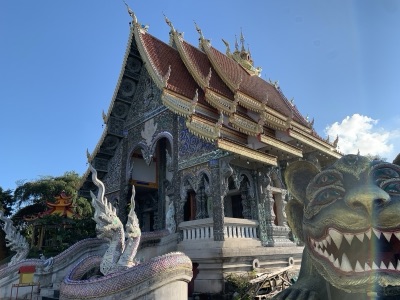
Photo: Chainwit. / Wikimedia Commons (CC BY-SA 4.0)
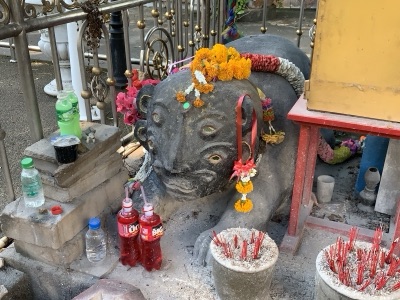
Photo: Chainwit. / Wikimedia Commons (CC BY-SA 4.0)
Beliefs at the temple. The Thai Press (2020) reports that people like to pay their respects to Maeng Si Hu Ha Ta in the evening, believing their troubles will leave with the setting sun (ตาวันฯต฿กฯดินฯ, ta wan tok din). Chiang Mai News (2023) reported visitors bringing sacks of charcoal to fulfil vows, because in the tale the creature loves to eat hot coals.
From tale to mascot. Maeng Si Hu Ha Ta became the mascot of the "Chiang Hai Games" sports event in Chiang Rai in November 2018. Its designer, a Chiang Rai artist known as "Poy", named the character "Kham Suk" after her grandmother and said the name means gold, just like the Kham Mueang word kham (Krungthep Turakij, 2018). Chiang Rai Vocational College has also designed handwoven cotton Maeng Si Hu Ha Ta dolls as a provincial souvenir (Norathep Pothipeng and colleagues, 2025).
Kham Mueang words from the tale
Kham Mueang words found in this tale, in story order, with meanings from the dictionary.
| Kham Mueang | Reading | Meaning |
|---|---|---|
| tui | tui | fat, plump |
| kho tan | kho tan | to beg; a beggar |
| tuk | tuk | suffering, hardship, poverty |
| po · mae (แม่) | po · mae | father · mother |
| haeo | haeo | a wooden spring-pole used to trap animals (a snare) |
| khok | khok | an enclosure, an animal pen |
| dang fai | dang fai | to light a fire |
| hing nao | hing nao | to warm oneself by a fire against the cold |
| than · fai | than · fai | charcoal · fire |
| kham | kham | gold |
| fang | fang | to bury, as in burying treasure |
| hang | hang | a trough, a channel |
| luk khoei | luk khoei | son-in-law |
| phaya (พญา) | pha-ya | a king, a ruler, the chief one |
| lop | lop | greedy, wanting more than enough |
| ni | ni | to run away, to escape |
| huean (เริอฯร) | huean | a house, a home |
| tam nan (ตํานาฯ) | tam nan | a legend, a story passed down for a long time |
Just for fun (answers after each arrow)
-
What does Maeng Si Hu Ha Ta eat? → red-hot coals
-
What does the Kham Mueang word kham mean in this tale? → gold
-
What did Ai Thukkhata build to marry the princess? → a golden rain gutter (hang) from his house to the palace
-
According to the dictionary, what do the four ears stand for? → the Four Sublime Abodes
-
What does dang fai hing nao mean? → to light a fire and warm yourself against the cold
Summary
- Maeng Si Hu Ha Ta is the strange creature of the Wat Phra That Doi Khao Khwai Kaeo legend in Chiang Rai: black and fat like a bear, with four ears and five eyes.
- It eats hot coals and its droppings become kham, which in Kham Mueang means gold.
- The tale tells of Ai Thukkhata, an orphan who obeyed his father and became the king's son-in-law, while the greedy king was trapped in a cave. Some tellings say the beast was Indra in disguise.
- The dictionary records Khruba Chaiyawongsa Phatthana's reading: four ears for the Four Sublime Abodes, five eyes for the Five Precepts.
- Today the creature lives on as a temple statue, a shrine and "Kham Suk", the mascot of the Chiang Hai Games.
Read the full entry for แมงสี่หูห้าตา in the Moradok Lanna dictionary, then learn more Kham Mueang bug words in Kham Mueang insects or another guardian legend in Pu Sae Ya Sae.
Sources
- Moradok Lanna dictionary: แมงสี่หูห้าตา · คำ · หิงหนาว · แฮ้ว
- Pinanong Panchuen. (2018). แมง 4 หู 5 ตาในตำนาน สู่มาสคอตเจียงฮายเกมส์ [The legendary four-eared, five-eyed beast becomes the Chiang Hai Games mascot]. Krungthep Turakij
- Nu Di Yak Ru. (2021). เที่ยวพร้อมตำนานวัดดอยเขาควายแก้ว [Visiting with the legend of Wat Doi Khao Khwai Kaeo]. Blockdit
- The Thai Press. (2020). วัดพระธาตุควายเขาแก้วเปิดตำนานพระอินทร์จำแลง "แมงสี่หู ห้าตา" [The temple reveals the legend of Indra in disguise, "Maeng Si Hu Ha Ta"]. The Thai Press
- Chiang Mai News. (2023). คอหวยแห่ซื้อถ่านกระสอบแก้บน วัดพระธาตุดอยเขาควายแก้ว [Lottery fans bring sacks of charcoal to fulfil vows at Wat Phra That Doi Khao Khwai Kaeo]. Chiang Mai News
- Norathep Pothipeng et al. (2025). การออกแบบตุ๊กตาผ้าฝ้ายทอมือรูปแบบสัตว์ในตำนานสี่หูห้าตา [Design of handwoven cotton dolls in the form of the four-eared, five-eyed mythical animal]. Journal of Textile, Fabric and Fashion Research 5(2)
Look up "แมงสี่หูห้าตา" in the Moradok Lanna dictionary (in Thai)


